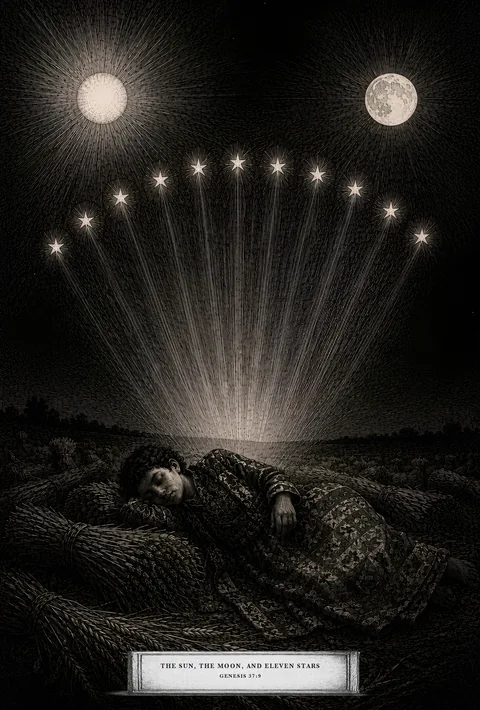
The heavens declare the glory of God; and the firmament sheweth his handywork. Day unto day uttereth speech, and night unto night sheweth knowledge.
— Psalm 19:1-2
Sun, Moon, and Stars
Little is more symbolic than the speech the sky pours forth, day after day and night after night — knowledge shown without a word, in every tongue at once. All creation testifies, and Scripture provides the key that unlocks the symbolic meaning of the sun, the moon, and the stars; with their meaning unlocked, we can come to understand how they govern the day and the night.
The method is simple: search the Scriptures for every reference to the sun, the moon, and the stars, decode their symbolic meaning, and watch that meaning reflected in the very structure of creation. And the stakes are not academic: “He appointed the moon for seasons” (Psalm 104:19) — the appointed times — and the announcement of the gospel itself carries the command to keep them:
Behold upon the mountains the feet of him that bringeth good tidings, that publisheth peace! O Judah, keep thy solemn feasts, perform thy vows…
The bringer of the good tidings and the command to keep the feasts arrive in one breath; and it will take wisdom to discern the truth of the matter.
From the first page of Scripture the lights of heaven are given a job, and it is not merely to glow. The founding verse[1], in its own order:
And God made two great lights; the greater light to rule the day, and the lesser light to rule the night with the stars.
The Psalm that recounts the same creation leaves no doubt:
The sun to rule by day… The moon and stars to rule by night: for his mercy endureth for ever.
The stars are no afterthought scattered in the dark; they rule the night together with the moon — “the ordinances of the moon and of the stars for a light by night” (Jeremiah 31:35). The greater light governs the day; the lesser light and the stars govern the night.
The Hebrew names the two lights with the family’s own words. “Greater” and “lesser” are ha-gadol and ha-qaton — the very pair the King James itself renders “her eldest son Esau… her younger son Jacob” (Genesis 27:15), and “the name of the elder was Leah, and the name of the younger was Rachel” (Genesis 29:16). Read the founding verse with the family’s own vocabulary, and it says what Joseph will dream: the elder light to rule the day, and the younger light to rule the night with the stars — a household hung in the sky from the fourth day.
Scripture keeps a portrait of the younger. When Samuel asks Jesse for his sons, “There remaineth yet the youngest” — ha-qaton — “and, behold, he keepeth the sheep” (1 Samuel 16:11); and David the qaton, the anointed shepherd, is the name the prophets give the Messiah centuries after David slept:
And I will set up one shepherd over them, and he shall feed them, even my servant David; he shall feed them, and he shall be their shepherd.
Two offices are written into the lights at the founding: they are set “to rule” (Genesis 1:16-18), and to be “for signs, and for seasons” (Genesis 1:14) — to mark the appointed times.
Joseph’s Dream
Scripture interprets its own symbol. Joseph dreams that “the sun and the moon and the eleven stars made obeisance” to him, and his father reads the dream on the spot: “Shall I and thy mother and thy brethren indeed come to bow down ourselves to thee…?” (Genesis 37:9-10). Jacob does not hesitate: the sun is the father, the moon the mother, the eleven stars the brothers — the lights are read as persons, a governing household. Lift the dream from the one family to the whole, and each light tells what it is.
The Sun: the Father
The sun is the greatest light; the moon and the wandering stars shine only with what they borrow from it — so it stands for the source. The dream named the sun the father, and the Psalm names Him outright:
For the LORD God is a sun and shield: the LORD will give grace and glory…
He alone shines of Himself; all other light is His light, handed on.
The verse holds a second office beside the first — a sun and shield — and the psalm has already said who the shield is, two verses up:
Behold, O God our shield, and look upon the face of thine anointed.
The shield is the Anointed — the one who stands between the source and the man. Abram heard the office in the first person: “Fear not, Abram: I am thy shield” (Genesis 15:1). And Moses felt it on the mountain: God’s own hand held over him in the cleft while the glory passed by (Exodus 33:22). The sun, and beside it the shield: the source, and the curved covering that hands on what a man can bear of it.
When the New Testament names Him by this office, it names the whole household with Him:
Every good gift and every perfect gift is from above, and cometh down from the Father of lights, with whom is no variableness, neither shadow of turning.
The “lights” He is Father of are the lights of this chapter — the lesser light and the stars, the children who shine with what He gives.
Mark where the verse sets the perfection: not on the Father alone, but on what stands with Him — the Greek is par’ hō, beside whom. The Hebrew text of James reads it the same way: every good gift comes down “from the light of the Father” — the letters under “from the light,” מאור, spell ma’or, the luminary of the fourth day — and “beside him” (etslo, the close-company word) “there is no exchange of light and darkness.”
The light that stands beside the Father of lights with no variableness, neither shadow of turning is the Son — and of the moon’s faces, exactly one carries no shadow of turning at all: the full, constant and complete the whole night it reigns. And the Son of man has a face in the sky, by the Lord’s own word:
And then shall appear the sign of the Son of man in heaven: and then shall all the tribes of the earth mourn, and they shall see the Son of man coming in the clouds of heaven with power and great glory.
A sign that appears in heaven — the fourth day’s own vocabulary again, a sign of the lights — and the reader of this chapter now knows which face it is: the full, unshadowed witness.
Scripture has already named the good gift the Father of lights sends down from above. On the fourth day, “God gave them in the firmament of the heaven” — the verb is natan, to give, under the King James’ “set” [2] — gave them “for signs, and for seasons”, the moedim, the appointed times — “and God saw that it was good” (Genesis 1:14-18). Given from above, given for the appointed times, and pronounced good: the fourth day is James’ sentence, written forward. And Moses says the giving reaches every people: the sun, the moon, and the stars, “which the LORD thy God hath divided unto all nations under the whole heaven” (Deuteronomy 4:19) — chalaq, to apportion, as lots are dealt — the appointed times are the portion the Father of lights deals to all under heaven.
That mark matters: a perfect and complete gift bears no shadow of turning — it will divide the true sign from the counterfeit when the counterfeit appears.
The Moon: the Faithful Witness
The moon rules the night, yet it has no light of its own — all it gives is the sun’s light turned back to the earth. That is the Son exactly: “The Son can do nothing of himself, but what he seeth the Father do” (John 5:19); “I am the light of the world” (John 8:12) — light reflected, not self-made, the Father’s light carried faithfully into the dark. It is David’s covenant psalm that seats his throne among the lights:
His seed shall endure for ever, and his throne as the sun before me. It shall be established for ever as the moon, and as a faithful witness in heaven.
The Hebrew under “throne” is kisse — the same three letters as keseh, the full moon, an identity Blood Moon Over the Moon City weighs verse by verse — and the word under “before me” is neged: in front of, facing — Strong’s, “a part opposite; a counterpart, or mate” — the very word of the helper made “meet for him” (Genesis 2:18).
His throne as the sun facing me: exactly one light stands opposite the sun and returns his whole face, and so the psalm’s next breath names the seat for what it is — the throne, the full moon, established forever, the faithful witness in the sky.
The word testifies that the throne stands to the sun as the wife stands to her husband — the ezer ke-negdo, the helper who is his counterpart and mate. Joseph’s dream read the moon as the wife and mother; the psalm has already seated her as the sun’s neged — two witnesses, and at the mouth of two witnesses the matter is established: the moon is the sun’s symbolic wife, the counterpart who stands facing him.
Revelation opens by handing the psalm’s title to its Owner: “Jesus Christ, who is the faithful witness, and the first begotten of the dead” (Revelation 1:5) — the Faithful Witness is the Messiah’s own name, and the moon is that name written in the sky. The qaton son who kept the sheep holds the qaton light’s throne.
The lesser light that governs the night is the Son, bearing the Father’s light through it.
The night it shines in is this present age — “the night cometh, when no man can work” (John 9:4); “the night is far spent, the day is at hand” (Romans 13:12). Into that dark the Son came as its light:
And the light shineth in darkness; and the darkness comprehended it not.
The Greek under “comprehended” is katalaben — to seize, to take hold of — and it carries two readings, both true. The Hebrew text of John reads the taking-hold as power: the gloom “does not have power over it” — the darkness cannot overpower the light. And read as the mind’s taking hold — understanding — the measure is Scripture’s own: understanding is the commandments done (Psalm 111:10) — to understand a light is to walk by it. The world’s night could not put out its light, and would not obey it: the witness shines full in the dark, and the dark does not keep what it shows.
“As long as I am in the world, I am the light of the world” (John 9:5) — for a light that shines in the dark is the light of the night. As the moon carries the sun’s light while the sun is down and unseen, so the Son carries the Father’s into the world’s night, “a light that shineth in a dark place, until the day dawn” (2 Peter 1:19) — until the righteous shine as the sun. And one light keeps the verse’s exact hours: the full moon rises as the sun sets and does not set until the day dawns — sunset to sunrise, the whole watch of the dark — the timetable of the promise hung in the sky.
The two dominions have their peoples: the children of light and of the day (1 Thessalonians 5:5). The day’s children are the covenant righteous; the night is where the nations sit — “Galilee of the Gentiles; the people which sat in darkness saw great light” (Matthew 4:15-16). And that is why the night is given governors at all: the moon and the stars are set over the night, the Son and His righteous carrying His light to the people in the dark.
The Stars: the Righteous
The moon does not rule the night alone — “the moon and stars to rule by night” (Psalm 136:9) — and the stars that rule beside Him are named:
And they that be wise shall shine as the brightness of the firmament; and they that turn many to righteousness as the stars for ever and ever.
The wise — those who heard and did — are the stars; “ye are the light of the world” (Matthew 5:14).
Note how a star shines, for it is not the moon’s way. The moon gives back a light that strikes it from without; a star burns — each one a fire of its own, shining from within. That too is exact. His light is not bounced off the righteous; it is kindled in them — “God… hath shined in our hearts” (2 Corinthians 4:6), “Christ in you, the hope of glory” (Colossians 1:27) — treasure carried “in earthen vessels” (2 Corinthians 4:7). The saints shine as the stars shine: a received fire burning from within; and so they rule the night at His side, through the long night of this age, until the morning.
This co-reign is stated as plainly as Scripture can state it:
Blessed and holy is he that hath part in the first resurrection: on such the second death hath no power, but they shall be priests of God and of Christ, and shall reign with him a thousand years.
John saw the scene open with the bench being seated — “I saw thrones, and they sat upon them, and judgment was given unto them… and they lived and reigned with Christ a thousand years” (Revelation 20:4). The stars are not ornaments of the night; they reign in it, with the Light that burns in them.
The Relay of Light
Hold the offices together and a question surfaces that must be settled before the counterfeit: this chapter read the sun as the Father — yet Malachi calls the Son “the Sun of righteousness” (Malachi 4:2); it read the moon as the Son — yet Joseph’s dream read her as the mother. Do the symbols trade places?
They do not — they name offices, not persons: the source of light in a relation, and the faithful reflector in a relation. And Scripture hangs the whole chain on one verse:
But I would have you know, that the head of every man is Christ; and the head of the woman is the man; and the head of Christ is God.
Paul then restates the chain in light-language: the man is “the image and glory of God: but the woman is the glory of the man” (11:7), the very word he hangs on the sky — “one glory of the sun, and another glory of the moon” (1 Corinthians 15:41). Glory of is reflection-language: each bearer in the chain is moon to the one above, and sun to the one below.

Toward the Father the Son stands in the moon’s office: “the brightness of his glory” (Hebrews 1:3), doing nothing of himself (John 5:19) — the faithful witness. Toward the bride He stands in the sun’s: the bridegroom of Psalm 19, “the Sun of righteousness” arising with the day.
The office keeps handing down the chain: “I am the light of the world” (John 8:12) — “Ye are the light of the world” (Matthew 5:14) — the same title, passed one link. When the Sun left the sky, the moon and the stars carried His light through the night.
When one verse sets Jesus as sun and another sets Him as moon, neither has moved Him: the two texts stand on opposite sides of the same Man — one looking up the chain, one looking down. And the world’s long night will end the way the sky rehearses it every morning: the faithful witness of the night rises at the day as the Sun of righteousness, “with healing in his wings.”
The Mazzaroth: the Twelve Tribes
The stars are counted, and they come to twelve. Joseph saw eleven, and himself the twelfth — the sons who became the tribes of Israel. John sees them gathered into a crown:
And there was seen a great sign in the heavens: a certain woman clothed in the sun, and the moon under her feet; and from her head begins the cycle, the first of the twelve stars.
The covenant nation wears the whole of heaven — clothed with the sun, the moon at her feet, the year’s round beginning at her head. And the verse announces itself in the fourth day’s own vocabulary: a great sign in the heavens — the words of the two great lights set in the heavens “for signs, and for seasons” (Genesis 1:14-16); what John saw is one of the signs the lights were hung to give.
Every choice in that rendering is the Hebrew’s own.[3] The sign is nes — not a mere signal but a standard, raised high for every eye, the ensign-word of the “root of Jesse” (Isaiah 11:10). The crown is kether, the royal crown of Esther — a circle of authority, and the circle a cycle: rule that runs a round; her “head” is rosh, the word every beginning opens with. And echad stands twice in the sentence — one, a certain, first, the word of “the first day” (Genesis 1:5) — once counting the woman, and once, with min, ranking her: first of the twelve.
The counted sign can be read in the sky itself. The stars of God gather into constellations, the “Mazzaroth” He brings forth in their season (Job 38:32), and His people gather into the twelve tribes, the constellations of His heaven — and of the twelve figures of that circuit, exactly one is a woman: Virgo, the virgin.
A bride wears the sun by receiving and reflecting its light. Not by the sun standing in her — a figure the sun stands in rides the sky by day, washed invisible in his glare, a sign no eye could ever see — but by the full moon standing in her, delivering the whole of the sun’s light from directly opposite: the Bridegroom clothing his bride — the relay this chapter has already drawn.
Her feet are answered too, for the moon under them is not a footstool of contempt; it is the stone she stands on. Scripture names the believer’s footing — “and that Rock was Christ” (1 Corinthians 10:4); “upon this rock I will build my church; and the gates of hell shall not prevail against it” (Matthew 16:18); “he… set my feet upon a rock, and established my goings” (Psalm 40:2). The woman clothed by her Bridegroom stands on her Rock: the bride upon the moon, the assembly upon Christ.
This clothing is not courtesy; it is commandment.
If he take him another wife; her food, her raiment, and her duty of marriage, shall he not diminish.
Torah binds a husband to three portions — food, raiment, and the appointed time of marriage — and the verse’s Hebrew is this chapter’s own vocabulary: “her raiment” is kesutah, her covering, from kasah, to cover — and “shall he not diminish” is yigra, to lessen, to withhold. Read the sky by the statute: at her appointed time the Bridegroom clothes His bride with the whole of His light, her covering undiminished — and by this we know that the symbol of the Bridegroom clothes the symbol of the bride, because the Husband keeps His own law.
If any doubt remains, Isaiah names the day that settles it:
Moreover the light of the moon shall be as the light of the sun, and the light of the sun shall be sevenfold, as the light of seven days, in the day that the LORD bindeth up the breach of his people, and healeth the stroke of their wound.
On that day the portions are paid in the open sky: the moon wears the sun’s own brightness — the bride clothed to the full — and the sun blazes sevenfold, and the day it happens is a healing day, the breach bound up. The lights do not trade places; the Husband raises His wife’s portion to His own. From her the circuit begins — Virgo, the sign of Issachar, the tribe of “men that had understanding of the times, to know what Israel ought to do” (1 Chronicles 12:32)[4] — and the full moon standing at her feet marks the head of the year.
The lights, then, are read straight through: the Father the sun, the Son the moon that bears His light through the night, the righteous the stars that rule the night with Him, gathered into the twelve tribes. And the promise to the stars is the sun’s own brightness: “Then shall the righteous shine forth as the sun in the kingdom of their Father” (Matthew 13:43).
The Wandering Stars
Not every light keeps its station in a figure: among the twelve wander the planets. One verse seems to curse the wanderers, so set its two witnesses side by side. The Greek text of Jude, describing the false teachers of his letter, reads:
Raging waves of the sea, foaming out their own shame; wandering stars, to whom is reserved the blackness of darkness for ever.
The Hebrew text of Jude describes the same men — with no star in the sentence:
And like waves of the sea that cast out mire and mud.
The Hebrew is Isaiah word for word — “the wicked are like the troubled sea… whose waters cast up mire and dirt” (Isaiah 57:20) — and the Greek’s added figure does not change the subject: in both witnesses the curse falls on men, wicked men who keep no station, not on any light of the sky.
The Greek needs no correction either, for Jude names his source in his next breath — “Enoch also, the seventh from Adam, prophesied of these” (Jude 14) — and Enoch’s vision says exactly which stars have the darkness reserved:
This place is the end of heaven and earth: this has become a prison for the stars and the host of heaven. And the stars which roll over the fire are they which have transgressed the commandment of the Lord in the beginning of their rising, because they did not come forth at their appointed times. And He was wroth with them, and bound them…
The star bound over to darkness is not the wanderer that keeps its circuit; it is the star that broke its appointed times — the lawless light, and the men who shine like it. Read with the source Jude himself quotes, the two witnesses agree: the Hebrew condemns the wicked in Isaiah’s storm-waves, the Greek condemns the same men in Enoch’s time-breaking stars — and the charge inside the star-figure is precisely this book’s charge, the abandoning of the appointed times. No planet is condemned for lawful wandering — the wanderers keep their circuits and their seasons — and two of them carry the two claims this chapter has been weighing.
The king of the wanderers — the greatest of them — the Hebrews name Tzedeq: Righteousness. And King of Righteousness is a title with an Owner: Malki-Tzedek, “first being by interpretation King of righteousness” (Hebrews 7:2) — the priest-king whose order the Messiah holds forever: “Thou art a priest for ever after the order of Melchizedek” (Psalm 110:4).
Look at it through any glass: it wears stripes across its whole face; it bears one great wound in its side; and its color is the red-orange of a sardius stone. John saw that stone on the throne — “he that sat was to look upon like a jasper and a sardine stone” (Revelation 4:3) — and Isaiah saw the marks on the Servant: “he was wounded for our transgressions… and with his stripes we are healed” (Isaiah 53:5). The king planet wears the King’s own marks — striped, pierced, sardius-red — and its Hebrew name is Righteousness.
One wanderer the nations served, and Scripture names the service:
But ye have borne the tabernacle of your Moloch and Chiun your images, the star of your god, which ye made to yourselves.
Chiun is the old name of Saturn — Stephen, quoting the verse, reads it “the star of your god Remphan” (Acts 7:43) — and Amos sets the star beside Moloch, the idol fed with children, exactly as the nations’ own stories tell of Saturn devouring his sons. The goat-shaped devils Israel was forbidden to serve — “they shall no more offer their sacrifices unto devils” (Leviticus 17:7) — are the se’irim, the same word the King James elsewhere renders satyrs (Isaiah 13:21).
The satyr’s planet comes dressed for the part: a six-sided crown of storm stands on its pole, and round about it hangs a great ring — a millstone. “It were better for him that a millstone were hanged about his neck, and he cast into the sea, than that he should offend one of these little ones” (Luke 17:2) — the sentence pronounced on those who offend the little ones, worn as a collar by the star of the god who ate his own. How this star’s name came to stand over the seventh day of the week is a question The Day of Saturn takes up. Two wanderers among the twelve: the King’s, wearing the wounds and the stripes of Righteousness; and the counterfeit’s, wearing the millstone.
In Lucifer’s Declared Plan we will discover how God documented Satan’s plan to corrupt these signs — to change the times and the laws.