When Does the Month Start?
When I first started seeking the truth in the calendar, I came across this crazy idea that the month starts with the full moon. I almost dismissed it as too ridiculous to even consider, but something inside me prompted me to recognize that I needed to “test everything and hold on to that which is good.” If I had dismissed something simply because it was so far from every tradition I had ever heard, I might never have discovered the most compelling case from scripture to define the start of the month.
Having an accurate map is critical if you want to find your destination. A calendar can be viewed as a map of time and lets us know when to expect the LORD to act in major ways. If you desire to keep his commandments, such as the Sabbath and the Feasts, then you need to know when the month starts.
I’m friends with several prominent YouTuber teachers from well-known ministries who hold to traditional calendars, and I challenged them to prove their calendar using only Stellarium, a night-sky simulator, and the canonical scriptures (the Bible). Both of them told me I was rigging the challenge by not allowing them to introduce evidence of tradition of men and non-canonical texts. These teachers who lean heavily on a particular calendar in their teachings conceded right out of the gate that they had no meaningful evidence from the canon. This should be a major warning that we need to see what the canon does say before adopting the traditions of men.
The First Statute Given to Moses
The very first command or statute given to Moses was:
And the LORD spake unto Moses and Aaron in the land of Egypt, saying, This month shall be unto you the beginning of months: it shall be the first month of the year to you…
Observe the month of Abib, and keep the passover unto the LORD thy God…And thou shalt keep the feast of weeks… and thou shalt observe and do these statutes.
The first statute mentioned in Deuteronomy 16 is observing the month of Abib, which means we must know when that month begins and ends if we are to walk in it as a sign that the LORD is our God.
But I said to their children in the wilderness, ‘Do not walk in the statutes of your fathers’.
So the question one must ask is: what were the statutes of their fathers that they are not to walk in?
The Egyptology of the last century answered it: the ancient Egyptians began their lunar months on the morning the waning crescent first failed to appear — the day of the old moon’s invisibility — as Richard A. Parker established in The Calendars of Ancient Egypt (1950).
Here is what we know. Every ancient culture from Babylon to Egypt to China had a calendar that started the month on the dark or sliver moon. This is a tradition of the entire world! The question is, did the whole world happen to follow the LORD’s calendar, or did the Jewish people get coerced or otherwise corrupted to follow the world’s calendar? How could we even determine which is true? Were “some of the statutes” of our fathers, such as their Egyptian calendar months “Ok” and others “not ok”? If so, how could we tell?
Right off the bat, the LORD addresses the calendar and gives them an instruction about the start of the year, and it is in this context they were told not to walk in the statutes of their fathers, which could include the calendar of Egypt.
So what would happen if we only looked at scripture, and we looked at it with fresh eyes, not eyes tainted by a Jewish rabbi telling us what it means?
Before going further, we must address the word or phrase “new moon,” which has a modern scientific definition as the day the moon is invisible because it is in conjunction between the earth and sun. A better understanding of the phrase is “the phase of the moon that marks the beginning of a month” because there are many different traditions that use different phases. The scientific association with the dark moon is an artifact of how the majority of ancient nations started their months at or near the dark moon. It would be circular reasoning to say the month starts on the dark moon because the dark moon is called a new moon.
This argument presents a cohesive case for a full-moon calendar system using a Sola Scriptura framework, built upon a literal interpretation of several biblical texts and the physical astronomy described therein. This argument posits that the Holy Scripture provides an explicit, self-defining mandate for a calendar system that begins each month with the full moon, effectively nullifying contradictory traditions of men that use the dark conjunction or sighted sliver moon.
The Creation Mandate and the Rule of the Lights
Genesis 1:14–16 establishes the purpose and authority of the sun and moon: they are for “signs” (ʾōtōt) and “appointed times” (mōʿădīm).
And God made the two great lights— the greater light to govern the day, and the lesser light to govern the night with the stars (Genesis 1:16, literal syntax)
This passage establishes a non-negotiable condition for the moon’s authority for signs: it must “govern at night with the stars.”
Full Moon: Only the full moon is visible from dusk till dawn, ruling the entire night alongside the visible constellations. This is a dual witness, and there is one objective day when this occurs.
Crescent Moon: The sliver (crescent) moon quickly vanishes with the sunset, isn’t visible with the stars, is incapable of co-ruling the whole night with the stars, and isn’t a great light considering it is barely visible. Its defining property is that it is the smallest possible light on the moon that can be seen. Thus, it lacks the divine authority of a “great light” for defining the sacred mōʿădīm (appointed times). It is also a lone witness without sun or stars.
Dark Moon: It is not a light; thus, it is not for signs, and there can be two or three nights when no moon is visible even under ideal viewing conditions. Thus, the sign is ambiguous without calculation.
This mandate is echoed in the Psalms:
The sun to rule by day… The moon and stars to rule by night.
The full moon also fits the requirement that all things be established by two or three witnesses (Deuteronomy 19:15, 17:6; Matthew 18:16; 2 Corinthians 13:1; 1 Timothy 5:19; Hebrews 10:28), and we will see later that the moon and stars are faithful witnesses unlike those from the Jewish fables, because God is true and every man a liar.
The Direct Definition of the Month’s Start
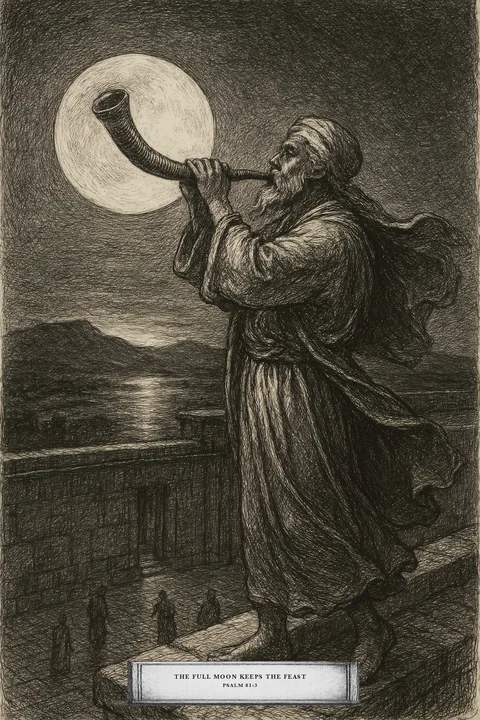
The scriptural pattern continues with direct instruction in Psalms 81:3, which uses synonymous poetic parallelism to equate the start of the month with the full moon phase:
“Blow in the renewed moon (ḥodesh) the shofar; in the full moon (keseh) for the day of our feast (ḥag).” (Psalms 81:3, literal translation)
literal rendering
Without an inserted “and”, the text equates ḥodesh (renewed moon) with keseh (fullness/full moon). The command is to sound the shofar for the unified event which marks the “day of our feast”, the Renewed Moon celebration. This verse defines the full moon as the authoritative “new moon” for the biblical calendar. There is no comparable verse that describes a dark or sliver moon in scripture.
Keseh is the noun form of the Hebrew root kasah, “to cover” — the verb of “The waters covered the mountains” and “the cloud covered the mountain”. Notice what covering means in every such use: not a blotting out, but an enveloping — the thing covered is clothed and filled by what covers it. Some argue that the “covered” moon must be the dark moon, hidden from view; that reading has the covering backwards. The root’s covering is a covering with something — waters, cloud, glory — and the moon at fulness is exactly that: its whole face covered with the sun’s light. Scripture itself settles which covering the word intends, because the same consonants that spell keseh, the full moon, also spell kisse, the throne — and when Scripture defines that throne, it hangs it in the sky:
His seed shall endure for ever, and his throne as the sun before me. It shall be established for ever as the moon, and as a faithful witness in heaven.
Job supplies the verbal bridge:
Thou renewest thy witnesses against me…
The verb translated “renewest” is chadash (H2318), the root from which chodesh, the Renewed Moon, is formed. The noun translated “witnesses” is ed (H5707), the same witness-word Psalm 89 uses for the faithful witness in heaven. The phrase translated “against me” is negdi (H5048), the exact form rendered “before me” in Psalm 89’s description of the throne as the sun.
Job’s immediate subject is his affliction, not the lunar calendar. Its independent setting gives the construction its evidentiary value: renewed witnesses facing the speaker. Psalm 89 supplies the lunar identity — the moon is the faithful witness — and repeats the facing relation. Lunar geometry then identifies the phase: only at the full moon does the lunar witness stand opposite the sun while its whole earth-facing surface is filled with light received from the sun.
That phase also completes the throne image: the covered seat, its whole earth-facing surface filled with the sun’s light. At the dark conjunction the moon shows the earth its unlit side; at fulness it stands opposite the sun, covered in light. The Aramaic kista and Akkadian kuseu, both meaning “full moon”, agree — the neighboring Semitic tongues kept the same word for the same phase — witnesses to the Hebrew root’s meaning, not substitutes for it. Covered with light, named by the throne it forms, and confirmed by the cognates on record, keseh is the full moon. If this was the only scripture pointing toward a full moon one could argue ambiguity, but this is only one of many legs of the argument.
The word used for feast (ḥaggēnu) does not require it to be a pilgrimage feast such as Passover or Tabernacles but can apply equally to Renewed Moon feasts. Those who attempt to explain this away as two different times of blowing have to insert “and” into the text and narrow the meaning of this word to only be a pilgrimage feast vs its broader use of any festive occasion or sacrifice. Furthermore, they have to apply it to only some months and not all. We know that renewed moon day was a festive feast because of the story of David being expected to eat with the king on the renewed moon. A third of the time this word is used in scripture it is referring to something other than a Pilgrimage Feast in the middle of the month.
The Hebrew Root: Renewal and Fresh Perfection
At its core, the Hebrew word translated as “new moon”, ḥōḏeš, comes from the verb ḥāḏaš (חָדַשׁ), which means “to be new,” “to renew,” or “to make fresh.” This isn’t a vague “starting over” — it’s about restoring to a complete, perfect state, like polishing something worn to its original shine. The Brown-Driver-Briggs Hebrew Lexicon (BDB, p. 294) defines ḥāḏaš as “to be new, renew, repair”, implying a fresh, unblemished completeness rather than a bare beginning.
For example:
-
In Ezekiel 36:26, God promises a “renewed heart” — not a blank slate, not a partially renewed, but a fully renewed, perfect one.
-
In Isaiah 43:19, “Behold, I will do a renewed thing” — something completely restored and effective, not partial.
-
In Psalms 104:30, “You renew the face of the earth”
-
Isaiah 61:4, “they shall renew the ruined cities”
-
Psalms 51:10, “Renew a steadfast spirit within me”
-
2 Chronicles 24:12, “Renew the house of the LORD”
-
2 Chronicles 15:8, “Renewed the altar of the LORD”
-
1 Samuel 11:14, “Let us renew the kingdom”
In all of these cases the word implies to restore to perfection. Applied to the moon, this suggests ḥōḏeš marks the phase when the moon is fully renewed, its most perfect form — a visible, complete circle of light. BDB notes that in Semitic contexts, such roots often carry this sense of “perfection through renewal,” tying back to the idea of wholeness.
Quick Explanation of the Noun Form (חֹדֶשׁ)
Root: Same three letters ח-ד-ש as all the verbs above.
Form Change: The noun is a qal passive participle (something that has been renewed) with a vowel shift (o-class for time nouns). This is standard Hebrew grammar for turning a verb into a noun meaning “the renewed thing” (like שֹׁמֵר from שָׁמַר = “guard” → “the one who guards”).
No Extra Letters: The core is חדש — same as the verbs. The final -esh sound is just the standard noun ending for this pattern — the pattern’s vowel carried on the root’s own final שׁ, not an added letter.
The noun ḥōḏeš is not a different word — it’s the noun version of the verb ḥāḏaš, implying “the moon that has been renewed to perfection.” Every verb use proves the meaning is full restoration. The noun carries the exact same meaning to the moon.
Diving Deeper into Meaning of Letters
To derive the meaning of a Hebrew word from the combined meanings of its individual letters is a legitimate approach rooted in the ancient origins of the Hebrew alphabet, which began as a pictographic script (Proto-Sinaitic, around 1800 BC) where each letter was a symbol representing an object or concept. Over time, these symbols evolved into abstract letters, but early Semitic scholars and biblical linguists (like those in the works of Jeff Benner or the Ancient Hebrew Research Center) recognize that Hebrew words often carry layered meanings from their letters’ original symbols — similar to how English words like “understand” combine “under” (position) + “stand” (posture) to convey grasping an idea. This method isn’t mystical or arbitrary; it’s a form of symbolic etymology used in academic Hebrew studies to uncover deeper intent, especially for roots like this one where the letters evoke vivid images. It’s not the only way to define words (context and usage are primary), but it provides thoughtful insight when the plain meaning aligns with the symbolic one, as we’ll see below.
The letter-by-letter breakdown of the word for “renewed moon” (ḥōḏeš in vocalized form; bare consonants: ח ד ש). The following table shows the ancient pictographic symbol for each letter and its general meaning in biblical Hebrew.
| Modern | Paleo | Symbolic Meaning |
|---|---|---|
ח |
𐤇 |
a wall, fence, separation, or enclosure |
ד |
𐤃 |
door, gate, move, transition |
ש |
𐤔 |
teeth, fire, light, menorah, shine, whiteness |
Putting the letters together (ח + ד + ש = ḥōḏeš), the word evokes a protected enclosure (ח) entering through a gate/door (ד) and transformed by fire/light/menorah/whiteness (ש) — a vivid picture of the moon moving into its complete, enclosed circle of bright shining whiteness or light. This isn’t a dark or partial phase (which lacks enclosure or light and whiteness); it’s the one night the moon is fully “enclosed” in perfection, and “lit up” like fire, and standing in one of the 12 pearly, moon like, gates which are often associated with the constellations, the Mazzaroth, or zodiac of the heavenly tabernacle.
The image fits the full moon without force, aligning with the Bible’s own use of the word for renewal to completeness. These letters also note dividing or separation of months as the gate/wall between one month and the next. The shining whiteness is hard to connect to a dark moon.
This aligns with the meaning of the Hebrew letters that describe the renewed moon as an enclosed light in a door/gate and matches the imagery of the Pearly Gates containing One Whole Single Pearl like a Full Moon sitting among the stars.
In what may be the original Hebrew of Revelation 12 we are given details that are missing in the Greek and English translations. These details strongly suggest that this isn’t merely Greek back-translated to Hebrew.
And was seen a great sign (light) in the heavens, a certain/one woman clothed in the sun and the moon under her feet and from her begins authoritative circle/cycle, one/first of twelve constellations (stars, Mazzaroth).
literal rendering
In Genesis, we are told that there are two “great signs” or “great lights” in the heavens and that the sun, moon, and stars are for times and seasons. We will revisit this later regarding when the year starts, but for now we see a great light clothed in the sun. The full moon is in Virgo in the spring when barley is in the ear (aviv) and if this is the head of the cycle of months (moonths) then this is clearly a full moon. The only other time Virgo can be “clothed in the sun” is the fall with a dark moon at her feet. At that time you cannot see the constellation stars of Virgo nor can you see the moon because the sun is in Virgo in the middle of the day.
Once you connect that the Hebrew word for “head” can mean start or height or source then you can bring more context to the rest of the sentence. The Hebrew word translated as “upon” can mean against, as in pressed up against, like you would press a tape measure against the wall. The word for crown is strongly connected to a circle that confers authority — and a circle is a cycle, and a cycle is the basis of the calendar. Crown → circle → cycle → calendar. But the most interesting aspect is the phrase “one of twelve stars” when you consider that a constellation consists of multiple stars. So the moon goes through the 12 constellations starting from Virgo.
And he dreamed yet another dream, and told it his brethren, and said, Behold, I have dreamed a dream more; and, behold, the sun and the moon and the eleven stars made obeisance to me. (Joseph being 12th/13th star)… and his father rebuked him, and said unto him, What is this dream that thou hast dreamed? Shall I and thy mother and thy brethren indeed come to bow down ourselves to thee to the earth?

And from here we see that Genesis defines the 12 stars as the 12 tribes of Israel and the moon is connected to Joseph’s mother, a certain woman!
And for the twelve stones, whether we understand by them the months, or whether we understand the like number of the signs of that circle which the Greeks call the Zodiac, we shall not be mistaken in their meaning.
Antiquities of the Jews 3.7.7 / 3.186
Then the twelve stones on the breast, which are not like one another in colour, and which are divided into four rows of three stones in each, what else can they be emblems of, except of the circle of the zodiac? For that also is divided into four parts, each consisting of three animals, by which divisions it makes up the seasons of the year…
…on his chest there are twelve precious stones of different colours, arranged in four rows of three stones in each row, being fashioned so as an emblem of the Zodiac. For the Zodiac also consists of twelve animals and so divides the four seasons of the year, allotting three animals to each season.
The constellation Virgo is connected to the tribe of Issachar, which is widely understood as the tribe that understands the times and knows when to act.
Of the children of Issachar, men that had understanding of the times, to know what Israel ought to do…
And with this we come “full circle”, knowing that the full moon is the great sign of the months signified by the constellations starting with Virgo in the spring.
The Eternal Witness and the “One” Moon
The theological weight for the full moon is sealed by God’s eternal oath in Psalm 89, where the specific grammar points to the full moon as the perfect, unchanging witness.
Once (ʾaḥath, feminine) I have sworn by My holiness… His throne shall be established forever like the sun before Me, like the moon— a faithful witness in the sky.
The unusual feminine Hebrew word ʾaḥath (“one/once”) is used deliberately. It bypasses the normal masculine form (ʾeḥād) to reference the unique “oneness” or “completeness” of the perfectly full moon which is also feminine. This “faithful witness” must be reliable and complete, mirroring the unchanging nature of the “Father of lights” and in stark contrast to the human “witnesses” used by tradition. In mathematical terms the moon goes from 0 to 1 or from nothing to fullness.
A Perfect Gift without Shadow of Turning
Every good gift and every perfect gift is from above, and cometh down from the Father of lights, with whom is no variableness, nor shadow of turning.
This verse from James makes an explicit reference to the “Father of Lights” to bring the context of the heavens and the perfect, complete, full gift which has no “shadow of turning”. Shadow of turning perfectly describes the dark or crescent moon and establishes that it is not associated with the Father of Lights. God’s law and timekeeping must be perfect and unchanging. The full moon is the physically most stable, perfect, and visually complete phase. To use the dark moon or fleeting, variable crescent moon is to follow “shadows of turning” and “traditions of men” that nullify Torah truth.
Deuteronomy tells us the sun, moon, and stars are a gift or allotment given to all mankind, not to worship as gods like the god-names given to the Gregorian days of the week, but for the appointed times.
Lest you lift up your eyes to heaven, and see the sun and the moon and the stars, all the host of heaven, and be drawn away and bow down to them and serve them — those which YHUH your God has allotted / apportioned / given as a portion to all the peoples under the whole heaven.
The Twelve Pearly Gates
“It had a great, high wall with twelve gates, and at the gates twelve angels, and on the gates the names of the twelve tribes of the sons of Israel were inscribed … And the twelve gates were twelve pearls; each one of the gates was a single pearl.” — Revelation 21:12
This verse deliberately repeats the word “one / single” twice in a single verse connecting it to the “once I have sworn” and the full moon faithful witness. The ancient Hebrew copy of Revelation, likely its original form, uses the exact same root (א־ח־ד) used in Psalm 89:38 for the moon’s “once” (אַחַת) — its one single night of perfect oneness.
Scripture repeatedly calls the heavens God’s tabernacle / dwelling place and all dwellings have gates or doors:
He who stretches out the heavens like a curtain, and spreads them like a tabernacle to dwell in.
In them hath he set a tabernacle for the sun, which is as a bridegroom coming out of his chamber (through a gate/door), and rejoiceth as a strong man to run a race. His going forth is from the end of the heaven, and his circuit unto the ends of it.
Canst thou bind the sweet influences of Pleiades, or loose the bands of Orion? Canst thou bring forth Mazzaroth in his season? or canst thou guide Arcturus with his sons? Do you know the ordinances of the heavens? Can you establish their rule on the earth?
With these verses we establish that the Mazzaroth (the constellations in the Zodiac) are connected to the times and seasons and are the gates associated with the months and named after the 12 tribes of Israel. The twelve tribes were encamped around the tabernacle in the wilderness in the exact same order as the twelve signs of the Mazzaroth. For example, Leo the Lion is associated with the tribe of Judah.
This aligns with the meaning of the Hebrew letters that describe the renewed moon as an enclosed light in a door/gate and matches the imagery of the Pearly Gates containing One Whole Single Pearl like a Full Moon sitting among the stars.

Zodiac and the 12 Tribes
| Tribe | Zodiac Sign (Mazzaroth) | Key Blessing Imagery and Relation (Genesis 49;Deuteronomy 33) |
|---|---|---|
Judah |
Leo (Lion) |
Describes Judah as a "lion’s whelp" who crouches and prevails; emphasizes strength and leadership. Matches Leo’s regal, fiery lion symbol; leads the east side of the encampment. |
Issachar |
Virgo (Virgin/Maiden) |
Portrays Issachar as a "strong donkey" bearing burdens (labor/service); links to rest and wisdom. Virgo’s harvest maiden symbolizes diligent work and purity. |
Zebulun |
Libra (Scales) |
Sees Zebulun as a "haven for ships" (trade/balance); Ties to abundance from seas/mountains. Libra’s scales represent justice, commerce, and equilibrium. |
Reuben |
Aquarius (Water-Bearer) |
Calls Reuben "unstable as water" but first in strength; Prays for his survival. Aquarius' water pourer evokes fluidity and humanity; leads the south side. |
Simeon |
Pisces (Fishes) |
Notes Simeon’s weapons and scattering; Deuteronomy 33 omits direct mention (often grouped with Levi). Pisces' dual fish symbolize division and hidden depths. |
Gad |
Aries (Ram) |
Says Gad "shall raid at their heels" (warrior/raider); Praises his lion-like strength and choice land. Aries' ram signifies initiative and conquest. |
Ephraim |
Taurus (Bull) |
Joseph, Ephraim’s father, speaks of fruitfulness; Calls him a "firstborn bull" with horns pushing peoples. Taurus' bull represents steadfast power; leads the west side (often with Manasseh as Joseph’s branches). |
Manasseh |
Gemini (Twins) |
Derived from Joseph’s blessings as a "fruitful vine"; Links to Ephraim as twins with "ten thousands." Gemini’s twins evoke duality and multiplicity. |
Benjamin |
Cancer (Crab/Shell) |
Portrays Benjamin as a "ravenous wolf" dividing spoil; Says he "dwells in safety" under God’s shelter. Cancer’s protective crab shell ties to security and tenacity. |
Dan |
Scorpio (Scorpion/Eagle) |
Describes Dan as a "serpent by the way" that bites heels (judgment/venom); Calls him a "lion’s whelp" leaping. Scorpio’s scorpion (or eagle paranatellon) symbolizes transformation and stinging justice; leads the north side. |
Asher |
Sagittarius (Archer) |
Says Asher’s "bread shall be rich" (abundance); blesses with oil, iron, and lasting strength. Sagittarius' archer evokes aim, exploration, and prosperity. |
Naphtali |
Capricorn (Goat-Fish) |
Calls Naphtali a "doe let loose" with beautiful words; Promises full favor and possession. Capricorn’s goat-fish hybrid represents ambition, agility, and watery depths. |
The East Gate and the Full Moon
Ezekiel gives us the clearest, most concrete calendar instruction in the entire prophetic future temple when he gives the instructions to open the East Gate on the day of the Renewed Moon.
Thus says the Lord GOD: The gate of the inner court that faces east shall be shut the six working days, but on the Sabbath it shall be opened, and on the day of the new moon it shall be opened … The people of the land shall worship at the entrance of that east gate before the LORD on the Sabbaths and on the new moons.
This instruction tells us to look east, where the sun and moon rise and open the gate. The earthly tabernacle is a reflection of the heavenly tabernacle.
They serve at a sanctuary that is a copy and shadow of what is in heaven. This is why Moses was warned when he was about to build the tabernacle: 'See to it that you make everything according to the pattern shown you on the mountain.'
From this we can infer that the signs in the heavens should follow the instructions on earth. The full moon, a faithful witness, should stand in the east gate or constellation on Renewed Moon Day. As the earth orbits the sun the constellation will change, and each month brings a new constellation.
This instruction says we should worship or bow down or face east, so a sign like the sliver moon in the west is fundamentally incompatible.

The Testimony of Sirach (Ecclesiasticus)
The argument presented thus far for the full-moon calendar system has relied exclusively on a literal, internal analysis of the Hebrew Scriptures (the Tanakh). We have deliberately dismissed mainstream Jewish and Christian traditions based on the scriptural warnings against the “commandments of men” that “nullify the word of God” (Mark 7:13).
However, a question remains: Is this full-moon interpretation a purely modern invention, a modern idea read back into the text?
To answer this, we can utilize extra-biblical texts like the Book of Sirach (Ecclesiasticus) as historical documents — not inspired Scripture — to confirm the existence and cultural plausibility of the concepts we’ve derived from the Bible alone.
Sirach is part of the Apocrypha, accepted as canonical by some traditions (Catholic/Orthodox) but excluded from the Hebrew and most Protestant canons. We do not use it to establish doctrine, but to establish historical context.
Using a historical document does not violate Sola Scriptura. It is the same as using Josephus, the Dead Sea Scrolls, or even a modern encyclopedia to understand the cultural landscape or vocabulary of the time. It confirms that the specific interpretation derived from Genesis 1 and Psalms 81 was a recognizable idea within the ancient Jewish world.
He made the moon also to serve in her season (gates) for a declaration of times, and a sign of the world. From the moon is the sign of feasts, a light that decreases in her perfection (plērōma/fullness/totality/completion). The month is called after her name, increasing wonderfully in her changing, being an instrument of the armies above, shining in the firmament of heaven…
This passage confirms that in the minds of some Jewish writers living around 200–175 BC, the “sign of feasts” was explicitly linked to the moon’s “perfection”, “fullness”, or “totality” (plērōma). Scripture assigns feasts as days of the month; therefore, the sign of the feasts is the sign for the start of the month. The verse also follows the pattern of perfection, decreasing then increasing again just like the moon does through the month.
Interpretations favoring a dark conjunction or sighted crescent as the month’s beginning introduce unnecessary strain. A dark-start view redefines plērōma as an endpoint of waning (fading to invisibility) rather than its literal peak of completion and brightness, despite the preposition ἐν ("in/at") placing the decrease squarely within that full state. The text omits any reference to darkness, concealment, or renewal from obscurity, beginning its emphasis at illuminated perfection. A crescent view, meanwhile, elevates the "marvelous increase" of verse 8 as the renewal sign while demoting plērōma to a secondary mid-month event, inverting the sequence: it would require starting with waxing, reaching perfection, then waning—contrary to the flow from plērōma-initiated decrease to contrasting increase. Such readings often depend on looser translations that shift "in her perfection" toward "after completing its course" or imply waning follows fullness separately, but the Greek syntax keeps decrease tied directly to the state of plērōma.
In its simplest, unbiased reading, Sirach 43:6–8 celebrates the moon’s cycle with fullness as the focus: the point of perfected light where observable change begins (decrease), followed by the beauty of growth amid phases. This portrayal lends Second Temple-era plausibility to a full-moon monthly start, where the heavens declare appointed times through visible glory rather than hidden absence, preserving the text’s elegant astronomical hymn without added assumptions or reordered logic.
This historical usage lends support to our linguistic interpretation of keseh in Psalms 81:3. It proves that our reading — that the moon’s completion or oneness is the marker for the appointed times — was a viable and circulating concept in antiquity, not a modern eisegesis (reading our own meaning into the text).
The existence of a text like Sirach counters the mainstream assertion that the full-moon calendar is a radical, fringe idea. It was a plausibly known tradition during the Second Temple period, a time of intense calendrical debate (evidenced by finds among the Dead Sea Scrolls).
While mainstream Judaism ultimately coalesced around the dark/sliver moon calendar after the Temple’s destruction, Sirach serves as evidence that other, highly developed Jewish perspectives existed that favored the full moon as the authoritative marker.
Abraham Covenant on a Dark Day
The precise alignment between Abraham’s covenant in Genesis 15 and the Exodus from Egypt in Exodus 12 supports a full-moon commencement for the scriptural month. Scripture presents these events as occurring on the "selfsame night" exactly 430 years apart, with matching lunar conditions. The timing of darkness and departure fits naturally with a month starting at full moon.
And when the sun was going down, a deep sleep fell upon Abram; and, lo, an horror of great darkness fell upon him….And it came to pass, that, when the sun went down, and it was dark, behold a smoking furnace, and a burning lamp that passed between those pieces.
The emphasis is on total darkness—no lunar light is present or implied. The covenant seals under a moonless sky during the night portion of the day.
Now the sojourning of the children of Israel, who dwelt in Egypt, was four hundred and thirty years. And it came to pass at the end of the four hundred and thirty years, even the selfsame day it came to pass, that all the hosts of the LORD went out from the land of Egypt.
This departure is specified as the night of the 15th of the first month (Abib/Nisan), the evening of the first day of Unleavened Bread. For the 15th’s night portion to be naturally dark (matching Genesis 15’s "great darkness"), the month must start at the full moon.
And they departed from Rameses in the first month, on the fifteenth day of the first month; on the morrow after the passover the children of Israel went out with an high hand in the sight of all the Egyptians.
In a traditional crescent-based calendar the full moon falls around the 14th–15th. This would make the Exodus night brightly illuminated by a near-full moon—breaking the "selfsame" dark-night parallel with Abraham’s covenant. This is an example of the principle of the Narrative revealing the calendar implicitly rather than explicitly stating it.
The Fading Light of Youth
Ecclesiastes 12 presents one of Scripture’s most poignant depictions of human aging and the inevitable decline of vitality. The Teacher uses vivid astronomical metaphors to describe how the brightness of youth gradually dims:
Remember also your Creator in the days of your youth, before the evil (dark) days come and the years draw near of which you will say, 'I have no pleasure in them'; before the sun and the light and the moon and the stars are darkened and the clouds return after the rain…
The sequence is deliberate: first the sun (greatest light, governing the day), then the light itself, then the moon, and finally the stars are darkened. This progression mirrors the natural order of celestial decline as perceived from earth—daylight fades, moonlight wanes, and even starlight seems diminished under clouds or failing vision. The imagery is not random; it evokes a complete cycle of brightness giving way to obscurity, just as the body loses strength and the spirit returns to God (v. 7).
If we apply this celestial analogy to the lunar month, the parallel becomes striking. The "youth" of the month should correspond to its brightest, most vigorous phase, just as human youth is marked by peak strength and illumination. Only the full moon fits this description:
-
It is the moment of maximum light, when the moon governs the entire night with undiminished radiance
-
From that point of perfection, the light begins to fade night by night—waning through gibbous, quarter, crescent, until darkness envelops the mid-month period.
-
The "darkening of the moon" in Ecclesiastes 12:2 thus finds its monthly echo in the waning phase that follows fullness, not in a faint beginning or invisible start.
A month that begins in darkness or a slender crescent would invert the analogy: its "youth" would be the weakest, least visible phase, with brightness increasing only later. This reverses the natural pattern the Teacher describes—youth as brightness that fades, not obscurity that grows. Scripture consistently portrays renewal as restoration to completeness (ḥāḏaš = to make fresh/perfect, as in Ezekiel 36:26 or Psalm 51:10), not a tentative emergence from nothing. The full moon alone embodies that restored perfection at the month’s outset, after which the light predictably declines, mirroring the Teacher’s warning that the years of strength give way to the "evil days" of diminishment.
This lunar parallel is not mere poetic license. The moon is God’s appointed "faithful witness in the sky" (Psalm 89:37), and its cycle is meant to teach us about time, seasons, and the human condition (Psalm 104:19). Just as youth begins in full vigor and fades toward the end, so the biblical month begins in full lunar glory and wanes toward mid-month darkness—setting the stage for major appointed times (Passover, Sukkot) to fall during the darkest nights, illuminated only by divine light (as in the pillar of fire during the Exodus). Then we are reborn on first fruits as Jesus was raised from the dead with the first visible crescent, and ultimately, we are fully renewed. To start the month in weakness or concealment would contradict both the astronomical witness and the life-cycle imagery Scripture uses to instruct us.
In this light, Ecclesiastes 12 reinforces the fuller biblical portrait: the moon’s "youth" is its perfected fullness, not its hidden or partial beginning. The month that starts at full moon honors the Creator’s design—beginning with brightness that fades, just as our days under the sun begin strong and draw toward their close.
The Predictability of the Renewed Moon
Another compelling argument for the full-moon commencement of the biblical month emerges not from complex linguistic debates but from the simple, practical reality of observation and the way Scripture assumes people could know the day in advance. The narrative in 1 Samuel 20 provides a clear window into this reality, while the mechanics of lunar visibility reveal why a crescent-based system creates uncertainty that the text does not reflect.
In 1 Samuel 20:5, David speaks to Jonathan with confidence: “Behold, to morrow is the new moon [ḥodesh], and I should not fail to sit with the king at meat…” Later, Saul expects David at the table on that day (vv. 24–27). The statement “tomorrow is the new moon” is made the day before, and both men treat it as a known, reliable fact around which royal plans and meals are arranged. The king’s court and household operate as if the day is certain—no mention of waiting to see if the moon appears, no contingency for clouds or poor visibility, no suggestion that the day might shift by a night or two. This level of advance certainty is difficult to reconcile with a system dependent on sighting the first visible crescent.
While it’s true that one could roughly "predict" a crescent by averaging the lunar cycle (29–30 days) or using basic math from previous observations, the exact day of visibility remains inherently uncertain in a pure observation-based system. The thin crescent is only visible for a short window after sunset, and factors like weather, atmospheric conditions, horizon obstructions, or the moon’s precise age after conjunction can delay sighting by 1–3 days. Even with averaging, there’s no guarantee—clouds could obscure it, forcing a wait. This unpredictability is captured in the biblical idiom for Yom Teruah (the new moon feast of the seventh month), often called "the day and hour no one knows" (echoing Matthew 24:36). In a crescent system, the day isn’t confirmed until witnesses actually see the sliver, making advance announcements like David’s risky or imprecise. A dark conjunction system requires calculation as observation alone is ambiguous as 2 to 3 nights in a row could have no visible moon.
By contrast, the full moon is the easiest lunar phase to predict and confirm through observation alone:
-
It is visible for nearly the entire night (~10–12 hours), rising near sunset and setting near sunrise.
-
Its appearance is unmistakable: a fully illuminated disk that clearly indicates the moon’s phase.
-
Advance predictability: The night before Renewed Moon Day, observe when the moon sets. If the moon sets while the sun is still 6° above the horizon (during afternoon daylight), this predicts that the next morning a full-looking moon will be visible at 12° above the western horizon at first light. This 6°/12° rule provides objective, observable criteria for determining when the month begins, requiring no astronomical calculations.
-
Renewed Moon Day timing: In a full moon calendar, the month begins at first light after the full moon (Renewed Moon Day), when the waning gibbous moon is 12-24° above the western horizon at dawn (about 1 hour before sunrise). At sunrise, the moon would be approximately 24-36° above the western horizon, depending on the exact waning phase. This provides a clear, observable marker for the start of each month.
This observational asymmetry is decisive. A crescent-based system introduces real uncertainty: tomorrow might not show a visible crescent, forcing a delay and disrupting plans. A full-moon system allows confident advance knowledge: count the days, observe the waxing progression, and the bright, unmistakable full disk will appear as expected. The narrative in 1 Samuel 20 assumes exactly this kind of certainty—no hesitation, no “if we see it,” no waiting for sighting. David and Jonathan plan around the day as if it is fixed and known. The king’s table is set with the expectation that the day has arrived. This fits the full moon far more naturally than a weather-dependent sliver.
The Solar Eclipse at the Cross
The darkness during Jesus’ crucifixion was foretold in the Old Testament as a sign of divine judgment and redemption. In Amos 8:9, the prophet declares:
And it shall come to pass in that day, saith the Lord GOD, that I will cause the sun to go down at noon, and I will darken the earth in the clear day.
This prophecy describes a darkening of the sun at midday—“in the clear day”— as in a solar eclipse, not an ordinary sunset. The event at the cross is consistent with this with added supernatural enhancement: Matthew 27:45 records that “from the sixth hour there was darkness over all the land unto the ninth hour” (noon to 3 p.m.). Mark 15:33 and Luke 23:44–45 confirm the same three-hour period, with Luke noting that “the sun was darkened.” This was no brief or routine phenomenon; it lasted far longer than any possible solar eclipse (maximum ~7.5 minutes) and covered “the whole land,” indicating a supernatural intervention.
The timing is explicit in the Gospels: the crucifixion took place during Passover, on or near the 14th of Nisan (Matthew 26:17–19; Mark 14:12–16; Luke 22:7–13; John 19:14). Leviticus 23:5 places the Passover sacrifice “at twilight on the fourteenth day of the first month,” with the feast beginning that evening. This mid-month placement is fixed in Scripture.
A solar eclipse—the only natural cause of daytime solar darkness—requires the moon to be in its dark moon phase (aligned between Earth and Sun, invisible from Earth). This alignment occurs roughly two weeks after the full moon. At full moon, the moon is on the opposite side of Earth from the Sun—making a solar eclipse astronomically impossible. Observers familiar with lunar cycles would have immediately recognized and recorded a solar eclipse when the moon was at or near full. Yet all ancient records merely record it as an unusual solar eclipse.
This impossibility is decisive for the calendar question. If the month began at the full moon, the waning phase would naturally bring the dark/new moon around days 14–15, making mid-month the darkest time of the lunar cycle. The crucifixion darkness, occurring precisely during this naturally dark mid-month period, would then be supernaturally intensified—light withdrawn during the sacrifice of the Lamb, fulfilling the prophetic word of Amos 8:9 without requiring an impossible eclipse. The predictable solar eclipse serves as a historic marker of the event that aids in identifying the year of the cross.
A dark or crescent month start would place the full moon mid-month (around the 14th–15th), which contradicts the emphasis on total, unnatural darkness when covenants are cut — remember Abraham. Only a full-moon start aligns the mid-month timing with the natural lunar darkness that the event amplified. The three hours of midday darkness, occurring at the time of the Passover sacrifice, fits the pattern of God using and intensifying His created signs (Genesis 1:14) for redemptive purposes.
We will spend a whole chapter proving that the calendar day begins at first light, so for now simply assume that the analogy to the day beginning in darkness is built on a false premise and if you want to use that kind of analogy to support the start of the month in darkness then it will ultimately turn the tables and support the full moon to start the month.
Clarification on Lunar Orbit and Visibility: Earth rotates eastward, but from our perspective, the moon appears to move westward across the sky (opposite to Earth’s rotation direction), though slower than the sun and stars. The moon’s apparent daily motion is about 12-13° westward relative to the sun, causing it to rise 50 minutes later each day. The full moon occurs when the moon is opposite the sun, rising at sunset and setting at sunrise, making it visible all night. On Renewed Moon Day (the morning after full moon), the waning gibbous moon sets about 50 minutes after sunrise, making it visible at first light (dawn) when it’s 12-24° above the western horizon, and at sunrise when it’s approximately 24-36° above the horizon.
Summary
Here is a concise bullet-point summary of the chapter’s key evidence for the full-moon month start. This list is designed so we can quickly grasp the magnitude and cumulative weight of the case, with each of the 16 points standing as an independent line of reasoning from Scripture, astronomy, narrative, or historical context.
-
Creation Mandate – The Moon as a "Great Light" to Govern the Night Genesis 1:16 and Psalm 136:8–9 require the lesser light to rule the night with the stars. Only the full moon remains visible from dusk to dawn, co-ruling the entire night alongside constellations (dual witness). Crescent vanishes quickly after sunset, dark moon provides no light at all.
-
Two or Three Witnesses Principle Deuteronomy 19:15 (and parallels) demands matters be established by two or three witnesses. Full moon + stars provide concurrent, visible testimony all night; crescent is brief/lone, dark moon absent. The moon and stars are faithful witnesses in the sky (Psalm 89:37).
-
Psalm 81:3 – Direct Equation of Renewed Moon (ḥodesh) with Full Moon (keseh) Synonymous poetic parallelism without an inserted “and” equates the blowing of the shofar on the renewed moon with the full moon for the day of our feast. No comparable verse defines a dark or sliver moon as the start.
-
Ḥodesh / Ḥāḏaš Root – Renewal Means Restoration to Perfection Every biblical use of ḥāḏaš (renew) describes complete restoration to wholeness (new heart, renewed strength, renewed altar, renewed earth). Only the full moon visually embodies full restoration after waning; crescent is partial, dark is absence.
-
Job 10:17 and Psalm 89 – The Renewed Witness Facing the Speaker Job joins chadash (renew), ed (witness), and negdi (facing me) in one independent construction. Psalm 89 uses the same witness and facing language while identifying the moon as the faithful witness. Only at the full moon does the lunar witness stand opposite the sun with its whole earth-facing surface filled with received light.
-
Pictographic Hebrew Letters (ḥ-d-š) Ancient symbols: enclosure/wall (ḥ) + door/gate (d) + teeth/fire/light/whiteness (š) → enclosed, shining circle of full light passing through a gate. Fits the full moon as the one night it is fully enclosed in perfection and lit like fire/whiteness; hard to connect to dark or partial phase.
-
Psalm 89 – The Moon as Faithful Witness of "Oneness" The feminine “once/ʾaḥath” (unusual) + “faithful witness in the sky” points to the moon’s unique night of perfect completeness (full moon). Contrasts with variable crescent/dark phases.
-
James 1:17 – No Shadow of Turning from the Father of Lights God’s gifts are perfect and unchanging. Full moon is the most stable, visually complete phase; crescent/dark are variable and shadowed, fitting “shadow of turning.”
-
Revelation 21:12 – Twelve Single Pearly Gates Gates are single pearls (one whole, round, white). Echoes Psalm 89’s “once/one” and the full moon as a perfect, luminous circle among the heavenly gates/constellations.
-
Mazzaroth and 12 Tribes Alignment Numbers 2 encampment order matches the 12 zodiac signs (Genesis 49 / Deuteronomy 33 animal imagery). Renewed moon (enclosed light in a gate) fits full moon standing in the heavenly tabernacle gates each month.
-
Ezekiel 46:1–3 – East Gate Opens on Renewed Moon Inner east gate opens on new moon for worship (people face east). Full moon rises in the east at sunset, visible during night worship; crescent rises in the west after sunset, incompatible with eastward orientation.
-
Sirach 43:6–8 – Sign of Feasts from Moon’s Perfection (plērōma) Second Temple text links the “sign of feasts” to the moon’s fullness where light decreases, then marvels at increase. Sequence (perfection → decrease → increase) matches full-moon start; mid-month full in dark/sliver inverts the order.
-
Abraham Covenant & Exodus Parallel – Selfsame Dark Night on 15th Genesis 15 covenant sealed in total darkness; Exodus 12:40–41 departure on “selfsame day” 430 years later (Numbers 33:3 – 15th). For mid-month (15th) to be naturally dark, month must start at full moon (waning to dark mid-month). Crescent start would make 15th near full/bright.
-
Ecclesiastes 12 – Youthful Brightness Fades to Dark "Evil Days" Youth = peak brightness (sun/light/moon/stars); old age = darkening. Month "youth" = full moon (brightest phase), fading to mid-month darkness. Inverts if month starts dark/crescent (youth = weakest phase).
-
1 Samuel 20 – Advance Certainty of "Tomorrow is the New Moon" David announces “tomorrow is the new moon” with confidence; Saul expects him. Full moon is unmistakable and predictable days in advance (waxing progression visible at sunset). Crescent is weather-dependent, uncertain, often delayed 1–3 days.
-
Crucifixion Darkness (Amos 8:9 Prophecy & Eclipse Impossibility) Amos 8:9 prophesied sun darkened at noon. Crucifixion darkness (3 hours, noon–3 p.m.) occurred during Passover (14th–15th). Solar eclipse impossible at full moon. Mid-month darkness only natural if month starts at full moon (waning to dark mid-month). Supernatural intensification of natural lunar darkness.
This list captures the breadth and interlocking nature of the evidence: direct textual equations, semantic consistency, astronomical observation, narrative predictability, prophetic alignment, and historical plausibility. Each point stands on its own yet reinforces the others, building a cumulative case that the full moon—not the dark or sliver—serves as the visible, perfect, and predictable sign God appointed for times and seasons.