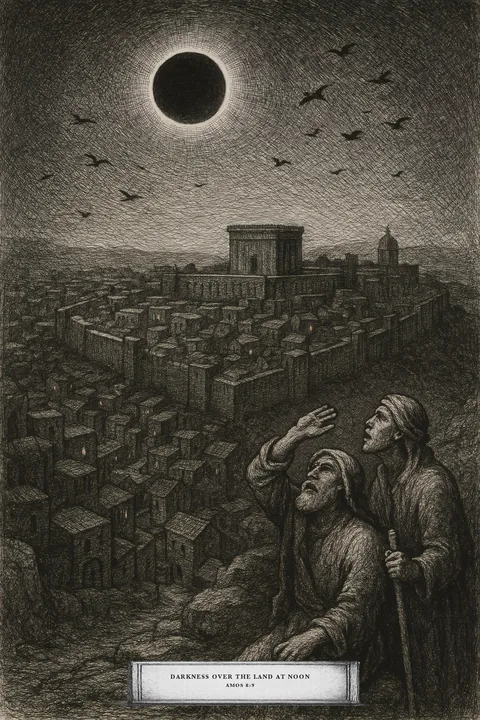
32 AD Resurrection
Proving the year of the cross and establishing the calendar are not just academic exercises; they are absolutely necessary if one wants to walk in the Truth, interpret prophecy, and prove that one is keeping feasts and Sabbaths at the appointed times. Every single attempt to date the crucifixion (whether one expects it to land on Wednesday, Thursday, or the traditional Friday) follows the same hidden pattern:
-
Start with the Pharisee tradition about how the temple calendar allegedly worked.
-
Use that calendar to decide what day of the week the crucifixion “must” have been.
-
Pick the year between AD 26 and 36 in which Passover falls on that weekday (usually 30 or 33 AD)
-
Make everything else fit the chosen year no matter how unlikely
This conclusion is reinforced by asking any AI assistant — trained on the sum of the published arguments — to summarize the primary reasons for and against each candidate year. The answers usually reference the day of the week as one of the top factors. The calendar is assumed to be so absolute that all other facts pale in consideration.
These assumptions violate at least 6 different scriptures by elevating rabbinic Jewish “fables” (as the Bible puts it) and inherited tradition to unquestionable truths, forcing unnatural interpretations of all other facts. The point of this chapter is to go through the evidence without any consideration for the day of the planetary week and interpret every primary source we can find as straightforwardly as possible.
If the result of this effort yields unambiguous support for a year when Saturday Sabbath is entirely incompatible with the gospel accounts, then this becomes one of the strongest arguments for Lunar Sabbath, which is compatible with the gospel accounts in every year. On the other hand, if the evidence is inconclusive, contradictory, or points to a year with a Wednesday, Thursday, or Friday crucifixion, then we would have various degrees of ambiguous evidence, neither supporting nor contradicting Saturday or the Lunar Sabbath.
There are several years we can pinpoint with extremely high confidence using entirely independent lines of evidence:
-
The year John the Baptist started his ministry (Fall 28 AD)
-
Jesus declared Favorable Year of the Lord (Fall 29 AD)
-
Temple was 46 years in building. (30 AD)
-
The 490th year from Ezra’s Decree (32 AD)
-
Passover Solar Eclipse (32 AD)
-
The year Herod Died (1 BC)
Then, from this information, we have various constraints defined by the Bible, including:
-
3 Passovers mentioned in the Gospel of John
-
Jesus is 6 months younger than John the Baptist
-
They start their ministries at 30.
There is sufficient evidence to identify the day Jesus was most likely born and even the week of John’s conception. Each element will have to be rigorously proven, and the alleged conflicting evidence addressed, which will take time. We will go through all the primary sources and double-check the rationale used to derive popular assumptions.
It usually boils down to the same fundamental problem: because of the assumed infallibility of the Passover timeline and the day of the cross, most researchers were forced to rationalize and adopt less straightforward interpretations of the facts before them, often dismissing testimony as “errors” without evidence, assuming implausibly tight timelines of various events, and deviating from standard practices. Others then built on top of these unreasonable assumptions without challenging the foundation.
The most straightforward reading of Tiberius’ 15th year without any special pleading is that Tiberius’ 15th year started fall 28 AD and runs through fall 29 AD. According to scripture, it is during this window that John’s ministry must start and that John must turn 30.

The Day of the Lord’s favor is declared at the end of every 7th year as slaves are freed and debts are forgiven. Evidence points to this cycle starting in 1406 BC, and this is confirmed by Josephus documenting such a Sabbath in 35 BC. Therefore, the only year that Jesus could lawfully say “this is fulfilled in your hearing” is Day of Atonement 29 AD.
At this time, Jesus had already grown in fame and spent 40 days in the desert after his baptism. A plausible argument could be made that his first miracle, turning water into wine, is a typological fit for the feast of new wine around the 10th of the 5th month. This was after 40 days in the desert, which pushes his baptism to sometime before Shavuot in 29 AD. Since Jesus is 6 months younger than John and he was not quite 30 years old when baptized, this puts a window for Jesus’ baptism in the first 3 months of the Hebrew calendar in 29 AD (aka between Nisan 1 and the Shavuot/Pentecost).
The Priestly Cycles confirm John’s conception around Hanukkah, his birth around Tabernacles, and Jesus’s birth around Passover, consistent with him being the Lamb of God. Thus, Jesus’ baptism was likely at the start of Nisan before Passover, aligned with the anniversary of Aaron’s dedication of the priests.
Given the 40 days in the wilderness, it is impossible for 29 AD to be one of the Passovers mentioned. This is consistent with the next fact. Three dates anchor what follows: Herod’s regal count runs from the Roman decree of 38 BC, his de facto reign from the capture of Jerusalem in 36 BC, and he died in 1 BC. Part Five, The Reign of Herod the Great, proves each of them from the primary sources — and answers, source by source, the objections a reader may have inherited — with evidence strong enough for 99.9% confidence. For now we will continue the case for 32 AD and explore its profound calendar implications. From those dates, the 46th year of building the temple was spring 29 AD to spring 30 AD; therefore, the most likely date for the first Passover encounter is 30 AD, which in and of itself destroys the most popular theory: the 30 AD cross. With those dates fixed, the three Passovers of John’s Gospel land as follows:
-
30 AD Passover #1 (46 years building temple): John 2:13 — “And the Jews’ passover was at hand, and Jesus went up to Jerusalem.”
-
31 AD Passover #2 (mid-ministry, feeding of the 5,000 near the time): John 6:4 — “And the passover, a feast of the Jews, was nigh.”
-
32 AD Final Passover (leading to crucifixion):
And the Jews' passover was nigh at hand: and many went out of the country up to Jerusalem before the passover, to purify themselves.
Using King James Pure Bible Search “Passover | Easter” occurs exactly 77 times; therefore, it appears there is a high probability there is a supernatural checksum in play. There are also 7⁷ words/verse numbers in the standardized KJV; therefore, removing a Passover verse would break at least two seemingly supernatural checksums on the integrity of the canon. I point this out because some argue that one of these verses was an addition to the text and others argue that there may have been more Passovers. This is not hard evidence, but it does make one pause before considering arguments that these Passover references were scribal insertions.
Finally, 32 AD is the 490th year from Ezra’s decree to restore and rebuild Jerusalem, which aligns with Daniel’s prophecy on the timeline to the Anointed Prince. This means that 32 AD is a perfect match and 33 AD has to plead undocumented Passovers in combination with non-literal non-inclusive 490 years among other things.
All earlier-year theories require unique and historically unsupported rationalizations that Luke used an unconventional 14th year of Tiberius, and they ignore or stretch beyond reason a multitude of completely independent proofs of the reign of Herod the Great. I don’t expect you to believe me on this, so we will go through every single piece of primary evidence I could find and let you draw your own conclusions.
Big claims require big evidence, and I will prove them each in turn.
Tiberius 15th Year
The first major piece of evidence is that Luke tells us John the Baptist started his ministry in the 15th year of Tiberius.
In the 15th year of the reign of Tiberius Caesar, while Pontius Pilate was governor of Judea, Herod tetrarch of Galilee, his brother Philip tetrarch of Ituraea and Trachonitis, and Lysanias tetrarch of Abilene, during the high priesthood of Annas and Caiaphas, the word of God came to John son of Zechariah in the wilderness.
In standard Roman historiography, Tiberius Caesar’s reign is universally dated from his accession in AD 14 following Augustus’s death on August 19 of that year, with Senate confirmation shortly thereafter, leading to a consistent reckoning of his 15th regnal year as spanning approximately fall AD 28 to fall 29. Ancient sources such as the historians Tacitus (in his Annals), Suetonius (Lives of the Caesars), and Cassius Dio (Roman History), along with contemporary inscriptions, coins, and official documents like the Res Gestae Divi Augusti, uniformly count Tiberius’s years from this point without reference to any prior co-regency or alternative starting dates, treating his sole emperorship as the benchmark for chronological references to events like provincial appointments, military campaigns, and senatorial decrees. This accession-based method aligns with broader Roman imperial dating conventions, where regnal years began from the emperor’s formal assumption of power, and remains the unchallenged consensus among classical scholars and numismatists outside of specific interpretive debates in biblical studies.
Most people, especially in Christian circles and among those familiar with New Testament studies, describe Luke (the author of the Gospel of Luke and Acts) as a highly detail-oriented and accurate historian—often calling him a "historian of the first rank" or one of the most reliable ancient writers. This reputation stems largely from the work of scholars like Sir William Ramsay (a prominent archaeologist who initially approached Luke skeptically but reversed his view after fieldwork, concluding that Luke demonstrates "habitual accuracy" in geography, politics, titles of officials, and local customs, placing him alongside great historians like Thucydides).
Ramsay’s assessment has been echoed widely: Luke is praised for meticulous research, eyewitness-like details (especially in the "we" sections of Acts), and precise naming of 32 countries, 54 cities, and 9 islands without error. Luke’s attention to detail strongly suggests that he would use widely accepted practices when dating the years of Tiberius and is unlikely to be the sole historian to count the years in an unprecedented manner.
-
Suetonius (Life of Tiberius 23–24, 73): Anchors succession precisely to Augustus’ death on August 19, AD 14 (Nola), with Senate ratification shortly after. Total reign phrased as factual elapsed time from that point to March 16, AD 37 (~22 years, 7 months). No mention of earlier grants (e.g., AD 12–13 tribunician power) shifting the start; those are described as preparatory privileges (Tiberius 21).
-
Tacitus (Annals 1.5–14): Details the exact sequence — Augustus’ death August 19, AD 14; Tiberius convenes Senate using existing powers but hesitates on full titles until September. Events and durations tied to this AD 14 pivot (Annals 6.51 confirms ~23 years total from succession). No alternative start referenced.
-
Dio Cassius (Roman History 57.1–3): Explicitly dates the imperial transition to AD 14, with year-by-year narratives beginning there (e.g., “in the consulship following Augustus’ death”). Tribunician renewals pre-AD 14 noted (56.28), but regnal narrative and durations start post-accession.
-
Josephus (Antiquities 18.2.2, 18.6.10): States Tiberius “succeeded him” directly after Augustus’ death, with precise duration “twenty-two years, five months, and three days” matching elapsed time from mid-late AD 14 to AD 37. No reset to Jewish calendars or pre-AD 14 counts; treats Tiberius with Roman factual months/days.
-
Inscriptions and Coins (e.g., Roman Imperial Coinage Vol. I; CIL entries): Tiberius’ titles (e.g., TRIB POT I starting AD 14/15 issues; PONTIF MAXIM from AD 15) and regnal numbering reset at sole rule in AD 14. No carryover from earlier tribunician terms.
Based upon all of this, it is most likely that Luke used the exact same convention as everyone else at the time. Even Tiberius hesitated to claim full titles until the senate ratified him.
The only reason people rationalize any other interpretation is to make their other “sacred” interpretations fit without having to claim scripture is in error. In other words, it is only the other misinterpreted evidence from Herod the Great’s reign and other scripture that is presented as evidence that Luke used a unique dating method. However, allowing that other evidence to reinterpret Luke here is circular logic.
We must let each piece of evidence stand independently before considering them collectively.
Year of Release
Jesus proclaimed liberty on the Day of Atonement in the Year of Release when he read Isaiah 61 in Nazareth.
The Spirit of the Lord is upon me, because he has anointed me to proclaim good news to the poor (debt forgiveness). He has sent me to proclaim liberty to the captives (those sold to serve) and recovering of sight to the blind, to set at liberty those who are oppressed (by debt), to proclaim the year of the Lord’s favor. And he began to say to them, 'Today this Scripture has been fulfilled in your hearing.'
Luke 4:18–19
Proclaiming the year of the Lord’s favor and forgiveness of debts is what Torah commands to be done at the end of every seven years. The fact that Jesus declared it fulfilled in their hearing tells you exactly when this event took place — at the end of the 7th year.
At the end of every seven years thou shalt make a release. And this is the manner of the release: Every creditor that lendeth ought unto his neighbor shall release it; he shall not exact it of his neighbor, or of his brother; because it is called the LORD’s release.
And if thy brother, an Hebrew man, or an Hebrew woman, be sold unto thee, and serve thee six years; then in the seventh year thou shalt let him go free from thee.
And Moses commanded them, saying: ‘At the end of every seven years, at the appointed time in the year of release [Shemitah], at the Feast of Tabernacles, when all Israel comes to appear before the LORD your God… you shall read this law before all Israel.
And you shall count seven sabbaths of years for yourself, seven times seven years; and the time of the seven sabbaths of years shall be to you forty-nine years. Then you shall cause the trumpet of the Jubilee to sound on the tenth day of the seventh month; on the Day of Atonement you shall make the trumpet sound throughout all your land. And you shall consecrate the fiftieth year, and proclaim liberty throughout the land to all its inhabitants. It shall be a Jubilee for you.
So we are told that at the end of every 7 years, which would be the fall feasts, we are to proclaim liberty throughout the land on the Day of Atonement. To be fair, this specific command is in the context of a Jubilee, but the same liberty is also proclaimed every 7th year.
Luke gives us additional context that allows us to infer it was a Day of Atonement — they treated Jesus like a scapegoat!
When they heard these things, all in the synagogue were filled with wrath. And they rose up and drove him out of the town and brought him to the brow of the hill on which their town was built, so that they could throw him down the cliff. But passing through their midst, he went away.
The Torah describes two goats: one sacrificed, the other (scapegoat) sent away bearing sins.
And Aaron shall lay both his hands on the head of the live goat, and confess over it all the iniquities of the people of Israel, and all their transgressions, all their sins. And he shall put them on the head of the goat and send it away into the wilderness by the hand of a man who is in readiness. The goat shall bear all their iniquities on itself to a remote area, and he shall let the goat go free in the wilderness.
Later Jewish tradition adds the goat being pushed off a cliff in the wilderness to ensure death.
He [the man appointed] brought it [the scapegoat] out to the wilderness… They made for it a ramp because of the Babylonians who used to pull its hair and say to it, ‘Take [our sins] and go, take and go.’ … The man who led it divided the crimson thread [tied to its horns]: half he tied to the rock, and half between its horns, and pushed it [the goat] from behind. And it rolled down and before it reached halfway down the mountain it was dashed to pieces [limbs separated]. He then returned and sat under the last booth until it grew dark.
Driving Jesus off of the cliff like a goat tied to a rock is exactly what was acted out in Luke 4. It is noteworthy that while the Jews were violating the Torah by throwing the goat off a cliff, Jesus “passed through their midst and went away” just like Leviticus commands “he shall let the goat go free in the wilderness”. And so we have by typology and by law that Jesus did this in the 7th year on the Day of Atonement, or at the very least “at the end of the 7th year”. We have already established that the cycle began when they crossed the Jordan River in 1406 BC and this is confirmed by Josephus in 36/35 BC with the capture of Jerusalem on a Sabbath year (counted fall 36 BC to fall 35 BC). Following this cycle we discover that Jesus did this on Day of Atonement in 29 AD, in the first story after his baptism in Luke chapter 4.
At this time he had already grown famous for miracles in the surrounding towns.
And Jesus returned in the power of the Spirit into Galilee: and there went out a fame of him through all the region round about.
This means he needed time to grow in fame after being baptized and spending 40 days in the wilderness and before the Day of Atonement 29 AD which lines up perfectly with Jesus getting baptized shortly before his 30th birthday (Passover). His 40 days in the wilderness would end shortly before Shavuot allowing 7 weeks before his first miracle at the Feast of New Wine and another 7 weeks before the Day of Atonement.
Jordan River Crossing
Confirming 29 AD as a Sabbath year requires that you can trust the 1406 BC date for the crossing of the Jordan River. This is established by the following foundational evidence:
And it came to pass in the 480th year after the children of Israel were come out of the land of Egypt, in the fourth year of Solomon’s reign over Israel, in the month Zif, which is the second month, that he began to build the house of the LORD.
The year that Solomon’s temple began construction in 966 BC is well established by both secular and biblical sources. This puts the Exodus from Egypt in 1446 BC which aligns perfectly with the records of Egyptian Pharaohs. From there Israel spent 40 years in the desert.
If 1406 BC was the first year of a Jubilee cycle, then 1407 BC was the 7th year of the Sabbath cycle. Putting it all together, 29 AD is the seventh year of the 205th Sabbath from the Jordan River crossing. The year of the crossing is further confirmed by aligning with the following Jubilees:
-
573 BC - Ezekiel 40 Rosh Hashanah (the head of the year)
-
672 BC - The scripture was restored to Josiah
-
965 BC - Second year building Solomon’s temple
-
Josephus’ confirmed Sabbath year 35 BC
We know many dates with high confidence because the years of Nebuchadnezzar are established by clay tablets that record 21 positions of the sun, moon, and stars. These records provide as close to absolute certainty as you could hope and are the ultimate basis of key dates.
The bottom line is that if the dating of Solomon’s temple was off by even a single year all of these other dates would also come out of alignment.
Empire-Wide Loyalty Oath
The next point of reference scripture gives us to the timing of Jesus’s birth is the census that caused Joseph and Mary to travel to Bethlehem.
Now it came to pass in those days, there went out a decree from Caesar Augustus, that all the world should be enrolled (apographē). This was the first enrolment (apographē) made when Quirinius was governor of Syria. And all went to enrol themselves, every one to his own city. And Joseph also went up from Galilee, out of the city of Nazareth, into Judaea, to the city of David, which is called Bethlehem, because he was of the house and family of David; to enrol himself with Mary, who was betrothed to him, being great with child.
ASV

In the closing years of Herod’s reign, Augustus received coordinated public declarations of allegiance in different parts of the empire. In February of 2 BC he was also granted the title Pater Patriae (“Father of the Fatherland”), twenty-five years after assuming supreme power. Luke does not explicitly identify his apographē with a loyalty oath, so the proposed connection must be tested by its chronological and historical fit rather than asserted as a direct identification.
There was also a great disturbance among the people because of a command that the king gave to swear allegiance to Caesar and to himself. For there were certain men among the Jews who valued the laws of their country above all things… Accordingly, when all the people of the Jews gave assurance of their good-will to Caesar, and to the king’s government, these very men [the Pharisees] did not swear, being above six thousand; and when the king imposed a fine upon them, Pheroras’ wife paid the money for them.
Antiquities 17.2.4
The primary evidence includes the Res Gestae Divi Augusti itself (chapter 35), which records the 2 BC Pater Patriae honor, together with a surviving oath-text found on a Greek inscription from Paphlagonia (OGIS 532), which says that the oath was also sworn “by all the people in the land.” The inscription (OGIS 532, found at Gangra/Germanicopolis in Paphlagonia, modern Turkey) records a loyalty oath to Augustus and his family. Its opening lines date it explicitly to:
In the third year after the twelfth consulship of Imperator Caesar, son of the god, Augustus, on the day before the nones of March [March 6] at Gangra…
Gangra
Augustus’ twelfth consulship was in 5 BC. Exclusive elapsed-year reckoning places the inscription in March 2 BC (4 BC = one year after, 3 BC = two, and 2 BC = three); inclusive or Paphlagonian civic-era reckoning places it in March 3 BC. The inscription itself expresses the date by its ancient ordinal formula rather than printing either modern BC conversion.
Luke does not explicitly identify the enrollment with this loyalty oath. Nevertheless, the 1 BC chronology brings Luke’s enrollment, Josephus’s Judean oath, the Paphlagonian oath, Augustus’s Pater Patriae honor, and Luke’s thirty-year interval into one coherent 3–2 BC setting. The 4 BC chronology can appeal to an earlier oath attested at Conobaria around 6/5 BC and can place Josephus’s oath in that earlier setting, but it must also move Luke’s enrollment to an earlier, otherwise unidentified event. Neither oath inscription directly records an apographē, ancestral-city travel, or a Judean enrollment. The proposed identification is therefore not direct proof, but the convergence gives the 1 BC chronology a substantially better explanatory fit.
On this reconstruction, Joseph and Mary made the journey in the early spring of 2 BC, when a late-pregnancy Mary could still travel and Jesus was born shortly afterward. The lack of room in the inn is easily explained by the Passover crowd. This would put John’s birth 6 months earlier, in the fall of 3 BC. If you add 30 years to that, John would start his ministry in the fall of 28 AD, perfectly aligned with the most straightforward understanding of what Tiberius’ 15th year would have meant to people when Luke wrote his gospel. This is discriminating circumstantial evidence rather than a fully independent identification: the observations fit the 1 BC chronology better even though the surviving sources do not state that Luke’s enrollment and the oath were the same administrative act. All of that said, there is one mystery that remains unexplained:
This was the first enrolment (apographē) made when Quirinius was governor of Syria.
ASV
Quirinius is commonly understood to have become governor in 6 AD, which happens to align with another census that was taken; however, unlike the census in 3–2 BC, the 6 AD census (apographē) did not require people to return to their homes. 6 AD is also far too late a date for a plausible birth of Jesus. This means either Luke was mistaken (unlikely) or the word “first” could be translated as “before” as many have argued. The translation as “before” would be far more probable if Luke was originally written in Hebrew as some scholars (like James R. Edwards) argue.
46 Years Building the Temple
John gives us a very clear time marker for the first Passover — it had taken 46 years to build it at that point:
The Passover of the Jews was at hand, and Jesus went up to Jerusalem…. It has taken forty-six years to build this temple, and will you raise it up in three days?
The only question we need to figure out is when did they start building the temple:
In the eighteenth year of his (Herod the Great) reign… he undertook to rebuild the Temple.
Antiquities 15.380
-
Josephus writes this immediately after describing Herod’s final consolidation of power in 36 BC (proven in Part Five, The Reign of Herod the Great). The eighteenth year of Herod’s reign, in the sense required by the context of Antiquities 15.380, is most likely the eighteenth year after he seized Jerusalem — not the eighteenth year after the Senate’s decree in Rome.
This places the intent to rebuild the temple in 18 BC, because his first effective year started spring 35 BC, 6 months after capturing the city in 36 BC. However, the Jews did not trust Herod and wouldn’t let him start construction immediately.
But Herod himself went about the work with great zeal, because he hoped that this would be the most illustrious monument of his reign. The people, however, were afraid that, even if he should collect the materials, he might not carry out the rebuilding, but that, having pulled down the whole temple, he might leave it in that condition and not be able to complete the new one. And this danger appeared probable, because the undertaking was so vast. Therefore Herod, in order to remove this suspicion and to prove that he was in earnest, prepared all the materials beforehand, and collected a thousand wagons to carry the stones, and selected ten thousand of the most skilled workmen, and purchased priestly garments for a thousand priests, and trained a thousand priests in the arts of masonry and carpentry, and only then, when everything was ready, did he begin the reconstruction. And so he pulled down the old foundations and laid others, and upon them he erected a new temple.
If we date purely from the 18th year, then the 46th year would be spring 29 to spring 30; however, we have already established that he would have been in the wilderness for 40 days this particular year. The prep work was extensive (training 1000 priests, gathering materials) so the earliest they could start would be the following year: spring 17 BC. 46 construction years later brings us to the spring of 30 AD, the very first Passover at which it could be said 46 years. Construction on the temple was ongoing through 65 AD just a few short years before the temple was destroyed. If 30 AD was the first passover, then the second was 31 AD and the final would be 32 AD. At the time this was said Jesus also said:
‘Destroy this temple, and in three days I will raise it up.’
While it obviously alludes to him being killed and resurrected on the 3rd day, it also can be interpreted prophetically as 3 years from this conversation: 30 AD, 31 AD, and 32 AD inclusively. This prophetic interpretation is not strictly necessary, but it doesn’t hurt the case.
Daniel’s 490-Year Prophecy
The book of Daniel has one of the most profound prophecies in the Bible because it gave us an exact timeline, with year counts, to the arrival of the Anointed Prince. There are several ways of viewing these prophecies but they all point to the same year. I have taken the liberty of doing a literal translation of the Hebrew.
Know therefore and understand, that from the going forth of the commandment to restore and build Jerusalem until Anointed Prince shall be 70 ( שׁבעים ) sevened (שׁבעה). (70x7 = 490)…
literal rendering
Your bible probably translates it something closer to:
… until Anointed Prince there will be seven weeks and sixty-two weeks. It will be rebuilt with plaza and moat and the times end in distress.
literal rendering
Under this understanding you would add it up and conclude 69 weeks or 483 years. People then reference the prior verse for context:
Seventy weeks (490 years) have been determined upon thy people, and upon thy holy city, for sin to be ended, and to seal up transgressions, and to blot out the iniquities, and to make atonement for iniquities, and to bring in everlasting righteousness, and to seal the vision and the prophet, and to anoint the Most Holy.
LXX Brenton
This is the origin of looking for Daniel’s 70th week given that 69 of 70 weeks appear to be accounted for in Daniel 9:25; however consider what John had to say:
He Himself is the propitiation (atonement) for our sins, and not for ours only but also for the sins of the whole world.
Jesus was the propitiation for our sins and this is one of the things mentioned to happen in 70 weeks. This means that one of the layered interpretations of Daniel 9:24 and Daniel 9:25 is that atonement would be made 490 inclusive years from the order to restore and rebuild Jerusalem. I thought the translation of Daniel 9:25 was awkward by mentioning 7 weeks and 62 weeks which is why I decided to look deeper into the text. Surely there is a reason he didn’t just write 69. When I looked deeper I chose to consider all plausible interpretations of the vowel points because the vowel points were an oral tradition that was not written down until 100’s of years after Jesus. When you look at the literal Hebrew and avoid interpretive re-ordering of words you will see it reads like a mathematical code:
There shall be 70 ( שׁבעים ) sevened (שׁבעה) and 70 ( ושׁבעים ) sixty (שׁשּׁים ) and two/second (וּשׁנים) they will come back [again] and rebuild the plaza and moat and in anguish/distress the times end.
literal rendering
Standard Hebrew is similar to English in that we would generally say “seventy weeks” and not “weeks seventy”, but in Daniel he intentionally writes “weeks seventy”. It goes deeper than that because the word translated as “weeks” is actually the exact same letters as the word “seventy” which is an oddity. This word literally means “a group of 2 or more 7’s” which by default is 70, but can also be “a complete cycle of 7’s” which is an apt description of a Jubilee of 49 years. The word order is a contextual hint that something more is going on here and that there is symbolic word-play going on. Here is my proposed interpretation of the literal text:
There shall be 70 ( שׁבעים ) sevened (שׁבעה) [years] and [on] Jubilee ( ושׁבעים ) sixty (שׁשּׁים ) and then a second (וּשׁנים) [order with 70x7] they will come back [again, a second time] and rebuild the plaza and moat and in anguish/distress the times end.
literal rendering
It turns out that on the 60th Jubilee Sultan Suleiman I gave an order to restore and rebuild Jerusalem and this order included the Plaza (Temple Mount) and moat/trench. The evidence of this decree is engraved in stone and visible in Jerusalem today. The first order to restore and rebuild Jerusalem lacked the plaza and moat. Thus, history is a witness to the interpretation. The 490th year from the second decree ends around 2026. The point of this is to add support to the expectation of Messiah Prince after 70 “sevened” or 70 repeated 7 times, aka 490 years from the first decree to restore and rebuild Jerusalem as documented by Ezra.
Scripture tells us the year the decree was issued and that Ezra left in the 1st month and arrived in the 5th month.
And the year seven to Artaxerxes king of Persia… and they came to Jerusalem in the month the fifth… this the copy of the letter which sent Artaxerxes the king.
literal rendering
Upon the death of Cyrus, Cambyses reigned… [earlier kings omitted]. But now the seventh year of Artaxerxes was come, and our nation was in great danger of perishing, by reason of the kings’ anger at us… Ezra, a priest and a scribe of the laws of Moses, came to the king, and with many tears besought him to give him leave to go to his own country… The king was so moved with compassion, that he wrote a letter to the treasurers of Syria and Phoenicia, and to those beyond the river, and gave order that they should assist Ezra in building the temple, and in offering sacrifices, and in whatever else he should ask… Ezra gathered together the captivity beyond the river, and fasted, and besought God for a prosperous journey… And he set forward the twelfth day of the first month, and came to Jerusalem in the fifth month…
A Case for the 458 BC Decree
In reconstructing the chronology of biblical events, particularly those tied to the post-exilic period in Ezra and Nehemiah, the precise dating of Artaxerxes I’s seventh regnal year (Ezra 7:7–9) emerges as a pivotal anchor. This year marks Ezra’s departure from Babylon in the month of Nisan (spring) and his arrival in Jerusalem in Av (summer), under the king’s decree permitting the restoration of Jewish religious practices and governance. Historical scholarship has debated whether this seventh year aligns with 458 BC or 457 BC, with implications for broader prophetic timelines, such as Daniel 9’s "seventy weeks." Through an analysis of primary sources—including the biblical text, Flavius Josephus, and Aramaic papyri from the Elephantine Jewish colony in Egypt—we can substantiate a high confidence in 458 BC as the correct alignment, rendering 457 BC unlikely.
The Historical Context and Regnal Reckoning
Artaxerxes I ascended the Persian throne following the assassination of his father, Xerxes, in late 465 BC. Persian kings typically employed a spring-to-spring (Nisan-to-Nisan) calendar for regnal years, with an accession period covering the remainder of the year following a predecessor’s death. Under this system:
-
Accession year: Late 465 BC to Nisan (March/April) 464 BC
-
Year 1: Nisan 464 BC to Nisan 463 BC
-
Year 7: Nisan 458 BC to Nisan 457 BC
Ezra’s journey, commencing on Nisan 1 and concluding on Av 1 (a four-month span), thus falls squarely in the spring and summer of 458 BC if adhering to the Persian-Babylonian reckoning. Some scholars propose a Jewish fall-to-fall (Tishri-to-Tishri) calendar, shifting the seventh year to 457 BC, based on evidence from Nehemiah and certain Elephantine documents. However, as detailed below, the cumulative evidence from extrabiblical artifacts strongly favors the Persian calendar’s application here, particularly for an official decree issued under imperial authority.
Key Evidence Supporting 458 BC
-
Biblical and Josephan Alignment: The Ezra narrative specifies a Nisan-to-Av journey in the seventh year, implying a spring start. Josephus corroborates this with a first-to-fifth-month timeline, fitting a standard Persian regnal count. For 457 BC, it assumes a strict fall calendar, but the journey’s spring timing fits less seamlessly, as it would push the decree into late 458 BC without strong warrant from the Persian administrative context.
-
Elephantine Papyri: Anchoring the Accession: These Aramaic documents from a Jewish-Persian garrison in Egypt provide contemporaneous records of Artaxerxes' reign. Several papyri, such as AP 6, fix the accession to late 465 BC and year 1 to Nisan 464 BC, directly supporting year 7 as 458 BC. Others, like AP 13 and Kraeling 4, confirm later-year consistencies, while AP 8’s year 6 check aligns well. Although some double-dated papyri suggest occasional fall reckonings among Elephantine Jews, this was not uniform for regnal years in official Persian contexts, and the overall corpus supports the spring-to-spring system for Artaxerxes' chronology.
-
Cairo Sandstone Stele: Decisive Overlap: This artifact, discovered in an Elephantine context, explicitly dates to year 7 in May–June 458 BC, corresponding to the Hebrew month Sivan—potentially during Ezra’s travel. This precise solar-lunar overlap fits perfectly with a spring start for year 7 in 458 BC. For a fall-to-fall reckoning (as proposed for 457 BC), the date falls too early: May–June 458 BC would still be in year 6 (ending in Tishri 458 BC), creating a mismatch without evidence of calendar anomaly.
Why 457 BC Is Extremely Unlikely
Advocates for 457 BC cite a Jewish fall calendar, evidenced in Nehemiah (Nehemiah 1:1; 2:1, where Kislev precedes Nisan in the same year) and some Elephantine double-datings. However, Ezra’s context—operating under Persian authority—likely defaults to the imperial spring calendar, as the decree was an official edict from the king. The Cairo Stele’s May–June 458 BC dating as year 7 creates a six-month discrepancy for 457 BC, undermining the fall reckoning in this instance. Moreover, while Elephantine Jews sometimes used fall reckonings for civil matters, this was not consistently applied to Persian regnal years in decrees, and the stele’s explicit dating aligns with spring norms. Scholarly consensus among many historians favors 458 BC for these reasons, often tied to Persian administrative practices rather than interpretive biases in prophetic exegesis.
Conclusion: High Confidence in 458 BC points to 32 AD. This date harmonizes the biblical account with Persian administrative norms and key Elephantine evidence, providing a robust chronological foundation. The 457 BC alternative requires overriding the decree’s Persian context with a less-attested uniform Jewish calendar shift, which falters against artifacts like the Cairo Stele. Thus, we can assert with extreme confidence that Artaxerxes I’s seventh year aligns with 458 BC, anchoring related biblical timelines with historical precision. Given spring 458 BC is the first year of the decree, the 490th year starts spring 32 AD. Thus, according to this interpretation of Daniel’s prophecy, the atonement for sins should be completed no later than Passover 32 AD.
Signs in the Sun, Moon, and Stars
Scripture tells us that the sun, moon, and stars are for signs and seasons, so we should expect some kind of activity in the heavens on the day of the cross. Scripture even predicts a sign that would occur:
And it shall come to pass in that day, saith the Lord GOD, that I will cause the sun to go down at noon, and I will darken the earth in the clear day.
And then Matthew and the other gospels describe it happening.
Now from the sixth hour (noon) there was darkness over all the land unto the ninth hour. (3 PM)
In Babylonian days they knew enough to predict exactly when to expect an eclipse, but not where the eclipse would occur. The clearest primary evidence of this knowledge comes from Babylonian astronomical diaries (cuneiform tablets, e.g., from the Seleucid era, ~3rd–1st century BC). These record predicted solar eclipses that were expected but not observed at the prediction site (Babylon), because the path of visibility shifted geographically. A direct example is preserved and quoted in historical compilations (e.g., F. Richard Stephenson’s Historical Eclipses and Earth’s Rotation, drawing from original tablets):
The 28th, 74 deg after sunrise, solar eclipse (at) 5 months’ distance; when I watched I did not see it.
This refers to a predicted solar eclipse on 7 September 247 BC. Babylonian astronomers, using arithmetic progressions (precursors to the Saros cycle), accurately forecasted the time (here, ~74 degrees after sunrise, equivalent to a specific hour) but the eclipse was not visible in Babylon — it occurred far north. The prediction was for a potential event on that date/time, but location/visibility was uncertain. Pliny the Elder (Natural History 2.10) notes varying visibility and timing of eclipses by location, implying ancients recognized that predictions were global in timing but local in observation:
…this eclipse is visible to different nations…
Combined with the Saros cycle (known to Chaldeans/Babylonians by ~7th century BC, later to Hipparchus), which repeats eclipses ~every 18 years + 11 days but shifts the path ~120° westward (one-third around Earth), ancients could reliably predict recurrence times, but not precise paths/locations without advanced parallax/geometric models (achieved later by Ptolemy in the Almagest, ~2nd century AD). This limitation is why Babylonian records often note “predicted but not seen” — they knew when to watch, but not definitively where it would appear. No earlier Greek source (e.g., Herodotus on Thales) claims location prediction; Thales (~585 BC) reportedly forecasted only the year/season.
Now we have established that the professional sky watchers were very sophisticated and knew not only that solar eclipses can only occur on the dark phase of the moon, but they also knew the exact months in which to expect a solar eclipse. This means that a solar eclipse occurring on a full moon would have been a most astonishing event, an event that would be noted by those who record such things. The fact that the supernaturally dark eclipse was recorded as a solar eclipse means the timing was most likely aligned with an expected solar eclipse and the only thing unexpected about it was its duration and intensity. Here is a summary of every ancient witness I could find documenting the eclipse at the cross:
-
Phlegon (c. AD 137): In the fourth year of the 202nd Olympiad (July 32 to July 33 AD), an eclipse of the sun happened, greater and more excellent than any that had happened before it; at the sixth hour, day turned into dark night, so that the stars were seen in the sky, and an earthquake in Bithynia toppled many buildings of the city of Nicaea.
-
Thallus (c. AD 52): Thallus, in the third book of his Histories, explains away this darkness “as an eclipse of the sun”
-
Tertullian (c. AD 197): Urges Romans to “investigate it even now” in their archives (Apologeticus 21.19). The Acta Diurna or consular fasti likely noted this spring portent, as eclipses were state omens.
Of these reports, only Phlegon provides an approximate date connected to the 4th year of the 202nd Olympiad. This claim appears to support a 33 AD crucifixion, but is over 105 years removed from the event and could easily be approximate because it is only 2.5 months off from Passover 32 AD. NASA’s Five Millennium Canon of Solar Eclipses documents a partial solar eclipse on April 28, 32 AD (Julian calendar). It gives the instant of greatest eclipse as 9:42:10 Terrestrial Dynamical Time (TDT), corresponding under NASA’s historical ΔT model to approximately 6:51:59 UT. At Jerusalem’s longitude, that instant corresponds to approximately 9:13 AM local mean solar time, but the location of greatest eclipse was far to the north and west of Jerusalem. NASA’s local-circumstances calculation places Jerusalem’s small partial phase at approximately 5:28–6:07 UT, or 7:49–8:28 AM local mean solar time, with local maximum near 8:08 AM.
The relevance of this astronomical eclipse to the argument is its date and timing, not its magnitude or location, and it is not being offered as a natural explanation for the Gospel’s three hours of darkness. Under the Full Moon start of month calendar presented in this book, the proposed Passover in 32 AD coincides with the date of an independently calculated solar eclipse. If this were the only data point available, then 32 AD would be the best fit among the candidate years considered here. Not only that, but the lunar year began with a full blood moon (though not visible in Israel). This makes 32 AD the standout year from 30 to 33 AD. Thus, even with a dark moon calendar, Passover would have the most distinctive sign among those years.
The Friday Argument
Throughout this book, we have been systematically testing various calendars against as many primary sources as allow us to connect a day of the week to a day of the month and a year. The goal is to see which of the many calendar theories (dark moon, sliver moon, full moon, etc.) are compatible. When it comes to traditional arguments about which years had a “Passover” technically compatible with the gospel narrative, most people are willing to cherry-pick any calendar theory for how the month might have started if it suits their narrative. Then, in other contexts, they will pick a different calendar, and they rarely attempt to force consistency; instead, they chalk it all up to the “fog of history.”

We have identified three ways to start the month derived from common ways adopted by various groups or assumed to be true by tradition:
-
Dark: The first sunset after the dark conjunction
-
Crescent: The evening with the first naked-eye visible crescent
-
Full: The first morning after the full moon
| Event / Year & Key Date Assumption | Dark | Crescent | Full |
|---|---|---|---|
Exodus Manna (1446 BC) |
✓ |
✖ |
✓ |
Jordan Crossing / First Fruits (1406 BC) |
✖ |
✖ |
✖ |
First Temple Destruction (587 BC) |
✖ |
✓ |
✖ |
First Temple Destruction (587 BC) |
✓ |
✖ |
✓ |
Second Temple Destruction (70 AD) |
✖ |
✖ |
✖ |
Second Temple Destruction (70 AD) |
✓ |
✓ |
✓ |
If you study the table closely, you will discover that no single method is compatible with all known test cases, but significantly, the most common assumption (first visible crescent), which is testified in great detail using robust stories about two witnesses reporting it and signal fires, is the least compatible with all available testimony. So what would happen if we took the most compatible option of the group, the Dark Conjunction, and used it as the basis for determining the day of the week for Passover in the years 30 to 33 AD? There are numerous rules that people could apply for how to start the year, but regardless of which rule set you use, it always boils down to one of two months. Ironically, this equates to either first or second Passover. This means that if you miss first Passover due to a calendar error, you end up keeping second Passover without realizing it (assuming you start the months properly).
| Year | Month 1 Date | Month 1 Day | Month 2 Date | Month 2 Day |
|---|---|---|---|---|
28 AD |
Mar 29 |
Monday |
Apr 27 |
Tuesday |
29 AD |
Apr 17 |
Sunday |
May 16 |
Monday |
30 AD |
Apr 6 |
Thursday |
May 5 |
Friday |
31 AD |
Mar 26 |
Monday |
Apr 24 |
Tuesday |
32 AD |
Apr 13 |
Sunday |
May 12 |
Monday |
33 AD |
Apr 2 |
Thursday |
May 1 |
Friday |
Recall Passover is always on the 14th (by definition), followed by Unleavened Bread on the 15th, and First Fruits on the 16th. Recall the ample evidence to support that First Fruits was kept on the 16th according to Josephus.
But on the second day of unleavened bread, which is the sixteenth day of the month, they first partake of the fruits of the earth: for before that day they do not touch them.
See the chapter on Passion Week and the true meaning of “heart of the earth” for the full evidence that the most plausible day for Passover suggested by the Bible had to be a Friday by a wide margin. With that foundation, we can see that for all potential years, using the least conflicted traditional calendar (the dark conjunction) and most universally accepted starting month, there is not a single year with a Friday Passover. This forces everyone to adopt the most conflicted sliver moon calendar that is incompatible with most tests or adopt an extreme minority view regarding how the year starts. The majority rule is that Passover must occur after the equinox, but some say that the “new” moon must occur after the equinox. In our pursuit of truth, we must approach these matters with humility and grace, recognizing that many sincere believers have long held to cherished interpretations of the crucifixion timeline and the Sabbath. Yet Scripture calls us to test all things (1 Thessalonians 5:21) and to let the Word be our final authority, not tradition or majority opinion.
The difficulty arises when attempts to harmonize the Gospel accounts with a fixed planetary week require the simultaneous use of multiple, mutually incompatible calendar systems for events that Scripture presents as occurring under one unified divine order. The Exodus manna, the fall of Jericho on the appointed day of First Fruits, the precise three Passovers in John, the darkness at the crucifixion, and the resurrection timing—all are explicitly tied to God’s perfect, unchanging timing. These are not isolated incidents that can be assigned different rules of new-moon sighting or equinox priority on a case-by-case basis. To do so implies that God Himself operated under shifting calendrical frameworks within the same redemptive history, or that He altered the courses of the sun, moon, and stars at various points to accommodate human reckoning. Such a view, however unintentionally, casts doubt on the reliability of the very scriptural markers God gave us as signs and seasons.
When ancient biblical tests produce contradictions under a Saturday-Sabbath assumption, the response is often to introduce "reasonable doubt" by suggesting celestial anomalies or divine interventions. When more recent historical tests (such as the dates of the temple destructions) conflict, the same traditions that are leaned upon to affirm an unbroken Saturday Sabbath are quietly set aside as unreliable oral transmission or Talmudic error. Yet those same traditions are upheld elsewhere when they appear to support the desired conclusion.
This selective application reveals a deeper tension: logical inconsistency is, by definition, incompatible with truth. God is not a God of confusion (1 Corinthians 14:33), but of perfect order and unchanging character. He is Truth itself (John 14:6), and contradiction cannot reside in Him. If a proposed framework demands that we accept mutually exclusive calendars operating at once, or that God must have suspended the ordinary laws of creation to make the pieces fit, then that framework cannot be aligned with the nature of the God we serve.
With gentleness and respect, therefore, I invite every reader to lay aside preconceptions and ask: Does the model you hold truly honor God’s perfection, or does it require you to tolerate contradictions that Scripture itself does not permit? The call is not to defend a tradition at all costs, but to seek the harmony that must exist when we allow one consistent, biblically faithful calendar to govern the whole record. In doing so, we honor the God whose works are perfect and whose ways are just, trusting that truth will stand firm under honest scrutiny.
Conclusion
This case builds on several independent chronological anchors (e.g., Tiberius' 15th year as fall 28-29 AD for John’s ministry start, the 46-year temple timeline placing the first Passover in 30 AD, the 490-year count from the 458 BC decree landing on 32 AD, and the partial solar eclipse aligning with Passover under a full-moon-start calendar). These interlock without mutual dependence, creating a tight timeline for a 3-year ministry ending in 32 AD. Alternatives like 30 or 33 AD require ad hoc adjustments—such as redefining regnal years, inserting undocumented Passovers, or ignoring constraints like the Year of Release proclamation—to fit, which introduces unnecessary complexity. The logic favors the option where facts align naturally over one needing extra rationalizations.
On the Sabbath, the analysis shows fixed planetary weeks (Saturday) generate inconsistencies across historical test cases (e.g., temple destructions, Exodus events) unless cherry-picking calendar starts, leading to conflicts in weekday-Passover alignments for 28-33 AD. A lunar sabbath system, tied to moon phases, eliminates these by allowing flexibility without violating the data, satisfying Occam’s razor: fewer assumptions to explain the same observations make it the stronger model.