Passion Week — 3 Days & 3 Nights
The timeline from Jesus entering Jerusalem on a donkey to his appearance in the upper room after his resurrection has been hotly contested due to a number of factors, including conformity to calendar assumptions and the interpretation of the Sign of Jonah. I argue that Jesus does everything on his appointed times and must fulfill all things according to Torah. After all, the appointed times have always been a shadow of things to come, and the substance is of Christ.
Jesus entered Jerusalem on the 10th day of the month according to the Passover instruction to take the lamb into the house on the 10th day.
Tell all the congregation of Israel that on the tenth day of this month every man shall take a lamb according to their fathers’ houses, a lamb for a household.
Then the Passover Lamb was to be killed “between the evenings,” which is generally thought to be between noon and sunset, or about 3 PM.
and you shall keep it until the 14th day of this month, when the whole assembly of the congregation of Israel shall kill it at between the evenings (between noon and sunset).
This aligns with the exact time Jesus was killed:
Now from the sixth hour there was darkness over all the land until the ninth hour (3 PM). And about the ninth hour Jesus cried out with a loud voice, saying, 'Eli, Eli, lema sabachthani?' that is, 'My God, my God, why have you forsaken me?' … And Jesus cried out again with a loud voice and yielded up his spirit.
It was now about the sixth hour, and there was darkness over the whole land until the ninth hour, while the sun’s light failed. And the curtain of the temple was torn in two. Then Jesus, calling out with a loud voice, said, 'Father, into your hands I commit my spirit!' And having said this he breathed his last.
Then scripture strongly implies that Jesus was raised on First Fruits:
But in fact Christ has been raised from the dead, the first fruits of those who have fallen asleep.
Both biblical accounts demonstrate that First Fruits is on the 16th of the first month, and the Septuagint (the ancient Greek translation of Leviticus) shows that the ancients understood that it was the day after the first day of Unleavened Bread. Since the first day of Unleavened Bread is always on the 15th, it implies First Fruits is always on the 16th. The traditional Hebrew biblical text says the day after the Sabbath, which is identical in meaning to the Septuagint under a Lunar Sabbath interpretation but potentially ambiguous under a Saturday Sabbath. Nevertheless, Josephus confirms that they always observed first fruits on the 16th.
When you put all of that together, we have hard calendar dates for the day he was killed and the day he was raised that satisfy the 12 verses stating he would be killed and raised on the third day from the day he was delivered up, beaten, and put to death. This is a fundamental challenge for those who say that he died on a “Wednesday” or “Thursday” because by the universally used inclusive counting those would be 4 or 5 inclusive days. Instead, they overturn these verses and the First Fruits typology based upon a single verse referring to 3 days and 3 nights in the “heart of the earth.”
Before getting into the Sign of Jonah, let’s review the 11 scriptures establishing the timeframe. Take special note that the time frame starts from the suffering and not the death:
From that time Jesus began to show his disciples that he must go to Jerusalem and suffer many things from the elders and chief priests and scribes, and be killed, and on the third day be raised.
and they will kill him, and he will be raised on the third day. And they were greatly distressed.
and deliver him over to the Gentiles to be mocked and flogged and crucified, and he will be raised on the third day.
And he began to teach them that the Son of Man must suffer many things and be rejected by the elders and the chief priests and the scribes and be killed, and after three days rise again.
for he was teaching his disciples, saying to them, The Son of Man is going to be delivered into the hands of men, and they will kill him. And when he is killed, after three days he will rise.
who will mock him and spit on him, and flog him and kill him. And after three days he will rise.
ESV
saying, The Son of Man must suffer many things and be rejected by the elders and chief priests and scribes, and be killed, and on the third day be raised.
And after flogging him, they will kill him, and on the third day he will rise.
and said to them, Thus it is written, that the Christ should suffer and on the third day rise from the dead.
Jesus killed by hanging him on a tree. God raised him on the third day and made him to appear
that Christ died for our sins in accordance with the Scriptures, that he was buried, that he was raised on the third day in accordance with the Scriptures
That very day (first day of the week)…The things concerning Jesus of Nazareth, a man who was a prophet mighty in deed and word before God and all the people, and how our chief priests and rulers delivered him up to be condemned to death, and crucified him. But we had hoped that he was the one to redeem Israel. Yes, and besides all this, it is now the third day since all these things.
All 12 of these verses are quite clear about the timing, especially when combined with Passover and First Fruits timing, but these verses are often overlooked in favor of the Sign of Jonah.
The Sign of Jonah
An evil and adulterous generation seeks for a sign, but no sign will be given to it except the sign of the prophet Jonah. For just as Jonah was three days and three nights in the belly of the great fish, so will the Son of Man be three days and three nights in the heart of the earth.
The argument is that “heart of the earth” means dead and/or in the grave and that Friday (Day 1), Saturday (Night 1, Day 2), and Sunday (Night 2, Day 3) is missing one of the 3 nights of the Sign of Jonah. Therefore, they argue, he must have been killed on Thursday and put in the grave exactly at sunset. This would allow Thursday night to be the first night, but requires ignoring that in all 12 verses the latest they start their reference point is his death and many start their reference point earlier at being handed over. This appears to strain the plain reading of many verses to support an imperfect application of a single verse derived from an assumed interpretation of the Sign of Jonah.
The typical way to resolve the “3 days and 3 nights” is to allow it to be understood as a metaphor for 3 inclusive calendar days; however, there is an even stronger case that can be derived by doing a deeper study on the meaning of the phrase “heart of the earth” and of the parable of Jonah.
That deeper study fills its own chapter — The Sign of Jonah, at the close of this part. Its result, in brief: Jonah himself was the sign — “as Jonas was a sign unto the Ninevites, so shall also the Son of man be to this generation” (Luke 11:30) — and Scripture locates the heart of the earth. God says of one city:
This is Jerusalem: I have set it in the midst of the nations and countries that are round about her.
Jonah names his own destination with the mirrored phrase:
For You cast me into the deep, into the heart of the seas, and the floods surrounded me; all Your billows and Your waves passed over me.
NKJV
The seas are a defined symbol — “the waters… are peoples, and multitudes, and nations” (Revelation 17:15) — so the heart of the seas is the midst of the peoples, and the heart of the earth is the land’s center: Jerusalem, not the tomb. The three days and three nights therefore measure the Son of Man under the city’s power — seized on the night of the betrayal, given back on the third day: the 14th, the 15th, and the 16th. Mark the implication before moving on. If the three days run from the seizure on the 14th to the resurrection on the 16th, with the sabbath of the 15th between them, then the cross falls on the sixth day of the week — the 14th, the day before the sabbath — exactly as the Gospels describe it: “the preparation, that is, the day before the sabbath” (Mark 15:42). The tradition is not wrong to hear a sixth-day crucifixion in those verses; it errs only in nailing that sixth day to a Roman Friday. On the calendar this book has proven, the 14th of the month is the sixth day of the week — every month — and the sign of Jonah, the twelve timeframe verses, and the preparation-day accounts all land on the same day without a single verse strained.
The table shows the sign scene by scene; the full chapter proves each of its 26 rows from the text:
| Jonah | Jesus |
|---|---|
The word comes: “Arise, go to Nineveh” |
Jesus tells Judas, “That thou doest, do quickly” |
Jonah rises to flee from the LORD |
Judas leaves Jesus, “and it was night” |
Jonah pays the fare |
Judas is paid thirty pieces of silver |
Jonah goes “down” to Joppa and into the ship |
Jesus goes out across the Kidron to Gethsemane, beneath the Mount of Olives |
God sends a storm for Jonah; the ship is about to break |
The rulers fear that because of Jesus Rome will take their place and nation |
Jonah sleeps in the ship while the storm gathers |
On the first night, the disciples sleep three times while the Passion gathers |
Captain wakes Jonah: “What meanest thou, sleeper? Arise!” |
Jesus wakes the disciples: “Rise, let us be going” |
A lot singles out the man for whose sake the storm has come |
Judas’s sign singles out Jesus, and the officers seize Him outside the gates |
Sailors question Jonah about his identity and the cause of the storm |
High priest and Pilate question Jesus about his identity and the cause of the trouble |
Jonah’s confession makes the sailors exceedingly afraid |
Jesus' claim makes Pilate “the more afraid” |
Sailors ask, “What shall we do unto thee?” |
Pilate asks, “What shall I do then with Jesus?” |
Sailors row hard to release Jonah but cannot |
Pilate seeks to release Jesus but cannot prevail |
Sailors cry, “lay not upon us innocent blood” |
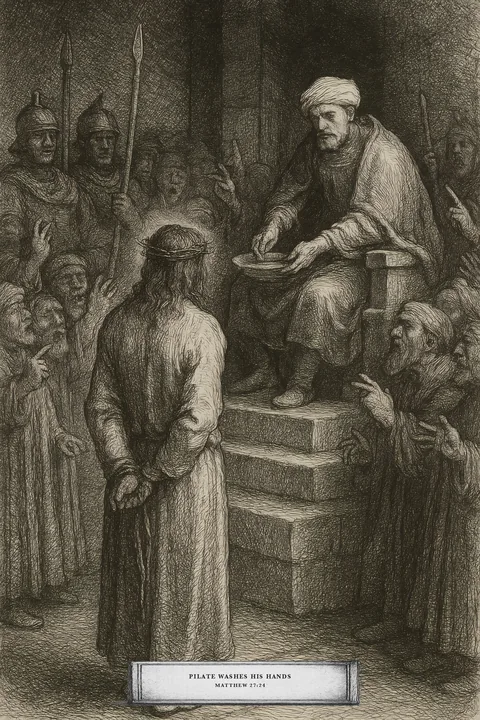
Pilate washes his hands: “I am innocent of the blood of this just person” |
The appointed storm moves the sea against the ship |
Herod, Pilate, the Gentiles, and Israel gather by God’s determined counsel |
Jonah says, “Take me up, and cast me forth” |
Jesus voluntarily lays down his life |
Jonah is cast to the sea so the ship will not perish |
One man is given to the crowd so the nation will not perish |
The Great Fish is the appointed ruler over the sea that has raged |
Caesar is the head; Rome acts through the rulers, soldiers, and turbulent peoples |
The fish receives the man surrendered by the ship |
Pilate delivers Jesus after Jerusalem declares, “We have no king but Caesar” |
The sailors fear the LORD exceedingly and sacrifice |
The centurion fears greatly: “Truly this was the Son of God” |
In his prayer Jonah recalls the red reeds wrapped about his head |
On His descent to death Jesus wears the bloody crown of thorns |
Jonah’s lot marks the man surrendered to the sea |
Soldiers cast lots for Jesus’ garments |
Three days and three nights in the fish |
Three days and three nights in the heart of the earth |
Jonah’s prayer ends, “Salvation (yeshuah) is of the LORD” |
His name is JESUS (Yeshua): “for he shall save his people” |
Jonah cast up alive onto dry land |
Jesus rises alive from the tomb |
The command comes again: “Arise, go to Nineveh”; Jonah obeys |
The risen Jesus sends the gospel to the nations |
Jonah angry that the great city is spared |
Israel “filled with envy” as the gentiles receive mercy |
The Plain Reading of Jesus' Burial
In approaching the burial of Jesus through a plain reading of the Scriptures, we set aside any preconceived notions about calendars, day lengths, or external pressures like impending holy days. Instead, we let the narrative unfold as it is written, focusing on the sequence of events described in the Gospels. The accounts in Matthew 27:57–60, Mark 15:42–47, Luke 23:50–56, and John 19:38–42 present a deliberate, honorable process carried out by Joseph of Arimathea and Nicodemus, with the women from Galilee observing. This is not portrayed as a frantic scramble but as a fitting burial for the Messiah, aligned with first-century Jewish customs of dignity and care for the dead.
The story begins with Jesus' death at the ninth hour. Shortly after, Joseph—a respected member of the council and a secret disciple—approaches Pilate to request the body. Pilate, surprised that death has already occurred, summons the centurion for confirmation before granting permission. Joseph then takes the body down from the cross. Nicodemus joins him, bringing a substantial mixture of myrrh and aloes, about seventy-five pounds in weight, which was a quantity fit for a royal entombment, echoing the honors given to kings like Asa in 2 Chronicles 16:14.
From there, they prepare the body according to Jewish burial customs. This would involve first washing the body to cleanse it of blood, sweat, and dirt from the crucifixion— a respectful act to restore dignity. Next comes the anointing: the myrrh (a resinous, aromatic substance) and aloes (fragrant wood powder) are mixed and applied, likely by pouring or sprinkling them into the folds of linen strips as the body is wrapped, creating a protective and fragrant shroud. This wrapping forms a cocoon-like enclosure, securing the spices within to honor the deceased and combat natural odors. Finally, the prepared body is laid in a new tomb hewn from rock, in a nearby garden—a serene and private location chosen for its convenience and suitability.
The women who had followed from Galilee watch the entire process, noting how the body is laid. After this, they return home to prepare their own spices and ointments, intending to complete or supplement the anointing later.
Logical Timeline for a Proper Burial
Without any assumptions about time constraints from hypothetical calendars, the plain sequence suggests a process unfolding over several hours, allowing for the care and reverence implied in the texts. Historical Jewish sources, such as descriptions in Josephus (Antiquities 15.3.3 on honorable burials) and the Mishnah (Semahot 8:1–7 on wrapping and anointing), indicate that a dignified burial for someone of status could reasonably take 4–8 hours or more from start to finish, depending on the number of helpers and the thoroughness of each step. With Joseph and Nicodemus working together—possibly with assistance from servants or others—the timeline might look like this, based solely on the narrative flow:
| Step | Description from Scripture | Estimated Duration for Proper Execution |
|---|---|---|
Request and Confirmation |
Joseph asks Pilate; Pilate confirms death with centurion |
1–2 hours (including travel and discussion). |
Removal from Cross |
Body is taken down. |
30–60 minutes (careful handling of wounds and limbs). |
Transport to Tomb |
Body carried to the nearby garden tomb |
15–30 minutes (short distance, but respectful transport). |
Washing and Anointing |
Body cleansed and spices applied |
1–3 hours (thorough mixing, layering in linens for full coverage with 75 pounds). |
Wrapping and Placement |
Linen shroud applied; body laid in tomb |
30–60 minutes (securing wrappings, sealing entrance). |
This adds up to a total of approximately 5–8 hours from the moment of death, allowing the preparation to be done with the respect due to the Son of God. The women’s observation and subsequent preparation of additional spices suggest they had time to return home afterward, further indicating no undue rush in the primary burial.
Supporting Evidence from the Shroud of Turin
One artifact that aligns with this plain reading is the Shroud of Turin, which bears the image of a crucified man consistent with first-century Jewish burial practices. Forensic analysis shows blood flow patterns and body positioning that indicate the body was wrapped shortly after death, with a mixture of myrrh and aloes (detected via pollen and chemical residues) layered in the linen, supporting a thorough, multi-hour preparation process rather than a minimal one. The absence of decomposition signs on the shroud further corroborates a timeline where the body was entombed promptly but properly, without extended exposure.
In this plain reading, the burial emerges as a profound act of devotion, unfolding naturally over the hours following death. It sets the stage for the women’s return with their spices, the Sabbath rest, and the eventual discovery of the empty tomb on the first day of the week, all without needing to impose external timelines or restrictions. This approach honors the text as it stands, revealing a Messiah buried with the dignity He deserved.
The Old Testament prophecy that the Messiah’s body would not undergo decay is found in Psalm 16:10, which is explicitly applied to Jesus in the New Testament. Here are the key verses:
For you will not abandon my soul to Sheol, or let your holy one see corruption.
Therefore he says also in another psalm, 'You will not let your Holy One see corruption.' For David, after he had served the purpose of God in his own generation, fell asleep and was laid with his fathers and saw corruption, but he whom God raised up did not see corruption.
He foresaw and spoke about the resurrection of the Christ, that he was not abandoned to Hades, nor did his flesh see corruption.
ESV
Because you will not abandon my soul to Hades, or let your Holy One see corruption.
These passages emphasize that, unlike ordinary humans (such as David), the Messiah’s body would not experience the natural process of decomposition, fulfilling a divine promise of resurrection without corruption.
A Rushed Burial Would Be Problematic
A rushed burial, as might occur under severe time constraints (e.g., minimal cleansing, hasty wrapping, or insufficient spices), would pose significant issues in the context of first-century Jewish practices and the prophecy of no decay. Jewish customs, as reflected in sources like the Mishnah (Semahot 8:1–7), emphasized thorough preparation to honor the deceased and mitigate the rapid onset of decomposition in a hot climate like Judea (where decay could begin within hours post-death, with rigor mortis setting in 3–4 hours and odors soon after). A hurried process might involve skipping steps like full washing or adequate anointing, leaving the body more exposed to environmental factors and accelerating natural breakdown. This could imply "corruption" (pit in Hebrew, diaphthora in Greek, meaning decay or putrefaction), directly contradicting the prophecy that the Holy One’s flesh would see none. The Gospels portray the burial as complete and honorable, not abbreviated, underscoring divine fulfillment: any implication of haste leading to decay would undermine the miraculous nature of the resurrection, where Jesus' body rose incorruptible, as a sign of victory over death.
Kingly Accommodations Throughout His Life and Burial
From birth to burial, Jesus was provided with accommodations befitting a king, symbolizing His divine royalty and fulfilling prophecies of the Messiah as the King of Israel. At His birth, the Magi presented gold (a royal treasure), frankincense (used in priestly incense, signifying divinity), and myrrh (a perfume for anointing and burial, foreshadowing His death)—gifts reserved for monarchs (Matthew 2:11). During His ministry, Mary anointed His feet with costly perfume (a pound of pure nard, worth a year’s wages), wiping them with her hair, which Jesus defended as preparation for His burial (John 12:3–7; Mark 14:3–9). This act echoed royal anointings, like those of kings in the Old Testament (e.g., 1 Samuel 10:1).
His burial continued this pattern: Nicodemus brought seventy-five pounds of myrrh and aloes—a lavish, kingly quantity akin to royal entombments (John 19:39–40; compare 2 Chronicles 16:14 for Asa’s spice-filled burial). The body was wrapped in fine linen (Mark 15:46), and laid in a new, rock-hewn tomb owned by the wealthy Joseph of Arimathea (Matthew 27:57–60), fulfilling Isaiah 53:9: "And they made his grave with the wicked and with a rich man in his death." Even in death, these provisions—far exceeding standard burials—affirmed His kingship, contrasting the humility of His life with the eternal honor of His resurrection.
All of these considerations fit seamlessly with the prior evidence of a first light start of day presented in the chapter “When Does the Day Start?”, but require significant compromises and time compressions to work with the traditional calendar and sunset start of day.
The Apparent Women and Spices Paradox
The Gospels describe the actions of the women who followed Jesus from Galilee—Mary Magdalene, Mary the mother of James, Salome, Joanna, and others—in relation to the spices and ointments for His burial. Two passages seem at first to conflict:
They saw the tomb and how His body was laid. Then they returned and prepared spices and ointments. And on the Sabbath they rested according to the commandment.
When the Sabbath was past, Mary Magdalene, Mary the mother of James, and Salome bought spices, so that they might come and anoint Him.
At first glance, Luke says the women prepared spices before resting on the Sabbath, while Mark says they bought spices after the Sabbath. Critics sometimes claim this requires two Sabbaths (a high day followed by a weekly one) with a workday in between, implying a longer timeline than Friday crucifixion to Sunday resurrection. However, the paradox disappears when we read the accounts plainly as complementary rather than contradictory. The women did not do everything in a single moment; they performed two related but separate actions at different times.
Resolution Under Sunrise-Start Day (No Haste Required)
In the sunrise-start day framework (day begins at dawn, as argued elsewhere with resurrection evidence from pre-dawn tomb visit to post-sunset upper room), the timeline provides generous room for deliberate, reverent actions without any imposed rush. The Sabbath begins Saturday morning (~6 AM), giving the women the full evening and night of Friday after the burial to work.
Friday Afternoon/Evening/Night (After Burial): Jesus dies at the ninth hour (~3 PM). Joseph and Nicodemus complete the initial burial with 75 pounds of myrrh and aloes (John 19:39–40). The women observe how the body is laid (Luke 23:55; Mark 15:47). They then return home and prepare whatever spices and ointments they already have on hand (Luke 23:56a). With no sunset deadline, this preparation can take several hours into the night—mixing, grinding, measuring—done thoughtfully and without pressure.
Saturday Morning to Sunday Morning (Sabbath Rest): They rest fully during the Sabbath day, from Saturday dawn to Sunday dawn, honoring the commandment (Luke 23:56b; Exodus 20:8–11).
Saturday Evening/Night (After Sabbath Ends): Once the Sabbath concludes at Sunday dawn (or practically in the preceding evening as the day transitions), the women go out and buy additional spices (Mark 16:1)—perhaps fresher supplies, more quantity, or specific types to supplement what Joseph and Nicodemus used. They then proceed to the tomb very early Sunday, while it is still dark or at sunrise (John 20:1; Mark 16:2; Luke 24:1), discovering the empty tomb.
This sequence is natural and unforced: “prepared” refers to using what they had Friday night, “bought” refers to acquiring more Saturday evening/night. No contradiction exists; the actions are sequential and complementary, driven by devotion.
Resolution Under Traditional Sunset-Start Day
Even under the conventional sunset-to-sunset calendar, the paradox resolves without needing two Sabbaths or extra days:
Friday Afternoon/Evening (Before Sunset): After burial, the women return home before sunset and quickly prepare whatever spices they already possess (Luke 23:56a).
Saturday (Full Sabbath Rest): They rest from sunset Friday to sunset Saturday (Luke 23:56b).
Saturday Evening (After Sunset): Markets reopen post-Sabbath; the women buy additional spices (Mark 16:1) and head to the tomb at dawn Sunday.
Again, “prepared” (Luke) is Friday evening with available items; “bought” (Mark) is Saturday evening. The accounts harmonize as two phases of the same intent.
In both frameworks, the women and spices accounts fit a Friday crucifixion to Sunday resurrection without strain. There is no need to stretch the timeline to Wednesday or Thursday to create artificial gaps. This is especially true if you accept the conclusion that the Sabbath is only during daylight hours and not inclusive of the night. The plain reading shows devoted women acting in stages—preparing immediately after burial, resting on the Sabbath, buying more afterward, and arriving early Sunday—perfectly consistent with the repeated “third day” statements (Luke 24:21, 46; Acts 10:40; 1 Corinthians 15:4) and the fulfillment of First Fruits on the 16th.
This resolution upholds the integrity of all four Gospels, honors the women’s faithfulness, and reinforces that the burial itself was complete and kingly, while the women sought to add their own loving touch. No contradiction remains when the texts are allowed to speak plainly.
Issues with Traditional Resolutions
In the Wednesday crucifixion theory, death occurs Wednesday afternoon (14th Nisan), followed by high Sabbath Thursday (15th, Unleavened Bread), a supposed "workday" Friday, weekly Sabbath Saturday, and resurrection Sunday (or late Saturday). Proponents use the Friday "gap" to explain the women’s spices: they prepare/buy on Friday (resolving Luke 23:56’s pre-Sabbath prep and Mark 16:1’s post-Sabbath buy), resting on the two Sabbaths.
| Issue | Wednesday | Thursday |
|---|---|---|
"Third Day" Verses |
Wednesday → Sunday = 5 days inclusive (violates all 12 verses) |
Thursday → Sunday = 4 days inclusive (contradicts the 12 verses) |
Burial Time |
~3 hours to sunset; 75 lb spices + washing + wrapping require 4–6 hrs → overruns high Sabbath |
~3 hours to sunset; same prep needs 4–6 hrs → overruns high Sabbath |
Women’s Spices |
They let the hastily prepared body decay without going on the work day between the sabbaths. |
High Sabbath + weekly Sabbath = back-to-back rests → no gap for buying/preparing while body decays rapidly |
Decay Risk |
72–96 hrs → almost certain decomposition (contradicts no-decay prophecy) |
60–72 hrs → high risk of decay (contradicts incorruptibility) |
Sabbath Logistics |
Assumes high Sabbath, prep day, weekly Sabbath → contradicts single Preparation Day |
Two consecutive Sabbaths with no intervening day |
First Fruits Alignment |
Sunday = 17th or 18th (misses fixed 16th per Josephus) |
Sunday = 17th (misses 16th) |
Sign of Jonah |
Forces grave literalism; ignores Jerusalem as "heart of the earth" and 26 parallels |
Same literalism; extended grave time strains inclusive idiom |
But the free Friday raises a glaring internal contradiction: If Friday was a full workday with no rest restrictions, why didn’t the women visit the tomb that day to anoint the body? The Gospels show their devotion—they observed the burial (Luke 23:55; Mark 15:47), prepared spices immediately after, and went at dawn Sunday despite risks. A free Friday would logically prompt an earlier visit, especially with decay concerns in Judea’s heat (decomposition starts ~24–48 hours post-death, per ancient views like John 11:39’s four-day "stink").
Summary
Passion Week is a living demonstration of the true calendar, and its natural reading demands a calendar based on either “Friday” or a “Lunar Sabbath,” with a first-light start to the day. This causes major contradictions once you realize how this interacts with the broader calendar debate.
Using the dark-moon calendar (like the one Jews use today) and the standard start of the year, there is simply no year that is compatible. You must adopt a delayed start of the year in 30 or 33 AD to keep this calendar.
Cross with Dark Conjunction Start of Month
On the dark-conjunction reckoning, here are the first days of the first two months for every candidate year:
| Year | Month 1 Date | Month 1 Day | Month 2 Date | Month 2 Day |
|---|---|---|---|---|
28 AD |
Mar 29 |
Monday |
Apr 27 |
Tuesday |
29 AD |
Apr 17 |
Sunday |
May 16 |
Monday |
30 AD |
Apr 6 |
Thursday |
May 5 |
Friday |
31 AD |
Mar 26 |
Monday |
Apr 24 |
Tuesday |
32 AD |
Apr 13 |
Sunday |
May 12 |
Monday |
33 AD |
Apr 2 |
Thursday |
May 1 |
Friday |
This, in turn, forces one into a first-visible-crescent start of the month and a calendar that allows the month to begin well before the equinox. If you use a viable start of year rule for the crescent calendar then 33 AD has Passover on Saturday in 30 and 33 AD. Meanwhile, the “blood moon” and other celestial events people point to in 33 AD also fail to line up.
I hope you can start to see the problem: to arrive at a Friday Passover, people must take one of two roads whole.
| One road | The other road | |
|---|---|---|
The month begins |
on the Dark Moon |
on a visible sliver moon |
The year begins |
after the equinox, rather than the traditional rule |
before the equinox, contrary to the barley requirements |
Either way most people are currently holding logically inconsistent beliefs about calendar rules.