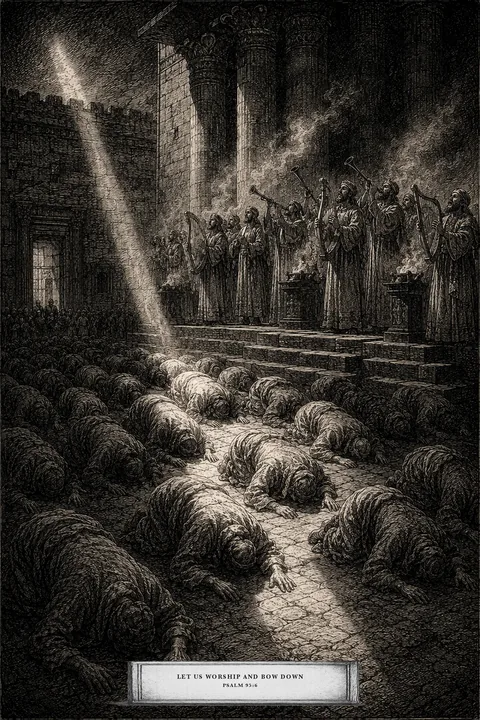
O come, let us worship and bow down: let us kneel before the LORD our maker.
— Psalm 95:6
Worship
Say the word “worship” today and a music set answers: songs before the sermon, a genre on the radio, a team on a stage. The word has been compressed to one of its accompaniments — and a reader who carries “sing songs in church” into Scripture will misread every command that hangs on the word, up to the last angel’s cry: “worship him that made heaven, and earth, and the sea” (Revelation 14:7).
The word falls in nearly two hundred verses. Gather them, and the first thing Scripture does is separate worship from singing — inside single scenes, in parallel columns, the tools this book has used from the beginning.
Watch Hezekiah’s temple service hold three acts apart in one verse:
And all the congregation worshipped, and the singers sang, and the trumpeters sounded: and all this continued until the burnt offering was finished.
The congregation worshipped, and the singers sang: two different acts, performed by different people at the same moment. Two verses later the acts meet in one body, and the wording shows which is which: “they sang praises with gladness, and they bowed their heads and worshipped” (2 Chronicles 29:30). Jehoshaphat’s assembly divides the same way:
And Jehoshaphat bowed his head with his face to the ground: and all Judah and the inhabitants of Jerusalem fell before the LORD, worshipping the LORD. And the Levites… stood up to praise the LORD God of Israel with a loud voice on high.
Worship falls down; praise stands up. Singing is a fine companion to worship — the psalms command it — but Scripture never confuses the two, because the worship-word has a body in it.
The Hebrew word is shachah: to bow oneself down, to prostrate. The King James renders the very same word “worship” toward God, “bow down” at Sinai, and “did obeisance” toward men: Abraham bows himself to the children of Heth (Genesis 23:7), Absalom bows to the ground before the king (2 Samuel 14:33), and Mordecai refuses it to Haman — “Mordecai bowed not, nor did him reverence” (Esther 3:2). The word itself is simply homage: the body bent before a superior, the subject before his king. What makes it the worship of God is not a change of word; it is the One it bends to.
The Greek says the same thing with a different gesture. Proskuneō, the New Testament’s worship-word, is built from “toward” and “kiss”: the subject’s kiss toward his king. And the homage-kiss is no Greek invention — Scripture’s Hebrew knows it well:
Kiss the Son, lest he be angry, and ye perish from the way, when his wrath is kindled but a little. Blessed are all they that put their trust in him.
The seven thousand faithful in Elijah’s day are counted by the same gesture withheld: “all the knees which have not bowed unto Baal, and every mouth which hath not kissed him” (1 Kings 19:18). Apostate Israel says of its idols, “Let the men that sacrifice kiss the calves” (Hosea 13:2). And Job, clearing himself of the oldest idolatry, describes sun-worship as exactly this: “If I beheld the sun when it shined… or my mouth hath kissed my hand: this also were an iniquity… for I should have denied the God that is above” (Job 31:26-28).
Knee and mouth, bow and kiss: worship is the body’s declaration of allegiance. That is why it can be demanded, refused, and died for — none of which makes sense of a song.
Now consider the first time the word appears in the Bible, because Scripture’s first use of a word is a teacher. It is Abraham speaking, on the third day, with the wood on his son’s shoulders:
And Abraham said unto his young men, Abide ye here with the ass; and I and the lad will go yonder and worship, and come again to you.
The first worship in Scripture is a man walking up a mountain to obey the costliest command he was ever given. No instrument, no assembly, no song — obedience with everything on the altar is what Abraham calls worship, and Scripture agrees with him: “to obey is better than sacrifice” (1 Samuel 15:22).
From the bow, Scripture builds worship’s fixed pair. Hear the second commandment — for the commandment about false worship uses the worship-word itself:
Thou shalt not bow down thyself to them, nor serve them: for I the LORD thy God am a jealous God…
“Bow down” is shachah — the word rendered “worship” everywhere else — and it never travels alone: bow down, and serve. The pair holds wherever worship is tested. The three Hebrews in Babylon: “we will not serve thy gods, nor worship the golden image” (Daniel 3:18). Paul on the pagan world: they “worshipped and served the creature more than the Creator” (Romans 1:25).
“Creature” is the Greek ktisis — the made thing, anything at all that is not the Maker — and Paul’s inventory two verses earlier is Moses’ own idolatry catalog, item for item: the image “like to corruptible man, and to birds, and fourfooted beasts, and creeping things” (Romans 1:23; Deuteronomy 4:16-18), a list Moses runs on to “the sun, and the moon, and the stars” (Deuteronomy 4:19). The made thing men serve takes a fixed political shape in the Bible’s symbolic language: the beast, a kingdom of men — a different Greek word, but the same structure, for a kingdom is as much a made thing as a carved one — so that creature-worship comes to its head exactly where this chapter is going: “all the world… worshipped the beast” (Revelation 13:3-4), and the everlasting gospel answers by naming God by the one act no creature shares: “worship him that made.”
When Satan asked Jesus for a single prostration — “All these things will I give thee, if thou wilt fall down and worship me” (Matthew 4:9) — the answer welds the pair together forever:
…for it is written, Thou shalt worship the Lord thy God, and him only shalt thou serve.
The bow is the posture; the service is the life that proves the posture told the truth. This is why Paul can define the whole worship of a Christian without mentioning an assembly at all:
I beseech you therefore, brethren, by the mercies of God, that ye present your bodies a living sacrifice, holy, acceptable unto God, which is your reasonable service.
One prostration confesses a master; the rest of the week serves him. Satan understood the arithmetic — he asked for the bow because the service follows it.
Now look closely at what Jesus quoted, because there is a discovery in it. “It is written,” He said — in Deuteronomy, where the verse reads:
Moses wrote “fear”; Jesus rendered it “worship.” The Lord Himself treats the two words as one thing — and the rest of Scripture backs His translation in parallel columns: “him shall ye fear, and him shall ye worship, and to him shall ye do sacrifice” (2 Kings 17:36); “O worship the LORD in the beauty of holiness: fear before him, all the earth” (Psalm 96:9); “Who shall not fear thee, O Lord?… all nations shall come and worship before thee” (Revelation 15:4). Worship is the fear of the LORD made visible — and what the fear of the LORD is, the next chapter will establish as the root under every symbol in this book. Hold the equation; we will need it in a moment at the end of the age.
The equation also exposes the counterfeit, for Jesus named a worship that counts for nothing:
But in vain they do worship me, teaching for doctrines the commandments of men.
He is quoting Isaiah — and in Isaiah, the word behind “worship” is “fear”: “their fear toward me is taught by the precept of men” (Isaiah 29:13). There is the definition of vain worship, by the same fear-worship equation: homage redefined by human precept — worship of the true God, on terms He never gave.
It is worth sitting with the irony: a generation that compressed “worship” into a form of its own devising is described by the very verse. The lips draw near, the heart is far, and the terms are ours. God does not weigh worship by its sincerity but by whose commandments shape it.
His terms include His calendar. Throughout Scripture, worship is a thing men “go up” to do at appointed times: Elkanah “went up out of his city yearly to worship and to sacrifice unto the LORD of hosts in Shiloh” (1 Samuel 1:3); the firstfruits are set down before the altar, “and worship” (Deuteronomy 26:10); Greeks “came up to worship at the feast” (John 12:20); and the Ethiopian eunuch “had come to Jerusalem for to worship” (Acts 8:27). Paul then says he “went up to Jerusalem for to worship” (Acts 24:11), and defines the act for the governor: “so worship I the God of my fathers, believing all things which are written in the law and in the prophets” (Acts 24:14). Ask Paul what his worship is, and he answers with the law believed — which, in the Bible’s symbolic language, means the law obeyed.
The prophets set worship on the appointed days to the end of days:
And it shall come to pass, that from one new moon to another, and from one sabbath to another, shall all flesh come to worship before me, saith the LORD.
The surviving nations go up “to worship the King, the LORD of hosts, and to keep the feast of tabernacles” — and the family that will not go up gets no rain (Zechariah 14:16-17). Worship, in Scripture’s grammar, is kept — like a feast, like a commandment — at His times, in His presence, on His terms.
Now the last angel’s cry can be read with every word weighed. In the middle of heaven flies the messenger with the everlasting gospel — the scene the Gospel chapter left with us — and this is the whole proclamation:
Fear and worship, the pair Jesus welded, side by side one last time. And listen to how the One to be worshipped is identified — “him that made heaven, and earth, and the sea” — for Scripture has exactly one commandment that grounds itself in that formula:
For in six days the LORD made heaven and earth, the sea, and all that in them is, and rested the seventh day: wherefore the LORD blessed the sabbath day, and hallowed it.
The everlasting gospel’s call to worship echoes the sabbath commandment’s own ground clause. The angel is not inventing a new religion at the end of the age; he is pointing every nation back to the Maker’s memorial — the appointed day that marks who made whom.
The Hebrew text of Revelation reads the verse the same direction: “Fear YHWH and make your prayer to him… and make prayer to the one who created the heavens and the earth and the sea and the wells.”[1] Where the Greek says worship, the Hebrew witness says prayer made to Him — homage addressed to a person; in neither language is the angel calling the nations to a song service.
The reason the angel must cry it is that a rival is collecting bows. The chapter before is the Bible’s last worship crisis: “they worshipped the dragon… and they worshipped the beast” (Revelation 13:4), and the image of the beast causes “that as many as would not worship the image of the beast should be killed” (Revelation 13:15) — Babylon’s furnace again, the bow-or-burn test of Daniel 3, staged for the whole earth. The final division of mankind is drawn at exactly the word this age thinks means singing: everyone bows and serves — the only question, as with the shadow, is whose.
Scripture guards the direction of the bow so jealously that when John — John, at the end of the visions — falls at the feet of the angel who showed them, he is refused on the spot:
See thou do it not: for I am thy fellowservant, and of thy brethren the prophets, and of them which keep the sayings of this book: worship God.
The compressed word unfolds, and every sense of it lines up behind one meaning. Worship is homage in the body and allegiance in the life: to bow to God and to serve Him only — the fear of the LORD acted out, at His appointed times, on His terms and not ours. Singing can carry it; it cannot replace it. Its counterfeit is worship shaped by the commandments of men; its rival is the beast who wants the bow; and its final proclamation calls every nation to the Maker of heaven, and earth, and the sea.
One thread remains, the one Jesus tied worship to when He answered Satan from Deuteronomy — the fear of the LORD. That is the last symbol these doctrine studies must define.