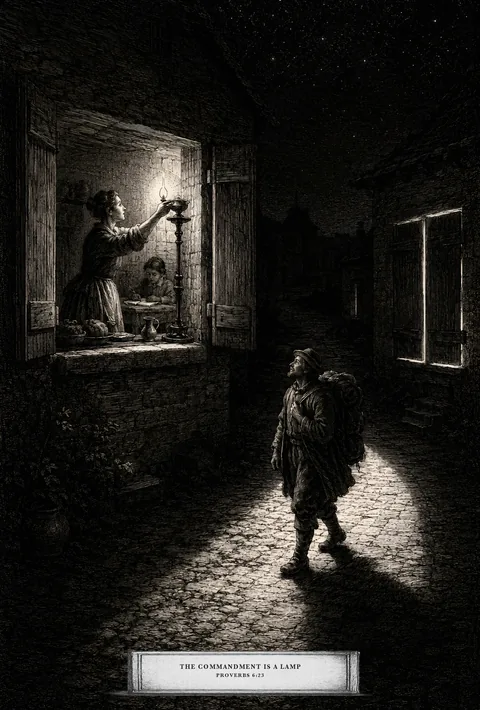
For the commandment is a lamp; and the law is light; and reproofs of instruction are the way of life.
— Proverbs 6:23
Light and Darkness, Day and Night
The lamp needs oil to burn, and the burning oil makes light. What, in Scripture, is that light? Not a feeling, not a mood, not a vague glow of truth. The word says it plainly:
For the commandment is a lamp; and the law is light; and reproofs of instruction are the way of life…
The law is light. The word lit the path before David’s feet — “Thy word is a lamp unto my feet, and a light unto my path” (Psalm 119:105) — and the prophet set the law as the very test of whether a man has any light in him at all:
To the law and to the testimony: if they speak not according to this word, it is because there is no light in them.
Let Your Light Shine
Light, then, is the law lived — and lived where it can be seen:
Ye are the light of the world… Let your light so shine before men, that they may see your good works, and glorify your Father which is in heaven.
Light is not kept in the head; it is “good works” that men can see. That is why a hidden lamp is no lamp at all — “neither do men light a candle, and put it under a bushel” (Matthew 5:15). The oil of tried obedience burns up into visible conduct. Light is righteousness done in the open.
Isaiah prices it in deeds:
And if thou draw out thy soul to the hungry, and satisfy the afflicted soul; then shall thy light rise in obscurity, and thy darkness be as the noonday…
Feed the hungry, and light comes up like dawn. And the LORD Himself is source and sum: “The LORD is my light and my salvation” (Psalm 27:1) — light and yeshuah in one breath.
Why Men Love the Dark
Which tells you at once what darkness is — not ignorance, but concealment. The Hebrew choshek comes from a root meaning to hide, and Jesus names the motive:
…men loved darkness rather than light, because their deeds were evil. For every one that doeth evil hateth the light, neither cometh to the light, lest his deeds should be reproved.
Men do not love the dark because they cannot see; they love it because it hides what they are doing. So “God is light, and in him is no darkness at all” — nothing hidden in Him — and to “walk in darkness” while claiming fellowship is simply to lie (1 John 1:5-6). The two ways run opposite: “the path of the just is as the shining light”; “the way of the wicked is as darkness: they know not at what they stumble” (Proverbs 4:18-19).
There is also a counterfeit light, and Isaiah marks it:
Behold, all ye that kindle a fire, that compass yourselves about with sparks: walk in the light of your fire, and in the sparks that ye have kindled. This shall ye have of mine hand; ye shall lie down in sorrow.
A man can refuse God’s light and still not love the dark — he lights his own: his own teaching, his own righteousness, the fig-leaf lamp. Sparks of your own kindling are to the light what the fig-leaf apron of Genesis 3:7 was to the garment — a covering of your own making.
Day and Night
The division has a clock, set on the first day:
…and God divided the light from the darkness. And God called the light Day, and the darkness he called Night.
Light and darkness are the day and the night. So the day is the time to walk and work in the light, and the night the time of hiding and sleep. “I must work the works of him that sent me, while it is day: the night cometh, when no man can work” (John 9:4); “walk while ye have the light, lest darkness come upon you” (John 12:35). The day is when deeds are seen and tested; the night is when men hide, sleep, and stumble — “if a man walk in the night, he stumbleth, because there is no light in him” (John 11:10).
The division was once drawn on a map, in the ninth plague:
…and there was a thick darkness in all the land of Egypt three days: They saw not one another, neither rose any from his place for three days: but all the children of Israel had light in their dwellings.
Two houses under one sky: the covenant home lit, the lawless land dark — the whole symbol staged as history.
The believer is told which he belongs to:
Ye are all the children of light, and the children of the day: we are not of the night, nor of darkness. Therefore let us not sleep, as do others; but let us watch and be sober.
To be a child of light is to be a child of the day — and over against them stand the children of the night: “they that sleep sleep in the night; and they that be drunken are drunken in the night” (1 Thessalonians 5:7), doing their deeds in the dark. Two households divide all men. The day asks its own posture — stay awake, stay sober, keep working — “the night is far spent, the day is at hand: let us therefore cast off the works of darkness, and… put on the armour of light” (Romans 13:12). The children of the night sleep on and are overtaken; the children of the day watch, and are ready when the morning breaks.
Outer Darkness
The end of the man who keeps to the dark is told in a scene already seen — the guest with no wedding garment:
…Bind him hand and foot… and cast him into outer darkness; there shall be weeping and gnashing of teeth.
There the symbols meet. The man had no garment — no righteous acts; the foolish virgins had no oil — no tried obedience, and so no light; and each is put out of the lit feast into the outer dark. No garment, no oil, no light: one condition under three figures.
The division is old, and it is final. God “divided the light from the darkness” on the first day (Genesis 1:4), and He divides them on the last. To walk in the light is not to feel illumined; it is to keep His commandments where every eye can see — and to have nothing left that needs the dark. What Scripture calls that open allegiance — a word our age has shrunk to a style of music — is the next chapter.