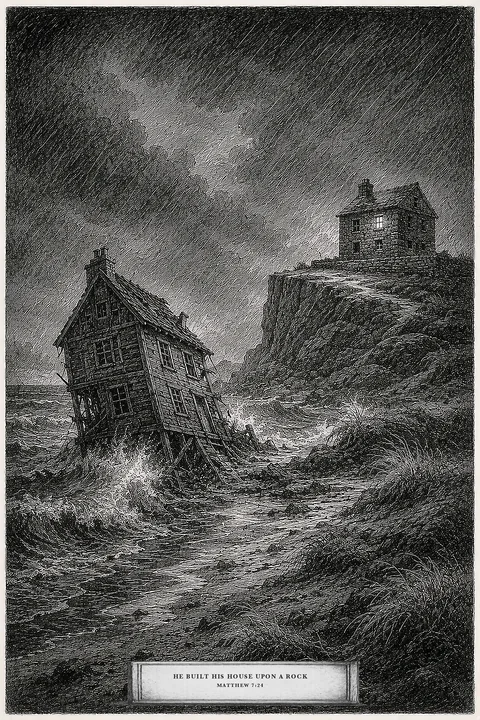
Whosoever heareth these sayings of mine, and doeth them, I will liken him unto a wise man, which built his house upon a rock.
— Matthew 7:24
The Fool and the Wise
A single word can put a man “in danger of hell fire”:
…whosoever shall say, Thou fool, shall be in danger of hell fire.
If calling someone a fool is that grave, the word is worth knowing — and it has drifted far from its meaning in Scripture. To us a fool is someone slow or silly. In the Bible a fool is something else entirely, and it has nothing to do with intelligence.
Hearing and Doing
The fool is marked first by what he says in his heart:
The fool hath said in his heart, There is no God. They are corrupt, they have done abominable works…
Not “there is no God” as a theory, but as a way of living — as though no one were watching and nothing were owed. From there the rest follows: “fools despise wisdom and instruction” (Proverbs 1:7); “the way of a fool is right in his own eyes” (Proverbs 12:15) — his own eyes again, his own measure of right. And the Lord Himself draws the line — not between those who hear and those who don’t, but between two men who hear the very same words:
Both hear. One does, one does not. That is the whole difference between the wise and the fool. Wisdom, then, is not cleverness but obedience: “a good understanding have all they that do his commandments” (Psalm 111:10); “keep therefore and do them; for this is your wisdom” (Deuteronomy 4:6). The fool is not the dull man; he is the disobedient one, however clever.
The Ten Virgins
With that definition in place, the parable of the ten virgins opens, for it is built of symbols already defined. Begin with who the virgins are — and who they are not. The Hebrew Matthew reads the parable’s first line: the kingdom of heaven is like ten virgins who took their lamps and went out to meet the bridegroom and the bride.[1] The virgins are not the bride; they go out to meet her. Scripture painted the scene long before, in the royal wedding psalm:
She shall be brought unto the king in raiment of needlework: the virgins her companions that follow her shall be brought unto thee. With gladness and rejoicing shall they be brought: they shall enter into the king’s palace.
The virgins are the bride’s espoused company, following her in — each one “espoused… as a chaste virgin” (2 Corinthians 11:2). And in the law, a virgin can already belong to a husband. “Lament like a virgin girded with sackcloth for the husband of her youth” (Joel 1:8) — espoused, the wedding still ahead, and yet the law already counts her his wife (Deuteronomy 22:23-24). Virginity in this language is covenant standing — espoused to one and gone after no other — not a grade earned.
The number is not decoration. When the LORD tore the kingdom from Solomon’s son, the prophet Ahijah rent a new garment and counted the pieces: “Take thee ten pieces… I will give ten tribes to thee” (1 Kings 11:31) — and it is that ten-tribe house, put away for her adultery and promised home again, whom the prophets insist on calling “the virgin of Israel” (Amos 5:2; Jeremiah 31:4). “Turn again, O virgin of Israel” (Jeremiah 31:21) stands in the very chapter that announces the renewed covenant (Jeremiah 31:31): the wife lawfully freed by her Husband’s death is espoused afresh — as though a maiden. And the kingdom of heaven is likened to ten virgins.
All ten therefore stand in one covenant standing. None is a harlot; all are espoused, all carry lamps, all wait for one Bridegroom — and still five are shut out. What divides them is not their purity as a literal virgin in the modern sense, but their store:
They that were foolish took their lamps, and took no oil with them: But the wise took oil in their vessels with their lamps.
The Hebrew Matthew names the two natures outright: five were lazy fools, and five diligent and wise — laziness is precisely the fool’s disease, hearing without rising to do. They are not careless about a detail; they are foolish women — the nature comes first, the empty lamp only reveals it. When the cry comes at midnight, their own mouths pronounce the verdict — “our lamps are put out”: in the Hebrew, nid’akhu, the verb Scripture keeps for one lamp only — “the lamp of the wicked shall be put out” (Proverbs 13:9; 24:20). They are virgins by standing, not by deed — just as the house of Israel kept the name “virgin” through all her wanderings — and their own confession files them with the wicked: the fool was never the defiled woman; he is the hearer who does not do. They beg the wise for oil, are refused, and are sent off to buy it — and while they are gone, the door is shut.
One verse decodes the scene: “the commandment is a lamp; and the law is light” (Proverbs 6:23). The lamp is the commandment — and all ten carry it, just as both builders heard the very same sayings. The light is the law lived, as the next chapter will show.[2] Between the lamp and the light stands the oil: burn it, and the commandment in hand becomes a life that shines; lack it, and the lamp holds the commandment still, but gives no light.
Read the whole verse, for it does not stop at the lamp and the light: “the commandment is a lamp; and the law is light; and reproofs of instruction are the way of life” (Proverbs 6:23). The Psalms name that reproof oil: “let the righteous smite me; it shall be a kindness: and let him reprove me; it shall be an excellent oil” (Psalm 141:5). Lamp, light, and oil are not three metaphors gathered from three unrelated places. Proverbs sets the commandment, the law, and corrective instruction in one sentence; the Psalm supplies the oil-word for the correction that turns the hearer toward the way of life.
What Is the Oil?
Everything turns on the oil, so everything turns on knowing what it is. The common readings rank this way:
| Rank | Common interpretation |
|---|---|
1 |
The Holy Spirit |
2 |
Saving faith |
3 |
Grace |
4 |
Good works |
5 |
Readiness |
6 |
The word, or a relationship with Christ |
The leading answer is the Holy Spirit — and the parable refuses it. The first reading brings the wrong oil to the lamp. Exodus lists “oil for the light” and “spices for anointing oil” as separate provisions (Exodus 25:6): the first is pure beaten olive oil for burning (Exodus 27:20), while the second is compounded with 4 spices and restricted to the sanctuary, its vessels, and its priests (Exodus 30:22-33). The virgins carry lamp oil; no one in the parable is anointed. Verses joining royal or priestly anointing to the Spirit therefore do not define the symbol in their vessels: they concern the oil of appointment, not oil for light. The short study The Anointing defines that difference in full.
Proverbs has already staged the parable’s inventory:
There is treasure to be desired and oil in the dwelling of the wise; but a foolish man spendeth it up.
Wise and foolish, oil stored and oil exhausted — Matthew carries the same 3 terms into the virgins' vessels.
The mechanics refuse the Spirit reading too. The Spirit can be received through the laying on of hands (Acts 8:17), but the same scene condemns Simon for treating that gift as something purchasable: Peter and John are ministers of God’s gift, not sellers drawing down a private reserve (Acts 8:18-20). The wise refuse because dividing their oil may leave too little for either company; the Spirit is not a finite, zero-sum quantity that leaves one believer short when another receives Him, and God gave Him to Christ “not by measure” (John 3:34). The Spirit fell on Cornelius’s house “while Peter yet spake” (Acts 10:44): the gift can arrive in a moment. What cannot be produced in a moment is a life already lived, its obedience stored and proven before the midnight cry.
The wise send the foolish to “buy” oil (Matthew 25:9); but the Spirit is a gift that cannot be bought — “Thy money perish with thee, because thou hast thought that the gift of God may be purchased with money” (Acts 8:20). Nor can it be grace or faith, gifts freely given, for this oil must be gathered beforehand, kept in one’s own vessel, and cannot be lent to another.
The parable’s word is exact, for Scripture commands just such a purchase:
Buy the truth, and sell it not; also wisdom, and instruction, and understanding.
These are not four loose virtues; each is a symbol Scripture fixes to one thing — the law kept. The truth is the law itself — “thy law is the truth” (Psalm 119:142); wisdom and understanding are the doing of it (Psalm 111:10) — “the fear of the Lord, that is wisdom; and to depart from evil is understanding” (Job 28:28); and instruction is its discipline, which only fools despise (Proverbs 1:7). To buy the truth, then, is to buy and keep the law.
Scripture also tells us what the commandment carries: “all thy commandments are truth” and “all thy commandments are righteousness” (Psalm 119:151, 172); “his commandment is life everlasting” (John 12:50). Yet carrying the commandment outwardly is not the same as carrying its truth within. John names the foolish condition exactly: “He that saith, I know him, and keepeth not his commandments, is a liar, and the truth is not in him” (1 John 2:4). The commandment can be heard and professed while its truth is not in the man. The wise do the opposite: “lay up my commandments with thee… write them upon the table of thine heart” (Proverbs 7:1-3); “Thy word have I hid in mine heart, that I might not sin against thee” (Psalm 119:11). The renewed covenant makes the same inward store its first promise: “I will put my law in their inward parts, and write it in their hearts” (Jeremiah 31:33).
Now the vessels are visible. All ten hold the lamp of the commandment; only the wise have received its truth and correction inwardly, where it can govern the life and burn as obedience.
The price is never silver — “buy… without money and without price” (Isaiah 55:1) — but a listening, obeying ear: “hearken diligently unto me, and eat ye that which is good… Incline your ear, and come unto me: hear, and your soul shall live; and I will make an everlasting covenant with you” (Isaiah 55:2-3). What it costs is a whole life of hearing and doing; what it buys is the covenant itself, and life; and what is so bought is never sold, never passed to another hand.
Proverbs confirms the same substance without a parable, moving from open rebuke and the faithful wounds of a friend to oil, perfume, and “hearty counsel” (Proverbs 27:5-9). The instruction that must be bought is the oil the wise receive and keep: truth and correction worked inward until they govern the life.
The Spirit Behind the Oil
Lamp oil is Spirit-taught truth and correction received, kept, and worked into proven obedience. It is the tested, pressed fruit of the Spirit stored inwardly; light is that obedience made visible as an example to others. God names the source of that fruit:
I will put my spirit within you, and cause you to walk in my statutes, and ye shall keep my judgments, and do them.
The Spirit is the cause; the walk and the doing are His work made manifest. Jesus says the Spirit “will guide you into all truth” (John 16:13), and Scripture has already fixed the truth as the law — “thy law is the truth” (Psalm 119:142). Paul keeps the same order: “it is God which worketh in you both to will and to do of his good pleasure” (Philippians 2:13). Galatians calls the result “the fruit of the Spirit” (Galatians 5:22): not the Spirit Himself, but what His life brings forth in a person.
Zechariah’s oil-fed lampstand does not reverse the order. The word to Zerubbabel is “Not by might, nor by power, but by my spirit” because the work in view is the temple his hands will finish (Zechariah 4:6-9). When Zechariah asks what the olive branches are, the angel calls them “the two anointed ones” (Zechariah 4:11-14); he never says, “the oil is the Spirit.” The Spirit is the power by which God’s appointed servants complete the work, while the flowing oil is the supply by which the lamp gives light.
This is the oil: Spirit-taught truth bought and kept, correction received, and the tried doing of both stored in one’s own vessel. The oil is obedience formed inwardly; the light is that obedience burning where others can see it and glorify the Father (Matthew 5:16). The foolish, sent to buy it at the last hour, find the door already shut.
The wise virgin has sat for her portrait before: “She perceiveth that her merchandise is good: her candle goeth not out by night” (Proverbs 31:18) — the buying done in time, the lamp still burning through the night watch: the very two marks the parable joins. The Pearls of Wisdom chapter will name her.
Scripture says what oil is. It is the pressed fruit of the olive — “pure oil olive beaten for the light, to cause the lamp to burn always” (Exodus 27:20) — and the olive tree is Israel, the covenant people: “The LORD called thy name, A green olive tree” (Jeremiah 11:16). Oil is fruit crushed and tested until it yields; it is the Spirit’s work ripened into obedience, proven under pressure and stored up over a life. Burned, it is what turns the lamp to light — the commandment held becomes the law lived, obedience made visible, the symbol of the next chapter.
The foolish had the lamp — the profession, the commandment in hand — but no oil, no store of works; so when the test came, there was no light. And no one can lend it: your neighbor’s obedience will not burn for you.
The place where the Lord Himself was pressed even bears the name: Gethsemane, the oil press. And it sits on the Mount of Olives (Luke 22:39) — by these symbols the mount of the olive nation: Israel itself. On the olive-nation’s own hill stood the press, and there the Lord was crushed under the weight of death — His sweat “as it were great drops of blood” (Luke 22:44) — and gave up the oil of a perfect obedience: “not my will, but thine, be done” (Luke 22:42).
The foolish are turned away with the worst words in Scripture: “I know you not” (Matthew 25:12) — the same verdict as “I never knew you” spoken over those who worked lawlessness.
The foolish virgins were not undone by a forgotten errand; they were foolish from the first — hearers who never became doers, lamps that never held oil. And the wise were wise the way the wise man built on rock: they heard, and they did, and when the Bridegroom came their light was burning. Between the fool and the wise there is finally one question — the question this whole book keeps asking: not what you heard, but whether you did it.