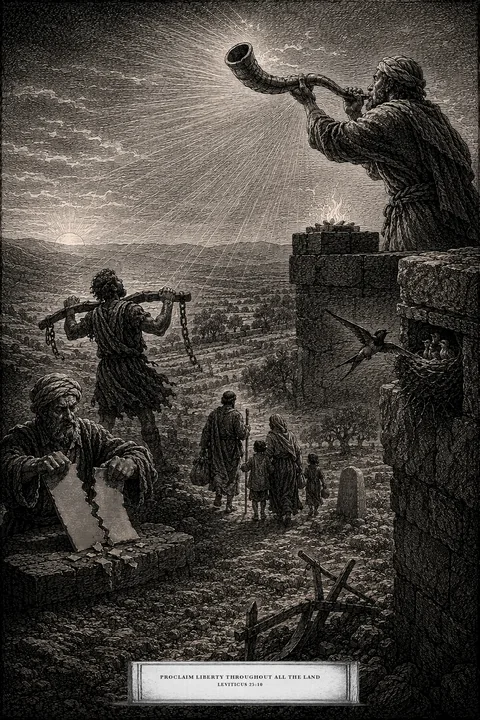
Proclaim liberty throughout all the land unto all the inhabitants thereof.
— Leviticus 25:10
Liberty
The words on the Liberty Bell are Scripture: “Proclaim LIBERTY throughout all the land unto all the inhabitants thereof” (Leviticus 25:10). Ask the modern reader what liberty means, and he will answer with the bell, not the verse: freedom from rule — no king, no master, no one telling me what to do. Carry that meaning back into the Bible and every verse about liberty bends out of shape. So we do what this book has done from the first chapter: put down the assumed meaning, gather every use, and let Scripture define its own word.
The gathering is short work, because the Hebrew word rendered “liberty” appears only seven times — and every one of them belongs to the same institution. Here is the verse the bell quotes, restored to its sentence:
And ye shall hallow the fiftieth year, and proclaim liberty throughout all the land unto all the inhabitants thereof: it shall be a jubile unto you; and ye shall return every man unto his possession, and ye shall return every man unto his family.
Liberty in Scripture is the jubilee: the fiftieth year, decreed by the King, when debts are cancelled, slaves go free, and every man walks home to his inheritance and his family. Ezekiel calls it simply “the year of liberty” (Ezekiel 46:17). And the jubilee is the crown of a rhythm the law keeps beating: every seventh year is a release — debts let go, the Hebrew servant sent out free (Deuteronomy 15:1-2; Exodus 21:2) — seven sevens of years, and then the trumpet of the fiftieth.
Notice what kind of thing this liberty is. It is not the absence of law; it is a command of the law. It does not happen when rule breaks down; it happens on a set day, at the King’s proclamation, precisely because His rule stands. Pressure, profit, or persuasion may move a slaveholder; Scripture’s liberty is of another order: a decree from above him that sends the captive home. Scripture’s liberty is a release proclaimed by a King.
The prophets carry the word forward to the Anointed:
The Spirit of the Lord GOD is upon me; because the LORD hath anointed me to preach good tidings unto the meek; he hath sent me to bind up the brokenhearted, to proclaim liberty to the captives, and the opening of the prison to them that are bound;
— “to proclaim the acceptable year of the LORD” (Isaiah 61:2): the year of release — the same seventh-year release, so named by the law itself (Deuteronomy 31:10). And this is the passage Jesus stood up and read in the synagogue at Nazareth, closing the book with “this day is this scripture fulfilled in your ears” (Luke 4:21) — a release year, for He proclaimed the release in the year the law appoints it. The gospel chapter found that the gospel is the proclamation of the kingdom; here is the same announcement from the other side: the gospel is a release proclaimed — the King’s decree of liberty to His captive people.
Before asking who the captives are, look once more at the word itself, because Scripture has hidden a picture in it. The same Hebrew word rendered “liberty” — Strong’s counts them as one word — also names a bird: the swallow.
Yea, the sparrow hath found an house, and the swallow a nest for herself, where she may lay her young, even thine altars, O LORD of hosts, my King, and my God.
The swallow is the liberty-bird — free in exactly the way our age imagines freedom, answering to no fence and no field, “the swallow by flying” (Proverbs 26:2). And where does Scripture set the free bird’s nest? At the altars of God. Liberty, given a body and wings, flies home to the altar and raises her young there. The picture and the law teach one lesson: the jubilee does not release a man into the open sky; it returns him “unto his possession… unto his family” — home, to the household of God.
Now, who holds the captives? The Judeans put our own objection to Jesus — we are free men already:
“Never in bondage to any man” — spoken by men standing in a Roman province, whose fathers served in Egypt and Babylon; self-sufficiency talks exactly like Laodicea. Jesus does not argue the history; He names the deeper slaver. The master is sin, and every man who commits it is its servant — well-fed, unshackled, and owned.
Against that master no constitution helps; the release comes the only way jubilee ever comes, by the word of the King’s Son: “If the Son therefore shall make you free, ye shall be free indeed” (John 8:36). And the instrument of release is stated in the same breath: the truth[1] — which Scripture defines as God’s law — is what makes free. The law is not the chain; the law is the writ of release.
Here the symbol turns against the modern meaning hardest, so let the law itself say it. When God brought Israel out of the house of bondage, He did not release them to autonomy:
For unto me the children of Israel are servants; they are my servants whom I brought forth out of the land of Egypt: I am the LORD your God.
This is the jubilee chapter speaking — the liberty chapter of the Torah — and its ground for freeing every Hebrew slave is that they already have a Master: “they are my servants… they shall not be sold as bondmen” (Leviticus 25:42). The demand carried to Pharaoh says the same: “Let my people go, that they may serve me” (Exodus 8:1).
Liberty in Scripture is a change of masters, never the absence of one. Paul writes it as an equation: “Being then made free from sin, ye became the servants of righteousness” (Romans 6:18) — and again, “being made free from sin, and become servants to God, ye have your fruit unto holiness, and the end everlasting life” (Romans 6:22). Peter joins the two words that our age holds apart: “As free… but as the servants of God” (1 Peter 2:16).
There is no third condition. “To whom ye yield yourselves servants to obey, his servants ye are” (Romans 6:16): every man serves; the proclamation decides whom.
The free man’s charter, then, is a law — and James calls it exactly that:
But whoso looketh into the perfect law of liberty, and continueth therein, he being not a forgetful hearer, but a doer of the work, this man shall be blessed in his deed.
“The perfect law of liberty” — to modern ears a contradiction, to Scripture a plain description: the law that contains the jubilee, frees the slave, and returns every man to his inheritance is liberty’s own constitution, and we will be “judged by the law of liberty” (James 2:12). This is why Paul can command men to “stand fast therefore in the liberty wherewith Christ hath made us free” (Galatians 5:1) — liberty is a standing, kept by continuing in the charter, exactly as Jesus said: “if ye continue in my word… ye shall know the truth, and the truth shall make you free” (John 8:31-32). “Where the Spirit of the Lord is, there is liberty” (2 Corinthians 3:17), and the whole creation waits to be delivered “into the glorious liberty of the children of God” (Romans 8:21) — the cosmic jubilee, when everything held captive walks home.
The law even paints the freed man’s highest choice. A Hebrew servant goes free in the seventh year — but the law provides for one who will not go:
And if the servant shall plainly say, I love my master, my wife, and my children; I will not go out free: Then his master shall bring him unto the judges; he shall also bring him to the door, or unto the door post; and his master shall bore his ear through with an aul; and he shall serve him for ever.
Offered the open sky, the servant chooses the house — for love, which Scripture defines as keeping the master’s commandments — and the choice is sealed in a revealing place and manner: his ear, at the door post. The ear is the organ of hearing, and in Hebrew hearing is obeying — one verb, shama, stands under both English words: “if ye will obey my voice” (Exodus 19:5) and “Hear, O Israel” (Deuteronomy 6:4) are the same command, and Samuel sets that verb above the altar itself: “to obey is better than sacrifice, and to hearken than the fat of rams” (1 Samuel 15:22). The door post is where the word is written — “thou shalt write them upon the posts of thy house” (Deuteronomy 6:9), the same posts the Way chapter found inscribed with the word and marked with the blood. So the willing servant has his hearing fastened forever to the post that carries the commandments: obedience pinned to the word, at the entrance of the house he refused to leave.
David sings the Servant who made that choice, and uses the law’s own verb:
Sacrifice and offering thou didst not desire; mine ears hast thou opened: burnt offering and sin offering hast thou not required. Then said I, Lo, I come: in the volume of the book it is written of me, I delight to do thy will, O my God: yea, thy law is within my heart.
The Hebrew under “opened” is karah, Strong’s “to dig… to bore”: ears bored for him, the willing bond-servant’s mark. Isaiah’s Servant answers in kind: “The Lord GOD hath opened mine ear, and I was not rebellious” (Isaiah 50:5). Here is the swallow nesting at the altar, enacted in flesh. And Jesus set the two figures side by side in the same breath as His teaching on freedom: “the servant abideth not in the house for ever: but the Son abideth ever” (John 8:35) — the Son is the one who stays in the Father’s house by nature, and the freed slave who loves his Master stays by choice.
In the Bible’s symbolic language, many symbols come paired with a counterfeit, and liberty’s is the one our age lives in. Peter describes teachers who sell the modern meaning:
While they promise them liberty, they themselves are the servants of corruption: for of whom a man is overcome, of the same is he brought in bondage.
Liberty as license — “liberty for an occasion to the flesh” (Galatians 5:13), “liberty for a cloke of maliciousness” (1 Peter 2:16) — is not liberty misused; it is the old master’s brand under a new name, for “whosoever committeth sin is the servant of sin.” The offer of freedom from God’s rule is the serpent’s original sales pitch, and it has never once delivered: the man who escapes the law of liberty does not walk free, he walks back into the slaver’s house.
God takes the proclamation seriously enough to punish its betrayal in kind. In the last days of Jerusalem, king Zedekiah proclaimed a liberty — the word is the jubilee word — and every man freed his Hebrew slaves; then the princes turned and dragged their freed brothers back into bondage (Jeremiah 34:8-16), polluting the covenant they had cut in the house called by God’s name. Hear the sentence:
Therefore thus saith the LORD; Ye have not hearkened unto me, in proclaiming liberty, every one to his brother, and every man to his neighbour: behold, I proclaim a liberty for you, saith the LORD, to the sword, to the pestilence, and to the famine; and I will make you to be removed into all the kingdoms of the earth.
The symmetry is exact and terrible: deny the release, and God proclaims your liberty — to the sword. The man who will not free his brother is himself released from God’s protection, and the shadow departs from him.
The symbol stands defined, and Scripture defined every part of it. Liberty is the King’s jubilee release: out of the slaver’s house — sin, Egypt, Babylon — and home to the household, inheritance, and service of God. Its home is the altar, where the liberty-bird nests; its constitution is the perfect law of liberty; its counterfeit is autonomy, the promised freedom that Scripture calls a return to bondage.
“Let my people go, that they may serve me”: the release and the service are one decree. And whether a man, once freed, will hear and serve is the whole difference between the fool and the wise — the next chapter.