They shall keep the way of the LORD, to do justice and judgment.
— Genesis 18:19
Justice and Judgment
“Judgment” lands on the modern ear as a threat. It is the gavel, the sentence, the Day — a word for condemnation, so that “do not judge” has become, for many, the only commandment left standing. “Justice” fares no better: an abstraction, argued about, marched for, never quite located.
Scripture does something with these words that neither sense allows. It commands them — as deeds: “to do justice and judgment” (Genesis 18:19), “execute judgment” (Jeremiah 22:3), “keep ye judgment” (Isaiah 56:1). You cannot do a condemnation or keep an abstraction. The word “judgment” falls in over four hundred verses; gather them, and both words come back from Scripture defined — and joined.
Start with “justice,” and with a wobble in the English of the kind the shadow chapter taught us to treat as a signpost. Set these two commands side by side:
For I know him, that he will command his children and his household after him, and they shall keep the way of the LORD, to do justice and judgment…
Thus saith the LORD; Execute ye judgment and righteousness, and deliver the spoiled out of the hand of the oppressor: and do no wrong, do no violence to the stranger, the fatherless, nor the widow…
“Justice and judgment”; “judgment and righteousness.” In the Hebrew these are the same two words — the word rendered “justice” in Abraham’s verse is the word rendered “righteousness” in Jeremiah’s. The Psalter says the same sentence twice, once under each rendering: “Justice and judgment are the habitation of thy throne” (Psalm 89:14) and “righteousness and judgment are the habitation of his throne” (Psalm 97:2). And Isaiah puts both renderings in a single verse: “Keep ye judgment, and do justice: for my salvation is near to come, and my righteousness to be revealed” (Isaiah 56:1).
The first word resolves at once, because Scripture has already defined righteousness out of its own mouth: “it shall be our righteousness, if we observe to do all these commandments” (Deuteronomy 6:25); “all thy commandments are righteousness” (Psalm 119:172). Justice is righteousness under a second English name — not an abstraction to be argued about but the commandments done, toward God and toward one’s neighbor. That is why justice can be commanded, learned, and performed.
Now “judgment” — Hebrew mishpat — and watch what company it keeps. Moses uses it for the law itself:
And what nation is there so great, that hath statutes and judgments so righteous as all this law, which I set before you this day?
The statutes and judgments are taught “for to do them” (Deuteronomy 4:1). The longest psalm prays the word over and over as a name for God’s own word: “the judgments of thy mouth” (Psalm 119:13); “every one of thy righteous judgments endureth for ever” (Psalm 119:160) — sworn to and kept like any commandment (Psalm 119:106).
A judgment, in Scripture, is not the gavel falling; it is the ruling — what the law declares to be due. That is why judgment can be “kept”: to keep judgment is to render what God’s rulings say is owed. It is also why the loss of judgment is described as a failure of law, not a failure of courts: “the law is slacked, and judgment doth never go forth” (Habakkuk 1:4). Judgment goes forth from the law the way a verdict goes forth from a statute.
Owed to whom? Scripture answers with a list we have met before:
Thus speaketh the LORD of hosts, saying, Execute true judgment, and shew mercy and compassions every man to his brother: And oppress not the widow, nor the fatherless, the stranger, nor the poor…
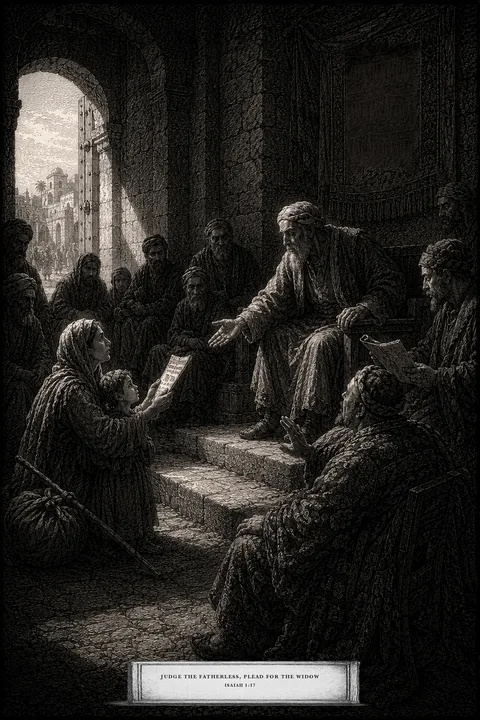
Execute true judgment — and immediately, the four names of the gleaning corner. This is judgment’s home address in Scripture. God “doth execute the judgment of the fatherless and widow” (Deuteronomy 10:18); Israel is told to “seek judgment, relieve the oppressed, judge the fatherless, plead for the widow” (Isaiah 1:17); and the indictment of the princes is exactly its absence — “they judge not the fatherless, neither doth the cause of the widow come unto them” (Isaiah 1:23), “the right of the needy do they not judge” (Jeremiah 5:28) — where “right” is mishpat again: the needy man’s judgment is his due, the portion God’s law rules to be his.
Job wore it: “I put on righteousness, and it clothed me: my judgment was as a robe and a diadem” — and then the inventory of what the garment was made of: “I delivered the poor that cried, and the fatherless… I was eyes to the blind, and feet was I to the lame… a father to the poor: and the cause which I knew not I searched out” (Job 29:12-16). And God sets the crown on this meaning with a definition this book could not improve upon:
…did not thy father eat and drink, and do judgment and justice, and then it was well with him? He judged the cause of the poor and needy; then it was well with him: was not this to know me? saith the LORD.
To do judgment for the poor is to know God — and knowing, in the Bible’s symbolic language, is covenant relationship proven by obedience. The man who renders the weak their due is not merely imitating God’s character; he is inside it.
Ezekiel writes the whole equation out as a case study, and adds a third English rendering to our pair:
But if a man be just, and do that which is lawful and right, …and hath not oppressed any, but hath restored to the debtor his pledge… hath given his bread to the hungry, and hath covered the naked with a garment; He that hath not given forth upon usury… hath executed true judgment between man and man, Hath walked in my statutes, and hath kept my judgments, to deal truly; he is just, he shall surely live, saith the Lord GOD.
“Lawful and right” is — once more — the same Hebrew pair: mishpat and tsedaqah, judgment and justice, rendered now a third way. Three English costumes, one Hebrew command; and Ezekiel’s inventory shows what the command looks like on a weekday: the pledge restored, the hungry fed, the naked covered, no usury taken, honest rulings between man and man — the statutes walked in, the judgments kept. “He is just, he shall surely live.”
Jesus reads the word exactly this way. His sharpest woe against the Pharisees hangs on it:
Woe unto you, scribes and Pharisees, hypocrites! for ye pay tithe of mint and anise and cummin, and have omitted the weightier matters of the law, judgment, mercy, and faith: these ought ye to have done, and not to leave the other undone.
Judgment is a matter of the law — one of its weightiest — and it is a thing left undone, not a doctrine left unbelieved.
Isaiah had said the Messiah would come for precisely this, in parallel columns that seal the word’s meaning: “he shall bring forth judgment to the Gentiles… till he have set judgment in the earth: and the isles shall wait for his law” (Isaiah 42:1-4) — judgment answered by law, line upon line — and Matthew quotes the passage of Jesus (Matthew 12:18-20). The Branch of David “shall execute judgment and justice in the earth” (Jeremiah 23:5); His throne is established “with judgment and with justice from henceforth even for ever” (Isaiah 9:7); thrones in Scripture stand on nothing else, for “justice and judgment are the habitation of thy throne” (Psalm 89:14). Solomon was given his kingdom for this stated purpose — “therefore made he thee king, to do judgment and justice” (1 Kings 10:9) — and David held it the same way: he “executed judgment and justice unto all his people” (2 Samuel 8:15). A king who will not render the law’s due is not a flawed ruler; he is a throne with the habitation missing.
English has drifted on this word in one more direction, and testing it recovers a whole office. To the modern ear a judge only sentences; in Scripture, to judge is to rule. The book of Judges is not a book of magistrates: “the LORD raised up judges, which delivered them out of the hand of those that spoiled them” (Judges 2:16) — Othniel “judged Israel, and went out to war” (Judges 3:10), and Nehemiah calls the whole line “saviours, who saved them” (Nehemiah 9:27).
When Israel demanded a monarchy, they defined the word for us: “make us a king to judge us… that our king may judge us, and go out before us, and fight our battles” (1 Samuel 8:5, 20). Isaiah stacks the offices into a single confession: “the LORD is our judge, the LORD is our lawgiver, the LORD is our king; he will save us” (Isaiah 33:22). To judge is to govern by the law — to guide, defend, and set right — which is why Moses could describe a day of judging as a day of teaching: “I judge between one and another, and I do make them know the statutes of God, and his laws” (Exodus 18:16).
Because judging is ruling, God describes covenant-making itself in judgment-language. Hear Him promise a second Exodus:
And I will bring you into the wilderness of the people, and there will I plead with you face to face. Like as I pleaded with your fathers in the wilderness of the land of Egypt, so will I plead with you, saith the Lord GOD. And I will cause you to pass under the rod, and I will bring you into the bond of the covenant:
“Plead” is, in the Hebrew, the judge-verb itself — more literally, I will enter into judgment with you face to face — and the sentence before names what that judging is: “with a mighty hand… will I rule over you” (Ezekiel 20:33). When God entered into judgment with Israel in the wilderness, He was not condemning Israel; He was becoming her King — disputes judged rightly by His law, the flock passed under the shepherd’s rod, the people bound into the covenant. Condemnation falls only where the rule is refused: “I will purge out from among you the rebels” (Ezekiel 20:38). Judgment is the rule; condemnation is what the rule does to lawbreakers — one verdict the office renders, not the office itself.
Read with that office in view, Scripture does with this word what our English no longer permits. The righteous pray for judgment: “Judge me, O God, and plead my cause… O deliver me” (Psalm 43:1; so also 26:1; 35:24) — words no defendant says to a hanging judge, and exactly what an oppressed subject says to a good king. Creation rejoices at its approach:
Let the heavens rejoice, and let the earth be glad; let the sea roar, and the fulness thereof. Let the field be joyful, and all that is therein: then shall all the trees of the wood rejoice Before the LORD: for he cometh, for he cometh to judge the earth: he shall judge the world with righteousness, and the people with his truth.
The field is joyful because the Judge is the rightful King arriving to put the world in order. And judgment is a thing given to the saints as an inheritance: “judgment was given to the saints of the most High; and the time came that the saints possessed the kingdom” (Daniel 7:22) — thrones, in Revelation’s replay of that scene: “I saw thrones, and they sat upon them, and judgment was given unto them… and they lived and reigned with Christ” (Revelation 20:4); “ye also shall sit upon twelve thrones, judging the twelve tribes of Israel” (Matthew 19:28). To receive judgment is to be seated — given a shepherd’s share in the King’s own office.
The Day itself now comes back into focus, because the God of Scripture judges with the same word. Abraham’s question at Sodom — the first courtroom scene in the Bible — asks it plainly: “Shall not the Judge of all the earth do right?” (Genesis 18:25), where “do right” is, in the Hebrew, do mishpat: the Judge of all the earth does judgment, renders what is due, and can be argued with on exactly those terms — as Abraham then does.
Solomon ends his book on the two clauses this book keeps finding joined — fear God, and keep his commandments (Ecclesiastes 12:13) — and then: “For God shall bring every work into judgment” (Ecclesiastes 12:14).[1] The judgment men fear as an alien terror is nothing but the rulings they were handed at Sinai. At last, those rulings are applied by the Judge who wrote them: “So speak ye, and so do, as they that shall be judged by the law of liberty” (James 2:12). Judgment Day holds no surprises for the man who kept the judgments.
What God feels about all this, He states in the first person. “To do justice and judgment is more acceptable to the LORD than sacrifice” (Proverbs 21:3) — the altar itself ranks below it, as obedience ranks above sacrifice. “What doth the LORD require of thee, but to do justly, and to love mercy, and to walk humbly with thy God?” (Micah 6:8). And when God names His own works, this is it:
But let him that glorieth glory in this, that he understandeth and knoweth me, that I am the LORD which exercise lovingkindness, judgment, and righteousness, in the earth: for in these things I delight, saith the LORD.
Against that delight stands the collapse, and Isaiah paints it in the Bible’s own symbolic vocabulary: “the way of peace they know not; and there is no judgment in their goings: they have made them crooked paths” — “judgment is turned away backward, and justice standeth afar off: for truth is fallen in the street” (Isaiah 59:8, 14). Way, judgment, justice, truth — the symbols fall together, because they were never separate things: the way is walked, the truth is the law, and judgment and justice are the law rendered to one’s neighbor. A generation that calls evil good hears no answer but Malachi’s echo of its own voice: “Where is the God of judgment?” (Malachi 2:17).
The two words stand defined, and the definition was hiding in the book’s first use of them. When God says why He chose Abraham, He names the whole walk in one clause: “they shall keep the way of the LORD, to do justice and judgment” (Genesis 18:19) — the first time Scripture speaks of the way of the LORD, it defines it, as the Way chapter found, and the definition is these two words.
Judgment is the law’s ruling — what God declares due, kept like a commandment and owed first to the widow, the fatherless, the stranger, and the poor. Justice is righteousness wearing its public name — the commandments done where a neighbor can be wronged or righted. To do them is to know God; to abandon them is to slacken the law; and to be judged, at the last, is only to meet again the rulings we were given to keep — the perfect law of liberty, which is where we turn next.