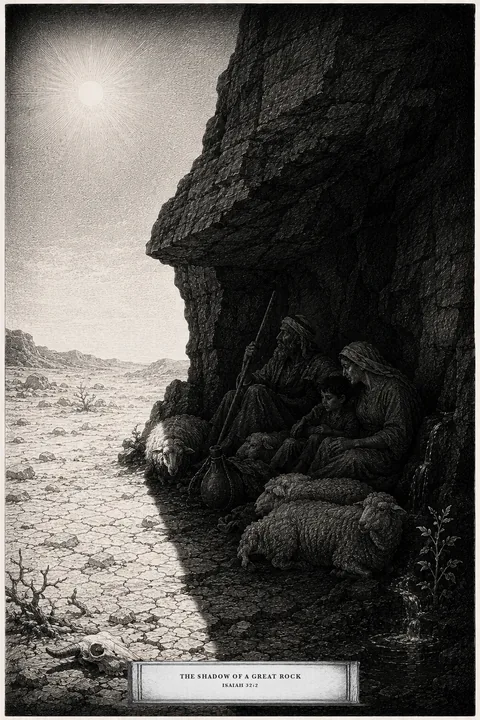
He that dwelleth in the secret place of the most High shall abide under the shadow of the Almighty.
— Psalm 91:1
Shadow
Say the word “shadow” and gloom answers — and on that gloom an entire doctrine has been built. Ask why the commandments no longer bind, and the verse quoted most in answer is a shadow verse:
The teaching runs: the sabbaths and feasts were only shadows pointing ahead to Christ; the substance has come, so the shadows are discharged — who keeps company with a shadow once the body has arrived? Every step of that reading leans on a single assumption: that a shadow is a poor and dispensable thing — gloom, a lesser copy, a something-less-than. The assumption is the reader’s, not Scripture’s.
This chapter gathers every use of the word — it falls in some eighty verses — and finds the shadow is not the danger and not the discount: the shadow is the shelter. Hold the verdict on Colossians until the evidence is in; the verse will be waiting further down this road, and by then it will read as the opposite of a discharge.
Begin where the King James itself lets the meaning slip through in plain English. When Joshua and Caleb plead with Israel not to fear the Canaanites, listen to the word they choose:
Only rebel not ye against the LORD, neither fear ye the people of the land; for they are bread for us: their defence is departed from them, and the LORD is with us: fear them not.
“Their defence” is the Hebrew tsel — their shadow. The nations’ shadow has departed, and a people stripped of its shadow stands naked to judgment. Solomon uses the same word the same way: “wisdom is a defence, and money is a defence” (Ecclesiastes 7:12) — in the Hebrew, a man shelters in the shadow of wisdom as in the shadow of money.
Twice the translators reached for “defence” because the sense demanded it: in Scripture, a shadow is a covering that protects. That is the habit to carry from this page: when the English wobbles between renderings, the wobble is a signpost — look beneath it.
The righteous live under a different shadow.
He that dwelleth in the secret place of the most High shall abide under the shadow of the Almighty.
How excellent is thy lovingkindness, O God! therefore the children of men put their trust under the shadow of thy wings.
The shadow of His wings is where David hides (Psalm 17:8), makes his refuge until calamities pass (Psalm 57:1), and rejoices (Psalm 63:7) — and those wings are the kanaph, the edge where the fringe is bound as the reminder of the commandments (Numbers 15:38-39).[1] “The LORD is thy keeper: the LORD is thy shade upon thy right hand” (Psalm 121:5) — the LORD does not merely cast a shadow; He is the shade. And Isaiah sets the definition in parallel columns — Scripture’s habit of defining a term by saying the thing twice:
Refuge answers shadow; storm answers heat. So too the shadow of a great rock (Isaiah 32:2); the tabernacle is “for a shadow in the daytime from the heat, and for a place of refuge” (Isaiah 4:6). The Servant testifies, “in the shadow of his hand hath he hid me” (Isaiah 49:2), and God answers Zion, “I have covered thee in the shadow of mine hand… Thou art my people” (Isaiah 51:16). The bride sits under her beloved’s shadow with delight (Song of Solomon 2:3). The prodigal nation comes home to it: “They that dwell under his shadow shall return; they shall revive” (Hosea 14:7). And under the anointed king’s shadow Israel shall live among the heathen (Lamentations 4:20).
Trust, hiding, delight, revival, life among the nations — that is the shadow’s company in Scripture. It is good to be in the shadow.
Shade from what? Read the refuge verses again and notice what the shadow shields from: the heat. “The LORD is thy shade… the sun shall not smite thee by day” (Psalm 121:5-6).
At full strength, the heat in Scripture is not the weather: “our God is a consuming fire” (Deuteronomy 4:24; Hebrews 12:29). Isaiah asks the question outright — “Who among us shall dwell with the devouring fire? who among us shall dwell with everlasting burnings?” — and answers it: “He that walketh righteously” (Isaiah 33:14-15). To live near God is to live near the fire, and only the covered live there.
Moses himself was shaded so: “I will put thee in a clift of the rock, and will cover thee with my hand while I pass by” (Exodus 33:22) — the shadow of God’s own hand set between a man and God’s own glory. And whose hand is that? The hand of the LORD is the hand that saves: “his right hand, and his holy arm, hath gotten him the victory” (Psalm 98:1) — where “gotten the victory” is the Hebrew yasha: His right hand works yeshuah. The hand-shadow set between a man and the glory is God’s own salvation — Yeshua — standing in the gap; it was the Servant who said, “in the shadow of his hand hath he hid me” (Isaiah 49:2).
One psalm says both halves in a single breath: “the LORD God is a sun and shield” (Psalm 84:11) — the Sun and the shield from it, the fire and the covering, in one Person. He shades us from Himself, and the shade is His Messiah.
Now the equation closes, because we already know where the covering hangs. The shadow the psalms trust is the shadow of the wings, and Psalm 91 lays the two lines side by side: “under the shadow of the Almighty… under his wings shalt thou trust” (Psalm 91:1, 4). The wings are the kanaph, the covenant corners where the tassels are bound to remind the wearer of the commandments — and it is the cherubim’s wings that shadow the mercy seat (Hebrews 9:5). Wings, shade, commands: one covering.
The commandments are not the fire; they are the shade that lets a man dwell beside it — which is why the same Sun that smites the uncovered rises “with healing in his wings” on them that fear His name (Malachi 4:2). It is good to be in the shadow, because the alternative is not the open sky; it is the open blaze.
The symbol scales up, exactly as the sea and the mountain did. A kingdom is a tree, and a tree casts shade: a kingdom’s shadow is its protection spread over peoples. When Jotham told the trees’ parable of kingship, the offer of the crown was an offer of shade:
Ezekiel draws the empire of Assyria as a cedar, and names what its shadow held:
When the cedar falls, “all the people of the earth are gone down from his shadow” (Ezekiel 31:12). Nebuchadnezzar’s tree gave the beasts of the field shadow (Daniel 4:12); God’s own planted cedar shelters “all fowl of every wing… in the shadow of the branches” (Ezekiel 17:23); and the kingdom of heaven grows into the mustard tree “so that the fowls of the air may lodge under the shadow of it” (Mark 4:32). Every kingdom is a shadow-offer; that is what a kingdom is to the people under it.
Which is why the false shadow is a snare. Judah ran from Assyria to “trust in the shadow of Egypt” — and God answered, “the trust in the shadow of Egypt” shall be “your confusion” (Isaiah 30:2-3). Israel spread her idolatry “under oaks and poplars and elms, because the shadow thereof is good” (Hosea 4:13) — even sin is shadow-hunger; the idolater is a man sheltering under the wrong tree.
Everyone lives in some shadow. The question Scripture presses is whose.
There is a Presence in this shadow, and the thread runs from the tabernacle to the gospels. When the cloud of glory settled on the finished tabernacle, the Greek Old Testament says it overshadowed it — epeskiazen (Exodus 40:35) — and that is the very verb the New Testament keeps reaching for. At the transfiguration, “a bright cloud overshadowed them” (Matthew 17:5) — brightness that shades. The sick were laid in the street “that at the least the shadow of Peter passing by might overshadow some of them” (Acts 5:15). And at the head of the gospel:
And the angel answered and said unto her, The Holy Ghost shall come upon thee, and the power of the Highest shall overshadow thee: therefore also that holy thing which shall be born of thee shall be called the Son of God.
The Son was conceived under the overshadowing — the same covering cloud that filled the tabernacle came down over a virgin in Nazareth. The shadow of God is not the absence of His light; it is the nearness of His body.
The nearness of His body is not a figure of speech; it is how shadows work, and Scripture builds a word on it. The Hebrew for the “image” of God in which man was made — tselem (Genesis 1:26) — is built on tsel, the shade-word: an image is a shadow-figure, the outline a body casts. With that in hand, return to the verse that opened this chapter:
Which are a shadow of things to come; but the body is of Christ.
The common teaching hears “mere shadow” — and discards the sabbaths and feasts the verse is speaking of, as though Paul had called them worthless. But a shadow is not detached from its body; it is attached to it. Where a shadow falls, a body stands, and a light shines behind it.
The law is “a shadow of good things to come” (Hebrews 10:1) — good things — and to keep the feast is to stand inside the outline of the Body that casts it, the way a man stands in the shadow of a great rock. A shadow does not abolish its body, and a body does not abolish its shadow: they arrive together, and the shadow is precisely where the body is found. Far from a warrant to discard, the shadow is the proof that the good things are real, near, and lit from behind by God.
The verse itself resists the discharge twice more. Its command is “let no man judge you” — protection for those keeping the holyday, the new moon, and the sabbaths, not a sentence against them; the judges were the outsiders with their “touch not; taste not” (Colossians 2:21), not the feasts. And its tense is present while its object is future: the feasts “are” — decades after the resurrection — “a shadow of things to come”: still casting, still pointing, the standing schedule of what remains. A shadow ahead of a body means the body is still approaching; the appointed times are the outline of an arrival.
Ask whose arrival, for the verse answers in its last clause: “the body is of Christ.” The shade is His Messiah. Scripture had said so long before Colossae:
The breath of our nostrils, the anointed of the LORD, was taken in their pits, of whom we said, Under his shadow we shall live among the heathen.
The Messiah’s shadow is where His people live. The bride sings the same: “I sat down under his shadow with great delight, and his fruit was sweet to my taste” (Song of Solomon 2:3); and Isaiah’s King is the shadow embodied — “a king shall reign in righteousness… and a man shall be… as the shadow of a great rock in a weary land” (Isaiah 32:1-2), the great rock this chapter has been standing beside all along. So the feasts are not a shadow instead of Christ; they are the shadow of Christ — cast by His body, falling where He stands — and the man who keeps them is standing in his Messiah’s shade.
Now even the darkest use of the word gives up its comfort. The “shadow of death” — Hebrew tsalmavet, death’s shadow — is Death’s outline and boundary, not Death itself.
Yea, though I walk through the valley of the shadow of death, I will fear no evil: for thou art with me; thy rod and thy staff they comfort me.
Through — not into. A valley is the low passage between mountains, and mountains are kingdoms: David crosses the border from Death’s kingdom of darkness toward the Shepherd’s kingdom of life (Colossians 1:13). He does not belong to Death’s rule; the Shepherd guides him across its boundary. God “turneth the shadow of death into the morning” (Amos 5:8); He “brought them out of darkness and the shadow of death, and brake their bands in sunder” (Psalm 107:14); and on the people sitting “in the region and shadow of death, light is sprung up” (Isaiah 9:2; Matthew 4:16). Wherever a shadow lies, a light is shining — the shadow of death itself testifies that the morning exists. The rest of the word’s uses fall in line: our days pass “as a shadow” (1 Chronicles 29:15; Psalm 144:4) because a shadow moves as the sun crosses — but with “the Father of lights” there “is no variableness, neither shadow of turning” (James 1:17): His shadow never moves off His people, because His light never moves.
Step back and take the lesson, because this chapter is a prime example of the whole method. A word that nearly every reader carries as gloom is, by Scripture’s own usage, shelter: the Almighty’s wings, the kingdom’s tree, the overshadowing cloud, the law’s outline of good things to come, and even death reduced to a shadow with the morning behind it. We recovered it the same way as always: gather every use, read the parallel columns, and treat the translators’ wobble — shadow here, “defence” there — as a signpost to the Hebrew underneath.
It is good to be in the shadow. The only question is whose.