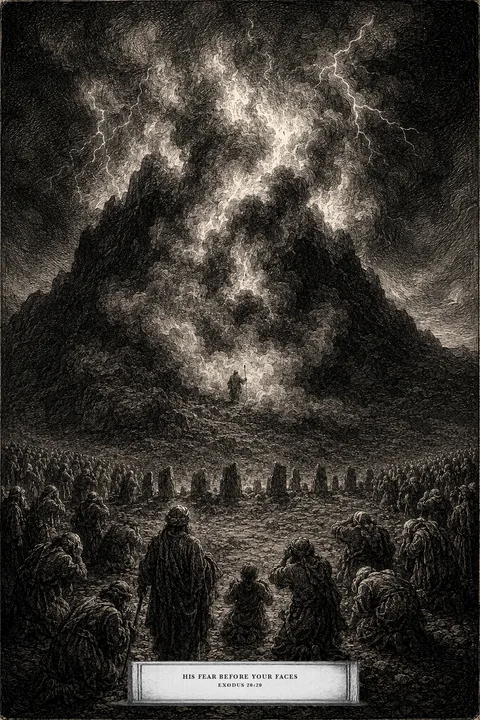
Fear God, and keep his commandments: for this is the whole duty of man.
— Ecclesiastes 12:13
The Fear of the Lord
Solomon devoted a whole book to trying every road under the sun, then ended it in one sentence:
Let us hear the conclusion of the whole matter: Fear God, and keep his commandments: for this is the whole duty of man.
This is the last symbol of Part Two because it is the root of all the rest — and, like the rest, it has been hollowed out. The fear of the LORD is taken either as raw terror or as a soft “reverence” that asks nothing of anyone. Scripture means neither. It defines the fear of God by what it does.
Not Terror, but the Root of Obedience
Moses asks the question outright, and answers it:
…what doth the LORD thy God require of thee, but to fear the LORD thy God… to keep the commandments of the LORD…
To fear God is to be moved to keep His commandments — the two are set down in one requirement; and again, “the LORD commanded us to do all these statutes, to fear the LORD our God” (Deuteronomy 6:24). It shows itself as a turning from evil: “the fear of the LORD is to hate evil” (Proverbs 8:13); “by the fear of the LORD men depart from evil” (Proverbs 16:6); “the fear of the Lord, that is wisdom; and to depart from evil is understanding” (Job 28:28). Fear is not a passing feeling about God; it produces obedience to God. Love and faith bear the same fruit, but the words are not interchangeable: fear turns from evil, love gives itself faithfully, and faith holds God’s promise; obedience makes each visible. The last chapter showed Jesus making the same equation from the other side: quoting “thou shalt fear the LORD thy God” (Deuteronomy 6:13), He rendered it “thou shalt worship the Lord thy God” (Matthew 4:10) — the fear of the LORD is the thing worship acts out.
The Beginning of Wisdom
It is also where wisdom starts:
The fear of the LORD is the beginning of wisdom: and the knowledge of the holy is understanding.
— and the wise, we saw, are those who “do his commandments” (Psalm 111:10). So the fool, who has said “There is no God,” has no fear, and therefore no wisdom, however clever he may be; he is back on the sand. Every wise man in Scripture begins here.
Fear Him
The fear is owed to One only — not to men, not to the powers that can reach the body:
…fear not them which kill the body… but rather fear him which is able to destroy both soul and body in hell.
“Sanctify the LORD of hosts himself; and let him be your fear” (Isaiah 8:13). The world fears a thousand things and not God; those who fear God need fear nothing else.
This fear is no burden — it is “clean, enduring for ever” (Psalm 19:9), a “treasure” (Isaiah 33:6), “a fountain of life” (Proverbs 14:27). It is also the doorway of everything this book has been doing:
The secret of the LORD is with them that fear him; and he will shew them his covenant.
Fear Him, and the covenant opens. And the renewed covenant writes this very fear where the law is written: “I will make an everlasting covenant with them… I will put my fear in their hearts, that they shall not depart from me” (Jeremiah 32:40).
The Fear of Man
There is a rival fear, and it wants the same seat. Fear governs obedience — what a man fears identifies the voice he is disposed to obey — so the fear of man is the exact counterfeit of the fear of God, and Scripture sets the two against each other in a single line:
The fear of man bringeth a snare: but whoso putteth his trust in the LORD shall be safe.
One is a snare, the other safety; and the snare springs by turning obedience toward the wrong voice. Where the fear of God keeps the commandments, the fear of man breaks them.
Saul lost the kingdom to it — “I have sinned… because I feared the people, and obeyed their voice” (1 Samuel 15:24): he feared them, so he obeyed them, and disobeyed God. The rulers who believed “did not confess him… for they loved the praise of men more than the praise of God” (John 12:42-43). And Paul names it a fork with no middle ground: “if I yet pleased men, I should not be the servant of Christ” (Galatians 1:10). No man serves both.
Turn it the other way and the same law delivers. The midwives “feared God, and did not as the king of Egypt commanded them” (Exodus 1:17) — the greater fear overruled the lesser, and they kept the higher command. Abraham names the vacuum from the other side: where “the fear of God is not in this place,” men “will slay” (Genesis 20:11) — take out the one fear and the other floods in. So it is the fear of God that casts the fear of man out: “The LORD is my helper, and I will not fear what man shall do unto me” (Hebrews 13:6; Psalm 118:6).
The feared man is:
I, even I, am he that comforteth you: who art thou, that thou shouldest be afraid of a man that shall die, and of the son of man which shall be made as grass…
Again: “all flesh is grass… the grass withereth… but the word of our God shall stand for ever” (Isaiah 40:6-8). To fear man is to fear grass: to break the law that stands forever for the favour of a face that withers by evening. The fear of God and the fear of man are one throne with two claimants, and every man seats one of them.
The Whole Duty
It is fitting that the last symbol of these doctrine studies should be Scripture’s first demand. When the everlasting gospel — the gospel of the kingdom, as found in the Gospel chapter — is carried to every nation at the end, it is this:
…Fear God, and give glory to him; for the hour of his judgment is come…
— and five verses on, the ones who belong to God are “they that keep the commandments of God, and the faith of Jesus” (Revelation 14:12). Fear and obedience, first to last.
The symbols come home. The kingdom is a mountain and the peoples a sea; the gospel is the renewed covenant, the law going forth from Zion; the way, the truth, and the life are that law walked; the name is the covenant owned, the garment the righteousness worn, the light the covenant made visible; the wise are those who do it, and the fools those who do not. Strip every figure back to the thing it guards, and one command stands under them all: “Fear God, and keep his commandments: for this is the whole duty of man.”
The whole duty stated is not yet the whole duty done — and every man who hears the command has already broken it. What Scripture actually asks of the lawbreaker — what saying “Lord, Lord” requires, and what it does not — is the path to salvation, and it is the next chapter.