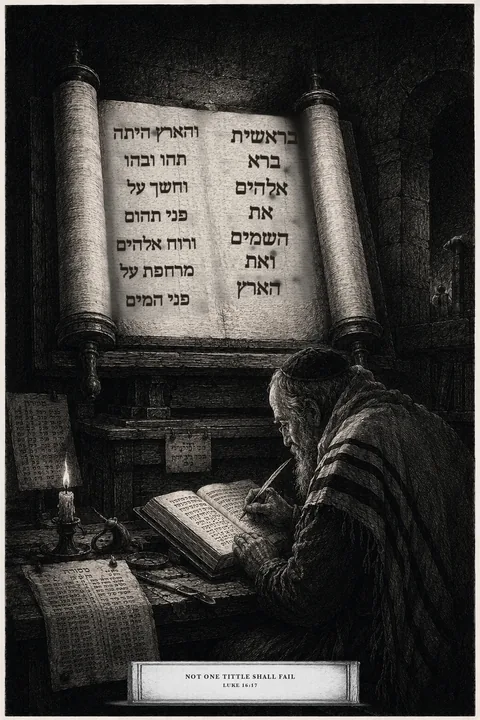
And it is easier for heaven and earth to pass, than one tittle of the law to fail.
— Luke 16:17
What Is the Point?
Walk into any synagogue on earth and ask to see the scroll. The Torah read aloud this Sabbath, like the Torah read in Jesus’ day, carries no vowels — bare consonants, letter after letter, exactly as the scribes have copied them for thousands of years. The reader supplies the vowels.
Every vowel you have ever seen printed in a Hebrew Bible was added later — the pointing system was fixed by the Masoretes of Tiberias, careful men working roughly from the seventh to the tenth century after Christ, a thousand years and more after the last prophet set down his last letter. What the prophets wrote, what the scribes counted and guarded jot by jot, was letters. What the Masoretes added was a reading — one choice of vowels for each word — written down and handed on as tradition.
The distinction is not a technicality; it is Jesus’ own.
For verily I say unto you, Till heaven and earth pass, one jot or one tittle shall in no wise pass from the law, till all be fulfilled.
The jot is the yod, the smallest letter of the alphabet; the tittle is smaller still — the little horn of a stroke that separates one letter from its look-alike.

The pledge of preservation is sworn to the letters, down to their smallest parts. It says nothing of vowel points, because when He said it there were none to swear by.
The oldest witnesses we hold read exactly the way the promise runs. The scrolls from the caves at Qumran, copied before the apostles preached, carry the bare consonants. The Greek translation of the Old Testament — the Septuagint, made two to three centuries before Christ — is something even more useful: a written record of how an older Hebrew text was understood a thousand years before the Masoretes pointed theirs. Sometimes the difference is a different reading of the same consonants; sometimes the Greek reflects a different consonantal tradition. Either way, the Greek is an elder witness that must be weighed rather than dismissed.
The apostles have already told us which court they sat in. The Introduction of this book stood on the fortieth Psalm — “I delight to do thy will” — so read two verses up, in the psalm as the Masoretic Hebrew gives it:
Sacrifice and offering thou didst not desire; mine ears hast thou opened: burnt offering and sin offering hast thou not required.
The writer of Hebrews then quotes that same verse and places it in a different mouth:
Wherefore when he cometh into the world, he saith, Sacrifice and offering thou wouldest not, but a body hast thou prepared me.
“A body hast thou prepared me” is the old Greek reading of the psalm, and it is not what the surviving Masoretic consonants say. The apostle sets it in the Messiah’s own mouth “when he cometh into the world,” and two verses later the psalm arrives at the line this book began with: “Lo, I come… to do thy will, O God” (Hebrews 10:7). The New Testament’s canon of the Old includes readings the surviving Masoretic tradition does not carry. That is not a problem to be explained away; it is a permission — the apostolic practice treats the pre-Masoretic reading as the word of God.
The Introduction already showed what hangs on this. The same three letters — חלב — are chalav, milk, or cheleb, fat, divided only by the points — and here is exactly what that means, blown up large enough to see:

The letters are the text; the bars and dots beneath them are the tradition — marks the prophets never wrote, and the choice between them decides which food the verse names. Ezekiel 34:3 convicts the shepherds either way — eating the fat in the pointed text, drinking the milk in the older Greek. One word, two pointings, and a doctrine in each.
The points must be weighed for what they are. The Masoretes were the most careful custodians a text has ever had — they counted the letters of every book, marked the middle letter of the Torah, and built a fence of numbers around the text precisely so that nothing could be added or lost. Honor them for it.
Yet custodians are not judges, and these custodians were not neutral. The vowels they fixed are the synagogue’s vowels, handed down through the very generations that had answered the Messiah question with a ban — and Scripture documents the enforcement itself:
The Jews had agreed already, that if any man did confess that he was Christ, he should be put out of the synagogue.
It worked, and on the men best placed to know better:
Nevertheless among the chief rulers also many believed on him; but because of the Pharisees they did not confess him, lest they should be put out of the synagogue: for they loved the praise of men more than the praise of God.
A reading that confessed too much could cost a man his place, his trade, and his family’s standing; the reading that survived a thousand years of that pressure is the reading of those who stayed.
Psalm 22:16 is another well-known textual problem. The KJV, NKJV, and many other standard translations read “they pierced my hands and my feet.” The Masoretic tradition reads “like a lion, my hands and my feet,” while the older Greek and a Judean Desert Hebrew witness support a verb. The details have been examined in scholarly literature for generations and need not be retried here. The example establishes the narrower point this chapter needs: the Masoretic text is an important witness, not an infallible endpoint that automatically overrules earlier Hebrew and Greek evidence.
A command stands over exactly this.
Ye shall not add unto the word which I command you, neither shall ye diminish ought from it, that ye may keep the commandments of the LORD your God which I command you.
Kept as commentary, the points add nothing — they stand beside the word, a reading of men, weighed like any reading. But elevated to Scripture itself — bound into the text and taught as though God had inspired them — they become an addition to the word in the plainest sense: a mark of man on every syllable of God’s, “Add thou not unto his words, lest he reprove thee, and thou be found a liar” (Proverbs 30:6).
The command exists “that ye may keep the commandments” — the fence against adding exists for the sake of obedience, the same stake this chapter set at its start. And His calendar sat under the same fence: the same community that fixed the vowels had long since traded the moon that is watched for a moon that is calculated — the appointed times this book reaches in the next part were guarded by the same social pressure.
This is no charge that the letters were lost; guarded by their numbers and answered by the scrolls from the desert, they held — held so well that the rare disputed letter stands exposed for weighing. It is the vowel points that are on trial. What the pointing added, by its own accounting, was a tradition of reading — and tradition is a category Scripture has already taught this book how to handle.
The Gentiles shall come unto thee from the ends of the earth, and shall say, Surely our fathers have inherited lies, vanity, and things wherein there is no profit.
Peter says the redeemed were bought out “from your vain conversation received by tradition from your fathers” (1 Peter 1:18); Jesus charges the scribes with “making the word of God of none effect through your tradition” (Mark 7:13). None of that abolishes the scribes’ text — it ranks it. The letters are the text; the pointing is the fathers’ reading of it — often right, worth hearing, and never the judge.
The ranking gives this book its rule, and it cuts both ways. A reading the letters permit may stand even against the pointing — but it earns its place the way every reading in this book earns it: every occurrence gathered, witnesses required, counter-texts weighed. The pointing and the re-reading each get a vote; neither gets a veto until the letters and the witnesses agree.
The stakes are the same stakes this book has carried from its first chapter: obedience. “Ye eat neither fat nor blood” is a standing command (Leviticus 3:17), spelled in milk’s own letters — and the pointing a man trusts decides what obedience sets on his table. A man who intends to keep the commandments exactly will want them exactly as they were written. Dig past the points to the letters; that is where the best meat is cut.
There is one more thing the letters do — something no pointing can record and no translation can carry. They rhyme in meaning. The next chapter opens that second dimension: one verse, written once, that reads two ways and is true in both.