A word fitly spoken is like apples of gold in pictures of silver.
— Proverbs 25:11
Spoken Once, Heard Twice
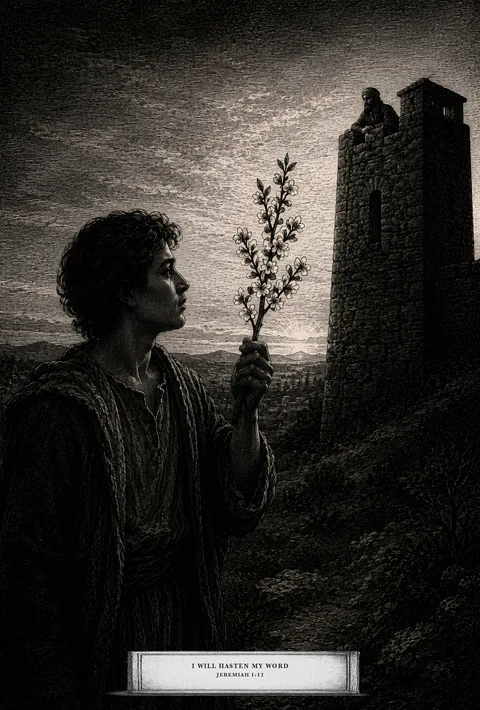
The first vision God ever gave Jeremiah — a boy protesting that he cannot speak — is a lesson in how to hear.
Moreover the word of the LORD came unto me, saying, Jeremiah, what seest thou? And I said, I see a rod of an almond tree. Then said the LORD unto me, Thou hast well seen: for I will hasten my word to perform it.
Read in English, the answer does not follow from the vision; an almond branch has nothing to do with hastening. Read in the letters, it is exact: shaqed, the almond — the tree that wakes first, blossoming while winter still holds — and shoqed, watching, wakeful, quick to act. Jeremiah sees a shaqed; God answers, I am shoqed — watching over my word to perform it. The vision means what it means because the words share their letters, and God does not leave the device to be discovered: He decodes it Himself and grades the seeing — “thou hast well seen.” The first thing the LORD teaches His new prophet is that His book plays on words.
English has puns too, and they are the quickest way to feel what is happening here. This book’s title is one such pun, built in homage to the device this chapter teaches: say it aloud, and MEAT The Bible’s Symbolic Language is also meet the Bible’s symbolic language — the food and the invitation in one sound, divided only by where the speaker pauses. No mark on the cover chooses for you: the title is printed unpointed, and the reader’s pause does for English what the vowels do for the Hebrew letters. And the word the title lands on is the book’s whole claim: what the Introduction poured as milk, these chapters serve as meat.
English wordplay is only an analogy, not the thing itself — our puns are accidents of sound that amuse, and then are done. Hebrew wordplay is built into the letters of the text itself, and it instructs: the second reading is not a joke riding on the first; it is a second witness standing beside it. David states the principle as plainly as it can be said:
God hath spoken once; twice have I heard this: that power belongeth unto God.
Spoken once; heard twice. One text, written one time, carrying two readings — and the previous chapter showed why the letters can do this: the consonants stand fixed while the vowels move. Where both readings survive the method’s tests, both are meant, and the truth is the whole.
There is a practical reason the book of a covenant people works this way. Scrolls were costly, copying was slow, and memory was the storage medium — the parables chapter counted what that economy does to density, one deliberate reference every few words. A people who must carry the word in their heads need handles, and a word that echoes another word is a handle: the rhyme fixes the verse in the ear. But these rhymes do more than aid the ear — they rhyme in meaning, so that the memory-hook and the message are the same device.
Hear Isaiah do it in a verse this book has already stood on twice. The song of the vineyard ends its case with a double verdict:
For the vineyard of the LORD of hosts is the house of Israel, and the men of Judah his pleasant plant: and he looked for judgment, but behold oppression; for righteousness, but behold a cry.
The English shows the sense and loses the sound. He looked for mishpat and found mispach; for tsedaqah and heard tse’aqah — judgment and its crime one letter apart, righteousness and the victim’s scream nearly the same word. The verdict rhymes, and the rhyme is the indictment: what Israel produced sounded like what God asked for, and was its opposite. No hearer who caught it ever forgot it.
Or hear the proverbs warn a young man, walking the whole warning on a single pair of letters:
Can a man take fire in his bosom, and his clothes not be burned? Can one go upon hot coals, and his feet not be burned? So he that goeth in to his neighbour’s wife; whosoever toucheth her shall not be innocent.
Woman and fire — ishah and esh — share their letters, and the proverb is built on the share: take the woman into your bosom, and you have taken the fire. The same pair carries prophetic weight in Zechariah’s vision of the woman in the ephah (Zechariah 5:7-8), where the letters permit the fire-offering to sit inside the measure — the pun scales from a father’s warning to a prophet’s burden. And when the prophets write Babylon’s obituary, the pun goes to war:
Read it once, and the mighty men go soft; read the same letters again — nashim, the plural that serves ishah and esh alike — and the army is kindling. The prophets strike the match in the very next breath: “they became as women: they have burned her dwellingplaces” (Jeremiah 51:30) — and Nahum sets the two words in a single verse: “Behold, thy people in the midst of thee are women… the fire shall devour thy bars” (Nahum 3:13), nashim and esh standing side by side in the letters, each reading carried out on the same city.
The pun reaches back to the Bible’s first prophecy. In Eden, God promises the serpent war with the woman:
And I will put enmity between thee and the woman, and between thy seed and her seed; it shall bruise thy head, and thou shalt bruise his heel.
“Her seed” stands alone in the Torah, for Scripture reckons seed by the father; no genealogy runs through a mother. Read the letters again and the anomaly resolves: the seed of the ishah is the seed of the esh — the fire. And when the promise was kept, both readings met in one womb: the virgin supplied the flesh, and the seed no man fathered was conceived “of the Holy Ghost” (Matthew 1:20) — “the power of the Highest shall overshadow thee” (Luke 1:35) — the God who is “a consuming fire” (Hebrews 12:29) giving the woman the seed she could not have. Spoken once, heard twice — and both readings are the incarnation.
The woman herself is spoken once and heard at every depth. In the garden she is Eve; but Scripture will not leave her one woman. Isaiah watches the same mother travail: “before her pain came, she was delivered of a man child… for as soon as Zion travailed, she brought forth her children” (Isaiah 66:7-8) — the woman who bears the man child is Zion, the covenant people, pictured everywhere in the prophets as a woman, a bride, a mother. And John reopens the garden by name: the dragon of his vision is “that old serpent” (Revelation 12:9); the woman travails and bears the “man child, who was to rule all nations” (Revelation 12:5); and the serpent’s ancient enmity finds its stated target — “the dragon… went to make war with the remnant of her seed, which keep the commandments of God” (Revelation 12:17). Genesis 3:15 with both parties named at last: the woman is Israel, and her seed is the Messiah — and the commandment-keeping remnant with Him. Eve, Zion, the virgin, the fire: one prophecy, spoken once, and every hearing true.
This book has already leaned on the device: the Introduction read milk and fat out of one word. The wordplay binds symbol to symbol; it is the seam where the second dimension shows.
The heaviest readings in this book stand on this same ground, each with its chapter ahead. The NKJV keeps the full moon visible in Psalm 81:3; the Pearls of Wisdom chapter follows the second reading sitting in its letters (Part Four). The “son of the morning” of Isaiah 14 will give up a darker reading of the same letters (Lucifer’s declared plan, in Part Four). The “island of the innocent” that has puzzled translators in Job will resolve in the sea study (Part Six). The small examples establish the mechanism before the larger readings carry it further.
The Introduction called the symbol-web a fingerprint no forger could plant. The wordplay is the same hand pressing deeper: puns that consistently bind the same symbols — woman to fire, milk to fat — across authors separated by centuries are not a style; they are a signature, laid down in the one layer of the text that copying preserves letter for letter. The points could not record this dimension, and the translations cannot carry it. It was waiting in the letters.
So far the doubles have come one word at a time — a pair of readings caught in a single pair of letters. The next chapter opens a verse where the letters sustain the second reading from the first word to the last: an entire sentence, spoken once and heard twice.