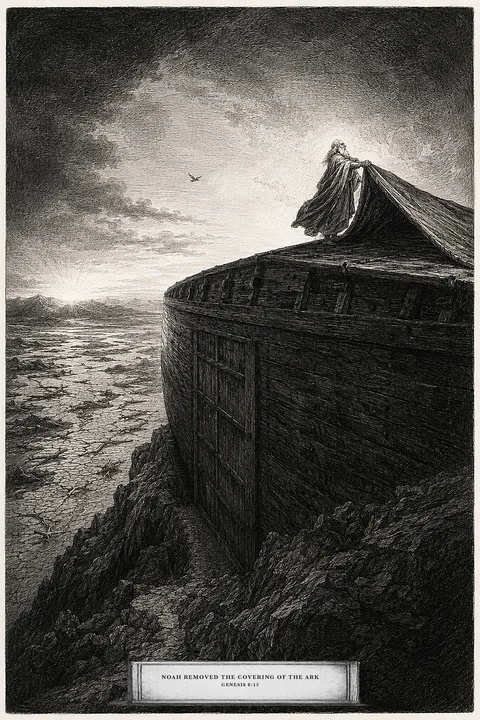
And as it was in the days of Noe, so shall it be also in the days of the Son of man.
— Luke 17:26
Noah Uncovered
The flood account closes with a verse that tells two stories in one set of letters: pointed as the Masoretes left it, a ship’s log; pointed again, the end of the age. The log first:
And it came to pass in the six hundredth and first year, in the first month, the first day of the month, the waters were dried up from off the earth: and Noah removed the covering of the ark, and looked, and, behold, the face of the ground was dry.
This is the only event in Genesis dated to the first day of the first month — and every Nisan 1 that Scripture dates after it marks a renewal: a tabernacle raised (Exodus 40:2), a temple sanctified (2 Chronicles 29:17; Ezekiel 45:18), a going up from Babylon begun (Ezra 7:9). The date phrase itself sets the one first — “in the one and six hundredth year” — where Noah’s own tallies run hundreds first: “three hundred and fifty years” (Genesis 9:28) — the order most of Scripture keeps. Jesus took this narrative, of all narratives, as the type of the end: “as it was in the days of Noe, so shall it be also in the days of the Son of man” (Luke 17:26).
The Letters Read Again
Remove the vowel points — the small signs added centuries after the letters were written — apply the Bible’s own symbolic language, and the same verse can also be read as:
At the completeness of six seals of the age — in the first month, the first day of the month — the peoples were desolated and laid waste from above the earth. God took up the righteous of the Sabbath’s ages with the covering of the covenant, and they appeared — and behold, the face of the earth was desolated.
Heard a third time, the letters open further — the sign, the full moon, the sword:
At the completeness of six seals of the age — at the chief renewal, on the Whole-day of renewed moon — the peoples were desolated and laid waste from above the earth. God took up the righteous of the Sabbath’s ages — the sign at the full moon of the covenant — and they appeared: and behold, His sword upon the face of Admah.
The table that follows shows how the same letters carry both stories — the received points beside this book’s, with the Bible’s own symbolic language supplying the senses, and beside every claimed sense its proof: the verse where the King James prints the same sense, the Scripture that defines the symbol, or the repointed word itself. Where the second and third hearings differ, the row carries both, marked 2 and 3. Notice what the second story tells: nothing that contradicts the prophecies of the end of the age written elsewhere — it confirms and clarifies what stands already established on independent ground. The parallel reading does not replace the log, and need not: it lives alongside it, a testimony to the supernatural intelligence required to tell two very different stories with one set of letters.
| Log | Masorete | MEAT | Prophecy |
|---|---|---|---|
and it came to pass |
וַיְהִי |
and it came to pass |
|
in the one |
בְּאַחַת |
Ezra 2:64 · H259 |
at the completeness |
and six |
וְשֵׁשׁ |
of six |
|
hundreds |
מֵאוֹת |
מֵ + אוֹת |
of the sign — seals |
year |
שָׁנָה |
H8141 |
of the age |
in the first month |
בָּרִאשׁוֹן |
בְּרִאשׁוֹן |
at chief renewal |
on the first day |
בְּאֶחָד |
Zech 14:7 · H259 |
on the Whole-day |
of the month |
לַחֹדֶשׁ |
לְחֹדֶשׁ |
of renewed moon |
were dried up |
חָרְבוּ |
Isa 19:5 |
were laid waste |
the waters |
הַמַּיִם |
Rev 17:15 |
the peoples |
from off |
מֵעַל |
Gen 1:20 |
from above |
the earth |
הָאָרֶץ |
the earth |
|
and he removed |
וַיָּסַר |
Isa 6:7 |
and He took away |
Noah |
נֹחַ |
Gen 6:9 |
righteous in all his generations |
— |
אֶת |
אֵת |
with2 |
the covering of |
מִכְסֵה |
|
the covering of2 |
the ark |
הַתֵּבָה |
Gen 6:14 |
of the covenant |
and he looked |
וַיַּרְא |
וַיֵּרָא |
and they appeared |
and, behold |
וְהִנֵּה |
and, behold |
|
was dry |
חָרְבוּ |
חַרְבּוֹ |
His sword |
the face of |
פְּנֵי |
upon the face of |
|
the ground |
הָאֲדָמָה |
הָאַדְמָה |
the Admah — Sodom’s sister |
For most rows the table takes nothing more than a different sense of the same word — a sense the translators themselves print in the verse cited beside it. A few of its readings want more light.
The date. Hebrew has no separate word for the in a phrase like this one — after the one-letter prefixes meaning in and of, the word the survives only as a vowel mark; in the bare letters, “in the first” and “in first” are written exactly alike, and whether this date says the at all is the points' choice, not the letters'. Rishon — “first” — never names its cycle: first of what, the verse does not say; “of the year” is carried in from other datings — and the King James itself prints this word “chief”: “the sons of David were chief about the king” (1 Chronicles 18:17). Chodesh — “month” — is the renewal, the KJV’s own “new moon,” at whatever scale the count is running: this verse has already stretched its year-word to the age, and the month-word stretches with it. Run the cycle at full scale and the slot reads: at the chief renewal — the regeneration of all things at the end of the age, “which God hath spoken by the mouth of all his holy prophets since the world began” (Acts 3:21). The Greek Matthew names that day “the regeneration, when the Son of man shall sit in the throne of his glory” (Matthew 19:28); the Hebrew Matthew reads the same clause “the day of the judgment, when the Man sits on the kisse of his glory.” Renewal on one page, judgment on the other — and both seat the day on the throne, and the throne and the full moon are one spelling: the kisse is the keseh. Echad, the day’s word, is the whole — “the whole congregation together” (Ezra 2:64) — and the moon at her fullness is Scripture’s whole moon: “the whole moon became as blood” (Revelation 6:12, literal Greek). Zechariah names the day by the same word and hands it the full moon’s signature: “one day… not day, nor night: but… at evening time it shall be light” (Zechariah 14:7). By the count, too, the day was already the moon’s: the head of the month that Part Four will seat at the moon’s fulness puts the unveiling on the keseh's own day before any letters are reheard at all. The formula keeps this voice everywhere it is written: on this same date the tabernacle is raised (Exodus 40:2), the sanctuary is cleansed (Ezekiel 45:18), and the going up from Babylon begins (Ezra 7:9) — the dwelling raised, the house cleansed, the people called out, at the chief renewal.
The taking. The verb “removed” is singular, and Noah — nuach, rest — is defined the first time Scripture introduces him: “just and perfect in his generations” (Genesis 6:9), where “perfect” is tamim, complete, and “generations” is dorot, the ages. Make Noah the righteous — a company — and the singular verb goes looking for a singular subject: God took the righteous, “caught up together… to meet the Lord” (1 Thessalonians 4:17), and they “appear with him in glory” (Colossians 3:4).
The sign. The little word et — the untranslatable object-marker — is, in the same two letters, ot, the sign: the sign-word is written without its vowel-letter in the very verse that appoints the lights “for signs, and for seasons” (Genesis 1:14, le’otot). One chapter later the narrative says the phrase aloud — “This is the sign of the covenant” — ot ha-brit, three times (Genesis 9:12, 13, 17) — spoken over the bow set in the cloud, in a sentence that itself opens with the bare et. Paul rules the seal beside it: “the sign of circumcision, a seal of the righteousness” (Romans 4:11) — a sign is a seal. The covering itself — mikhseh — is the same letters that, pointed otherwise, read keseh, the full moon, and kisse, the throne, a pair the Pearls of Wisdom chapter of Part Four will examine in full.
The sword. Charvu — “was dry” — is letter for letter charbo, His sword: “If he turn not, he will whet his sword” (Psalm 7:12). The sixth seal’s sky is Isaiah’s — “the heavens shall be rolled together as a scroll” (Isaiah 34:4) — and Isaiah’s next verse names what that sky sends down: “For my sword shall be bathed in heaven: behold, it shall come down… to judgment” (Isaiah 34:5).
The city. Ha’adamah — “the ground” — keeps its article and repoints the name beneath it: ha-Admah, the Admah, the city God overthrew with Sodom: “How shall I make thee as Admah?” (Hosea 11:8; Deuteronomy 29:23). The town wears the ground’s own word as its name — Hebrew sets the article on such names as readily as on the soil itself, the Ai, the Ramah (Joshua 7:2; Judges 4:5) — and the Lord’s key had already set the two judgments side by side: the days of Noah, then “likewise also… the days of Lot” (Luke 17:26, 28). The flood’s own verse carries Lot’s city in its last word. What that sign appoints, the Return on the Full Moon chapter gathers. What carries the sign, the Clouds of Heaven chapter will follow through the chariot, the throne, and the white horse after the calendar has established the moon’s office.
The Sixth Seal Vouches
The second story is not a new oracle; it is one John saw. Open the sixth seal: the sun black, the moon as blood, the heavens departing — and the kings of the earth crying to the mountains:
And said to the mountains and rocks, Fall on us, and hide us from the face of him that sitteth on the throne, and from the wrath of the Lamb…
The face, and the throne — kisse, the covering-word’s other pointing. The very next scene is the taken-up company: “a great multitude… clothed with white robes… These are they which came out of great tribulation” (Revelation 7:9, 14) — the covered ones. The flood account and the sixth seal are the same picture, and the second was written inside the first, letter for letter, two thousand years before John opened his eyes on Patmos.
Held to the Same Law
Hold these readings to the same law as every reading in this book. Each word must be attested in the lexicon — no invented senses; the assembled sentence must agree with Scripture written elsewhere — and here it is Revelation itself, seal by seal, that vouches; and the second reading must never unseat the first, and never touch a command. The log of the flood still stands; the ship still dried on a real mountain; nothing here loosens a verse from its plain sense. The warrant for hearing more than once is no scholar’s technique — it is the practice these chapters opened from Scripture’s own hand: God decoding His own pun for Jeremiah, David’s spoken once, twice have I heard, Isaiah rhyming his verdict into the letters.
What It Would Cost to Write
Now weigh what this verse would cost to write. A poet can rhyme a line; a careful author can plant a pun and land it. But sit down and try to compose twelve consecutive words that read as a dated entry in a ship’s log — grammar sound, narrative plain — while the same letters, pointed differently, read as the sixth seal of a book that would not be written for two and a half millennia: every alternate sense attested, every symbol matching the definitions Scripture gives elsewhere, the two readings never fouling each other from the first word to the last.
One pun is wit. A sustained double reading the length of a sentence, hidden under the points and waiting while empires rose and translation after translation printed only the log — that is not wit. This is the fingerprint the Introduction found in the web — the last chapter called the puns the same hand pressing deeper; here the hand writes an entire verse twice in a single stroke. And the key that unlocks it was hung on the door by the Lord Himself: as it was in the days of Noah — the days of Noah were written as the days of the Son of man.
Genesis 8:13 is one example — Scripture holds many more, for whoever will dig deeper — and here the printed reading keeps the first seat: the log is primary, and the prophecy rides within it. It is not always so. The chapter on Lucifer’s declared plan — the reading this book’s own cover is painted from — waits in Part Four to show the other case: a verse whose primary reading is, by the letters’ own weight, the one lying hidden under the points — hidden by the very one the verse is warning about.
There is one dimension deeper still. Before Israel wrote in the square letters of Babylon, the letters themselves were pictures — and the pictures preach. What the oldest pictures spell in the Name of God is the next chapter.