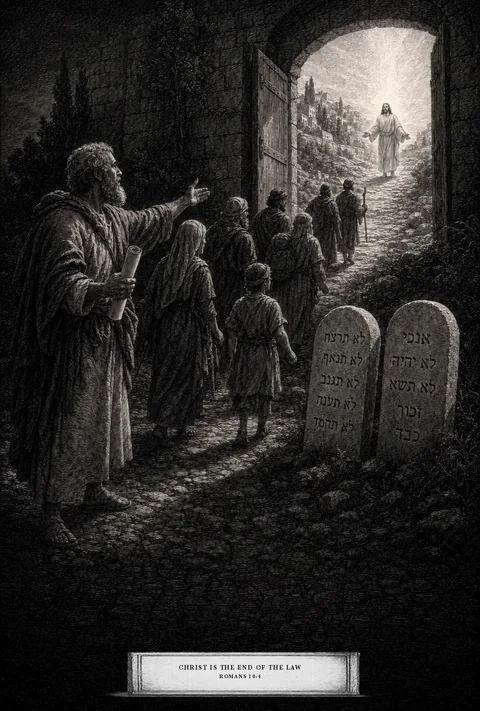
Do we then make void the law through faith? God forbid: yea, we establish the law.
— Romans 3:31
The End of the Law
Paul wrote one sentence that has been made to carry a conclusion he devotes whole chapters to forbidding:
For Christ is the end of the law for righteousness to every one that believeth.
Read end as termination, and Christ is where the law stops. Read it as purpose, and Christ is where the law was going. The English word can carry both senses, and so can the Greek beneath it. The sentence cannot be settled by the word end alone. Paul must be permitted to define Paul.
The End of the Commandment
The Greek word is telos: an end, outcome, destination, or goal. Paul uses it again where no one mistakes it for abolition:
Now the purpose of the commandment is love from a pure heart, from a good conscience, and from sincere faith… But we know that the law is good if one uses it lawfully.
8
Love did not terminate the commandment. Love is what the commandment was designed to produce — “love is the fulfilling of the law” (Romans 13:10). The same paragraph warns of men who desire to teach the law while understanding neither what they say nor what they affirm; Paul’s answer is not that the law is gone, but that it must be used lawfully (1 Timothy 1:7-8). His next sentence says “the law is not made for a righteous man, but for the lawless and disobedient” before listing murderers, whoremongers, menstealers, liars, and perjurers (1 Timothy 1:9-10). The criminal code is laid against the criminal; the righteous man does not need its sentence aimed at him because he is not doing what it condemns. The verse limits the law’s prosecuting office, not its definition of right-living.
Telos can name a resulting destination as well: freed from sin and become servants to God, “ye have your fruit unto holiness, and the end everlasting life” (Romans 6:22). Everlasting life does not abolish the fruit that reaches it. It is the end toward which that fruit runs.
Romans 10 supplies the same direction. Israel, Paul says, went about “to establish their own righteousness” and did not submit to “the righteousness of God” (Romans 10:3). Christ is then the telos “for righteousness to every one that believeth” — not the end of righteousness, but its embodied aim: God’s word believed, obeyed, and lived without defect. Paul had already closed the abolition reading in the same letter: “Do we then make void the law through faith? God forbid: yea, we establish the law” (Romans 3:31).
Christ is not where the law failed and stopped. He is the word made flesh, the law’s right-living purpose made visible, and the pattern into which His people are formed.
Paul Does Not Mean One Thing by Law
Law is not a magic word with one referent in every sentence. Paul regularly attaches a name to it, and the name controls the meaning:
Phrase |
Reference |
What governs |
law of God |
Romans 7:22, 25; 8:7 |
God’s instruction, delighted in and served by the inward man |
law of sin |
Romans 7:23, 25 |
sin ruling the flesh |
law of the Spirit of life |
Romans 8:2 |
the Spirit’s life-giving rule in Christ |
law of faith |
Romans 3:27 |
the principle of faith that excludes boasting |
law of Christ |
Galatians 6:2 |
burdens borne in fulfillment of Christ’s command |
commandments of God |
1 Corinthians 7:19 |
what remains when circumcision and uncircumcision are set aside |
commandments of men |
Colossians 2:22; Titus 1:14 |
human rules that turn from the truth |
The noun law does not erase its modifier. Freedom from “the law of sin and death” is not freedom from “the law of God” (Romans 8:2; 7:22). Nor does a human command become disobedience merely because a man gave it. Paul commands submission to civil rulers (Romans 13:1-7), children to parents, and servants to masters acting within their proper bounds (Ephesians 6:1-8). A human command becomes a rival command when it conflicts with, replaces, or nullifies what God commanded; then the order is fixed: “We ought to obey God rather than men” (Acts 5:29).
Paul has clear vocabulary for human rules that rival God’s command: “traditions of my fathers” (Galatians 1:14), “tradition of men” (Colossians 2:8), “commandments and doctrines of men” (Colossians 2:22), and “Jewish fables” joined to “commandments of men” (Titus 1:14). When Paul means God’s standard, he is equally plain: “the law is holy, and the commandment holy, and just, and good” (Romans 7:12), “the law is spiritual” (Romans 7:14), and “I delight in the law of God after the inward man” (Romans 7:22).
Any reading that pours all those laws into one bucket will make Paul contradict himself before the page turns.
Work Is Not Obedience
A work is a deed. Obedience names the deed’s relation to a legitimate command. The two can meet in one act without becoming synonyms.
A son who carries his father’s message has performed a work and obeyed his father. The same son may perform the same outward work for his employer without disobeying God; the authorities do not conflict. Disobedience begins when a command or deed crosses God’s command — when a tradition is kept by rejecting what God said (Mark 7:9).
Paul’s famous contrast in Romans 4 is not faith against obedience. He defines the work by its economic claim:
Now to him that worketh is the reward not reckoned of grace, but of debt. But to him that worketh not, but believeth on him that justifieth the ungodly, his faith is counted for righteousness.
The picture is a laborer presenting work for wages, making the payer a debtor. Jesus rules out that claim even after complete obedience: “when ye shall have done all those things which are commanded you, say, We are unprofitable servants: we have done that which was our duty to do” (Luke 17:10). Perfect obedience would still create no surplus with which to purchase forgiveness. The servant has done his duty; the Master owes no wage.
Abraham’s faith was not a substitute for obedience. “By faith Abraham, when he was called… obeyed” (Hebrews 11:8), and James says his faith “wrought with his works” and “by works was faith made perfect” (James 2:22). His work made faith visible; it did not turn duty into wages.
This is why Paul can write “not of works” and, in the next breath, say we are “created in Christ Jesus unto good works, which God hath before ordained that we should walk in them” (Ephesians 2:9-10). Works are excluded as the source and purchase price of the gift, then restored as the life the gift creates.
Paul’s other “not of works” sentences keep the same boundary. Election cannot be earned by children “not yet born, neither having done any good or evil” (Romans 9:11); calling cannot be earned when its purpose and grace were given “before the world began” (2 Timothy 1:9); salvation is “not by works of righteousness which we have done” in the letter that commands believers to “maintain good works” (Titus 3:5, 8). The excluded works either do not exist yet or cannot purchase the gift; the commanded works follow the gift and show what it produced.
Every Work of the Law in Its Place
The exact Greek phrase erga nomou, “works of the law does not carry one hidden code through every occurrence. Sometimes the context explicitly identifies God’s law. Sometimes the controversy is circumcision and enforced separation. Sometimes the disputed deed is not named.
Romans 9:32 carries a textual wrinkle worth keeping visible. The Received Text behind the KJV reads “works of the law.” The critical Greek text reads simply “as if by works,” without “of the law,” placing still more weight on the attempted manner rather than on a different code.
The Galatian controversy cannot be reduced to “God’s commandments are bad works.” Circumcision was a God-given sign, but the circumcision party turned it into a universal entry requirement and ground of standing. Paul separates the boundary mark from obedience in one sentence: “Circumcision is nothing, and uncircumcision is nothing, but the keeping of the commandments of God” (1 Corinthians 7:19). Galatians 5 makes the disputed use explicit: the man receiving circumcision is seeking to be “justified by the law” (Galatians 5:2-4). Circumcision itself cannot be the evil, for Paul circumcised Timothy in the next chapter of Acts (Acts 16:3). The error is demanding the sign as a purchase price and covenant gate God did not set for the nations.
Nor can every occurrence be renamed a commandment of men. Romans 3 and Galatians 3:10 explicitly identify God’s law. The uniform error lies not in the identity of every deed but in what men demand from it: justification, the Spirit, inheritance, or a boast as though God owed payment. The law identifies sin and defines right-living; it cannot ransom the man who already broke it, and obedience after the breach cannot turn duty into overpayment.
Passage |
Classification |
Words that decide it |
Romans 3:20, 28 |
God’s law — clear |
The law speaks to the world, gives knowledge of sin, is witnessed by the prophets, and is established in verse 31. |
Romans 9:32, KJV/TR |
God’s law — clear |
Israel pursues “the law of righteousness,” but not by faith, “as it were by works.” |
Galatians 2:16 |
Circumcision-party application |
Peter separates from Gentiles, fears “them which were of the circumcision,” and compels Gentiles “to live as do the Jews” (Galatians 2:12, 14). |
Galatians 3:2, 5 |
Ambiguous acts |
The contrast concerns receiving the Spirit by hearing of faith; no disputed act is named, though the letter’s live controversy is circumcision. |
Galatians 3:10 |
God’s law — explicit |
Paul writes “the book of the law” and quotes Deuteronomy 27:26: the curse falls on the one who does not continue in what is written “to do them.” |
Not Under, Dead To, and Delivered From
“Ye are not under the law, but under grace” is usually quoted with the next sentence missing. Paul supplies the forbidden inference himself:
For sin shall not have dominion over you: for ye are not under the law, but under grace. What then? shall we sin, because we are not under the law, but under grace? God forbid. Know ye not, that to whom ye yield yourselves servants to obey, his servants ye are to whom ye obey; whether of sin unto death, or of obedience unto righteousness?
Whatever “not under the law” means, Paul expressly says it cannot mean permission to sin. The paragraph is about dominion and masters: sin no longer rules; grace receives the servant; obedience runs unto righteousness. Grace does not leave the man masterless.
Romans 7 uses marriage to make the same point. Paul says the believer becomes “dead to the law by the body of Christ” so that he may be “married to another… that we should bring forth fruit unto God” (Romans 7:4). The man dies and changes covenant standing; Paul does not say the law died. His next question closes that escape: “Is the law sin? God forbid” — then he quotes the tenth commandment, “Thou shalt not covet” (Romans 7:7). The sequence ends with “the law is holy,” “the law is spiritual,” and “I delight in the law of God” (Romans 7:12, 14, 22).
Romans 8 names the weakness accurately: the law was weak “through the flesh,” so God condemned sin in the flesh “that the righteousness of the law might be fulfilled in us, who walk not after the flesh, but after the Spirit” (Romans 8:3-4). The Spirit cures the failed walker; He does not erase the right walk.
Galatians says likewise, “if ye be led of the Spirit, ye are not under the law” (Galatians 5:18), inside a passage that names adultery, idolatry, hatred, murder, and drunkenness as works of the flesh that exclude from the kingdom (Galatians 5:19-21). The chapter has just said “all the law is fulfilled in one word… Thou shalt love thy neighbour as thyself” (Galatians 5:14), and it closes the Spirit’s fruit with “against such there is no law” (Galatians 5:23). Led by the Spirit does not mean led into what the law condemns.
The Curse, the Schoolmaster, and the Letter
Christ redeemed us “from the curse of the law” (Galatians 3:13). The curse is not the law itself; it is the sentence the law pronounces on the transgressor. Paul quotes the sentence immediately: “Cursed is every one that continueth not in all things which are written in the book of the law to do them” (Galatians 3:10). The failure is not obedience but its absence. Canceling a prisoner’s sentence does not repeal the statute he broke.
The law cannot give life to the already dead: “if there had been a law given which could have given life, verily righteousness should have been by the law” (Galatians 3:21). Instruction can identify the right road and convict the man who left it; it cannot raise him from death or pay his debt. Life remains gift and promise.
Paul then calls the law a paidagōgos, the household custodian who guarded a child until maturity: “the law was our schoolmaster unto Christ… but after that faith is come, we are no longer under a schoolmaster” (Galatians 3:24-25). A son who comes of age is no longer under the custodian’s hand; he does not therefore become free to steal from his father, dishonor his mother, or worship another god. The guardian’s administration reaches its telos when the Father’s instruction is received inwardly and lived by faith.
“The letter killeth, but the spirit giveth life” is read with the same flattening. Second Corinthians 3 does not call God’s command evil; it contrasts 2 ministrations — “the ministration of condemnation” and “the ministration of righteousness” (2 Corinthians 3:9). The chapter opens with the Spirit writing, “not in tables of stone, but in fleshy tables of the heart” (2 Corinthians 3:3). The new covenant does not celebrate an empty heart. It moves the writing there.
Paul had already asked whether the good commandment was made death to him and answered “God forbid.” Sin worked death in him “by that which is good,” so that sin might appear exceeding sinful (Romans 7:13). The letter names and sentences the breach; the Spirit forgives, writes, and empowers the right-living the letter could command but never create.
Hebrews uses the same distinctions in its priesthood argument. “A change also of the law” is required because “the priesthood” has changed (Hebrews 7:12); the commandment disannulled is the preceding commandment governing mortal Levitical priests, replaced by the power of an endless life (Hebrews 7:16-18). The meats, drinks, washings, and carnal ordinances imposed until reformation belong to the tabernacle service the chapter is describing (Hebrews 9:1-10). The new covenant does not leave the heart blank: “I will put my laws into their mind, and write them in their hearts” (Hebrews 8:10). A changed priesthood and an inward writing cannot honestly be summarized as the end of every law.
Ordinances, Days, and Paul’s Verdict
Ephesians says Christ abolished “the enmity, even the law of commandments contained in ordinances” (Ephesians 2:15). The paragraph names its subject before the disputed phrase: circumcision and uncircumcision, aliens and citizens, the “middle wall of partition,” and the making of both peoples into “one new man” (Ephesians 2:11-19). Whatever the ordinances include, the thing Christ kills is the enmity that keeps the nations apart. The same letter later quotes the fifth commandment — “Honour thy father and mother” — and calls it “the first commandment with promise” (Ephesians 6:2). Paul cannot mean that every commandment was abolished in chapter 2 and binding in chapter 6.
Colossians does not say the Torah was nailed to the cross. It says God forgave trespasses by blotting out a singular cheirographon, a handwritten debt-record “that was against us” (Colossians 2:13-14). The hostile document matches the debt canceled; nomos, law, never appears in the sentence. When the chapter later identifies the ordinances to which the Colossians must not submit, it quotes them — “Touch not; taste not; handle not” — and names their source: “the commandments and doctrines of men” (Colossians 2:20-22).
The command concerning feast, new moon, and sabbath is not stop keeping them but “let no man therefore judge you” (Colossians 2:16). Paul calls them things which “are a shadow of things to come” — present shadow, coming referent — and a shadow is not an enemy of its body but the outline cast by it (Colossians 2:17). The verse may govern how the days are judged; it does not announce their abolition.
Galatians 4 is equally specific about the road being retraced. Its readers formerly “did service unto them which by nature are no gods,” and Paul asks why they turn “again to the weak and beggarly elements” before naming “days, and months, and times, and years” (Galatians 4:8-10). Gentiles cannot return to a Mosaic calendar they never kept. At minimum, the verse cannot bear the claim that every appointed time of God has ended while its own word “again” points backward to pagan bondage.
Romans 14 names neither sabbath nor unclean animals. Its dispute is between one who eats all things and a weak brother who “eateth herbs,” and it later adds wine (Romans 14:2, 21). The word translated “unclean” in verse 14 is koinos, common, not akathartos, the law’s word for an unclean animal. The chapter governs doubtful disputes, private esteem, and care not to destroy a brother over food; an unnamed day and a vegetarian’s conscience cannot repeal a named command.
Acts 15 likewise begins with the stated claim “Except ye be circumcised… ye cannot be saved” (Acts 15:1). The council refuses circumcision as the purchase price of covenant entry, gives the nations 4 necessary commands drawn from the law, and then observes that Moses “is read in the synagogues every sabbath day” (Acts 15:20-21). Paul afterward circumcises Timothy for the Jews, hastens to be at Jerusalem for Pentecost, and publicly demonstrates that the report he teaches Jews to forsake Moses is false: “thou thyself also walkest orderly, and keepest the law” (Acts 16:3; 20:16; 21:21-24). Those acts do not settle every command’s application to every covenant member, but they forbid turning Paul into a witness that God’s law was evil or dead.
Paul’s own verdict remains the safest reading rule:
Do we then make void the law through faith? God forbid: yea, we establish the law.
The end of the law is love from a pure heart, right-living formed in those who walk after the Spirit, and Christ Himself — the Word believed, the command obeyed, the Father’s character made visible. He is not the law’s funeral. He is its purpose.