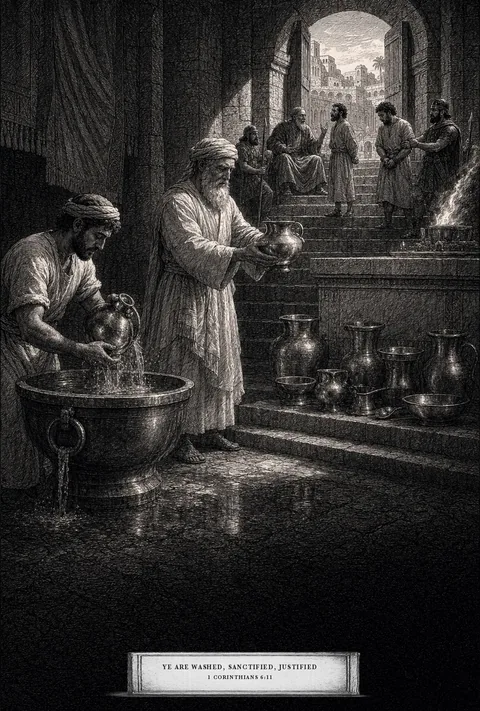
That ye may put difference between holy and unholy, and between unclean and clean.
— Leviticus 10:10
Uncommon Sanctification, Justification, and Cleanliness
Religious words are unusually easy to leave as milk. A hearer can repeat sanctification, justification, and cleanliness for years without being able to say what any one does that the other two do not. The irony begins with sanctification itself: it sets what was common apart for God, yet the word is commonly repeated without that distinction. Justification and cleanliness fare little better. These words become meat only when the whole word is worked: gather every use, let the plain passages establish the boundaries, and make each proposed definition survive the difficult ones.
What We Inherited
Most readers inherit two answers before they ever test the words. One is the systematic-theology answer, framed to summarize a doctrine. The other is the pastoral answer, compressed for ordinary teaching. Neither is yet the word’s definition; both must survive uses outside the passages that produced them.
Justification
The theological answer: God’s legal declaration that a sinner is righteous in His sight through faith in Christ’s atoning sacrifice, not personal works.
The pastoral answer: God declares me “not guilty.”
The test: Neither answer can define justify when people justify God, wisdom is justified by her children, words and deeds are justified, and men justify themselves. The longer answer may summarize Romans 3-5, but it imports three other disputed terms—righteousness, faith, and works—whose definitions cannot simply be assumed here.
Sanctification
The theological answer: The ongoing process by which the Holy Spirit sets believers apart and transforms their character after justification.
The pastoral answer: Becoming more like Jesus.
The test: Neither answer can carry the sanctification of Christ, the seventh day, food, vessels, an unbelieving spouse, or believers sanctified once for all. Even the broader answer, set apart for holy use, made sacred, or purified, fails wherever purified is treated as essential: God and Christ are sanctified, yet neither is impure.
Cleanliness and uncleanness
The theological answer: Ritual, moral, and spiritual purity or defilement governing fellowship with God and participation in the covenant community.
The pastoral answer: A clean heart draws near to God; whatever separates us from Him is unclean.
The test: Both answers blur the lines Scripture keeps separate: holy and common, clean and unclean. Childbirth, marital relations, and touching the dead produce uncleanness without transgression. Such conditions may restrict contact, approach, or use without implying moral guilt.
This chapter is not choosing the theological answer over the pastoral one. It tests both. A doctrinal summary may remain true within the passages from which it was built and still fail as the definition of the word. The question is which definition best explains every use without importing untested meanings from other disputed words.
Paul places all three operations in one sentence:
And such were some of you. But you were washed, but you were sanctified, but you were justified in the Name of the Lord Jesus and by the Spirit of our God.
NKJV
If the three verbs meant made spiritually better, Paul used three words where one would do. He did not. Each answers a different question.
Condition |
Action |
Result |
Question answered |
unclean |
wash or cleanse |
clean |
What defilement must be removed before this may approach or be used? |
common or profane |
sanctify |
holy |
To whom does this belong, and for what is it appointed? |
accused or condemned |
justify |
judged right |
What is the right verdict concerning this person, deed, word, or cause? |
The words overlap in the life they describe, but they are not synonyms.
Two Lines the Law Does Not Merge
The priests were commanded “that ye may put difference between holy and unholy, and between unclean and clean” (Leviticus 10:10). Ezekiel rebukes them for erasing the same two lines: “they have put no difference between the holy and profane, neither have they shewed difference between the unclean and the clean” (Ezekiel 22:26).
The opposite of holy is therefore common or profane. The opposite of clean is unclean. A common bowl need not be dirty or sinful; it is simply not claimed for sacred use. A person may become unclean by touching a corpse without ceasing to belong to the covenant. The lines can meet, but Scripture names them separately.
Justification stands on a third line. Where there is a controversy, the judges must “justify the righteous, and condemn the wicked” (Deuteronomy 25:1). The opposite of justification is condemnation: a judgment concerning what is right.
These contrasts are the definitions' frame. The full search confirms it. In the KJV’s Strong’s tagging, the principal Hebrew and Greek verbs occur hundreds of times: qadash, to sanctify, 173 times, and hagiazō 29; tsadaq, to justify or be righteous, 41, and dikaioō 48; taher, to cleanse or be clean, 94, and katharizō 37. The numbers prove nothing by themselves. The question is whether one definition can carry every use.
Sanctification: “It Is Mine”
Scripture comes close to defining sanctification in its first great application to a people:
Sanctify unto me all the firstborn, whatsoever openeth the womb among the children of Israel, both of man and of beast: it is mine.
Numbers repeats the act and supplies the direction: “I sanctified them for myself” (Numbers 8:17). Second Timothy supplies its purpose: the purged vessel is “sanctified, and meet for the master’s use, and prepared unto every good work” (2 Timothy 2:21).
The pattern is ownership, appointment, and fitting use. God claims something as His, appoints what it is for, and prepares or commands it to be treated accordingly.
The definition must be wider than moral improvement because Scripture sanctifies things that cannot repent. God sanctified the seventh day; the temple sanctifies its gold and the altar its gift (Genesis 2:3; Matthew 23:17, 19).
Food sharpens the point. Paul says it is sanctified “by the word of God and prayer” (1 Timothy 4:5), not by prayer alone. Prayer receives with thanksgiving what the Word has appointed; it does not overrule the Word’s definition of food. The Other White Meat follows that distinction through the clean and unclean beasts.
Christ supplies the decisive test against purified as the root meaning. The Father sanctified and sent Him, and Christ says, “for their sakes I sanctify myself” (John 10:36; 17:19). Nothing sinful was being removed from Him. He was appointed and given to the work for which He was sent.
The direction can also reverse. “Sanctify the LORD of hosts himself” (Isaiah 8:13) cannot mean make God morally better. Neither can “sanctify the Lord God in your hearts” (1 Peter 3:15). To sanctify God is to acknowledge Him as holy and treat Him accordingly. To sanctify His Name is to display rather than profane the claim it carries: “I will sanctify my great name… when I shall be sanctified in you before their eyes” (Ezekiel 36:23).
Even dedication to God is too narrow as the root definition. The same Hebrew verb prepares war (Jeremiah 6:4; Joel 3:9), proclaims a solemn assembly for Baal (2 Kings 10:20), and marks the men who “sanctify themselves” for the gardens — seeking holiness among the nation-trees while following after one of them and eating what it eats (Isaiah 66:17). The word describes a solemn claim and appointment; the context tells us whose claim and whether it is true or counterfeit.
This does not make conduct optional. Once a person is claimed for God’s use, the life must fit the claim. Paul calls abstaining from fornication “your sanctification” and sets sanctification against uncleanness (1 Thessalonians 4:3-7). The sanctified vessel must be purged and prepared for its Master’s work. Moral correction is therefore a necessary working-out of sanctification in people, but it cannot be the word’s root meaning.
Nor is every use progressive. “We have been sanctified… once for all” stands beside “may the God of peace Himself sanctify you completely” (Hebrews 10:10; 1 Thessalonians 5:23, NKJV). The claim may be established, then the claimed person brought fully into conformity with it.
Hebrews gives the antonym in one severe sentence: a man may count “the blood of the covenant by which he was sanctified a common thing” (Hebrews 10:29, NKJV). To profane what sanctified him is to treat the holy claim as common.
The definition that survives every direction is this:
Sanctify: To cause, appoint, or acknowledge as holy — removing someone or something from common status, placing it under an owner’s claim for an appointed purpose, and treating or preparing it accordingly.
Cleanliness: Fit to Approach
Uncleanness is not automatically wickedness. A woman became unclean after childbirth; husband and wife became unclean until evening after marital relations; whoever touched a dead body became unclean for seven days (Leviticus 12:2; 15:18; Numbers 19:11). None of those conditions is itself called sin. They temporarily govern contact, approach, and use.
The same vocabulary sorts animals and food, diagnoses skin and houses, and governs garments, vessels, bodies, and the sanctuary. Clean is free from the contamination or mixture that bars the thing from its permitted place or purpose. To cleanse is to remove that obstruction and make it fit to approach, touch, eat, wear, dwell in, or use.
Because sin defiles, the physical vocabulary becomes moral without losing its shape. David asks, “Wash me throughly from mine iniquity, and cleanse me from my sin,” then, “Create in me a clean heart” (Psalm 51:2, 10). Isaiah makes the washing visible: “Wash you, make you clean; put away the evil of your doings… cease to do evil; learn to do well” (Isaiah 1:16-17). John says the blood of Christ “cleanseth us from all sin,” and that confessed sin is forgiven and cleansed (1 John 1:7, 9).
Still, cleansing and sanctifying must not be collapsed. Christ acts “that he might sanctify and cleanse” His assembly by the washing of water by the Word (Ephesians 5:26). Paul tells the vessel to purge itself, then calls it sanctified and useful (2 Timothy 2:21). Cleansing removes what makes the vessel unfit; sanctification places the clean vessel under the Master’s claim and use.
The definition is therefore:
Cleanse: To remove the defilement that bars proper contact, approach, or use. Clean describes what is free of that defilement and fit for its permitted place. Uncleanness may picture or result from sin, but uncleanness and guilt are not identical in every passage.
Justification: The Verdict
The law’s courtroom supplies the clearest definition of justification: judges “justify the righteous, and condemn the wicked” (Deuteronomy 25:1). The warning repeats the pair: “He that justifieth the wicked, and he that condemneth the just, even they both are abomination to the LORD” (Proverbs 17:15).
To justify is to judge, declare, or demonstrate someone or something to be right concerning a charge. It cannot mean to transform a bad person into a morally good one, because people “justified God” by receiving John’s baptism, and Paul says God is justified in His sayings (Luke 7:29; Romans 3:4). God did not need moral improvement. Wisdom is justified by her children: the fruit vindicates the wisdom of its source (Matthew 11:19).
The same word can name a false verdict. The lawyer was “willing to justify himself,” and the Pharisees justified themselves before men (Luke 10:29; 16:15). Their claim did not change their conduct; it presented a case for a verdict.
Evidence matters because a judgment answers something. “By thy words thou shalt be justified, and by thy words thou shalt be condemned” (Matthew 12:37). Abraham and Rahab were justified by deeds that made their allegiance visible (James 2:21-25). James does not say their deeds purchased grace; he says Abraham’s faith worked with his deeds and was made complete by them.
Paul’s courtroom is just as explicit: “Who shall lay any thing to the charge of God’s elect? It is God that justifieth” (Romans 8:33). His question is who may successfully accuse when God has rendered the judgment. Justification is given freely by grace through Christ’s redemption and blood, not purchased as a laborer’s wage that places God in debt (Romans 3:24; 4:4-5; 5:9).
When Paul says God “justifieth the ungodly,” his own explanation follows in David’s words: iniquities forgiven, sins covered, sin no longer imputed (Romans 4:5-8). God does not rename ungodliness righteousness. He forgives the guilty man who comes by faith, answers the charge through Christ, and remains “just, and the justifier” (Romans 3:26).
The definition is:
Justify: To judge, declare, or demonstrate a person, word, deed, or cause to be right against a question or charge. God’s justification answers the charge against the sinner by grace through Christ; it is received, not earned as wages. Deeds may vindicate a claimed faith, but they cannot purchase the Judge’s mercy.
Paul’s disputed vocabulary of law, works, wages, debt, faith, and obedience was taken up at length in The End of the Law.
Three Operations, Not Three Decorations
Return to Paul’s sentence:
Washed — the defilement was removed.
Sanctified — the person was taken from common status, claimed in the Name, and appointed to God’s use.
Justified — the charge was answered and the judgment rendered through Christ.
The same Lord and Spirit perform all three, but Paul keeps their work distinct. A dictionary can summarize that work, and a seminary can organize it into doctrine; neither should be allowed to narrow a word until Christ cannot be sanctified, God cannot be justified, and childbirth cannot make unclean without making a mother wicked.
Milk can be memorized. Meat can be tested.