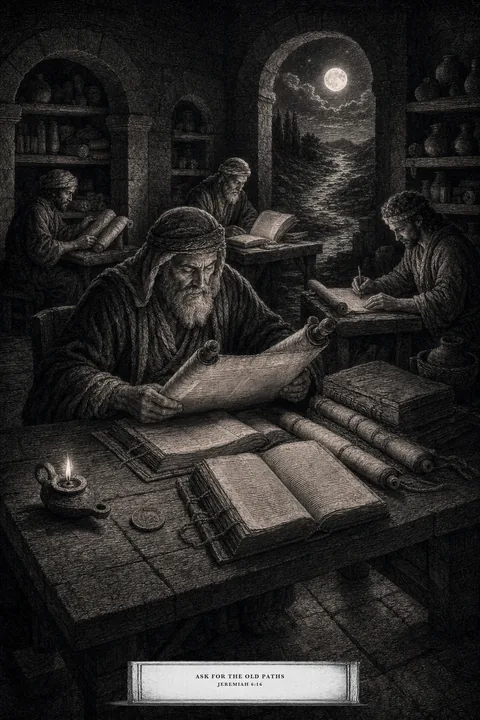
Thus saith the LORD, Stand ye in the ways, and see, and ask for the old paths, where is the good way, and walk therein, and ye shall find rest for your souls.
— Jeremiah 6:16
Ancient Symbols
I derived every definition in this book the same way: Scripture compared with Scripture, the clearer uses defining the harder ones, tested until the meaning held everywhere it appears. I took no reading from a commentary, ancient or modern; I kept the working library deliberately small. Only after the glossary was finished did I turn the search outward — first to what is taught today, which the badges measure, and then backward, through the church fathers, the targums, the rabbis, and the oldest commentaries on record, asking one question: had anyone read these words this way before?
The answer changed the complexion of my boldest claims. Of the forty readings the modern consensus does not teach, eleven turned out to be things the ancient interpreters already held, in whole or in part — not influences, for my derivations were finished before the search began, but witnesses: independent readers, most of them fifteen centuries closer to the language, landing where the texts land. Those eleven carry the ANCIENT badge in the Glossary, each entry naming its witnesses. This chapter lets them speak.
The Lights
The Sun, Moon, and Stars chapter argued that the moon is the faithful witness — the reflecting, submissive partner of a relation, bright only with another’s light. Augustine says it without hedging:
The moon is understood to be the Church, because she has no light of her own, but is lighted by the only-begotten Son of God, who in many places of holy Scripture is allegorically called the Sun.
Exposition on Psalm 11
Ambrose calls the moon a figure of the Church for the same reason in his Hexaemeron, and Origen had already drawn the pairing in his homilies on Genesis: Christ the sun, the Church the moon, the faithful her stars. The fathers fixed the pair at one scale; Scripture runs it at more than one. The relation itself is the symbol — a greater light, and a lesser bearing the greater’s whole light — so the sun can stand for the Father and the moon for Messiah, “established for ever as the moon, and as a faithful witness in heaven” (Psalm 89:36-37), as readily as for Christ and His Church. That refinement carries weight the fathers never spent: read the moon as the Son when the prophets fill it, darken it, or turn it to blood, and the prophecies open — as the Sun, Moon, and Stars and Return on the Full Moon chapters showed. The relational reading — the light borrowed, the witness faithful — was the church’s first instinct, not my invention; the scaling is where this book leaves the fathers behind.
The oil of the ten virgins belongs beside it. Today’s pulpit almost universally makes that oil the Holy Spirit; I found no ancient interpreter who read it so. What the ancients said, in a single voice, is what the parable’s own economy demands:
By lamps here, He means the gift itself of virginity, the purity of holiness; and by oil, humanity, almsgiving, succor to them that are in need.
Homily 78 on Matthew
The oil is the fruit of good works; the vessels are the human bodies in whose inward parts the treasure of a good conscience is to be laid up.
on Matthew 25
Jerome adds that the wise virgins are they who, “besides their faith, have the ornament of good works.” Oil as stored works is not a revision of the old teaching. It is the old teaching.
The ancients did not have everything right, and the difference is instructive. Chrysostom made the lamps virginity; Hilary made the vessels bodies; but Scripture had already defined the lamp itself: “the commandment is a lamp; and the law is light” (Proverbs 6:23) — “thy word is a lamp unto my feet” (Psalm 119:105). The virgins carry teachings, and the oil of stored works is what keeps a teaching burning. A tiny minority of Christians holds that reading today — largely the modern Torah-observant movement — yet it is the one definition Scripture itself supplies.
The Coin
The Coin chapter read the coin as a person: stamped with an owner’s image, assigned a value, sought when lost. Gregory the Great preached the fullest ancient form of it on the lost drachma — the coin bearing the image is man, made in the image of his Maker and hunted through the swept house — and Gregory of Nyssa found the royal image hidden under the soul’s filth, waiting to be uncovered. Tertullian had reached the equation’s edge centuries earlier:
The image of Caesar, which is on the coin, to Caesar; and the image of God, which is in man, to God — the money to Caesar, yourself to God.
On Idolatry 15
He stops short of naming the coin a symbol: his is the logic of one saying — the two images set side by side — not the identification carried through the lost drachma, the tribute money, and the stater in the fish’s mouth. The witnesses come piecemeal, each ancient touching the figure where his text required it; connecting every occurrence into one definition is the work the derivation does.
The Great Fish
The Great Fish of Jonah’s sign fared the same in Jewish antiquity. Where the modern reader sees only a miracle-whale, the Targum decodes the sea-monsters as kings:
He shall punish the king who magnified himself as Pharaoh the first, and the king who exalted himself as Sennacherib the second, and shall slay the king who is strong as the dragon that is in the sea.
Isaiah 27:1
Exodus Rabbah says the rod became a serpent-monster before Pharaoh “because Pharaoh was likened to a serpent, as it is stated: the great dragon that lies in the midst of his rivers” (Ezekiel 29:3). A great ruler among the sea of peoples, who swallows and is made to give back: the synagogue knew the figure before the church forgot it.
The Vessel on the Sea
The Ship chapter has already called its ancient witness: Hilary of Poitiers, reading the Lord’s boat-sermon — “the ship offers a type of the Church, within which the word of life is placed, and is preached to those without.” He does not stand alone. Hippolytus drew the whole rigging — the mast her cross, her two rudders the two Testaments:
The sea is the world, in which the Church is set, like a ship tossed in the deep but not destroyed; for she has with her the skilled Pilot, Christ.
On Christ and Antichrist 59
Tertullian read the storm-tossed boat of Matthew 8 as the church in the world’s waves; Augustine called Noah’s ark “a figure of the city of God sojourning in this world.” A governed vessel, crewed and piloted, riding the sea of the peoples: the ancients held the type and named one vessel; Scripture’s own usage — Tyre, Egypt, Babylon’s lament — supplies the wider register these chapters recovered.
Victorinus of Pettau (c. 260 AD), who wrote the earliest surviving commentary on Revelation, belongs in this company for a different identification: on the great city “spiritually called Sodom and Egypt, where also our Lord was crucified” (Revelation 11:8), he answers plainly — Jerusalem. The covenant city in bondage wearing Egypt’s name was the third century’s reading before it was mine.
The Week, the Way, and the Truth
That sabbath names the whole seven was the working assumption of antiquity. The Septuagint translates Leviticus' “seven sabbaths” as seven weeks outright; the Talmud argues the identification in so many words (Menachot 65a); the Didache dates fasts to “the second and the fifth day of the sabbath” — the week’s days numbered inside the unit, exactly as the Gospels count them. The Sabbath chapter derived the unit from the law’s own grammar; the oldest translators and the rabbis had already banked it.
The way and the truth read the same. The oldest church manual opens with it:
There are two ways, one of life and one of death, and great is the difference between the two ways.
chapter 1
The way of life that follows is nothing but commanded conduct — the commandments expounded for the walk (so also the Epistle of Barnabas). The Talmud parses Exodus 18:20’s “the way wherein they must walk” clause by clause into covenant deeds (Bava Metzia 30b). And for the truth, the identification could not be more direct: “Truth — this is Torah” (Berakhot 5b), the rabbis citing the very proverb I stood on, as the psalmist had already written: “thy law is the truth.”
The West, the Sign, and Righteousness
Scripture’s compass faces east, and I read the west — the hinder sea — as where a course ends. An ancient midrash makes the same move on the same letters, on Moses shown the land “unto the hinder sea” (Deuteronomy 34:2):
Do not read the last sea (ha-yam ha-acharon) but the last day (ha-yom ha-acharon): He showed him the whole world from the day it was created until the day the dead live.
section 357
The westward limit stands for the end of the course of history. Rashi set that reading in his commentary, where it has stood for nine centuries.
The sign as an enacted portent — a similitude lived in advance, whose fulfillment testifies — is the rabbinic principle ma’aseh avot siman le-vanim: the deeds of the fathers are a sign to the sons (Midrash Tanchuma, carried by Ramban at Genesis 12:6). And righteousness as right-living was simply the ancient definition of the word: Chrysostom glosses the hunger for righteousness as the hunger for “the whole of virtue” (Homily 15 on Matthew), and the Septuagint renders the righteousness of the kept commandment as mercy done (Deuteronomy 6:25). The forensic abstraction I declined to import is younger than every witness in this chapter.
What I Did Not Find
The record deserves to be read whole, so the misses stand beside the hits. For the renewed moon at full, the located ancient voices — Philo, the Talmud’s reading of the covered throne-day — stand with the very traditions this book contests; the case for the full moon rests on Scripture and the sky, not on the fathers, and the calendar chapters argue it on that evidence alone. The pearl the ancients gave to Christ and the kingdom, not to the moon; the sapphire they gave to the sky-blue of the throne; the palm of the hand, as a word distinct from the hand itself, none of them isolated at all. Nobody before the modern era placed Jerusalem under the harlot of Revelation 17 in any source my search reached — though Origen read Ezekiel’s harlot as the unfaithful covenant bride, and the equation the chapters build stands on Scripture’s own repeated usage.
That is the honest shape of it: the ancients are witnesses here, not judges. Where they agree, they testify to how much the modern pulpit has let fall; where they differ or fall silent, the derivations stand where they always stood — on the texts, which any reader can check. Ask for the old paths; but walk them because they are good, proven from the mouth of two or three witnesses of Scripture itself.
Why Not More?
A fair question follows: if eleven ancient witnesses strengthen these readings, why not gather a hundred? Why keep the library closed at all — why not weigh every commentary written since?
Because reading the opinions of men is more likely to corrupt the lens than to give fresh eyes on Scripture. A commentary is a map of the terrain drawn by another traveler, and a library of commentaries is maps of maps — the reader who studies the maps before walking the ground does not see the terrain; he sees the survey, with every bias of the surveying generation riding in unexamined. Groupthink is not a failure of intelligence; it is what happens, structurally, when men look to their peers instead of to the world — and peer pressure carries its own bribes, for the readings that cost a career to question go unquestioned. Science learned this the hard way, and its remedy is the blind analysis: the honest measurer refuses to look at prior measurements until his own is finished, because anchoring corrupts even the careful. That is the discipline this book kept. The library stayed closed while the definitions were derived; the definitions were frozen; only then were they set beside the moderns and the ancients alike, and the misses printed beside the hits. Independence without validation is isolation; validation without independence is an echo. The method here is both: fresh eyes on the terrain first, and the surveys consulted after — as witnesses, never as guides.
More to the point: approval from modern peers was never a basis for weighing an interpretation’s legitimacy. The texts are — and they judge every reading offered here, mine and the fathers' alike. And beneath the method lies its deepest reason: all credit for anything revealed belongs to the Father, through His Spirit, who “shall teach you all things, and bring all things to your remembrance” (John 14:26). Whatever is genuinely new in this book, I can take no credit for; and by the same measure there is no debt to seek out and credit every man who found it before me, for all truth comes from the same source. The witnesses of this chapter are honored not as owners of the readings, but as fellow hearers of the same Teacher. Ask for the old paths; the paths are His, not the surveyors'.
The pattern of this book has been the same from the first chapter: a vocabulary defined by Scripture, tested against every occurrence, and found already whole — the exam of the parables, the doctrine of the gospel and the law, the calendar of the appointed times, the prophecy of the mountains and the sea, and the studies that filled the vocabulary out. The words were never new. They were waiting to be heard again.