And the swine, though he divide the hoof, and be clovenfooted, yet he cheweth not the cud; he is unclean to you.
— Leviticus 11:7
The Other White Meat
For a generation the pork industry sold its product under one slogan: the other white meat — pork marketed as if it were poultry, clean-looking flesh for the health-conscious table. The slogan was better theology than its writers knew. The law’s swine is exactly that: the meat that presents clean and is not — and this book, whose title is MEAT, owes its readers the counterfeit before the vocabulary closes.
Start where the law starts. Leviticus sorts the beasts by two tests: the parted hoof — the outward test, the walk anyone can see — and the chewed cud, the inward one: food brought back up and worked again. The camel, the coney, and the hare all fail the same way, cud without hoof. Then comes the one beast in either list that fails the other way:
And the swine, because it divideth the hoof, yet cheweth not the cud, it is unclean unto you: ye shall not eat of their flesh, nor touch their dead carcase.
Moses' because is the definition: the visible sign is not merely insufficient — worn without the substance, it is the ground of the indictment. The swine appears to walk the walk — the hoof is the look of obedience, not the life of it — and never chews the word. The cud is this book’s own mechanic in animal form: milk is the word received, meat is the will done, and between them stands rumination — the word brought back up and chewed again, “in his law doth he meditate day and night” (Psalm 1:2).
The clean beast receives and re-works; the swine swallows once, swallows anything, and never brings it back. That is why it cannot tell pearls from slop: what has no second chewing has no taste — and the law says so in its own vocabulary, for the “jewel of gold in a swine’s snout” hangs on “a fair woman which is without discretion” (Proverbs 11:22), and the word under discretion is ta’am — taste, the very word of “O taste and see that the LORD is good” (Psalm 34:8). Job states the equation the snout fails: “Doth not the ear try words? and the mouth taste his meat?” (Job 12:11).
The New Testament has a one-word name for the hoof-without-cud structure. “Woe to you, scribes and Pharisees, hypocrites! For you are like whitewashed tombs which indeed appear beautiful outwardly, but inside are full of dead men’s bones and all uncleanness” (Matthew 23:27 NKJV) — the same outward/inward split as the parted hoof. Paul writes the beast’s definition into covenant standing itself: “he is not a Jew, which is one outwardly… But he is a Jew, which is one inwardly; and circumcision is that of the heart” (Romans 2:28-29). The swine is the outward-only covenant member, cast in flesh and forbidden at the table.
The Boar at the Vine
Asaph shows the beast at work against the covenant. God “brought a vine out of Egypt” and planted it (Psalm 80:8); the hedges broke, and “the boar out of the wood doth waste it” (Psalm 80:13). The boar is chazir, the swine; the wood is the forest — and the Trees chapter has already surveyed that forest: the towering trees are the gentile powers. The boar out of the wood is the unclean nation out of the gentile forest, gnawing the vine of Israel. Its verb is karsam, “doth waste” — it stands nowhere else in the Hebrew Bible, and it is about to reappear.
Pearls Under Feet
The Pearls of Wisdom chapter opened this verse; here stands the beast that dictated it:
Give not that which is holy unto the dogs, neither cast ye your pearls before swine, lest they trample them under their feet, and turn again and rend you.
The Hebrew Matthew[1] tightens both halves. “That which is holy” is written there as holy flesh — basar qodesh, the sacrificial meat of Haggai 2:12, carried in the covenant hem — so the withheld thing is MEAT, holy meat. And “lest they trample” reads “lest they chew them” — that verb, karsam, stands exactly once in the whole Hebrew Bible, at the boar in Asaph’s vine. A translator working backward from the Greek would have reached for the everyday word for trampling; this text reaches past it for the rarest verb in the language — the boar’s own.
One beast, one mouth, vine or pearls: the Hebrew Matthew does not construct the connection, it carries it. The consonants even close the scene: the verse ends ve-yachzeru — “and they turn to tear you” — chazar, the return-verb, written on the swine’s own letters. The chazir chazars; the beast does what its name says. Peter will need that pun shortly.
The Herd and the Tombs
In the country of the Gadarenes the symbol walks. Isaiah had marked where the swine-eaters dwell, seven centuries before:
Which remain among the graves, and lodge in the monuments, which eat swine’s flesh, and broth of abominable things is in their vessels;
Now hear Mark set the scene:
Graves, mountains, swine: the prophecy staged as an exorcism. The mountains are not scenery: a mountain is a kingdom, and the herd feeds hard against the kingdoms — the unclean nation grazing on the powers of the age — until it is driven off them into the sea of the peoples. The unclean spirits' own plea names their preferred house — out of the man, into the swine — and granted it, the herd “ran violently down a steep place into the sea… and were choked in the sea” (Mark 5:13): Legion, a Roman army word, drowned like Pharaoh’s host, as the Sea & Waters chapter read it. The city then begged Jesus to leave — the economy of the unclean preferred its herd to the healed man — and the man himself, clothed and in his right mind, was sent: “Go home to thy friends, and tell them how great things the Lord hath done for thee” (Mark 5:19) — pulled out of Isaiah’s tombs and mountains, and planted in gentile ground as its first herald.
The Far Country’s Trough
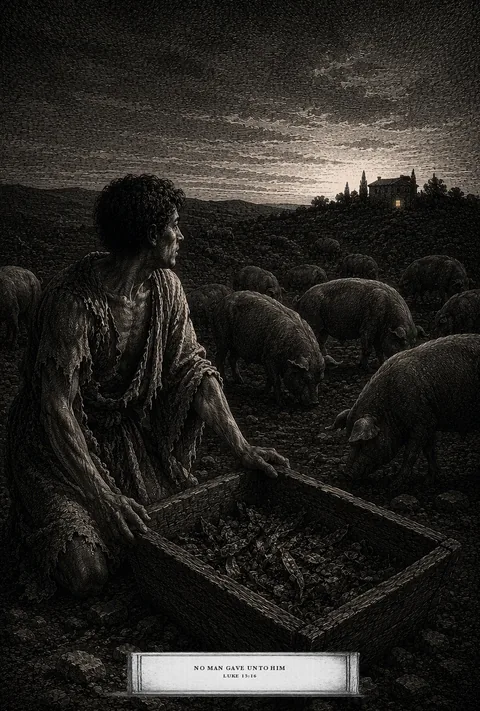
The prodigal lived it from the other side. In the far country the younger son “joined himself to a citizen of that country; and he sent him into his fields to feed swine. And he would fain have filled his belly with the husks that the swine did eat: and no man gave unto him” (Luke 15:15-16). The lost house in exile, bonded to the unclean nation, tending its appetites, envying its slop — and discovering that the far country feeds its swine and not its servants. His coming to himself is a bread-count — “how many hired servants of my father’s have bread enough and to spare” (Luke 15:17) — and his restoration is a robe and a table: “Bring forth the best robe… bring hither the fatted calf… and let us eat” (Luke 15:22-23). Feeding swine is what exile is; the feast is what return looks like. Between the trough where no man gave and the table where the Father gives stands the whole gospel — and the swine-field is the one station with no giver in it.
The Sow That Was Washed
Peter closes the case on the beast, and he closes it on teachers:
But it is happened unto them according to the true proverb, The dog is turned to his own vomit again; and the sow that was washed to her wallowing in the mire.
The chapter is doctrinal end to end — it opens on “false teachers… who privily shall bring in damnable heresies” (2 Peter 2:1) and calls them “wells without water” (2 Peter 2:17) — and it ends on the pun the Hebrew Matthew wrote into the swine verse: both halves of the proverb turn on returning, and the chazir is the returner. The washing was real; the nature was not changed by it. The sow’s appetite survived her bath, because a bath is not a birth: “by one Spirit are we all baptized into one body” (1 Corinthians 12:13) — washed and incorporated. Washed only, she goes back under the feet that trample — into the mire, the trodden street-clay, the one place Ezekiel’s healing river passes by: “the miry places thereof… shall not be healed” (Ezekiel 47:11).
The Swine Inside the Gates
The Old Testament’s last swine verses aim inward — not at Rome, but at covenant men wearing the beast’s structure. Isaiah’s indictment builds across two chapters: they sacrifice in gardens, burn incense on altars of brick, “remain among the graves… which eat swine’s flesh, and broth of abominable things is in their vessels” — and then the boast that gives the beast away: “which say, Stand by thyself, come not near to me; for I am holier than thou” (Isaiah 65:3-5). The swine-eater claims extra holiness — hoof without cud, worn as a crown. In the next chapter the offerings themselves invert: “he that killeth an ox is as if he slew a man… he that offereth an oblation, as if he offered swine’s blood” (Isaiah 66:3) — worship from the self-willed is the unclean offering, whatever is on the altar. The sequence ends at the LORD’s coming:
The gardens are not horticulture: a garden is a planted stand of nation-trees, as the Trees chapter surveyed — so these seek their sanctification among the nations, behind one tree in the midst, with a deliberate menu of the forbidden on their lips (the mouse stands on the same Leviticus list as the swine). Self-sanctified, gentile-grown, and judged at the coming: the food law stands in Scripture’s final vision, and the man who eats the counterfeit meat has made himself its emblem.
Now set Isaiah’s swine-eaters beside a phrase of Revelation. Twice the risen Lord speaks of “them which say they are Jews, and are not, but are the synagogue of Satan” (Revelation 2:9; 3:9) — the assembly that claims the name without the truth of it; and “thy law is the truth” (Psalm 119:142): the name worn, the law missing. That is the swine’s structure stated of a whole assembly: the outward sign worn, the inward work absent — Romans 2:28-29’s outward Jew, gathered into a body. Isaiah had already drawn them: “Your brethren that hated you, that cast you out for my name’s sake, said, Let the LORD be glorified” (Isaiah 66:5) — persecution dressed in praise, from inside the family, in the very chapter where the swine’s flesh is eaten by the self-sanctified. The parted hoof can incorporate; it can fill a room and call itself an assembly. What it cannot do is chew the cud — and by that test, not by the nameplate, the two assemblies are told apart.
Under the flesh-as-teaching register this book keeps meeting, one more floor opens. The consonants of basar, flesh, are the consonants of the herald’s tidings — the root of besorah, the gospel-word, as the Gospel chapter found. To eat swine’s flesh, at that depth, is to receive the swine’s tidings — “another gospel: which is not another” (Galatians 1:6-7) — the counterfeit good-news of the nation that never chews what it swallows. The other white meat is the other gospel.
Peter’s Sheet, and the Boundary
One vision guards this symbol from both abuses. When God opened the door to the nations He showed Peter a sheet of “all manner of fourfooted beasts” with the command, “Rise, Peter; kill, and eat” — and Peter gives the vision’s own interpretation, twice: “God hath shewed me that I should not call any man common or unclean” (Acts 10:28). The beasts are men; the vision is God taking nations into covenant — the Trees chapter walked it through. It changes what the nations are, not what dinner is: years later Peter still writes of the washed sow, because the beast that stays a beast stays unclean. A man may stop being pictured by the swine — the Gadarene was; the prodigal was — and the sheet declares that no nation is beyond the cleansing. But the picture itself never becomes food.
Living the Similitude
Now weigh what the whole case makes of the command itself. God says of the prophets, “I have multiplied visions, and used similitudes, by the ministry of the prophets” (Hosea 12:10) — and the Signs & Similitudes chapter showed what that ministry cost: Hosea’s marriage was the similitude, Ezekiel’s siege-brick was the similitude; the prophets did not merely speak the pictures, they lived them, by obedience. It went as far as the oven. Ezekiel was commanded to bake his siege-bread over human dung (Ezekiel 4:12), and the similitude was decoded on the spot:
Even thus shall the children of Israel eat their defiled bread among the Gentiles, whither I will drive them.
His protest is the measure of the man: “Ah Lord GOD! behold, my soul hath not been polluted: for from my youth up even till now have I not eaten of that which dieth of itself, or is torn in pieces; neither came there abominable flesh into my mouth” (Ezekiel 4:14). A prophet cast in a similitude of defiled food pleads his clean diet as his whole credential — and God changes the sign, not the man: “I have given thee cow’s dung for man’s dung” (Ezekiel 4:15). The food law casts every covenant household in the same theater. The man who eats the clean and refuses the swine enacts, three meals a day, the picture the law drew: take in what walks and ruminates — the word received and worked — and take nothing that only appears clean. His table is a lived similitude, as Hosea’s house was. The theater is not the reason the command binds — it binds because God spoke it — but it is the reason revealed: obedience is a role in the play, and the prophets teach us to want the part.
You have now watched the beast from every side — at the vine, under the pearls, among the tombs, at the trough, in the mire, and inside the gates claiming the name. Keep the command, and you fulfill the picture; explain the picture away and drop the command, and you have become the picture’s subject — the parted hoof with nothing brought back up. The command stands, the similitude stands on it, and the two assemblies stand before it: one brings the word back up and chews it toward doing; the other wears the hoof. Taste is the whole difference — and the glossary ahead holds the vocabulary this book has assembled so that yours, by use, may be exercised to discern.