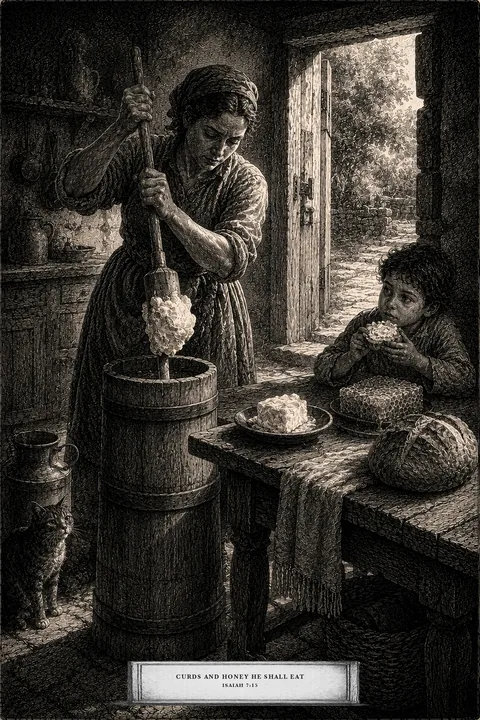
Surely the churning of milk bringeth forth butter.
— Proverbs 30:33
Butter
Butter begins at the churn: milk — the word received — worked by labor until it sets solid. Very few would connect butter to sound doctrine and meat. Scripture does, and in more places than the churn.
The Discernment Diet
Isaiah serves butter to the survivors:
The remnant eats the worked word. The outcome of that diet was named seven verses earlier — Immanuel eats butter and honey to “know to refuse the evil, and choose the good” (Isaiah 7:15), the discernment Hebrews assigns to the strong-meat eater (Hebrews 5:14).[1]
Washed Steps
Job, remembering his best days, packs four symbols into one sentence:
The steps are the walk — the way a man’s feet keep; and Job washed his in butter: a walk cleansed by the worked word. Beside it, the rock — the covenant — pours out rivers of oil, the pressed and proven works. No literal dairy explains the sentence; the symbols read it in one breath.
Butter in the Wilderness
When David fled Absalom, provision met him in the wilderness:
…wheat, and barley, and flour… and honey, and butter, and sheep, and cheese of kine, for David, and for the people that were with him, to eat: for they said, The people is hungry, and weary, and thirsty, in the wilderness.
The anointed king, hungering and thirsting in the wilderness, is fed butter by faithful hands. The counterfeit belongs to the very same story. Psalm 55 is David’s psalm of the betraying counselor in that crisis, and it names his speech:
Counterfeit butter and counterfeit oil in a single verse — speech worked smooth to imitate sound doctrine, with drawn swords beneath. The third symbol is swords, and the sword is the word — “the sword of the Spirit, which is the word of God” (Ephesians 6:17). All three terms of the psalm’s ledger are word-symbols — butter, oil, sword.
A symbol’s sense can turn with its bearer, and here every term is the deceiver’s version; but the structure of the analogy holds, and its holding is itself a witness: even the counterfeit prices itself in the true currency. In one crisis Scripture sets both dishes on the table: true butter carried to the fugitive king, and butter-smooth counsel hunting him.
A Lordly Dish
Jael’s hospitality escalates through the whole dairy:
He asked water, and she gave him milk; she brought forth butter in a lordly dish.
Asked for water, she serves milk and sets out butter — and the enemy of Israel, fed the richest the tent held, lies down and is finished. Whether the asked-for water carries the living-water register is a question this book leaves open; the escalation itself — water, milk, butter — runs the symbol’s whole ladder in one verse.
The churn stands, then, as more than a figure of growth. Butter is the word worked solid: the discernment diet, the remnant’s food, the wash of the walking feet — and the LORD himself accepted it at Abraham’s table (Genesis 18:8) and listed it in His own provision (Deuteronomy 32:14). The final test is whether what was set before you was churned — or merely smoothed. And the meat on the same table has its counterfeit too — the flesh that presents clean and is not — and it is the next chapter.