Thou shalt anoint them, and consecrate them, and sanctify them, that they may minister unto me in the priest's office.
— Exodus 28:41
The Anointing
Anointing is a church word everyone recognizes and few define. It has gathered oil, the Spirit, healing, power, and a feeling of divine presence into one religious fog. Scripture uses the word more exactly.
Marked for a Work
The Hebrew verb is mashach: to smear or rub. The Greek sacred-use verb is chriō, carrying the same act. The action is physical at first, but its purpose is stated in the sentence where Aaron and his sons receive it:
…thou shalt anoint them, and consecrate them, and sanctify them, that they may minister unto me in the priest’s office.
The final clause defines the first: anoint them that they may minister in the office appointed to them. Anointing marks a person as God’s own and installs him in a stated work. Kings are anointed to rule, priests to minister, and Elisha “to be prophet” in Elijah’s place (1 Kings 19:16).
The same verb is laid on things that can hold no spiritual gift:
Thou shalt take the anointing oil, and anoint the tabernacle, and all that is therein, and shalt hallow it, and all the vessels thereof: and it shall be holy.
The tabernacle, ark, altar, laver, and vessels are all anointed (Exodus 30:26-29; 40:9-11). No one imagines the altar received the Holy Spirit. Its anointing removed it from ordinary use, marked it as the LORD’s, and appointed it to the service for which it was made.
Anointed After the Spirit Departed
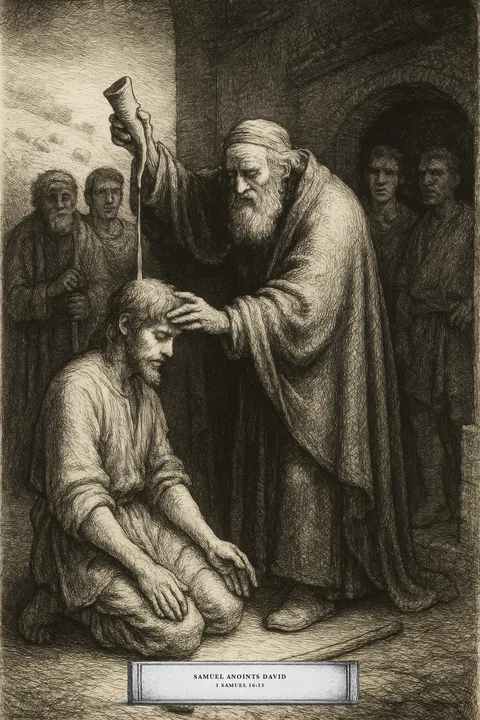
David receives both appointment and power, in 2 clauses Scripture keeps distinct: Samuel “anointed him in the midst of his brethren: and the Spirit of the LORD came upon David from that day forward” (1 Samuel 16:13). The oil marks the chosen king; the Spirit equips him for the kingdom. Related does not mean identical, and Saul proves the difference.
The next verse says “the Spirit of the LORD departed from Saul” (1 Samuel 16:14). Years afterward David still refuses to kill him:
The LORD forbid that I should do this thing unto my master, the LORD’S anointed, to stretch forth mine hand against him, seeing he is the anointed of the LORD.
Saul remained the anointed king after the Spirit departed. His appointment still stood until God removed him from the office; his empowerment did not.
Cyrus separates the terms even farther. God calls the Persian ruler “his anointed” and commissions him to subdue nations and release Israel (Isaiah 45:1), then says twice that Cyrus “hast not known me” (Isaiah 45:4-5). Scripture records no priest pouring Israel’s holy compound on his head, and the text grants him no indwelling Spirit. God nevertheless chose him, took his right hand, and assigned his work. God’s appointment is enough for the title: Cyrus is anointed because he is God’s appointed instrument.
The patriarchs bear the same name without a recorded oiling. God guards Abraham, Isaac, and Jacob from kings under the command “Touch not mine anointed, and do my prophets no harm” (Psalm 105:9-15). The status rests on God’s choice and claim, not on oil remaining in the hair.
Anointed With the Spirit
The New Testament states the relationship without collapsing it:
God anointed Jesus of Nazareth with the Holy Ghost and with power: who went about doing good, and healing all that were oppressed of the devil; for God was with him.
God appoints; Jesus is the appointed; the Holy Spirit and power equip Him; doing good and healing are the assigned work made visible. The Spirit does not define the verb any more than the priesthood defines it in Exodus. He is the power with which God furnishes the Anointed for His work.
Isaiah’s prophecy follows the same order: “The Spirit of the Lord GOD is upon me; because the LORD hath anointed me to preach good tidings” (Isaiah 61:1; Luke 4:18). The anointing has an infinitive attached — to preach — because an appointment names a work. Paul likewise places the acts side by side without making them synonyms: God “hath anointed us,” “sealed us,” and “given the earnest of the Spirit in our hearts” (2 Corinthians 1:21-22).
English hides another distinction. When the New Testament speaks of putting oil on the sick, perfume on a guest, or ointment on a body, it ordinarily uses aleiphō (Mark 6:13; Luke 7:46; John 12:3; James 5:14). When it speaks of God’s appointment of Jesus or His people, it uses chriō (Luke 4:18; Acts 4:27; 10:38; 2 Corinthians 1:21). One English word, anoint, covers both the ordinary smearing and the sacred appointment, and religious speech has blurred them back together.
Oil for the Light, Oil for the Office
The law refuses the final confusion in one inventory:
Oil for the light, spices for anointing oil, and for sweet incense.
Lamp oil and anointing oil stand as separate provisions. The lamp receives “pure oil olive beaten for the light” so that it will burn continually (Exodus 27:20). The holy anointing oil is a compounded ointment: olive oil carrying myrrh, cinnamon, calamus, and cassia, forbidden on ordinary flesh and forbidden to be copied (Exodus 30:22-33). The shared olive does not erase the different preparation or work.
Zechariah’s lampstand joins oil and Spirit without making them the same thing. The word to Zerubbabel is “Not by might, nor by power, but by my spirit” because the work in view is the temple his hands will finish (Zechariah 4:6-9). When Zechariah asks what the 2 olive branches are, the angel answers, “These are the two anointed ones” (Zechariah 4:11-14); he never answers, “the oil is the Spirit.” The Spirit is the power behind the appointed servants and their completed work. Ezekiel names that work in a person: “I will put my spirit within you, and cause you to walk in my statutes, and ye shall keep my judgments, and do them” (Ezekiel 36:27).
Anointing oil marks an office; lamp oil burns into light. The king’s appointment cannot be poured backward into the virgins' lamps and made their definition merely because both substances began at an olive. The question in the parable remains what the oil in a lamp does, where it is stored, why it cannot be lent, and what the wise must do to obtain it.
The Anointed One
The recovered word has been spoken in every church service. Mashiach comes from mashach; Messiah means Anointed One. Greek carries the title across as Christos, Christ. Andrew says it without a dictionary: “We have found the Messias, which is, being interpreted, the Christ” (John 1:41).
To call Jesus Christ is to confess that God appointed Him — the King, Priest, and Prophet in whom every lesser anointing meets — and furnished Him for the work. The title does not mean “the One who is oil,” nor does the verb mean “to give the Spirit.” It names God’s choice, claim, and commission.
To anoint is to mark a person or thing as God’s own and appoint it to a stated office or work. Oil may carry the visible mark; the Spirit may carry the power; the work declares what the appointment is for. Keep those 3 in their places and the religious fog lifts: sign, power, and office, joined without being confused.
The anointing gives oil its office. The next chapter takes another worked food in hand: Butter, milk labored until it stands solid.