Circumcise yourselves to the LORD, and take away the foreskins of your heart, ye men of Judah and inhabitants of Jerusalem: lest my fury come forth like fire.
— Jeremiah 4:4
The Foreskin
Jeremiah lays a double command on the same field: “Break up your fallow ground, and sow not among thorns… take away the foreskins of your heart” (Jeremiah 4:3-4). Plowing and circumcising, one operation in two figures — but the second figure assumes something: that a heart can wear a foreskin, and that the reader knows what one means. So gather the uses, as this book does with every candidate, and let Scripture define it.
Scripture’s Own Decode
Paul names what the circumcision of the heart removes, in so many words:
In whom also ye are circumcised with the circumcision made without hands, in putting off the body of the sins of the flesh by the circumcision of Christ.
What is cut away is “the body of the sins of the flesh.” That is the foreskin’s meaning, stated out loud: the foreskin is the blocking flesh — the layer of the natural man that covers a covenant member and stops its work. Test the definition against every member Scripture attaches it to.
The Blocked Members
The heart. Moses commands, “Circumcise therefore the foreskin of your heart, and be no more stiffnecked” (Deuteronomy 10:16) — the covered heart is the stiff neck. Leviticus pairs it with pride: exile runs its course “if then their uncircumcised hearts be humbled” (Leviticus 26:41). And when God himself performs the surgery, the freed function is love: “the LORD thy God will circumcise thine heart… to love the LORD thy God with all thine heart, and with all thy soul, that thou mayest live” (Deuteronomy 30:6).
The ear. “To whom shall I speak, and give warning, that they may hear? behold, their ear is uncircumcised, and they cannot hearken: behold, the word of the LORD is unto them a reproach; they have no delight in it” (Jeremiah 6:10). The flesh over the ear blocks the word from the organ of hearing — and to hear, this book has shown, is to obey. Here is the Old Testament’s own diagnosis of the crowd at Capernaum, who ate the loaves and could not hear the hard saying: the word arrived at ears still covered.
The lips. Moses protests his commission twice with the same figure — “how then shall Pharaoh hear me, who am of uncircumcised lips?” (Exodus 6:12, 30) — speech blocked at the member that should carry it.
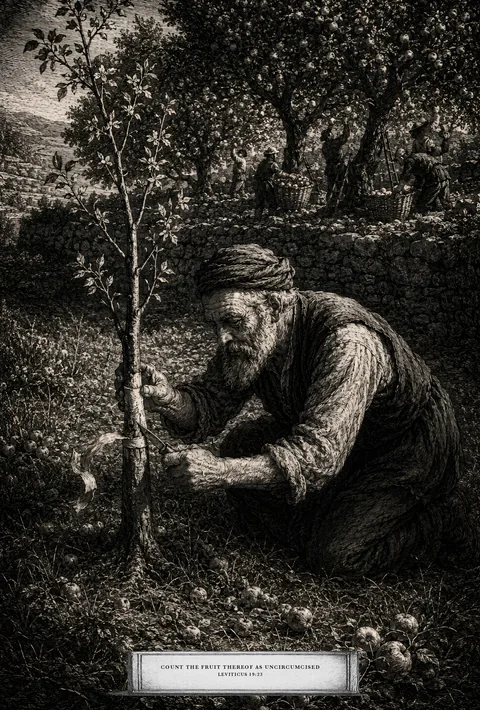
Even the fruit of a tree. “And when ye shall come into the land, and shall have planted all manner of trees for food, then ye shall count the fruit thereof as uncircumcised: three years shall it be as uncircumcised unto you: it shall not be eaten of” — and “in the fourth year all the fruit thereof shall be holy to praise the LORD” (Leviticus 19:23-24). The word is orlah, the foreskin word: a young tree’s produce is its foreskin until the covenant year — fruit blocked from acceptable use, then released holy.
Stephen gathers the members into one indictment: “Ye stiffnecked and uncircumcised in heart and ears, ye do always resist the Holy Ghost: as your fathers did, so do ye” (Acts 7:51).
Cut, or Be Cut Off
The covenant states the alternative in its own wordplay:
And the uncircumcised man child whose flesh of his foreskin is not circumcised, that soul shall be cut off from his people; he hath broken my covenant.
Cut the flesh away, or be cut away from the people — the choice is which cutting.
The sign’s placement also teaches, although this remains observation rather than derivation: the literal mark sits on the member where seed passes, and the seed, in the language of this book, is the word. The circumcision of the heart clears the same obstruction one member up: “circumcision is that of the heart, in the spirit, and not in the letter” (Romans 2:29).
Jeremiah’s two figures thus close into one. Break up the fallow ground; take away the foreskin: plow and knife, both removing the barrier so the seed can enter the heart and bear. The sower’s soils share one condition — unplowed, unbroken, choked — and the cure was published with the command: let God circumcise the heart, “that thou mayest live.”