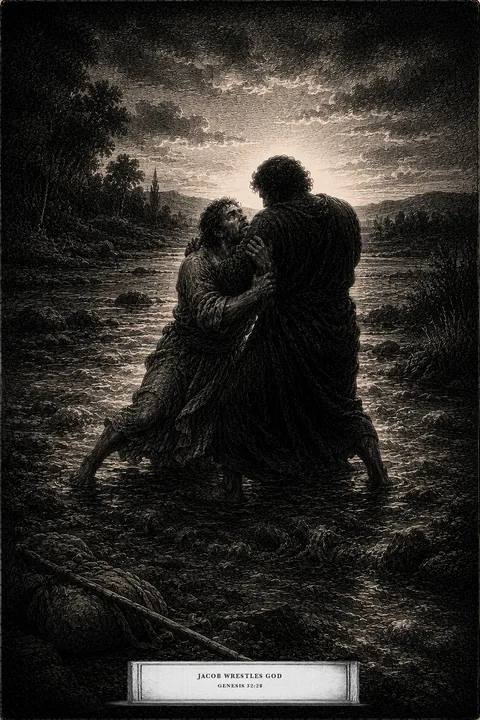
Thy name shall be called no more Jacob, but Israel: for as a prince hast thou power with God and with men, and hast prevailed.
— Genesis 32:28
Jacob, Israel, and Ephraim
A man wrestles God through the night, will not let go, and at daybreak is given a new name:
Thy name shall be called no more Jacob, but Israel: for as a prince hast thou power with God and with men, and hast prevailed.
What does that change of name mean? The common readings rank this way:
| Rank | Common interpretation |
|---|---|
1 |
Jacob the carnal “old man” put off; Israel the spiritual “new man” put on |
2 |
Simply the patriarch — and his nation — renamed; a plain name change |
3 |
From sinner to saint: a conversion at the brook |
4 |
A title earned for prevailing in the wrestling |
The first reading makes Jacob the flesh and Israel the spirit, the old self traded for the new — Paul’s “put off… the old man” and “put on the new man” (Ephesians 4:22-24) read back into the patriarch. It is half right and wholly misread, for Scripture will not let the change be a swap of two men.
God first gives him the name Israel after the wrestling (Genesis 32:28). Later, at Bethel, God reaffirms it: “thy name shall not be called any more Jacob” (Genesis 35:10). Yet Scripture keeps right on calling him Jacob, and God names Himself to the end “the God of Jacob.” Isaiah even trades the titles between the two names — “Israel… my servant, Jacob whom I have chosen” (Isaiah 41:8), then “Jacob my servant; and Israel, whom I have chosen” (Isaiah 44:1); and each name runs the whole range, for He “hath not beheld iniquity in Jacob” (Numbers 23:21) and yet “Israel is defiled” (Hosea 5:3).
The names are not flesh and spirit, the bad man traded for the good. There is a real change — but it is the straightening of one heart, not the swapping of two selves. They are one man told in two words, and between them lies the whole work of God on a human heart.
Jacob: The Crooked
The first name is a verdict. He was born gripping his brother’s heel — “his name was called Jacob” (Genesis 25:26), heel-grabber — and he lived up to it, seizing the birthright and stealing the blessing, until Esau cries out:
Is not he rightly named Jacob? for he hath supplanted me these two times…
The root of the name throws off a second word, aqob — crooked, deceitful — and that word lands on every one of us: “The heart is deceitful [aqob] above all things” (Jeremiah 17:9). Jacob is not one crooked man; he is the crooked heart itself, the grasping, scheming nature every son of Adam is born wearing. To be named Jacob is only to be human.
Israel: The Crooked Made Straight
The second name is what God does with such a heart. Israel — to prevail with God — is given not for bloodline but for what happened in the dark: he held on, “and prevailed.” Hosea tells how:
…he had power over the angel, and prevailed: he wept, and made supplication unto him…
The prevailing was not sharper cunning; it was the supplanter brought to the end of himself, weeping, clinging, asking. And the very root that named him crooked names the cure — “the crooked [aqob] shall be made straight” (Isaiah 40:4). Israel is Jacob made straight.
Which is why the new name is never simply handed over; it begins with a confession of the old. God asks, “What is thy name?” Jacob answers, “Jacob” (Genesis 32:27) — name the crooked thing, and only then receive the new.
The end of the work is a man with the grasping gone, and Jesus names him the moment He sees him: “Behold an Israelite indeed, in whom is no guile!” (John 1:47) — Jacob, with the Jacob taken out.
The Renewed Covenant
The new name is a renewed covenant. We have seen that a name is a covenant, and a new name a covenant renewed — and that is exactly what Jacob received. Going out to the nations, he had been given the covenant of his fathers at Bethel: “I am the LORD God of Abraham thy father, and the God of Isaac… the land whereon thou liest, to thee will I give it” (Genesis 28:13). Coming home, God renews it and seals it to the new name:
…Israel shall be thy name: and he called his name Israel. And God said unto him, I am God Almighty: be fruitful and multiply; a nation and a company of nations shall be of thee… And the land which I gave Abraham and Isaac, to thee I will give it, and to thy seed after thee will I give the land.
The covenant of the fathers, renewed with the son, under the new name — and already carrying the company of nations the scattered house will become.
See when it is won. The wrestling lasts “until the breaking of the day” (Genesis 32:24): Jacob holds on through the whole night — “I will not let thee go, except thou bless me” (Genesis 32:26) — and the new name, the renewed covenant, comes with the dawn.
Here is the pattern of the people who bear the name. Israel holds to God through the night — the long night among the nations, the scattering of his own house — and will not loosen his grip until the day breaks and the covenant is renewed. The one who holds on through the dark receives, in the morning, the new name and the covenant of his fathers made his own.
For the morning is when the long sorrow turns — “weeping may endure for a night, but joy cometh in the morning” (Psalm 30:5) — and it is the hour the Lord Himself, held in the heart of the earth through His own night, rose “very early in the morning… at the rising of the sun” (Mark 16:2), “the firstfruits of them that slept” (1 Corinthians 15:20). Hold on through the night, and the morning brings the new name, the renewed covenant, joy, and life.
They Are Not All Israel
Israel, then, was never a matter of descent. It is the new name of the one who overcomes, and the New Testament says so flatly:
…For they are not all Israel, which are of Israel:
The Jew is “one inwardly” (Romans 2:28-29) — and Paul’s definition carries Judah’s name inside it: Judah means praise — “Now will I praise the LORD: therefore she called his name Judah” (Genesis 29:35) — and the verse lands exactly there: the Jew inwardly is he “whose praise is not of men, but of God.” The word wears three coats — ethnic, religious, covenant — and as with every symbol, the context tells you which one it is wearing.
The blessing rests on “the Israel of God,” as many as “walk according to this rule” (Galatians 6:16); and the wild branch is “graffed in” to the same tree (Romans 11:17) — for here the tree is the nation, and this nation receives whoever is joined to it by covenant. This is the new name promised to every overcomer — “a new name… which no man knoweth saving he that receiveth it” (Revelation 2:17). Jacob at the ford is the first of them: the natural man who contends with God, is brought low, and rises bearing the covenant name.
Ephraim: Fruit in the Land of Affliction
Within Israel there is a firstborn, and his name carries a prophecy. Joseph calls his second son Ephraim — double fruit:
…Ephraim: For God hath caused me to be fruitful in the land of my affliction.
Fruit, and fruit in affliction — the name is the story. God sets this son above his elder (“Ephraim is my firstborn,” Jeremiah 31:9), and over him aged Jacob speaks the strangest blessing in Genesis:
…his seed shall become a multitude of nations.
A multitude of nations out of one tribe — the Hebrew is melo ha-goyim, the fulness of the nations.
The way it comes to pass is by scattering. Ephraim “mixed himself among the people” and became “a cake not turned” (Hosea 7:8), until he was “broken, that it be not a people” (Isaiah 7:8). The judgment looks like his end — but it is how the seed reaches every nation: he is lost on purpose, sown into all the earth. And Paul names the harvest in the very words of the blessing — “the fulness of the Gentiles” (Romans 11:25): melo ha-goyim, come in at last.
Two Sticks, One Nation
The scattered are lost to men, never to God; beneath the judgment runs a Father’s grief:
How shall I give thee up, Ephraim?… mine heart is turned within me, my repentings are kindled together.
The lost are sought — Jesus is sent “unto the lost sheep of the house of Israel” (Matthew 15:24) — and the divided are made one. The word for the two “sticks” Ezekiel is handed is ets — the same word Scripture uses for a tree — and he is told to make the two one:
…Behold, I will take the stick of Joseph, which is in the hand of Ephraim, and the tribes of Israel his fellows, and will put them with him, even with the stick of Judah, and make them one stick, and they shall be one in mine hand.
At this scale a tree is a nation; so these are two nation-trees — Judah and Joseph-Ephraim — made one tree, “one in mine hand,” that “they shall be no more two nations, neither shall they be divided into two kingdoms any more at all” (Ezekiel 37:22).
The sentence on the scattered is reversed:
…in the place where it was said unto them, Ye are not my people, there it shall be said unto them, Ye are the sons of the living God.
Peter says it of the gathered church: “which in time past were not a people, but are now the people of God” (1 Peter 2:10).
The two sticks have a second portrait, painted in the same orchard. The olive-tree name was given jointly — “The LORD called thy name, A green olive tree, fair, and of goodly fruit” — and the next verse names those who wear it: “the house of Israel and… the house of Judah” (Jeremiah 11:16-17). Two houses under one green name; so when Zechariah is shown “two olive trees” flanking the golden candlestick, emptying “the golden oil out of themselves” through pipes into its lamps (Zechariah 4:3, 12), the two trees of the one name stand where the two sticks stood. Revelation seals the reading: the two witnesses “are the two olive trees, and the two candlesticks” (Revelation 11:4) — and a candlestick, by the book’s own key, is an assembly (Revelation 1:20): not two men, but two covenant peoples bearing witness.
The trees supply oil — the pressed, proven works of the olive — the oil burns in the lamp, and the lamp, Scripture says, is “the commandment” (Proverbs 6:23); what comes out is light. For whom? Isaiah answers in one breath — to “raise up the tribes of Jacob, and to restore the preserved of Israel,” and “I will also give thee for a light to the Gentiles” (Isaiah 49:6); “this is your wisdom and your understanding in the sight of the nations” (Deuteronomy 4:6). The two sticks become one in His hand; the two olive trees feed one lamp.
The three names are one road. Jacob is the crooked heart every man is born with; Israel is that heart made straight, prevailing with God and given the covenant name; Ephraim is that people made fruitful in affliction, scattered as seed into all the nations, and gathered home into one. Israel was never a bloodline to be born into. It is a new name to be given — to the supplanter who weeps and holds on, in whom at last there is no guile.