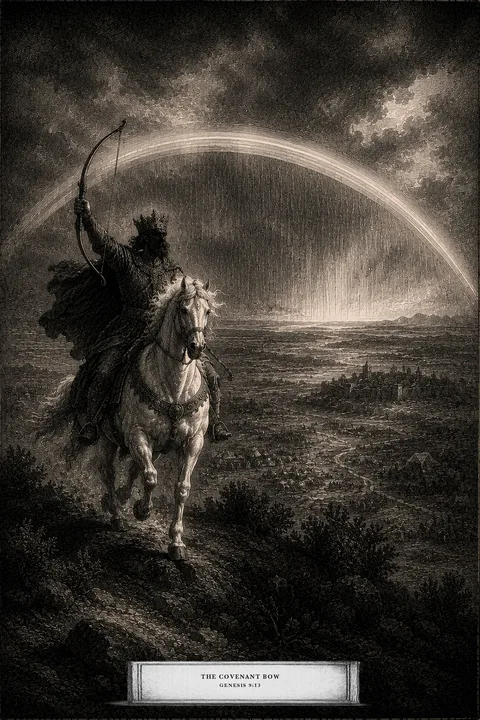
And the bow shall be in the cloud… that I may remember the everlasting covenant between God and every living creature.
— Genesis 9:16
The Bow
Everyone knows the rainbow as God’s sign after the flood. But the Hebrew names it plainly: it is a qesheth, a bow — the same word used everywhere else for the warrior’s weapon. Scripture states outright what this bow is:
I do set my bow in the cloud, and it shall be for a token of a covenant between me and the earth.
“A token of a covenant.” This is not an analogy we are reading into the text; the text sets the war-bow in the sky and names it the sign of God’s covenant. The bow is the covenant.
See its reach. God makes this first covenant “between me and you and every living creature of all flesh” (Genesis 9:15) — and in the language of these symbols a living creature is a nation: the beasts of Daniel’s sea are kingdoms, and the living creatures of Revelation are peoples. The very first bow-covenant, then, is struck not with one tribe but with every nation on earth — a universal covenant of peace, set over all the families of the ground. That reach governs what follows.
The Bow Is the Covenant
Once you see it here, the symbol runs everywhere, because qesheth is never merely hardware. It is a kingdom’s might: “the bow of Elam, the chief of their might” (Jeremiah 49:35). And it is a binding bond: Isaiah pictures fleeing rulers “bound” — the Hebrew is asar, to yoke, the root of the word for a vow — “by the bow” (Isaiah 22:3, where the KJV hides the word as “archers”).
Weapon, might, covenant, vow: one word carries them all, because they are one thing. A kingdom’s armed power is the outward face of the covenant that holds it together. The bow is what a people is strung together by.
The New Testament keeps the symbol whole. Its single bow — toxon, the only bow in the New Testament — belongs to the conqueror on the white horse:
…he that sat on him had a bow; and a crown was given unto him: and he went forth conquering, and to conquer.
He carries a bow, yet no arrow is ever loosed. He conquers not by the shot but by the bow itself — he wins the nations by covenant. (Whether this rider is the true King binding the nations to Himself or a counterfeit binding them to a lie is a question this book leaves open; either way, the instrument of conquest is a covenant.)
Scripture even stages the symbol inside a covenant scene. “Then Jonathan and David made a covenant, because he loved him as his own soul” — and the cutting is sealed by a handover of arms: “Jonathan stripped himself of the robe that was upon him, and gave it to David… even to his sword, and to his bow, and to his girdle” (1 Samuel 18:3-4). The bow passes when the covenant is cut. And when Jonathan fell, David commanded Judah to learn his lament — “he bade them teach the children of Judah the bow” (2 Samuel 1:18): the Song of the Bow, sung for the covenant-brother whose “bow turned not back” (2 Samuel 1:22).
Habakkuk writes the whole equation in a single verse:
Thy bow was made quite naked, according to the oaths of the tribes, even thy word.
God’s bow unsheathed is His sworn word to the tribes, riding out beside the “chariots of salvation” we met in the sea chapter (Habakkuk 3:8). And when God draws, look what fills His hand: “I have bent Judah for me, filled the bow with Ephraim” (Zechariah 9:13) — the covenant is the weapon, and the covenant people are its string and its arrows.
Make Us a Name
If the bow that holds a kingdom together is finally a covenant, then the bond can be made of nothing but a word. So it was with the first kingdom built against heaven: it was founded not on a weapon but on a name. At Babel men gather to build, and they name their purpose:
…let us make us a name, lest we be scattered abroad upon the face of the whole earth.
The reason they give is a name — “lest we be scattered.” The name is the bond that holds them as one people; cut it, and they fly apart. And a name[1], as the Name chapter showed, is a covenant — the binding constitution of a people. Babel’s project is a self-made covenant, a bow of their own stringing, forged to bind a kingdom together in defiance of the God who set the nations apart. And God answers in kind: He does not topple the tower, He cuts the bond.
…the LORD did there confound the language of all the earth: and from thence did the LORD scatter them abroad upon the face of all the earth.
Their one speech was the string of their bow; God cuts it, and the kingdom springs apart. The very scattering they built a name to prevent is the scattering He brings. Break the bond, and the people disperse.
Elam and the Mortar of Babel
This is the system Scripture calls Babylon, and it has a partner that shares its judgment: Elam. The two stand together in the first war in the Bible — four kings against five, the coalition led by “Chedorlaomer king of Elam” alongside “Amraphel king of Shinar” (Genesis 14:1, 9), and Shinar is Babel (Genesis 10:10). And where do they fight? In a valley “full of slimepits” (Genesis 14:10) — where the word for that slime, chemar, is the very word for the mortar of Babel’s tower: “slime had they for morter” (Genesis 11:3). The Elam-Babylon war is fought on ground paved with Babel’s own building-material.
Against them stands Abram with his household and his allies, “confederate” with him (Genesis 14:13) — in the Hebrew, literally masters of a covenant with Abram: a true covenant set against the self-covenant. So when the prophets take up Elam, they take up Babel’s old confederate — Jeremiah’s oracle against Elam stands as the prologue to his great prophecy of Babylon’s fall, and the sentence on both is the same: the bow broken.
Break the Bow
How, then, does God bring down a kingdom bound by such a bow? He breaks the bow. Hear it where it cannot be missed — bow-breaking set side by side with covenant-making:
And in that day will I make a covenant for them… and I will break the bow and the sword and the battle out of the earth, and will make them to lie down safely.
To break the bow is covenant work: the violent self-bond shattered, God’s own covenant of peace put in its place — and Hosea says it in the very scene where God re-betroths His divorced wife (Hosea 2:19), the wedding we met in the Marriage and Divorce chapter. So the sentence on the Babylon-system reads exactly so:
Behold, I will break the bow of Elam, the chief of their might.
Against Babylon herself, “every one of their bows is broken” (Jeremiah 51:56). The might, the constitution, the binding covenant of the kingdom are all that one bow, and God snaps it — “he breaketh the bow, and cutteth the spear in sunder” (Psalm 46:9). The kingdom that strung itself together against Him comes unstrung, and scatters.
Nor is the breaking reserved for the heathen. When Israel’s own covenant was strung against Him, the same sentence fell on His own house: “I will break the bow of Israel in the valley of Jezreel” (Hosea 1:5). For the covenant-breaker has a bow-name in Scripture: “they dealt unfaithfully… they were turned aside like a deceitful bow” (Psalm 78:57); “they return, but not to the most High: they are like a deceitful bow” (Hosea 7:16). A deceitful bow looks strung and true, and betrays the archer at full draw — the exact figure of a people wearing the covenant and failing it in the hand.
Two Names, Two Bows
Set the two covenants side by side and the whole symbol stands clear. At Babel men say, “let us make us a name” — a covenant seized, self-strung, to bind a kingdom against heaven; and God scatters it. In the very next breath of Scripture He turns to one man and says the opposite:
…I will make of thee a great nation, and I will bless thee, and make thy name great; and thou shalt be a blessing.
Not make us a name but I will make thy name — a covenant given, not grasped; and where Babel’s name was built to keep one people from scattering, Abraham’s name is given to bless all the families of the earth.
The bow God first hung in the cloud is hanging there still — “the everlasting covenant” (Genesis 9:16), His war-bow bent in peace over every nation on earth. Scripture sights it twice more, exactly where a covenant should hang. Ezekiel sees the glory ringed “as the appearance of the bow that is in the cloud in the day of rain” (Ezekiel 1:28); John sees “a rainbow round about the throne” (Revelation 4:3), and the mighty angel comes down crowned with one (Revelation 10:1). The war-bow of Noah’s sky encircles the throne of judgment itself: every verdict rendered from that seat is rendered from inside the everlasting covenant.
Notice what the sign is made of. A rainbow has no substance of its own; it is light shining through water — Ezekiel says exactly that, “the appearance of the brightness” in “the day of rain” (Ezekiel 1:28). In this book’s vocabulary neither ingredient is neutral: light is the commandment made visible — “the commandment is a lamp; and the law is light” (Proverbs 6:23) — and the rain is the word poured out — “my doctrine shall drop as the rain” (Deuteronomy 32:2). So the token of the everlasting covenant appears exactly where God’s law shines through His outpoured word: the sign is drawn in the sky out of the covenant’s own two ingredients.
Joseph’s blessing names the secret of a bow that never breaks: “his bow abode in strength… by the hands of the mighty God of Jacob” (Genesis 49:24). The bow’s universal reach is the very thing Babel grasped after to bind one people, and that Abraham was given to carry as blessing to all.
Two names, two covenants, two bows: one strung by men and broken, one set in the heavens by God and kept; every bow drawn against Him comes, in the end, unstrung. The covenant is the bow; and the only bow that abides is the one He strings.