He hath clothed me with the garments of salvation, he hath covered me with the robe of righteousness.
— Isaiah 61:10
Garments & Armor
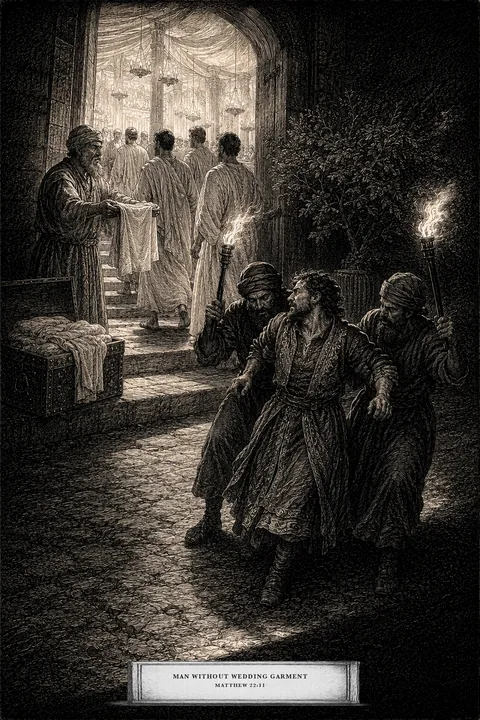
A man is bound hand and foot and thrown out of a wedding feast into the dark — and his offense was his clothing. The feast is no ordinary supper: it is a king’s, made “for his son” (Matthew 22:2) — a parable of the kingdom, and the wedding is the marriage of the Lamb.
The man “had not on a wedding garment” (Matthew 22:11), and when the king asks how he entered so, he has no answer; “he was speechless” (Matthew 22:12) — the Greek is stronger than the English: phimoō, to muzzle, the same word Paul uses of the ox that treads out the grain (1 Corinthians 9:9) and the very word Jesus speaks to the storm and to unclean spirits, “Peace, be still” (Mark 4:39), “Hold thy peace” (Mark 1:25). He was not merely at a loss for words; he was muzzled — silenced the way a power greater than his own silences what it overrules, with no defense in his mouth because he had none on his back.
He was not stopped at the gate — he was invited, seated, and only then found out, for “many are called” (Matthew 22:14). What condemns him is what he has on. At that very marriage Scripture halts to name the garment.
And to her it was granted to be arrayed in fine linen, clean and bright, for the fine linen is the righteous acts of the saints.
NKJV
The fine linen is the righteous acts of the saints — the things they did. The Greek is dikaiōmata, righteous deeds, and the NKJV keeps the plural action visible. The King James shortens it to “the righteousness of saints,” and on that one narrowed word a long confusion is built: righteousness gets turned from something you do into a state you merely have, sanctification folded into justification until the garment seems to require no weaving at all. But the word is plural and active — righteous acts.
The garment is righteousness performed; to be clothed is to have done it, to be bare is to stand in your sins. Nor is the doing self-made: the verse’s first clause says the linen “was given unto her” — deeds God “hath before ordained that we should walk in them” (Ephesians 2:10) — granted, then worn. So the man who came to the wedding with no garment came with no righteous acts on him at all — invited, seated, and naked.
Scripture says plainly what those acts are, for righteousness is itself a word men stumble over — taken for a vague goodness, or a verdict merely received. Put plainly, righteousness is right-living. For a creature under God’s authority, the commandments name what right-living is: “it shall be our righteousness, if we observe to do all these commandments” (Deuteronomy 6:25), for “all thy commandments are righteousness” (Psalm 119:172). Lest anyone make it a state without deeds, John says it in one line: “he that doeth righteousness is righteous” (1 John 3:7). The garment of righteous acts is therefore right-living made visible — the law kept, and worn.
God’s own righteousness does not break the definition. God obeys no superior; His ways are the measure of right: “all his ways are judgment: a God of truth and without iniquity, just and right is he” (Deuteronomy 32:4), and “the LORD is righteous in all his ways, and holy in all his works” (Psalm 145:17). God is Right-Living by definition. When Isaiah sees Him put on righteousness as a breastplate, God is going forth to do right — to judge, repay, and save where no man could (Isaiah 59:16-18).
Romans 4 and Philippians 3, often read as if reckoned righteousness had no life inside it, were treated with Paul’s wage, debt, faith, and obedience vocabulary in The End of the Law. Righteousness is God’s gift in source and right-living in substance: granted, then worn.
This is why the song over this chapter sings the way it does: “he hath clothed me with the garments of salvation, he hath covered me with the robe of righteousness” (Isaiah 61:10) — garments of yeshuah: the covering He gives is salvation-wear, and its fabric is righteousness. And it is the robe the father calls for when the prodigal comes home: “Bring forth the best robe, and put it on him” (Luke 15:22) — the covenant covering restored on repentance, before the boy can finish his speech.
The Covering Is the Covenant
Behind the garment stands the covenant. When God first took Israel for His own, He told it as the clothing of a newborn cast out naked in the open field:
…I spread my skirt over thee, and covered thy nakedness… and entered into a covenant with thee… and thou becamest mine.
Three phrases for one act: to spread the skirt, to cover the nakedness, to enter the covenant. That spread skirt is the kanaph, the wing, doing both of its offices: the edge that carries the fringe bound as the reminder to keep the commandments and do them (Numbers 15:39), and the shade a refuge shelters under.[1] The covenant contains the commands; faithfulness to them gains the covering — and what it covers is the nakedness, the sin.
What follows is a second gift, given inside the covenant:
Then washed I thee with water; yea, I throughly washed away thy blood from thee, and I anointed thee with oil. I clothed thee also with broidered work… and I girded thee about with fine linen…
First the covering of the covenant; then the clothing of the covered. Revelation keeps the same grammar at the wedding — “to her was granted that she should array herself” (Revelation 19:8): given, and put on by her; deeds God “before ordained that we should walk in them” (Ephesians 2:10), worked in her by His word, and washed whiter than snow when she stains them.
The righteous acts that make up the garment, then, are not scattered good turns — they are the covenant lived out, the law kept and worn where every eye can see it. As the name is the covenant owned, the garment is the covenant worn.
The first garment was cut at the cost of blood. The man and his wife stood naked by their sin, and God makes them “coats of skins” and “clothed them” (Genesis 3:21) — a covering that cost a life, the first blood shed to clothe the guilty, and the first shadow of the Lamb to come. So nakedness is a symbol in its own right, the exact opposite of the garment: the clothed are covered by covenant, the naked stand exposed in their breach — and every verse that defines the one defines the other.
Filthy Rags
The garment is woven of righteous acts, and the acts themselves are clean — but the cloth can be soiled. One verse is pressed into service to deny this:
But we are all as an unclean thing, and all our righteousnesses are as filthy rags…
It is read as if obedience itself were filth — as if the more law a man keeps, the dirtier he grows. But read the whole line: “we are all as an unclean thing,” and so even “our righteousnesses” come out stained. It is not the righteous act that is filthy; it is the sin it is worked in. The rag is blood-stained — fouled by the very iniquities the verse goes on to name — not because doing right is wrong, but because the doer is unclean. A clean deed from a stained hand comes away marked.
The answer to a dirty garment is not to take it off; it is to wash it. “Wash you, make you clean,” God says in the same prophet, and then, “though your sins be as scarlet, they shall be as white as snow” (Isaiah 1:16-18). The saints “washed their robes, and made them white in the blood of the Lamb” (Revelation 7:14); Joshua the high priest stands “clothed with filthy garments” until the word goes out, “Take away the filthy garments from him… I will clothe thee with change of raiment” (Zechariah 3:4) — the iniquity removed, the robe made clean. The keeping is itself commanded: the last beatitude in Scripture is for “they that do his commandments, that they may have right to the tree of life” (Revelation 22:14). Those who take no responsibility for their robe — who neither weave nor wash — are the ones found bare.
The Lord enacted it the night before He died. He girded a towel and washed the disciples’ feet, and when Peter refused, He warned, “If I wash thee not, thou hast no part with me” (John 13:8). Then the key:
He that is washed needeth not save to wash his feet, but is clean every whit.
The bath is baptism — washed once into the Name, and so into the covenant: “as many of you as have been baptized into Christ have put on Christ” (Galatians 3:27). A man is not bathed again and again; he is not baptized over and over, and the robe is put on once.
Yet his feet gather the dirt of the road and must be washed — the feet are the walk, the conduct that is a man’s way. Jesus therefore stooped to wash them: not a second baptism, but the daily cleansing of the walk that keeps the garment clean. And “ye also ought to wash one another’s feet” (John 13:14).
There is an opposite error, and it is the older one. In the garden the man and his wife “sewed fig leaves together, and made themselves aprons” (Genesis 3:7) — a covering of their own cut and their own measure, what was right in their own eyes. Scripture marks that road: “There is a way which seemeth right unto a man, but the end thereof are the ways of death” (Proverbs 14:12); “Every way of a man is right in his own eyes: but the LORD pondereth the hearts” (Proverbs 21:2).
God strips the fig leaves off and clothes them Himself, at the cost of blood. The covering must be cut to His pattern, not to ours.
The fig tree itself shows what such a covering is worth. Jesus came to one “having leaves” and “found nothing thereon, but leaves only”; He cursed it — “Let no fruit grow on thee henceforward for ever” — and it withered away (Matthew 21:19; Mark 11:13-14). The leaves are the show; the fruit is the substance. A tree hung with leaves and bearing no fruit is the fig-leaf covering in one picture — the look of righteousness where the works God came seeking are not. He is not fed by leaves; He looks for fruit.
Keep Your Garments
A garment given can still be defiled, so it must be kept. The Lord commends the few in Sardis “which have not defiled their garments,” and promises “they shall walk with me in white” (Revelation 3:4); Jude speaks of “hating even the garment spotted by the flesh” (Jude 23); and the watchword for the last hour is just this:
Behold, I come as a thief. Blessed is he that watcheth, and keepeth his garments, lest he walk naked, and they see his shame.
To keep the garment is to go on doing the righteousness it is made of. This is why the apostles speak of it as something you put on: “put ye on the Lord Jesus Christ” (Romans 13:14); “put on the new man,” and with him “bowels of mercies, kindness… meekness, longsuffering” (Colossians 3:10-12); as Job said long before, “I put on righteousness, and it clothed me” (Job 29:14). The clothing is conduct.
The wardrobe is God’s own: Isaiah watched Him dress — “he put on righteousness as a breastplate, and an helmet of salvation upon his head” (Isaiah 59:17) — and Paul issues the same suit to the soldier: the breastplate of righteousness, the helmet of salvation, truth for a belt and the word for a sword (Ephesians 6:14-17). The armour of God is not a figure borrowed from Rome; it is God’s own clothing from the prophets, lent to the man who will wear it. A robe is not framed and admired; it is worn, kept clean, and worn again tomorrow.
Naked
To be without the garment is to be naked, and nakedness, from the garden onward, is not nudity but exposure — the covenant covering gone, the shame seen. Laodicea is “wretched, and miserable, and poor, and blind, and naked” and does not feel it (Revelation 3:17); the warning “lest he walk naked, and they see his shame” (Revelation 16:15) is aimed at a way of life, not a state of undress. When God judges a covenant-breaker, He strips her: “Thy nakedness shall be uncovered, yea, thy shame shall be seen” (Isaiah 47:3). And Paul’s one dread for the day of resurrection is to be caught uncovered — “if so be that being clothed we shall not be found naked” (2 Corinthians 5:3). The naked are those with no righteousness to show and no covenant to plead — exactly the man at the wedding, speechless in his bare skin before the king.
The War-Dress
The wardrobe has a battle form. The helmet of salvation is commonly treated as a state of mind: confidence and assurance that guard the believer from doubt, fear, and lies. Now run the words through the whole of Scripture instead. The phrase is not Paul’s; it is a quotation, and its first wearer is not the believer:
And he saw that there was no man, and wondered that there was no intercessor: therefore his arm brought salvation unto him; and his righteousness, it sustained him. For he put on righteousness as a breastplate, and an helmet of salvation upon his head; and he put on the garments of vengeance for clothing, and was clad with zeal as a cloke.
The armor is God’s own war-dress, put on because no man could — which is what “the whole armour of God” (Ephesians 6:11) says when it is allowed to mean it: not armor from His stores, but the armor He wears, lent to the soldier. And the Hebrew under “salvation” is the word this book met on the mountains of the Gospel chapter: yeshuah — the helmet of Yeshuah. The head, covered with Him.
David had already defined the piece without naming it: “the strength of my salvation, thou hast covered my head in the day of battle” (Psalm 140:7) — a covered head, yeshuah, and a battle; and the covering verb is the sukkah root: a booth pitched over the head, and pitched by God’s hand — “thou hast covered.” And what covers a man’s head? “the head of every man is Christ” (1 Corinthians 11:3). The armor verbs are this chapter’s verbs — clothing verbs — and their object is a Person: “put ye on the Lord Jesus Christ” (Romans 13:14).
The forehead seals it. The high priest’s mitre carried a graven plate “upon Aaron’s forehead,” reading HOLINESS TO THE LORD, “that they may be accepted” (Exodus 28:36-38); the word is bound “as frontlets between thine eyes” (Deuteronomy 6:8); and the redeemed wear “his name… in their foreheads” (Revelation 22:4) — while the counterfeit is issued for the same head: the beast’s mark “in their foreheads” (Revelation 13:16). The helmet is the Name and word of Jesus covering the mind; the enemy makes helmets too.
Scripture even stages the two armors side by side, in a fitting room before a duel. Saul dresses David in his own gear — “and he put an helmet of brass upon his head” — and the shepherd takes it all off again: “I cannot go with these; for I have not proved them” (1 Samuel 17:38-39). The word under “proved” is nasah — tested; the King James even says David “assayed to go” — and the armor of a man failed the assay. David walks to the giant in what he had tested: “The LORD that delivered me out of the paw of the lion, and out of the paw of the bear, he will deliver me” (1 Samuel 17:37) — test all things; hold fast what is good, worn as battle-dress.
Even the weight teaches. Man’s armor is heavy on the wearer, and the tradition it stands for binds “heavy burdens and grievous to be borne” on other men’s shoulders (Matthew 23:4). God’s armor runs the other way: “my yoke is easy, and my burden is light” (Matthew 11:30); “his commandments are not grievous” (1 John 5:3) — and it is the armor of light (Romans 13:12). In English the two senses share one word, and the pun is ours, not the Hebrew’s: or is the light that shines, qal the light that weighs nothing, and the Greek splits them the same way. Even without the pun, the doctrine stands: the armor made of light is also the armor that is light, because the One who wore it first carries the weight.
Now walk down Paul’s whole list with the Glossary of this book open: the girdle of truth, the breastplate of righteousness, the feet shod with the gospel of peace, the shield of faith, the helmet of yeshuah, and the sword of the Spirit, “which is the word of God” (Ephesians 6:17). Every piece is a defined symbol: the whole armour of God is the symbolic vocabulary of Scripture, worn as clothing. The milk reading arms a man with his own feelings; the word read whole dresses him in Christ from head to foot.
The symbol takes its place with the rest. The gospel is the covenant announced; the way, the truth, and the life are the covenant embodied; the name is the covenant owned; and the garment is the covenant worn — righteous acts done, granted in the blood of the Lamb and kept clean to the end.
The marriage of the Lamb is set, and the call has gone out to many. But “many are called… few are chosen” (Matthew 22:14): the chosen are the few found on the highway of holiness, properly dressed. The one who walks some other road, or comes to the feast in a covering of his own cut, is the man without a garment — speechless at the door, and cast into the dark. And how a covenant binds not one wearer but a whole people together is the next symbol: the bow.