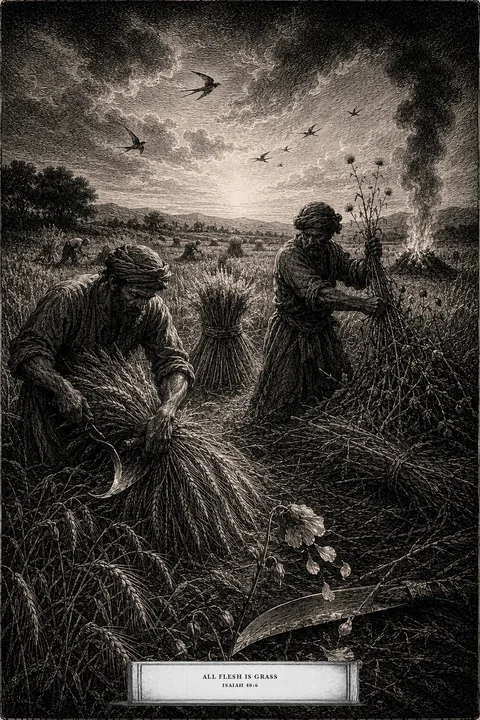
All flesh is grass… The grass withereth, the flower fadeth: but the word of our God shall stand for ever.
— Isaiah 40:6-8
Grass
At the political scale, a mountain is a kingdom and a tree is a rooted people; beneath them both stands the shortest-lived figure:
…All flesh is grass, and all the goodliness thereof is as the flower of the field… The grass withereth, the flower fadeth… but the word of our God shall stand for ever.
Grass is a man — a single mortal, up in the morning and gone by evening. “As for man, his days are as grass… the wind passeth over it, and it is gone” (Psalm 103:15-16); “in the morning it flourisheth… in the evening it is cut down, and withereth” (Psalm 90:5-6). So the three figures of a people are complete at that scale: a mountain is the kingdom, a tree the rooted people, and the grass the mortal flesh that springs up and dies within it. The categories describe different aspects, not three mutually exclusive objects: Psalm 1 can call the same man a tree when he is rooted, watered, and fruitful. The New Testament simply hands the definition back: “all flesh is as grass… The grass withereth” (1 Peter 1:24).
Grain Is Grass
Grass is not only the picture of frailty; it is also the field God farms. The grains that feed the world — barley and wheat — are grasses, and with them the symbol turns from the withering blade to the standing crop.
The field is sown, and Jesus names both the seed and the soil: “The seed is the word of God” (Luke 8:11), scattered on the hearts of men — some hard, some shallow, some good ground that bears. The seed must die to live:
Except a grain of wheat fall into the ground and die, it abideth alone: but if it die, it bringeth forth much fruit.
ASV
The word buried in a man is a seed that dies and rises into a harvest.
The Harvest
Grain is grown to be reaped, and the reaping is judgment. The prophets fixed that meaning long before the parables — Joel’s sickle thrust in because the harvest is ripe (Joel 3:13); the nations gathered “as the sheaves into the floor” to be threshed by Zion (Micah 4:12-13). So when Jesus says the same, He is not inventing an image but citing one:
…the harvest is the end of the world; and the reapers are the angels.
The field is the world, the crop is mankind, and the harvest is the day it is cut down. Revelation reaps the same field with the same words — “Thrust in thy sickle, and reap… for the harvest of the earth is ripe” (Revelation 14:15) — Joel’s command reissued at the end: one chain from the Prophets through the Gospels to the last book. The harvest has a present tense too: “Lift up your eyes, and look on the fields; for they are white already to harvest” (John 4:35); “The harvest truly is plenteous, but the labourers are few” (Matthew 9:37).
Wheat, Chaff, and Tares
Two different partings happen at the harvest, and the whole vocabulary is Old Testament. The first is the grain parted from its own husk. When the threshed wheat is thrown up into the wind, the light, empty chaff is carried off while the heavy grain falls back to the floor — and this is what the wicked are likened to, weightless and rootless: the chaff which the wind drives away (Psalm 1:4), “chased as the chaff of the mountains before the wind” (Isaiah 17:13) — the very kingdoms of the Mountain chapter, blown off like husks. John the Baptist says it in one breath and expects to be understood: “he will throughly purge his floor, and gather his wheat into the garner; but he will burn up the chaff with unquenchable fire” (Matthew 3:12).
The second parting is between two different plants. The tares are not the wheat’s own husk but a weed sown among it — darnel, which mimics the wheat so closely that the two cannot be told apart until the ear forms. That is the enemy’s work, and the Teacher’s key has already graded it: the field is the world, the good seed are the children of the kingdom, and the tares are the children of the wicked one (Matthew 13:38).[1]
The two are gathered by different means to one end. The chaff is winnowed off by the wind; the tares are bound in bundles for the fire while the wheat alone is gathered into the barn (Matthew 13:30) — the counterfeit gathered with the counterfeit, the grain kept. The threshingfloor is the day of judgment, and it misses nothing: neither the empty husk nor the planted lie.
Even the sifting carries mercy:
I will sift the house of Israel among all nations, like as grain is sifted in a sieve, yet shall not the least grain fall upon the earth.
ASV
It is the promise the Lord repeated to Peter under the same figure — sifted as wheat, but prayed for, and kept (Luke 22:31-32). The shaking is real; the grain is not lost.
The Firstfruits
One grain is reaped before all the rest. Barley ripens first, in the spring, and the law commanded that its first sheaf be brought and waved before the LORD — “a sheaf of the firstfruits of your harvest” (Leviticus 23:10) — the pledge of the whole harvest to come. That sheaf is Christ: “now is Christ risen from the dead, and become the firstfruits of them that slept” (1 Corinthians 15:20), raised in the very season of the wave sheaf, the first of a harvest that rises after Him.
Barley is the humble, early grain — the loaf that is Israel tumbling into Midian’s camp, the five loaves from which a multitude is fed (Judges 7:13; John 6:9). The firstfruits are few and lowly, but they carry the whole field in promise.
The Leaven
Grain ground and baked becomes bread, and “man doth not live by bread only, but by every word that proceedeth out of the mouth of the LORD” (Deuteronomy 8:3) — the bread is the word.
What, then, is leaven? It is bread soured. The very consonants that spell it also spell vinegar, an embittered heart, a cruel man; leaven is the loaf turned impure — fermented, puffed up, gone off. Leaven is corrupt doctrine working through the whole lump — purged from every house before Passover, banned from every offering on the altar (Exodus 12:15; Leviticus 2:11; Matthew 16:12; 1 Corinthians 5:6-7).[2] So the bread offered to God is unleavened — the feast kept “with the unleavened bread of sincerity and truth” (1 Corinthians 5:8) — a pure and unsoured word.
Ears to Hear
Set it together and the parables come clear. When Jesus told of a sower, of wheat among tares, of a harvest and a burning, He was not speaking a new tongue; He was speaking the oldest one. A hearer who knew that flesh is grass, that the harvest is the day of the LORD, that the wicked are chaff and tares and the firstfruits are the LORD’s own, needed no interpreter — the meaning was written already in the Law and the Prophets. That is why He could say “Who hath ears to hear, let him hear” (Matthew 13:9), and why His astonishment that His own disciples could not decode the sower was just (Mark 4:13).[3]
The words were sown centuries before; the parable only brought in the sheaves. To read the New Testament by the Old is to reap what was long since planted.