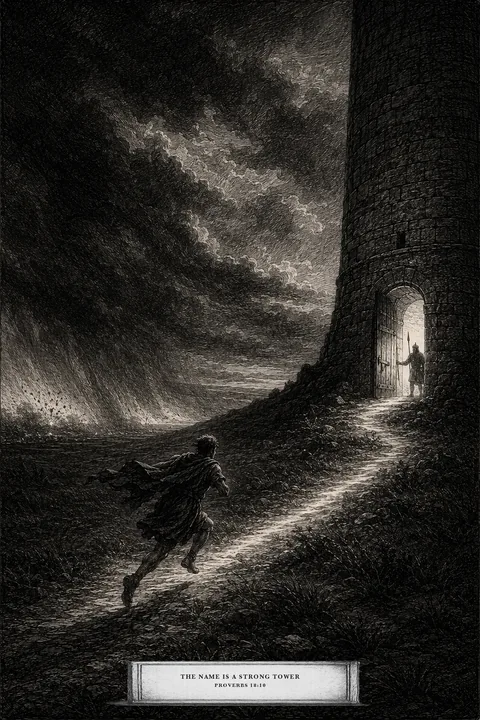
Except the LORD build the house, they labour in vain that build it: except the LORD keep the city, the watchman waketh but in vain.
— Psalm 127:1
The Tower
Solomon gives the symbol in one sentence:
The name of the LORD is a strong tower: the righteous runneth into it, and is safe.
The Name carries the Head’s Word, covenant law, and fruitful priesthood. The tower is that Name raised as a stronghold around the house that bears it. What the ark holds within, the tower makes defensible without.
A tower protects those gathered inside it. Its condition reveals the condition of the Name: strong and sheltering, begun but unfinished, or broken and fallen.
What the Tower Does
The tower is first a refuge. David calls God “a shelter for me, and a strong tower from the enemy” (Psalm 61:3), and Micah calls the tower of the flock “the strong hold of the daughter of Zion” to which the kingdom comes (Micah 4:8). The people do not run into a sound. They run under the authority, provision, and protection of the Head whose Name the tower bears.
The tower also watches and gives a signal. Habakkuk joins its height to its office: “I will stand upon my watch, and set me upon the tower, and will watch to see what he will say unto me” (Habakkuk 2:1). Israel’s moving stronghold carried the other half of the picture: the LORD went before them in a pillar of cloud by day and a pillar of fire “to give them light” by night (Exodus 13:21). Isaiah gathers both over Zion — “a cloud and smoke by day, and the shining of a flaming fire by night” — then calls the whole glory “a covering” and “a shadow in the daytime from the heat,” a refuge from storm and rain (Isaiah 4:5-6).
The tower is a watchtower and a lighthouse in one: raised high to see danger, giving light to guide the house, and covered to shelter those who come inside.
The marriage pattern makes the protection personal. The bride enters her Husband’s house, takes His Name, and obeys Him. The Husband answers that submission by giving Himself for her: “the husband is the head of the wife, even as Christ is the head of the church: and he is the saviour of the body… Christ also loved the church, and gave himself for it” (Ephesians 5:23, 25). He “nourisheth and cherisheth it, even as the Lord the church” (Ephesians 5:29).
The tower makes the Head’s protection visible: His Word is true, His covenant holds, and His priesthood lives to intercede for the house inside.
Solomon places the counterfeit in the next verse:
The rich man’s wealth is his strong city, and as an high wall in his own conceit.
The righteous man is set safely on high in the LORD’s Name; the rich man only imagines himself high behind wealth.
A Name Made from Below
Babel joins the Name and the tower as tightly as Proverbs does:
And the whole earth was of one language, and of one speech… And they said, Go to, let us build us a city and a tower, whose top may reach unto heaven; and let us make us a name, lest we be scattered abroad upon the face of the whole earth.
4
The Hebrew describes one lip and one set of words. Sharing one common word, the people gather into one body, build one city, raise one tower, and make one Name for themselves. What the true Head appoints from above, Babel tries to manufacture from below.
God strikes the structure at its word: “let us go down, and there confound their language, that they may not understand one another’s speech” (Genesis 11:7). The common word breaks, the people scatter, and “they left off to build the city” (Genesis 11:8). Their tower remains unfinished because the self-made Name cannot hold its house together under judgment.
Genesis answers Babel immediately through Abraham: men say, “let us make us a name,” while God promises Abraham, “I will… make thy name great” (Genesis 12:2). One is built by men to prevent their scattering; the other is given by God to gather a people under His promise.
Count the Cost
Jesus places an unfinished tower between 3 statements about who “cannot be my disciple.” It pictures the cost of taking a Name and failing to finish what was begun:
For which of you, intending to build a tower, sitteth not down first, and counteth the cost, whether he have sufficient to finish it? Lest haply, after he hath laid the foundation, and is not able to finish it, all that behold it begin to mock him, Saying, This man began to build, and was not able to finish.
The warning is framed by the cost of discipleship: leave every rival claim, bear the cross, and forsake all (Luke 14:26-27, 33). The foundation announces an intention before the finished tower proves it. An abandoned tower displays a Name claimed publicly and then emptied when the cost arrived.
Jesus had already pictured the same failure in the shallow soil:
But he who received the seed on stony places, this is he who hears the word and immediately receives it with joy; yet he has no root in himself, but endures only for a while. For when tribulation or persecution arises because of the word, immediately he stumbles.
NKJV
The shallow hearer begins with joy but has no depth to endure the test. The tower-builder begins with a foundation but has not counted what completion requires. Both receive the Word, begin visibly, and stop when the cost presses down. The unfinished tower is shallow soil made architectural.
Babel and the disciple’s tower meet at the same warning. Babel begins to make its own Name and leaves the work unfinished when its common word is broken. The disciple receives a Name from above and must let that Word take root deeply enough to finish.
The Tower in the Vineyard
Isaiah places a tower at the center of a vineyard and then identifies the land:
And he fenced it, and gathered out the stones thereof, and planted it with the choicest vine, and built a tower in the midst of it… For the vineyard of the LORD of hosts is the house of Israel, and the men of Judah his pleasant plant.
7
The vineyard is the house of Israel, and God’s promise concerning Solomon identifies the tower in its midst: “He shall build an house for my name” (2 Samuel 7:13). The tower is the sanctuary, the Name’s stronghold standing among the people.
Judah’s oracle stood a colt in this vineyard long before Isaiah sang it: “Binding his foal unto the vine, and his ass’s colt unto the choice vine (soreq)” (Genesis 49:11) — the very planting-word of Isaiah’s song, “planted it with the choicest vine (soreq)” (Isaiah 5:2). The vineyard is the house; its center holds the tower; and bound at the center, by Judah’s own oracle, waits the colt — until the One comes whose it is. The Hebrew Gospels draw the arrival exactly there. All 3 Hebrew synoptics set the tied colt at a tower — mivtsar, migdal, migdol — and the Hebrew Mark gives the geometry: “Go to that tower that is before you, and as soon as you enter the midst, you shall find one colt tied, upon which no rider has sat.”[1] A tower in the midst of the vineyard; a colt in the midst of the tower. The beast itself is the Coin chapter’s ledger walking: the firstling of the ass lives only by substitution — “every firstling of an ass thou shalt redeem with a lamb” (Exodus 13:13) — and this colt, “whereon never man sat,” is loosed the moment its Owner’s Name is spoken: “say ye that the Lord hath need of him; and straightway he will send him” (Mark 11:3). The owner’s hand opens at the Name — the strong tower of the proverb doing its work — and the Lamb who redeemed the bearer rides it into the city, loosing prisoners as He comes: “As for thee also, by the blood of thy covenant I have sent forth thy prisoners out of the pit” (Zechariah 9:11). The kingdom Micah promised arrives at the tower of the flock on the back of a redeemed ass: “unto thee shall it come, even the first dominion” (Micah 4:8).
Jesus keeps the tower when He retells Isaiah’s parable: the householder planted a vineyard, hedged it, dug a winepress, “and built a tower” before letting it to husbandmen (Matthew 21:33). Those husbandmen beat the servants and kill the son. The chief priests understand “that he spake of them” (Matthew 21:45): the men entrusted with the tower have rejected the Head whose Name it bears.
The temple can retain its masonry after its Name has been emptied. Jesus therefore tells the same leaders, “Behold, your house is left unto you desolate” (Matthew 23:38). It is no longer my Father’s house in His sentence; it is your house, a tower separated from the Head who gave it meaning.
When Towers Fall
Isaiah uses falling towers as the landmark of judgment: “there shall be upon every high mountain… rivers and streams of waters in the day of the great slaughter, when the towers fall” (Isaiah 30:25). The stone may fall in an instant, but the covenant stronghold has already been emptied by the rejection of its Head.
Jesus points to one fallen tower by name:
Or those eighteen, upon whom the tower in Siloam fell, and slew them, think ye that they were sinners above all men that dwelt in Jerusalem? I tell you, Nay: but, except ye repent, ye shall all likewise perish.
John interprets the tower’s name for us when Jesus sends the blind man to its pool: “Go, wash in the pool of Siloam, (which is by interpretation, Sent)” (John 9:7). The blind man obeys the Sent One, washes in Sent, and comes seeing. Jerusalem refuses the One sent to it, and Jesus warns the city that its enemies “shall not leave in thee one stone upon another; because thou knewest not the time of thy visitation” (Luke 19:44).
The tower of Sent becomes a sign to the city that rejects the Sent One. Its fall does not prove the crushed men were worse sinners; it proves every covenant claimant must repent before the larger stronghold comes down.
The pattern is consistent: a strong tower is the Head’s Name intact; an unfinished tower is a Name begun without depth to endure its cost; a fallen tower is a covenant stronghold broken, emptied, or judged. An intact Name gives the house somewhere to run; one emptied of its pillars leaves only a monument.