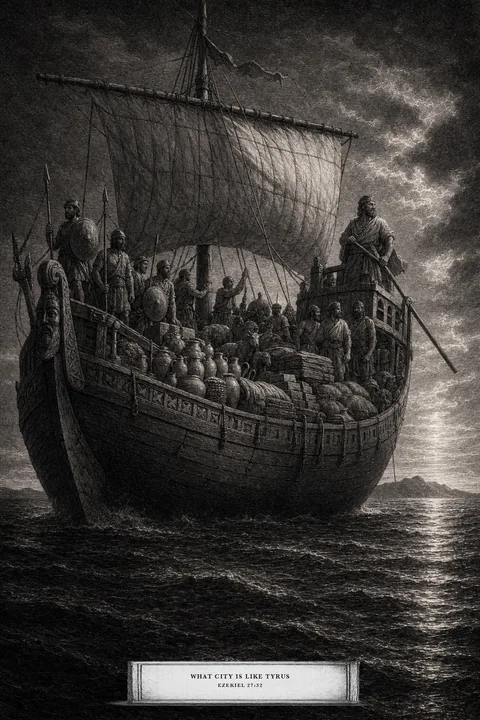
What city is like Tyrus, like the destroyed in the midst of the sea?
— Ezekiel 27:32
The Ship
Scripture does not leave the ship of state to political speeches. It builds one in front of us, plank by plank, and then tells us the city’s name.
The subject is Tyre, an organized city trading among peoples and nations. Ezekiel then constructs her as one vessel.
A City Built as a Ship
The boards are fir, the mast cedar, the oars oak, the benches ivory, and the sail embroidered linen (Ezekiel 27:5-7). Then the materials become people:
The inhabitants of Zidon and Arvad were thy mariners: thy wise men, O Tyrus, that were in thee, were thy pilots. The ancients of Gebal and the wise men thereof were in thee thy calkers… They of Persia and of Lud and of Phut were in thine army, thy men of war…
The transfer is exact. The city’s inhabitants are its sailors, its wise men steer, allied peoples defend it, and merchants from the surrounding nations fill its hold. Silver, iron, tin, lead, horses, precious stones, grain, honey, oil, spices, garments, lambs, rams, and goats pass through its markets (Ezekiel 27:12-24). The city’s commerce is the ship’s cargo.
Ezekiel gathers the whole polity into the vessel before it breaks:
Thy rowers have brought thee into great waters: the east wind hath broken thee in the midst of the seas. Thy riches, and thy fairs, thy merchandise, thy mariners, and thy pilots… and all thy men of war, that are in thee, and in all thy company which is in the midst of thee, shall fall into the midst of the seas in the day of thy ruin.
The east wind does not merely break Tyre’s fleet. It breaks “thee” — Tyre herself — and the lament closes by asking, “What city is like Tyrus, like the destroyed in the midst of the sea?” (Ezekiel 27:32). The city is the ship. The fall is written in Jonah’s own deep — the “midst of the seas” is, in the letters, the heart of the seas — and it is Babylon talk: Revelation sings this very lament over Babylon the Great, from the shipmasters' mouths — “What city is like unto this great city!” (Revelation 18:18) — and stages the same plunge, a millstone “cast… into the sea” (Revelation 18:21), the sinking Jeremiah rehearsed with a stone bound to his book: “Thus shall Babylon sink” (Jeremiah 51:63-64).
A ship is an earthly kingdom, city, state, or governed political body riding upon the sea of peoples. Its pilots are its rulers and counselors; its crew and company are its inhabitants and servants; its defenders and commerce travel within it; its cargo is its wealth. The surrounding symbols tell us its scale: the sea is the population in mass, while the ship is the bounded political structure raised over and carried by that population.
Its position matters. A fish lives within the sea as a person within the peoples; a ship rides upon the sea as government over the people it directs. The waters bear the structure, the pilots guide from above, and those aboard act together under its order.
The King Above the Sea
An earthly ruler needs a constructed vessel to stand above the peoples. Jesus does not. Scripture reserves direct dominion over the waters for God:
Which alone spreadeth out the heavens, and treadeth upon the waves of the sea.
Jesus comes to the disciples “walking on the sea” (Matthew 14:25), standing where an earthly government must build a ship to stand. The contrast is exact: the state is carried by the people beneath it; Christ’s authority over the people is inherent. He needs neither hull nor human office to keep Him above their tumult.
At Christ’s command, Peter also steps out of the ship and walks upon the water. But “when he saw the wind boisterous, he was afraid; and beginning to sink, he cried, saying, Lord, save me” (Matthew 14:29-30). Peter stands above the sea only while trusting and obeying the Word of the King who called him. When fear of the people and their tumult displaces that trust, he begins to sink back into the sea; Christ alone reaches down and raises him above it.
He also sails. When Jesus enters the ship with His disciples, the vessel becomes a governed company under its true Head. The storm fills it, its experienced sailors despair, and the One asleep in its stern rises and commands both wind and sea: “Peace, be still” (Mark 4:36-41). The ship may carry Him, but it does not give Him authority. His word preserves the company and stills the people beneath it.
Mark stages His teaching the same way. The multitude gathers by the sea, Jesus enters a ship and sits “in the sea,” and the whole multitude stands upon the land (Mark 4:1). The Teacher takes His seat above the peoples before He speaks the parables of the kingdom. The posture has a throne behind it — “The LORD sitteth upon the flood; yea, the LORD sitteth King for ever” (Psalm 29:10) — and the sermon He preaches from that seat is the sea’s own: the kingdom as a net “cast into the sea,” gathering of every kind (Matthew 13:47), spoken from a fishing vessel, upon the waters, to fishers of men. Every parable He speaks from that deck is a parable of the kingdom — the seven the Parables of the Kingdom chapter derived — and the deck itself is one: the King seated in a governed vessel, crewed by the men He has called, riding upon the peoples, sending the word out over the water to the multitude on the shore. He is preaching the kingdom and sailing it at once. Nor is the reading new: Hilary of Poitiers saw the staging in the 4th century — “the ship offers a type of the Church, within which the word of life is placed, and is preached to those without” (Commentary on Matthew, on 13:1-2) — the earliest surviving interpretation already takes the vessel for a governed people, and Scripture’s own usage widens the register to Tyre, to Babylon, to every nation riding the sea.
The two images therefore belong together without collapsing into one. The ship is constructed earthly rule riding upon the people; Jesus walking upon the sea is the true King ruling them directly. When He sails with His disciples, the earthly vessel and its company are placed under their rightful Pilot.
When the Ship Breaks
Paul’s final voyage gathers many of Scripture’s established symbols into one lived similitude: a ship upon the sea, prisoners and souls aboard, a tempest and wind, the sun and stars hidden, wheat cast into the sea, the vessel broken, every soul delivered onto an island, and a serpent cast into the fire (Acts 27–28). The complete meaning of that arrangement requires a study of its own. The point needed here is the one Scripture states plainly: there would be “no loss of any man’s life… but of the ship” (Acts 27:22). The ship and the people carried within it are joined, but they are not identical; the organized body can perish while its people are preserved.
Tyre’s Wake Reaches Babylon
Isaiah had already placed Tyre in the same sea. She is a “mart of nations,” a crowning city whose merchants are princes (Isaiah 23:3, 8). When the LORD stretches His hand over the sea, He “shook the kingdoms” (Isaiah 23:11), and the ships howl because their strength is laid waste (Isaiah 23:1, 14). The maritime city becomes a harlot trading with “all the kingdoms of the world” (Isaiah 23:15-17).
John takes up Ezekiel’s lament when Babylon falls. Again come the kings and merchants, the inventory of costly cargo, shipmasters and sailors standing afar off, dust cast upon their heads, and the cry, “What city is like unto this great city!” (Revelation 18:9-19). Babylon is Tyre’s world-spanning successor: the mercantile empire riding upon the same sea of peoples and enriching every vessel joined to her trade.
The image preserves scale. One ship is one governed body; many ships are many bodies riding upon the same sea, trading, fighting, or sailing together. Their alliances do not dissolve their borders.
The Ark Carries a House
Noah’s ark belongs beside the ship, but it should not be forced into the same word. The Hebrew calls it tevah, not the ordinary word for a ship. It is a covenant vessel: “with thee will I establish my covenant; and thou shalt come into the ark” (Genesis 6:18). God then calls, “Come thou and all thy house into the ark” (Genesis 7:1).
The house enters with every kind of beast and bird, clean and unclean, and the bounded vessel carries that ordered world through the flood (Genesis 6:19-20; 7:14-18). The beasts later stand openly for peoples and kingdoms; here every creature-kind is preserved under one covenant head until the waters fall.
The ark therefore confirms the structure without replacing Ezekiel’s definition. A vessel can bear a house, a covenant, and many kinds of people through judgment. Ezekiel shows what a political ship is; Noah shows what a covenant vessel can preserve.
A Metaphor the Nations Already Spoke
Scripture is sufficient to define the ship, yet the world around it already spoke the same political image. The evidence matters because it shows that a reader in the Mediterranean world did not need a modern commentator to invent the ship of state.
The 7th-century-BC poet Alcaeus pictured a vessel driven between opposing waves, its sail torn and water entering the hold; ancient commentary identified the ship as the state suffering under the tyrant Myrsilus. Aeschylus opens Seven Against Thebes with the ruler guarding the city’s affairs from the stern and guiding its helm; Suppliant Women calls the city a ship outright. Plato’s Republic expands the picture: sailors fight for control of the helm while rejecting the one man who understands navigation. Horace later addresses a battered ship driven back toward dangerous waters in an ode long recognized as an appeal to the Roman state.[1]
Those poets do not establish the biblical meaning. They establish recognition. Ezekiel establishes the meaning by calling the ship Tyre and naming every class of person aboard.
One Man for the Ship
Return to Jonah with the symbol in hand. The LORD sends a storm for one man, and the ship is “like to be broken” (Jonah 1:4). The crew tries to save Jonah and the vessel, but the storm continues until the man it seeks is surrendered (Jonah 1:7, 12-16).
Jerusalem’s rulers state the corresponding danger before the Passion: “the Romans shall come and take away both our place and nation” (John 11:48). Their ship of state is about to break. Caiaphas answers with the bargain spoken aboard Jonah’s vessel: “it is expedient for us, that one man should die for the people, and that the whole nation perish not” (John 11:50).
The ship is Jerusalem and Judea as an organized covenant polity. Its priests and rulers pilot it, its officers and people crew it, and Rome threatens to break it. Arrest by that body’s officers places Jesus under its custody even before they carry Him through a city gate; suffering outside the wall does not release Him from the state that condemned Him.
Rome is the larger imperial power ruling over the ship and the surrounding sea. At the sentence Jerusalem names its chosen head: “We have no king but Caesar” (John 19:15). The smaller ship surrenders one man to the Great Fish so that, as its rulers suppose, the ship may live.