For the vineyard of the LORD of hosts is the house of Israel, and the men of Judah his pleasant plant.
— Isaiah 5:7
Trees
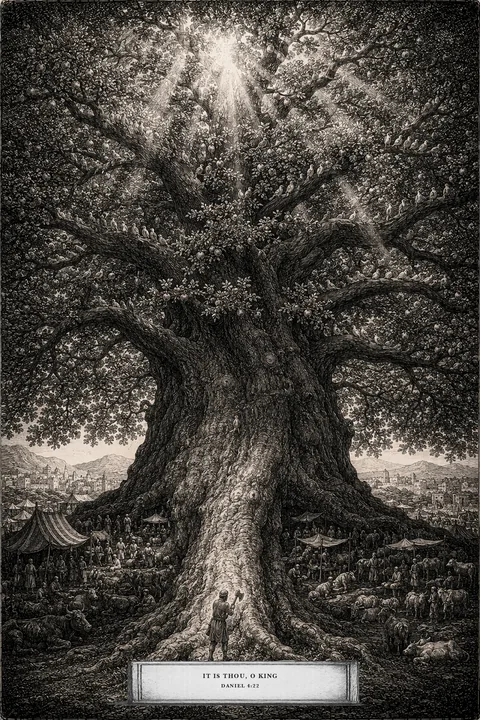
The four winds are held back “till we have sealed the servants of our God,” under the command “Hurt not the earth, neither the sea, nor the trees” (Revelation 7:3). The sea is the restless mass of peoples; the tree stands beside it in that verse, and Scripture defines it just as plainly. When Nebuchadnezzar dreams of a great tree filling the earth, Daniel does not guess; he decodes it:
It is thou, O king, that art grown and become strong: for thy greatness is grown, and reacheth unto heaven, and thy dominion to the end of the earth.
The tree is the king together with his dominion — Babylon embodied in its covenant head as a living, rooted body. The scale follows the tree’s growth: it begins as one planted life, grows into a house or lineage, and may mature into a people or nation. The person is not an exception to the national symbol; the person is its seed and covenant head. The same equation recurs across the prophets — Israel is a “vine” (Hosea 10:1), Assyria a “cedar” (Ezekiel 31:3), the covenant people an “olive tree” (Romans 11). Whatever the scale, the tree is a rooted life known by what grows from it — and the species itself helps identify its character.
The whole sequence is written in the history of Abraham: “I called him alone, and blessed him, and increased him” (Isaiah 51:2). One man becomes a house, tribes, and a nation. Ezekiel plants one “tender” twig from David’s royal cedar and watches it become “a goodly cedar” under whose branches birds of every wing dwell (Ezekiel 17:22-23). Jesus gathers the same movement into the mustard seed: one seed is sown, “but when it is grown… becometh a tree,” and the birds lodge in its branches (Matthew 13:31-32). Seed, person, house, nation: one continuous growth.
By Their Kind
The kind of tree is no accident; in the prophetic histories it often names the nation or house. Israel appears as the trees of the covenant land — the vine (Psalm 80:8), the fig, and the olive: “The LORD called thy name, A green olive tree” (Jeremiah 11:16); often all at once — “I found Israel like grapes in the wilderness; I saw your fathers as the firstripe in the fig tree” (Hosea 9:10), and “he hath laid my vine waste, and barked my fig tree” (Joel 1:7). The gentile empires are the towering forest trees — Assyria a cedar, and Pharaoh likened to the same “among the trees of Eden” (Ezekiel 31:3, 18).
When Jesus curses a fig tree (Matthew 21:19), or tells of a barren one in a vineyard (Luke 13:6), He is not teaching horticulture; He is pronouncing on Israel. The kind of tree identifies the rooted body — and often its character: the cedar’s imperial height, the vine’s call to fruit, the fig’s covenant standing.
The Anatomy of a Growing People
The tree is a precise symbol because its parts carry meaning. Paul lays out the anatomy with the olive tree:
And if some of the branches be broken off, and thou, being a wild olive tree, wert graffed in among them, and with them partakest of the root and fatness of the olive tree…
The root is the body’s origin and covenant foundation — the patriarch or Head from whom the life proceeds, and the covenant word that makes the whole holy. The branches are the members who grow from or are joined to it. Branches can be broken off (cut from the nation) and others grafted in, and the tree persists through the exchange. A house or nation is a living structure: rooted in its origin, composed of members, able to lose some and gain others without ceasing to be itself.
Fruit and the Fire
A tree is judged by what it produces. Jesus states it as a rule:
…every good tree bringeth forth good fruit; but a corrupt tree bringeth forth evil fruit.
Whether the tree is a man, a house, or a nation, its fruit is what it produces; this is how a living body is weighed — by what it does. The barren tree is cut down:
Every tree that bringeth not forth good fruit is hewn down, and cast into the fire.
This is the standard image for judgment upon a rooted life, individual or corporate. The axe “is laid unto the root of the trees” (Luke 3:9); Babylon’s great tree is felled — “Hew the tree down” (Daniel 4:23, though a stump is left for regrowth). And a nation can be fruitful in form yet condemned: Israel was “an empty vine” that “bringeth forth fruit unto himself” (Hosea 10:1) — full of works, empty of covenant purpose.
A Forest of Nations
When Scripture sets the figure at national scale, the world’s nations together make a forest, and Scripture treats them so. The tree-texts that decoded the mustard seed — Ezekiel’s riddle of the low tree exalted and Daniel’s great tree that was a king — are the forest’s charter (Ezekiel 17; Daniel 4)[1], and the riddle’s closing word surveys the whole stand:
And all the trees of the field shall know that I the LORD have brought down the high tree, have exalted the low tree, have dried up the green tree, and have made the dry tree to flourish…
Here “all the trees of the field” are all the nations; God deals with them as a gardener deals with trees — felling the proud, raising the low.
The same parable fixes what the cedar is — and is not: the “high cedar” of that chapter is the royal house of David itself, and God promises to crop “of the highest branch” a tender twig and plant it “in the mountain of the height of Israel,” where it becomes “a goodly cedar” sheltering “all fowl of every wing” (Ezekiel 17:22-23). Assyria a cedar, David’s house a cedar, the righteous growing “like a cedar in Lebanon” (Psalm 92:12): the cedar is height and majesty, whoever bears it — the symbol is the stature, not a badge of the heathen. And the great trees shelter others: under Nebuchadnezzar’s tree “the beasts of the field had shadow… and the fowls of the heaven dwelt in the boughs” (Daniel 4:12) — the peoples and tribes that live within an empire’s reach.
This fixes the tree among the symbols already defined. A mountain is a kingdom — the seat of ruling authority. A tree at this scale is the nation, the living body of a people, which grows on the mountain, under its jurisdiction. The sea is those same peoples in their unrooted, turbulent state — beasts rise from the sea (Daniel 7), but shelter under the tree (Daniel 4). And beneath the tree is the grass — the individual mortal, which is its own study. Kingdom, rooted people, mortal flesh: mountain, tree, grass.
Two more branches of the symbol remain before the beasts. The pair of olive trees Zechariah saw return in Revelation as the two witnesses — covenant trees standing before God (Zechariah 4:14; Revelation 11:4), taken up in the Jacob, Israel, and Ephraim chapter. The symbol’s beginning is the righteous man: “he shall be like a tree planted by the rivers of water, that bringeth forth his fruit in his season” (Psalm 1:3); the redeemed are “trees of righteousness, the planting of the LORD” (Isaiah 61:3). Jesus makes the personal scale explicit: “a good tree bringeth not forth corrupt fruit” becomes, four verses later, “a good man out of the good treasure of his heart bringeth forth that which is good” (Luke 6:43-45). As that fruit becomes seed in others, the man stands as the root or head of a multigenerational house, as Abraham grows into Israel, Nebuchadnezzar embodies his kingdom, and the cedar in Ezekiel 17 embodies David’s royal house. Grass is the mortal in his frailty; the tree is a life rooted in covenant, watered, branching beyond itself, and bearing fruit.
Beasts
Look again at the beasts that sheltered under Nebuchadnezzar’s tree (Daniel 4:12) — all the animals under its branches. For the beast is the other figure of a nation. Where the tree is a people rooted and fruitful, the beast is a people wild and ravening; and Daniel decodes it as plainly as he did the tree:
These great beasts, which are four, are four kings, which shall arise out of the earth.
A beast is a kingdom, and the kind of beast marks which — as the species of tree marked which nation. The lion, the bear, the leopard, and the nameless fourth are four empires (Daniel 7); “the ram… are the kings of Media and Persia… the rough goat is the king of Grecia” (Daniel 8:20-21). And these come up not from the garden but “from the sea” (Daniel 7:3) — the same peoples, seen now as predators rising from the restless deep.
The two figures meet in one man. The king who was the great tree is sentenced to become a beast — “Let his heart be changed from man’s, and let a beast’s heart be given unto him” (Daniel 4:16) — until he “did eat grass as oxen” (Daniel 4:33). The ruler who forgets God is carried down through the whole order, from the tree that filled the earth to a beast on all fours feeding on grass; for “man that is in honour, and understandeth not, is like the beasts that perish” (Psalm 49:20).
This is why clean and unclean divide the animals as the covenant divides mankind. God’s own are the flock — the sheep who hear His voice; the nations are the wild beasts. So when God opens the door to the Gentiles He shows Peter a sheet of “all manner of fourfooted beasts… and wild beasts, and creeping things” (Acts 10:12), with the command “Rise, Peter; kill, and eat… What God hath cleansed, that call not thou common” (Acts 10:13-15). To kill and to eat is the language of covenant-making — the sacrifice slain and the meal shared that seal it — so the vision is God taking the nations into covenant. Peter gives its meaning himself, twice over (Acts 10:28; 11:4-18):
Ye know how that it is an unlawful thing for a man that is a Jew to keep company, or come unto one of another nation; but God hath shewed me that I should not call any man common or unclean.
The unclean animals are the nations, cleansed by covenant.
It is why the Gentile is called a dog — “It is not meet to take the children’s bread, and to cast it to dogs,” and the woman answers, “yet the dogs eat of the crumbs” (Matthew 15:26-27): outside the house, an unclean animal, until she is brought in. Mark keeps the table in her answer — “the dogs under the table eat of the children’s crumbs” (Mark 7:28) — and the table is the dog’s defining line: the unclean beast outside the covenant meal. And the crucifixion psalm shows that beast at its work: “Dogs have compassed me… they pierced my hands and my feet” (Psalm 22:16) — the psalm rings the cross with beasts, the bulls of Bashan, the roaring lion, the dogs — and it was the dog, the Gentile power of Rome, whose hands drove the nails.
At the national scale, tree or beast, forest or field, clean or unclean, the figures concern the peoples of the earth, which God plants and fells, tames and cleanses.
Gardens
Where the trees are nations, a garden — a planted stand of trees — is a grouping of nations. Ezekiel says as much: he sets Egypt among “the trees of Eden, that were in the garden of God” (Ezekiel 31:9), and names them — “This is Pharaoh and all his multitude” (Ezekiel 31:18). The garden of God is a field of nation-trees.
Read so, a recurring charge in Isaiah changes register. Isaiah indicts Judah for worship “in gardens” — “that sacrificeth in gardens, and burneth incense upon altars of brick” (Isaiah 65:3), and shames her “for the gardens that ye have chosen” (Isaiah 1:29). The usual reading makes these literal pagan groves; by the symbol they are the nations Judah chose to run to — sacrificing among them, trusting in them — and the sentence fits the crime: “ye shall be as an oak whose leaf fadeth, and as a garden that hath no water” (Isaiah 1:30). She chose the gardens of the nations; she becomes a dead garden herself.
Which unlocks the hardest of them:
They that sanctify themselves, and purify themselves in the gardens behind one tree in the midst, eating swine’s flesh, and the abomination, and the mouse, shall be consumed together…
By the symbol it is plain: they sanctify themselves in the gardens — among the nations; behind one — following after one of them; eating the swine, the abomination, and the mouse — taking up the nations’ unclean ways. They enter the nations, follow one, eat its abominations, and share its end — “consumed together.”
The traditional reading takes this as a literal garden-cult, but it rests on a word that is not in the text. The Hebrew says only “after one in the midst”; “tree” is supplied by the translators — and with it gone, the literal reading has nothing left to name, so it guesses: a sacred tree, a priest in the midst, a deity called “One.” The symbol supplies nothing — “in the gardens, after one” is among the nations, following one — and it reads with the context, for the next verses show the LORD gathering “all nations and tongues” and sending the escaped “unto the nations” (Isaiah 66:18-19). The whole passage is about the nations; so is the garden.
The end-times setting proves the diet itself eternal. This is the last judgment — the LORD coming “with fire” to “plead with all flesh” (Isaiah 66:15-16), with all nations gathered to it (Isaiah 66:18). At that consummation God still consumes those who eat “swine’s flesh, and the abomination, and the mouse.” The line between clean and unclean is not abolished; it holds to the end of the age.
We have already seen that the law was not abolished but filled full, and that the covenant-name is everlasting — and the food law is part of that law; here it stands as the very ground of the verdict. Nor does the symbol soften the letter; the two are one act. To eat the nations’ unclean food is to sit at the nations’ table and take their defilement into yourself — so those who go in among the nations, follow one, and eat as it eats are consumed with it. The name is eternal, the law is eternal, and the diet is eternal with them.
Return, then, to the sealing. Before the four winds are loosed, the order is “Hurt not the earth, neither the sea, nor the trees” (Revelation 7:3) — and in that company the trees are rooted peoples, as the sea beside them is the unrooted multitude. The God who plants and fells the trees of the field is the One the winds obey.