And they shall see his face; and his name shall be in their foreheads.
— Revelation 22:4
The Seal
Ask what the seal of God is, and the answers run vague — a feeling of assurance, an invisible mark, a mystery reserved for the last days. Scripture is not vague about seals. A seal is a signet, and a signet carries one thing: its owner’s name. Judah left his signet as the pledge of his identity (Genesis 38:18); Pharaoh moved his ring onto Joseph’s hand and with it his authority (Genesis 41:42); and what the king’s ring stamps, “may no man reverse” (Esther 8:8). Press the ring into the wax and the wax carries the name — ownership marked, authority ratified, and the thing sealed kept safe against tampering until its appointed opening. Every use of the symbol in Scripture is one of those four pressings, and all four meet in the sealing this chapter is after: the servants of God marked before judgment.
The NAME chapter carried the weight already: the Name is the covenant identity of the house, carrying the Head’s Word, covenant law, and fruitful priesthood. The seal is that name impressed — the covenant owned, now written on its owner.
The Inscription, Quoted
Scripture does not leave the engraving to imagination. Paul holds the seal up and reads it out:
Nevertheless the foundation of God standeth sure, having this seal, The Lord knoweth them that are his. And, Let every one that nameth the name of Christ depart from iniquity.
Two engravings on one seal. The first is ownership — and it is a quotation: “the LORD will shew who are his, and who is holy” (Numbers 16:5), Moses' answer to Korah, the original dispute over who bears the holy name. The second is obedience: whoever names the name departs from iniquity. The word is adikia — unrighteousness — and righteousness has a written definition: “it shall be our righteousness, if we observe to do all these commandments” (Deuteronomy 6:25); “all unrighteousness is sin” (1 John 5:17). To depart from unrighteousness is to come back under the law of the Name just engraved. Whose you are, and how his own behave — the seal says nothing else, because a signet has nothing else to say.
The Plate on the Forehead
The forehead seal is not a novelty of Revelation; it is priestly equipment, prescribed in the law:
And thou shalt make a plate of pure gold, and grave upon it, like the engravings of a signet, HOLINESS TO THE LORD. And it shall be upon Aaron’s forehead… it shall be always upon his forehead, that they may be accepted before the LORD.
38
A golden plate, engraved signet-style with the holiness of the Name, worn always on the forehead of the man who stands before God. Now read Revelation with the plate in view: the hundred forty and four thousand stand with the Lamb, “having his Father’s name written in their foreheads” (Revelation 14:1) — a kingdom of priests, every one wearing the plate. And the book’s last page makes it the estate of all His servants: “they shall see his face; and his name shall be in their foreheads” (Revelation 22:4).
What the plate says in gold, the law says in commandments. Moses fixed the two places where the sign of the covenant sits, and decoded them in the same verse:
And it shall be for a sign unto thee upon thine hand, and for a memorial between thine eyes, that the LORD’S law may be in thy mouth…
The sign on the hand and the memorial on the forehead are defined out loud: the law in you. “Thou shalt bind them for a sign upon thine hand, and they shall be as frontlets between thine eyes” (Deuteronomy 6:8) — the commandments at hand and eyes; and Isaiah names the act with the symbol’s own word: “Bind up the testimony, seal the law among my disciples” (Isaiah 8:16). The seal of God, spelled three ways, is one thing: the Name and its law impressed where the man works and where he thinks. One commandment carries the full signet: a royal seal bears its owner’s name, office, and domain, and the sabbath is where all three stand written in the law — the LORD (the name), who made (the office), heaven and earth (the domain) — “a sign between me and you throughout your generations; that ye may know that I am the LORD that doth sanctify you” (Exodus 31:13, 17).
The Man with the Inkhorn
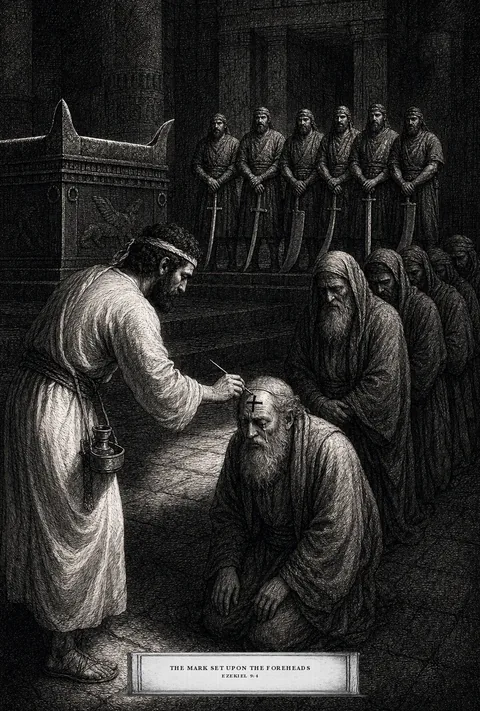
Revelation 7 is not the first time God marks foreheads before judgment. Ezekiel watched the whole scene run once: six men with slaughter weapons, and among them “one man… clothed with linen, with a writer’s inkhorn by his side” (Ezekiel 9:2). The order is given to the scribe first:
…set a mark upon the foreheads of the men that sigh and that cry for all the abominations that be done in the midst thereof… but come not near any man upon whom is the mark; and begin at my sanctuary.
6
Every element of the sixth seal is here: the forehead mark, set before the destroyers move; the destroyers forbidden to touch its bearers; and the criterion written into the commission — the marked are the ones grieving over lawbreaking. The mark even has a name: Ezekiel’s word is the letter tav, which in the old Hebrew script the prophets wrote is a simple crossed stroke — the last letter of the alphabet, set on the men judged worth keeping. So when John sees four winds held back “till we have sealed the servants of our God in their foreheads” (Revelation 7:3), the scene is Ezekiel’s, enlarged to the four corners: the scribe goes through first, and no wind blows until he is done. The seal holds through what follows — the tormentors of the fifth trumpet are commanded to hurt “only those men which have not the seal of God in their foreheads” (Revelation 9:4).
The Spirit Is the Impression
Who presses the ring? Paul answers three times: “ye were sealed with that holy Spirit of promise” (Ephesians 1:13); “the earnest of the Spirit in our hearts” (2 Corinthians 1:22); “sealed unto the day of redemption” (Ephesians 4:30). The signet is the Name; the man is the wax — “it is turned as clay to the seal” (Job 38:14) — and the hand that presses is the Spirit, writing the law where the frontlets pointed all along: “I will put my spirit within you, and cause you to walk in my statutes” (Ezekiel 36:27). The Son bore the impression first: “him hath God the Father sealed” (John 6:27).
This clarifies the sixth-seal scene, for the winds and the sealing are one element. Wind is ruach — spirit — and the four winds stand before the Lord as His executing spirits, as the next chapters will lay out in full. Revelation 7 is one Spirit stamping while four are held: the ruach presses the Name into the servants, and not a ruach of judgment blows until the last impression is made.
The Counterfeit Takes the Same Two Places
The beast also seals:
And he causeth all… to receive a mark in their right hand, or in their foreheads:
Hand and forehead — precisely the two places the law binds the commandments. The mark of the beast is the anti-frontlet: another name, another law, filling the hand that works and the head that thinks. Nobody wears both; the two marks are one question asked of every man — whose law fills your hand and your eyes?
Note which way the true seal faces. God’s servants do not merely carry His mark; He wears them: “though Coniah… were the signet upon my right hand, yet would I pluck thee thence” (Jeremiah 22:24) — and to faithful Zerubbabel, “I… will make thee as a signet: for I have chosen thee” (Haggai 2:23). The chosen man is the ring on God’s own hand — the beast’s men carry its mark on theirs. That is the whole difference between the seals: one names an owner who keeps you; the other brands the person it means to use up.
The bride knew the symbol’s last depth and asked for it:
Set me as a seal upon thine heart, as a seal upon thine arm: for love is strong as death…
Heart and arm — the same two places again, asked for by love. The sealed are not inventory; they are the espoused, kept as a “fountain sealed” (Song of Solomon 4:12) for the Husband who set His name on them. And the seal has a common form every man has carried in his pocket — refined metal struck with an image and a superscription, an owner’s name made money. What Scripture does with the coin is the next chapter.