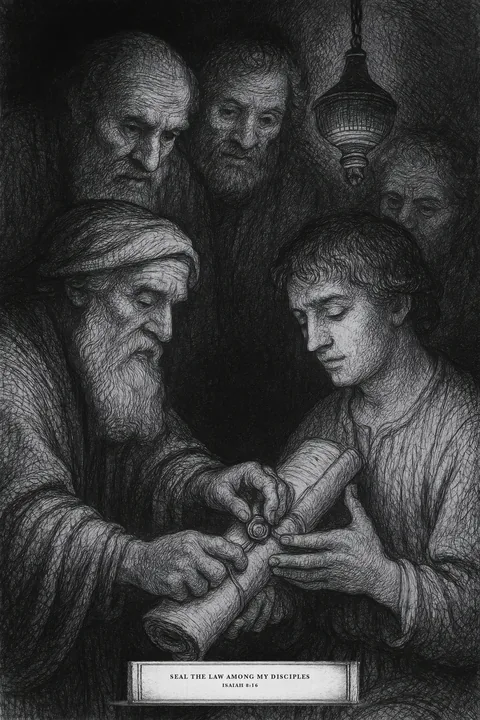
Bind up the testimony, seal the law among my disciples.
— Isaiah 8:16
The Disciple
The gospel’s last command is to disciple the nations, and everyone thinks he knows what the word means: a follower, a learner, a student of Jesus. The dictionary is not wrong; it is empty. A learner of what? Scripture does not leave the answer open — it defines the word exactly once, and it puts the definition in the mouth of the law itself:
Bind up the testimony, seal the law among my disciples.
The Old Testament’s word for disciples — limmudim, the taught ones — appears here in the law’s own custody clause. A disciple is where the law is kept when the testimony is bound: the scroll sealed in a living person. Isaiah uses the word once more, as a promise: “all thy children shall be taught of the LORD” (Isaiah 54:13) — limmudei YHWH, the LORD’s own disciples — and Jesus quotes that very line for His hearers (John 6:45).
The Gates
Jesus did not describe discipleship as a mood of admiration. He stated its terms, and three times He said cannot:
-
“If any man come to me, and hate not his father, and mother… he cannot be my disciple” (Luke 14:26)
-
“whosoever doth not bear his cross, and come after me, cannot be my disciple” (Luke 14:27)
-
“whosoever he be of you that forsaketh not all that he hath, he cannot be my disciple” (Luke 14:33)
These are gates, not growth curves — and inside the gates He named the marks: “If ye continue in my word, then are ye my disciples indeed” (John 8:31); “By this shall all men know that ye are my disciples, if ye have love one to another” (John 13:35) — and love is the keeping of the commandments (1 John 5:3); “Herein is my Father glorified, that ye bear much fruit; so shall ye be my disciples” (John 15:8) — and fruit is works. Indeed is the word to weigh: it is spoken to men who had just believed (John 8:30-31) — believed as a profession believes: His word accounted factual and worth trusting, an assent even “the devils” manage, who “believe, and tremble” (James 2:19). Scripture’s full belief walks: “He that believeth on the Son hath eternal life; but he that obeyeth not the Son shall not see life” (John 3:36, ASV) — one verse, and the opposite of believing is disobeying. So He hands the professors the walking itself as the test: continue in the word, and “then are ye my disciples indeed.”
Baptized into the Name
The commission binds the entry rite to the definition: “baptizing them in the name of the Father, and of the Son, and of the Holy Ghost” (Matthew 28:19). The NAME is the covenant identity of the house, carrying the Head’s Word, covenant law, and fruitful priesthood — and baptism places the disciple into it: “buried with him by baptism… even so we also should walk in newness of life” (Romans 6:4); “as many of you as have been baptized into Christ have put on Christ” (Galatians 3:27) — the Name worn as a garment. And the covenant one is baptized into has stated content:
this shall be the covenant that I will make with the house of Israel… I will put my law in their inward parts, and write it in their hearts.
The new covenant is not the law’s retirement; it is the law’s change of address — from tables of stone to the tables of the heart. Jeremiah’s promise and Isaiah’s seal are one act described twice: the law, written within. To be baptized into the Name is to enroll in that covenant — the heart handed in as the next table to be written.
As His Master
The church has a word for the goal of discipleship — Christlikeness — and the word is correct; it has simply been left undefined. Jesus defined it:
The disciple is not above his master: but every one that is perfect shall be as his master.
The disciple’s finish line is likeness. Then everything hangs on one question: what is the Master like? He is the One of whom the Father said, “obey his voice… for my name is in him” (Exodus 23:21); who kept His own in that name (John 17:11); and who set the pattern in a single sentence:
If ye keep my commandments, ye shall abide in my love; even as I have kept my Father’s commandments, and abide in his love.
He kept the law — perfectly: “Which of you convinceth me of sin?” (John 8:46). He came not to destroy but to fulfil (Matthew 5:17). To become like Him is therefore not a sentiment; it has exact content: “He that saith he abideth in him ought himself also so to walk, even as he walked” (1 John 2:6). He walked in the commandments. Christlikeness is the law sealed within — the consensus’s own word, given the Master’s own content.
Whose Works?
Becoming as the master is a warning before it is a promise: Jesus hung the sentence on a question about guides — “Can the blind lead the blind? shall they not both fall into the ditch?” (Luke 6:39). Israel had other masters, with disciples of their own (Mark 2:18), and He split their authority down the middle:
The scribes and the Pharisees sit in Moses' seat: all therefore whatsoever they bid you observe, that observe and do; but do not ye after their works: for they say, and do not.
What they relay from Moses' seat is commanded — observe and do; their own works are refused in the same breath, for a work is a deed executing a command, and their deeds executed their own legislation. The Hebrew Matthew reads the seeming concession out of the verse — its verb is singular: “all that he says to you, keep and do; but according to their ordinances and their deeds, do not do” — Moses speaking from the seat, and both columns of the refusal theirs. “They say, and do not” falls wholly on the men in the seat, and “their deeds” — ma’aseihem, their works — stand written beside their ordinances as the deeds that execute them. He read the charge to their face: “Why do ye also transgress the commandment of God by your tradition?… in vain they do worship me, teaching for doctrines the commandments of men” (Matthew 15:3, 9) — and the Hebrew again writes the legal terms into the verse: your taqqanot, your enactments, and mitzvat anashim, a commandment of men learned by rote. The same scene ends in the ditch: “they be blind leaders of the blind. And if the blind lead the blind, both shall fall into the ditch” (Matthew 15:14) — masters whose disciples, perfected, are as they are.
The prophets had already given this fork its legal name. Micah’s indictment of Israel names the crime as keeping — the covenant’s own verb — sworn to the wrong legislator:
For the statutes of Omri are kept, and all the works of the house of Ahab, and ye walk in their counsels; that I should make thee a desolation…
“Kept” is shamar, the verb of keeping the commandments, here used of a king’s statutes; evil works are another legislator’s statutes kept. Jehoshaphat is the bright mirror: he “walked in his commandments, and not after the doings of Israel” (2 Chronicles 17:4) — one nation, two legislators, and every deed executing one or the other.
Moses legislated the audit in advance: the prophet whose sign comes to pass, but who teaches departure from the commandments, is refused — “ye shall walk after the LORD your God, and fear him, and keep his commandments” (Deuteronomy 13:4). The judgment scene runs on that statute: the pleaders appeal to “many wonders” (Matthew 7:22, NKJV) — dynameis, powers or mighty acts, in the Greek, and otot, signs, in the Hebrew Gospel. No deeds are pleaded, yet deeds supply the verdict: “depart from Me, you who practice lawlessness” (Matthew 7:23, NKJV), echoing Psalm 6:8: “depart from me, all ye workers of iniquity.” Signs prove power; works prove whose command — and whose command, whose disciple.
The Name on the Forehead
The road that begins in baptism ends where the next chapter, The Seal, ends: “a Lamb stood on the mount Sion, and with him an hundred forty and four thousand, having his Father’s name written in their foreheads” (Revelation 14:1); “I will write upon him the name of my God” (Revelation 3:12). Baptized into the Name; perfected as the Master in whom the Name is; sealed with the Name at the last — the disciple’s whole arc is one Name carried from water to forehead, and the Name carries the law. Seal the law among my disciples: the commission, Isaiah’s clause, and the 144,000 are one sentence spoken three times.