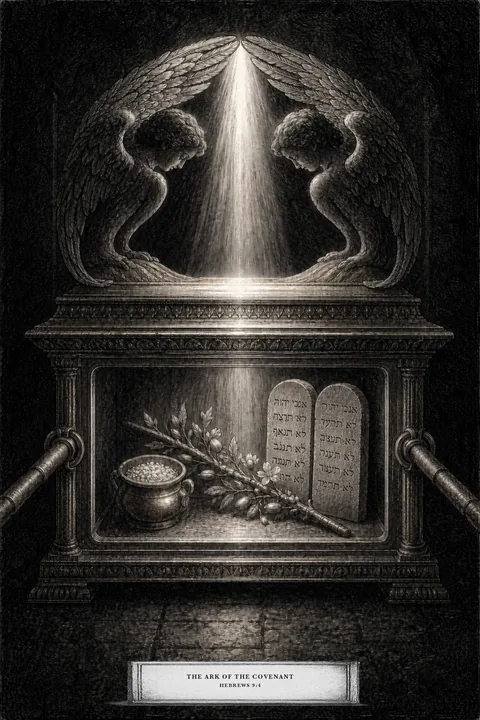
I have built an house for the name of the LORD God of Israel. And I have set there a place for the ark, wherein is the covenant of the LORD.
— 1 Kings 8:20-21
The Name
Nearly every Christian has ended a prayer with the words “in Jesus' Name.” We do it because Jesus made a promise that sounds unlimited:
And whatsoever ye shall ask in my name, that will I do, that the Father may be glorified in the Son.
Whatsoever is a hard word to explain away. Many readers have prayed sincerely, attached the phrase exactly as they were taught, and received no answer. If “in my Name” means adding the right words to the end, lived experience appears to contradict the promise. The more honest conclusion is that something is missing from the usual definition.
A Name is not a magic phrase added to the end of a prayer. It is not a pronunciation or sound, as though salvation depended on arranging the right syllables. It is not merely a label pasted onto something while leaving the thing itself unchanged.
An answered prayer or a wonder would not rescue the incantation. Jesus describes people who claim the greatest possible evidence:
Many will say to Me in that day, Lord, Lord, have we not prophesied in Your name, cast out demons in Your name, and done many wonders in Your name? And then I will declare to them, I never knew you; depart from Me, you who practice lawlessness!
NKJV
The testimony is theirs: “have we not?” They thought they prophesied, cast out demons, and did wonders in His Name; Jesus never confirms that they acted in it. He says He never knew them and identifies their actual deeds as lawlessness.
Even a sign that truly comes to pass does not settle whose Name is behind it. Moses gave Israel that test before they entered the land:
If there arise among you a prophet, or a dreamer of dreams, and giveth thee a sign or a wonder, And the sign or the wonder come to pass, whereof he spake unto thee, saying, Let us go after other gods, which thou hast not known, and let us serve them;
Moses explains why God permits the sign: “the LORD your God is testing you to know whether you love the LORD your God with all your heart and with all your soul” (Deuteronomy 13:3, NKJV). The test is resolved by the next command: “keep His commandments and obey His voice” (Deuteronomy 13:4, NKJV). The wonder comes to pass, yet the prophet is false because his word leads away from obedience to God. A miracle proves that something happened; it does not prove the Name claimed over it. The Name on the lips must be tested against the Word, covenant, and authority the life obeys.
To discover what is missing, follow the Name where Scripture places it: over an ark, inside a house. The ark is not empty. It holds manna, stone tables, and a rod that has come alive. Scripture defines each item in turn, and together they supply the substance no pronunciation or miracle can prove.
The Ark Bears the Name
When David first brought the ark toward Jerusalem, Scripture joined the ark and the Name in a single description:
And David arose, and went with all the people that were with him from Baale of Judah, to bring up from thence the ark of God, whose name is called by the name of the LORD of hosts that dwelleth between the cherubims.
The Name rests where the LORD dwells between the cherubim. David later looks from his cedar house toward that ark still sheltered by curtains: “I dwell in an house of cedar, but the ark of God dwelleth within curtains” (2 Samuel 7:2). God answers David’s desire through his son: “He shall build an house for my name” (2 Samuel 7:13).
Solomon joins every term when the house is finished:
I am risen up in the room of David my father, and sit on the throne of Israel, as the LORD promised, and have built an house for the name of the LORD God of Israel. And I have set there a place for the ark, wherein is the covenant of the LORD, which he made with our fathers, when he brought them out of the land of Egypt.
David asks for a house for the ark. God calls it a house for His Name. Solomon builds the house for the Name and places the ark inside it. The ark carries the substance of the Name, and the temple is the fixed house built around it.
The 3 Things Inside
Hebrews opens the ark and inventories its contents:
…the ark of the covenant overlaid round about with gold, wherein was the golden pot that had manna, and Aaron’s rod that budded, and the tables of the covenant.
Exactly 3 things are named: manna, the tables of the covenant, and Aaron’s fruitful rod. Each has already been defined by Scripture.
The manna is the Word. Moses says God fed Israel with manna “that he might make thee know that man doth not live by bread only, but by every word that proceedeth out of the mouth of the LORD” (Deuteronomy 8:3). The manna came as a daily portion of the Word, and God stated its purpose: “that I may prove them, whether they will walk in my law, or no” (Exodus 16:4).
The stone tables are the covenant law. Moses does not ask us to infer it:
And he declared unto you his covenant, which he commanded you to perform, even ten commandments; and he wrote them upon two tables of stone.
The covenant is spoken, commanded, and written. When Moses came down the second time, he put those tables “in the ark which I had made; and there they be, as the LORD commanded me” (Deuteronomy 10:5).
Aaron’s rod is the fruitful priesthood. Korah’s rebellion had challenged whom God appointed to draw near, so God required a rod from every tribal head and promised, “the man’s rod, whom I shall choose, shall blossom” (Numbers 17:5). The next morning the verdict was alive:
…behold, the rod of Aaron for the house of Levi was budded, and brought forth buds, and bloomed blossoms, and yielded almonds.
The rod is authority appointed by God, and its fruit proves the priesthood God chose. It was kept “before the testimony” as a witness against those who rejected that appointment (Numbers 17:10).
The ark therefore holds one coherent Name: the Head’s Word, the Head’s covenant, and the Head’s appointed priesthood bearing fruit. Remove any one and the object may keep its label, but it no longer carries the Name intact.
The Head and His House
A Name is the covenant identity of a house. The Head provides its Word, establishes its covenant law, and appoints its priesthood. The house does not vote its head into existence or furnish him with a rival word. It receives what its head provides.
God’s answer to David turns on this double meaning of house. David offers to build God a house of cedar; God replies, “the LORD telleth thee that he will make thee an house” (2 Samuel 7:11). One house is a building; the other is a people descended from a head. The Son of David joins them: “Destroy this temple, and in three days I will raise it up… he spake of the temple of his body” (John 2:19, 21); “ye also, as lively stones, are built up a spiritual house” (1 Peter 2:5); “Christ as a son over his own house; whose house are we” (Hebrews 3:6).
Zechariah sees that Head as King and Priest together:
Behold the man whose name is The BRANCH; and he shall grow up out of his place, and he shall build the temple of the LORD… and he shall sit and rule upon his throne; and he shall be a priest upon his throne.
The Name belongs to a house because a Name joins a head to a people under him. This is why a wife is called by her husband’s name. Isaiah’s 7 women ask one man, “only let us be called by thy name, to take away our reproach” (Isaiah 4:1). They are asking for marriage, not a new pronunciation.
Scripture does not soften what entering that house means. “The husband is the head of the wife, even as Christ is the head of the church… therefore as the church is subject unto Christ, so let the wives be to their own husbands in every thing” (Ephesians 5:23-24). Peter points to Sarah as the pattern: “the holy women also, who trusted in God, adorned themselves, being in subjection unto their own husbands: even as Sara obeyed Abraham, calling him lord” (1 Peter 3:5-6).
The bride takes her Husband’s Name by entering His house, coming under His authority, and obeying Him. God describes His own marriage to Israel with the same covenant act: “I spread my skirt over thee… yea, I sware unto thee, and entered into a covenant with thee… and thou becamest mine” (Ezekiel 16:8). The covering is His wing. Its corners carry the tassels; when the wearer looks upon them, they remind him of all the LORD’s commandments, to do them (Numbers 15:38-40).
This is also why a Name tells how its Head is known. John gives the test without qualification:
And hereby we do know that we know him, if we keep his commandments. He that saith, I know him, and keepeth not his commandments, is a liar, and the truth is not in him.
To know the Head is to receive His Word and keep His commandments. A label detached from that substance makes Him unknown, which is why Jesus answers the loudest users of His Name, “I never knew you.”
In My Name
Return to the promise that opened this chapter. It cannot mean that any request becomes binding when the right sound is attached. Paul extends the phrase over the whole life: “whatsoever ye do in word or deed, do all in the name of the Lord Jesus” (Colossians 3:17). No one can pronounce a phrase over every breath and motion. Everything can, however, be done within His priesthood, under His covenant, and in obedience to the Word of the Head whose Name is claimed.
John states the limit plainly: “if we ask any thing according to his will, he heareth us” (1 John 5:14). To ask in His Name is to ask as one belonging to His house, in agreement with the will His Word reveals. The opposite is equally plain: “He that turneth away his ear from hearing the law, even his prayer shall be abomination” (Proverbs 28:9). The mouth may say the Name while the ear refuses what the Name carries.
Applying the Name to the Lord’s Prayer
Once a symbol is defined, it should unlock passages beyond the verses used to establish it. The Lord’s Prayer is the most familiar application of the Name’s new meaning. Read with the definition in place, its petitions gather the Word, covenant, priesthood, and obedient house into a single pattern:
“Hallowed be thy name” is not a compliment added before the requests. It asks that the Name be made holy in the house that bears it. Ezekiel gives the opposite and the remedy: Israel “profaned my holy name” among the nations when their conduct made the people of the LORD a reproach, and God promises, “I will sanctify my great name… when I shall be sanctified in you before their eyes” (Ezekiel 36:20, 23). The next petition explains how: “Thy will be done.”
The ark’s contents then unfold through the prayer. “Give us this day our daily bread” reaches back to the manna, the daily portion of the Word given to prove whether the people would walk in the law (Exodus 16:4). The petition does not erase the request for literal food; it adds the deeper hunger for every Word from the mouth of God.
“Forgive us our debts, as we forgive our debtors” lives inside the covenant law. The law commands the release of debt, “because it is called the LORD’S release” (Deuteronomy 15:2), and Luke places the meaning beside the image: “forgive us our sins; for we also forgive every one that is indebted to us” (Luke 11:4). The one praying asks the covenant mercy he is commanded to practice.
The final plea, “deliver us from evil,” depends upon the priesthood. Jesus shows that intercession when He tells Peter, “Satan hath desired to have you, that he may sift you as wheat: but I have prayed for thee, that thy faith fail not” (Luke 22:31-32). Our High Priest “ever liveth to make intercession” for those who come to God by Him (Hebrews 7:25).
The Lord’s Prayer is therefore prayed in the Name from beginning to end: the Name hallowed in an obedient people, the Head’s will done, His Word received as daily bread, His covenant mercy practiced, and His priestly intercession carrying the house through trial. The symbol does more than correct a mistaken phrase at the end of prayer; it opens the prayer Jesus actually taught.
Taking the Name in Vain
The third commandment now reaches farther than careless speech:
Thou shalt not take the name of the LORD thy God in vain; for the LORD will not hold him guiltless that taketh his name in vain.
Vain is emptiness, something reduced to nothing. To take the Name in vain is to claim the covenant identity while rejecting, replacing, or removing the Word, the covenant law, or the fruitful priesthood appointed by its Head. Willful disobedience empties the Name because it rejects the authority of the One whose Name is claimed.
Moses binds the Name directly to obedience: “observe to do all the words of this law… that thou mayest fear this glorious and fearful name” (Deuteronomy 28:58). Ezekiel binds its profaning to the conduct of the people who wear it. Jesus binds its empty use to lawlessness. The witnesses agree: a Name becomes nothing when its substance is refused.
Isaiah makes the empty claim visible through a marriage proposal:
They want the man’s Name while keeping their own bread and their own garment. They ask for his covering without his provision, his household identity without submission to his house. It is the marriage form of “Lord, Lord”: the Name claimed while the Head’s Word and rule are refused.
The Counterfeit Name
A counterfeit Name does not merely miss one of the 3 pillars. It supplies a different word, covenant, or priesthood and places them under another head.
Babel is the first organized attempt: “let us build us a city and a tower… and let us make us a name” (Genesis 11:4). The next chapter gives the answer when God calls Abraham out and promises, “I will… make thy name great” (Genesis 12:2). One Name is manufactured from below; the other is appointed and provided by the Head above.
The conflict ends on the forehead. The beast marks its followers with “the name of the beast” (Revelation 13:17), while the Lamb stands with a people having His Father’s “name written in their foreheads” (Revelation 14:1). The Father’s Name is not an empty inscription: the same vision identifies them as those who “keep the commandments of God, and the faith of Jesus” (Revelation 14:12).
Every true Name has a Head, a Word, a covenant, a fruitful priesthood, and a house that bears them. Every counterfeit replaces at least one of those with something appointed by another head. This is why “there is none other name under heaven given among men, whereby we must be saved” (Acts 4:12). No other Head supplies the Word, covenant, and priesthood by which His house is saved.
The ark shows what the Name carries. The house shows who bears it. The bride shows how it is taken. The life shows whether it is held in truth or in vain.
Who can bear such a Name without emptying it? Isaiah frames the next question in one command: “seal the law among my disciples” (Isaiah 8:16). What is a disciple, and what must be sealed within him?