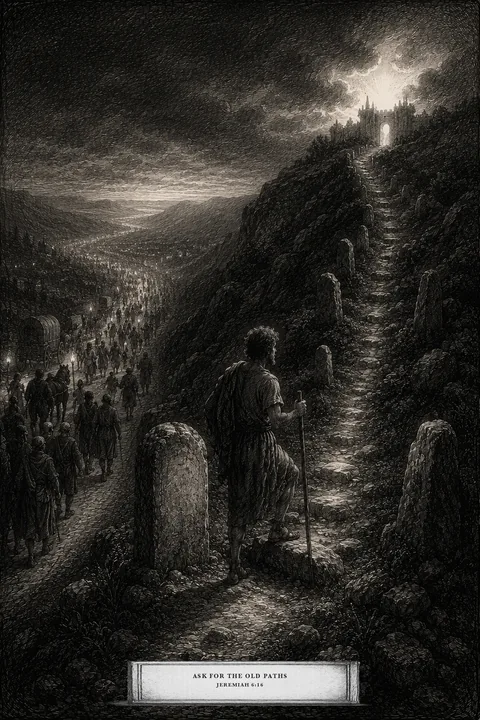
…ask for the old paths, where is the good way, and walk therein, and ye shall find rest for your souls.
— Jeremiah 6:16
The Way, The Truth, and The Life
Few verses are quoted more often, or examined less, than the one in which Jesus gathers three of His titles into a single breath:
Jesus saith unto him, I am the way, the truth, and the life: no man cometh unto the Father, but by me.
We hear it as one claim — Jesus is the only road to heaven — and move on. But He has named three things, not one, each a word Scripture has already filled with meaning; and the small word fastened to each is the — not a way, a truth, a life, but the, the particular one God defines.
Note, too, where the road actually leads: He says “unto the Father,” not “to heaven.” In Scripture the hope was never to climb up to heaven but for heaven to come down to earth — the holy city descending, God dwelling with men (Revelation 21:2-3). Take the three in the order He gave them.
The Way
Begin with “the way.” The Hebrew for a way, derek, comes from a verb meaning to tread: a road is not laid down before anyone walks it; it is made by the walking. So a person’s “way” is not where they are headed but how they go — their conduct, their manner of life. Scripture defines “the way of the LORD” the first time the phrase appears:
Not a feeling, not a direction — a manner of living: “to do justice and judgment.” Covenant-conduct, measured by God’s standard. Peter says the same from the other side, laying “the way of righteousness” alongside “the holy commandment” (2 Peter 2:21) — one thing named twice. This is the way Jesus sets against its opposite:
…wide is the gate, and broad is the way, that leadeth to destruction… narrow is the way, which leadeth unto life, and few there be that find it.
Two ways, two manners of walking, two ends. The narrow way is no secret route; it is the disciplined, Torah-shaped conduct that leads to life. Which is why the first followers of Jesus were not called Christians but were known, simply, as “the Way” — and when Paul was charged with belonging to it, here is how he owned the name:
“The Way” was not a new religion. It was the old covenant-conduct — “believing all things which are written in the law and in the prophets” — now walked in the light of its Messiah.
The Truth
Next, “the truth.” Here too the modern ear hears the wrong thing: we take truth to mean factual accuracy, a statement that matches the world. But Scripture says plainly what the truth is:
Thy righteousness is an everlasting righteousness, and thy law is the truth.
Not “thy law is true,” but “thy law is the truth” — the standard itself, the measure by which everything else is weighed. Jesus prays it the same way:
Sanctify them through thy truth: thy word is truth.
The law, the word — the covenant standard — is the truth. Other things are true only as they answer to it. So “the truth” is not a heap of correct facts; it is God’s own measure, His commandments, His word.
The Life
Third, “the life.” The word covers every breathing thing, but the life is narrower — the covenant-existence that flows from God and defines His people. John opens his Gospel by setting it equal to another symbol:
In him was life; and the life was the light of men.
The life was the light — and light is a defined symbol with its own chapter ahead: not truth in the abstract, but the law lived where men can see it (Matthew 5:16).[1] So John’s equation compounds the symbols: the covenant-existence, held perfectly in Him, was itself the lived example — obedience demonstrated in the open, where men could watch it and walk by it. The life does not merely exist; it shows.
The law itself is called by this name:
Two symbols compound in that phrase: at this scale the tree is the covenant people, and the life is the covenant-existence just defined — so the tree of life is the living nation, the community whose obedience is on display; and what one lays hold of to belong to it is wisdom, the law kept and done (Deuteronomy 4:6).[2] (The tree’s movement between a person, a house, and a nation is its own study; here it is enough that the law and the life are bound together.)
This is why the narrow way “leadeth unto life” (Matthew 7:14): the conduct yields the existence. Walk the pattern, and you enter the life it produces.
The Highway
There is a companion to “the way” that English blurs into it. A way (derek) is how you walk — conduct. A highway (mesillah, from a root meaning to cast up, to raise) is where you walk — the road itself, built up above the wilderness, cleared of stones, public and unmistakable. Isaiah names them in one breath:
And an highway shall be there, and a way, and it shall be called The way of holiness; the unclean shall not pass over it; but it shall be for those: the wayfaring men, though fools, shall not err therein. No lion shall be there, nor any ravenous beast shall go up thereon, it shall not be found there; but the redeemed shall walk there.
The highway is the covenant road — raised, holy, and safe — and every clause of the promise is built of symbols we can now read. No lion, no ravenous beast: the beast is a defined symbol — a kingdom of the world, “the fourth beast shall be the fourth kingdom upon earth” (Daniel 7:23) — and the lion is the beast Scripture names a ruler: “As a roaring lion… so is a wicked ruler over the poor people” (Proverbs 28:15); “her princes within her are roaring lions” (Zephaniah 3:3); “Israel is a scattered sheep; the lions have driven him away: first the king of Assyria… and last this Nebuchadrezzar king of Babylon” (Jeremiah 50:17). On every other road the flock walks hunted — the empires roar like lions and “lay hold of the prey… and none shall deliver” (Isaiah 5:29) — but no devouring ruler can set foot on this one, and the scattered sheep walk home unhunted: “they shall not hurt nor destroy in all my holy mountain” (Isaiah 11:9).
Even the fool — the man who hears God’s word and will not do it — “shall not err therein”: the covenant road is so plainly built that finding it was never the fool’s problem; “it is not hidden from thee, neither is it far off… the word is very nigh unto thee, in thy mouth, and in thy heart, that thou mayest do it” (Deuteronomy 30:11, 14). It must be prepared: “make straight in the desert a highway for our God” (Isaiah 40:3) — not a work of shovels but of repentance, the cry John the Baptist took up, clearing the obstacles off the covenant road. Where a people break the covenant, the road falls empty: “the highways lie waste… he hath broken the covenant” (Isaiah 33:8).
It is the road in Jesus’ parable of the wedding feast. When those first bidden refuse, the king does not cancel the feast — he widens the summons:
The call goes out to the highways and the house is filled — “compel them to come in, that my house may be filled” (Luke 14:23). Yet one guest is found there “which had not on a wedding garment” (Matthew 22:11), and is cast out: to be on the highway is not enough; the way — the conduct, the garment one wears — must match the road. Where and how stand or fall together, which is just what Isaiah called them: “the way of holiness.”
The Door
Where does the road lead? To a door. The highway of holiness runs home to the house of God, and the entrance is a person:
I am the door: by me if any man enter in, he shall be saved, and shall go in and out, and find pasture.
Not a door among doors — the door, the one way in. Now see what Scripture marks a doorway with. On its posts is written the word of God: “thou shalt write them upon the door posts of thine house, and upon thy gates” (Deuteronomy 11:20) — the commandments, the law, the truth, inscribed on the very frame you pass through. And on its posts is spread the blood of the lamb:
And the blood shall be to you for a token upon the houses… and when I see the blood, I will pass over you, and the plague shall not be upon you to destroy you.
The doorway of God’s house bears the word on its posts and the blood on its posts — the law and the lamb, the truth and the cross. Christ is that door. To come in by Him is to come in by the word and by the blood: past the commandment that is the truth, under the blood that turns the destroyer away.
One Torah, Three Aspects
Set the three side by side, and they are not separate claims but one reality seen from three angles. Solomon had already strung them on a single thread:
For the commandment is a lamp; and the law is light; and reproofs of instruction are the way of life.
The commandment — the standard, “the truth” — made visible as light, becomes a “way of life”: conduct that yields existence. The truth defines the way; the way produces the life. One Torah, three aspects: the measure, the walking, and the living.
From the gate of Eden the whole of it was already in view. There a “flaming sword” was set “to keep the way of the tree of life” (Genesis 3:24). The word rendered “keep” is shamar — to guard, to protect, to keep, to preserve and maintain; the very charge first given to Adam, to “keep” the garden (Genesis 2:15). It does not mean to bar the way but to preserve it.
What is that flaming sword? Paul names it: “the sword of the Spirit, which is the word of God” (Ephesians 6:17) — the same word Hebrews calls “sharper than any twoedged sword” (Hebrews 4:12). So from the very beginning the word of God has stood guard over the way of life — the truth guarding the way to the life, the three already bound together and kept open by the Word that runs through them all. (The sword and the flame are each their own study; here it is enough to see the Word keeping the way.)
The Torah Embodied
Now return to where we began, and the three titles open. When Jesus says “I am the way, the truth, and the life,” He is not stacking three metaphors. He is saying that the whole of it — the standard, the conduct, the existence — has become a person.
He is “the truth”: the law in the flesh, the commandment no longer cut in stone or even written on the heart but living, speaking, demonstrating. He is “the way”: covenant-conduct walked, for once, perfectly — the road made by His own treading. Hebrews names that road with a word every major translation flattens to “new”:
Having therefore, brethren, boldness to enter into the holiest by the blood of Jesus, By a freshly-slain and living way, which he hath consecrated for us, through the veil, that is to say, his flesh;
The Greek behind the usual “new” is prosphatos — built on the verb for slaughter: freshly slain.[3] A way freshly slain and living at once — the same paradox handed to every disciple who walks it: “present your bodies a living sacrifice” (Romans 12:1). The road into the holiest is a Person freshly slain and alive forevermore, consecrated for us through the veil of His own flesh. And He is “the life”: the covenant-existence the way leads to, held so fully that death could not keep it —
…I am the resurrection, and the life: he that believeth in me, though he were dead, yet shall he live.
This is the same claim the Gospel chapter made about the gospel[4] — the law of the kingdom, the renewed covenant written on the heart — said now in the first person. The One who is that law, kept whole in a single human life, can say without exaggeration: “I am the way, the truth, and the life.” He is the Torah embodied — the walking standard.
The last line, then, is not the slammed door it is so often made to sound like: “no man cometh unto the Father, but by me.” Read through the symbols, it is simply this: there has only ever been one way — one covenant-conduct, one standard, one life — and it now has a name. Not a new road to God, but the original road, walked perfectly and thrown open. To come by Him is to walk the way He is, by the truth He is, through the door He is, into the life He is.
The name He bears — what it is in this symbolic language, what it carries, and why everything hangs on it — is the next chapter.