Render therefore unto Caesar the things which are Caesar's; and unto God the things that are God's.
— Matthew 22:21
The Coin
Jesus defined this chapter’s symbol Himself, in a parable built for the purpose:
Or what woman, having ten silver coins, if she loses one coin, does not light a lamp, sweep the house, and search carefully until she finds it? And when she has found it, she calls her friends and neighbors together, saying, “Rejoice with me, for I have found the piece which I lost!” Likewise, I say to you, there is joy in the presence of the angels of God over one sinner who repents.
NKJV
The equation is stated in the last line: the found coin is the repenting sinner — the same celebration that met the prodigal son (Luke 15:23-24, 32), told with silver instead of a son. Identify this symbol correctly, and it unlocks a mystery woven through half a dozen parables — and, at the far end, the wisdom Revelation calls for: the mark of the beast, its image, its name, the number of its name, and why no man may buy or sell without them.
Decode the parable’s own symbols first. The woman sweeps the house — and in the paired lost-sheep parable, the sheep are “the lost sheep of the house of Israel” (Matthew 10:6); her ten coins are the house’s ten tribes. She searches by a lit lamp — and the lamp is the commandment (Proverbs 6:23); its light is the commandment lived, as the Light and Darkness chapter proves. By that obedience the coin is found: the lost are sought by the light of the law.
The Coin of the Census
One coin in the Gospels is named, examined face-up, and ruled on — and the scene opens as a trap:
Then the Pharisees went and plotted how they might entangle Him in His talk. And they sent to Him their disciples with the Herodians, saying, “Teacher, we know that You are true, and teach the way of God in truth; nor do You care about anyone, for You do not regard the person of men. Tell us, therefore, what do You think? Is it lawful to pay taxes to Caesar, or not?” But Jesus perceived their wickedness, and said, “Why do you test Me, you hypocrites? Show Me the coin of the census.”[1] So they brought Him a denarius. And He said to them, “Whose image and inscription is this?” They said to Him, “Caesar’s.” And He said to them, “Render therefore to Caesar the things that are Caesar’s, and to God the things that are God’s.”
NKJV
Look at what the coin carries: an image and a name. A beast is a kingdom — “the fourth beast shall be the fourth kingdom upon earth” (Daniel 7:23) — and a kingdom stamps its money. Caesar’s census coin therefore bears, on its face, the image of the beast and the name of the beast — the very two things Revelation says the world will be made to carry. Jesus held the whole question of the mark in His hand, and His ruling was already complete: give the beast back its coin.
Read without the symbols, “render unto Caesar” is a mirror — the tax-lover sees a command to pay, the tax-hater hears that everything is God’s — and the scene shrinks to a clever escape from a trap. Read with them, the sentence divides the world’s whole estate by image and inscription: everything stamped by the beast returns to the beast, and everything stamped by God returns to God. Whose image do you bear? “God created man in his own image” (Genesis 1:27), and the seal writes His inscription on the forehead — so what is rendered unto God is the image-bearer himself: “present your bodies a living sacrifice, holy, acceptable unto God, which is your reasonable service” (Romans 12:1).
So the pivot of the chapter is a question the tribute scene forces: if Caesar has a coin bearing his image, his inscription, struck for his census — what coin bears the image of God, the seal of God, the name of God, and the number of His name? The parable of the woman already answered: we are His coinage. What follows traces His coin through Scripture — minted, spent, carried in a fish’s mouth, counted, and counterfeited.
The Mint
A coin is the seal made money, and His coin is minted the way all coin is: dug from a field, refined in fire, stamped with the name. The field is the world (Matthew 13:38), and the treasure hid in it was worth selling everything to buy (Matthew 13:44). A coin lying loose is simply picked up; what the buyer found was ore — gold scattered through the clay of the field — and ore is not spent; it is refined. The refining is the trial — “he knoweth the way that I take: when he hath tried me, I shall come forth as gold” (Job 23:10) — and Zechariah hears what comes out of the furnace when the refined third is brought through:
…I will refine them as silver is refined, and will try them as gold is tried: they shall call on my name, and I will hear them: I will say, It is my people: and they shall say, The LORD is my God.
Refined, then stamped: those who come through the fire call on the Name, and God claims them as His own. The stamp is the seal the Seal chapter defined — the Name written on the forehead and the hand, the law sealed in the man.
What His Coin Buys
Caesar’s coin moves in Caesar’s market. God’s coin has a market of its own, and Scripture posts its prices: “Buy the truth, and sell it not; also wisdom, and instruction, and understanding” (Proverbs 23:23). Solomon wrote the whole exchange out — and notice what the money is, and where the goods come from:
Yea, if thou criest after knowledge, and liftest up thy voice for understanding; If thou seekest her as silver, and searchest for her as for hid treasures; Then shalt thou understand the fear of the LORD, and find the knowledge of God. For the LORD giveth wisdom: out of his mouth cometh knowledge and understanding.
Here is the treasure-hid-in-a-field parable in proverb form, centuries early: the seeking is priced as silver, the goods are hid treasures, and they issue “out of his mouth.” The risen Lord still runs the counter: “I counsel thee to buy of me gold tried in the fire, that thou mayest be rich” (Revelation 3:18) — He sells exactly what His mint produces. The vocabulary of this market — silver, treasure, and a mouth — carries us to the strangest coin-scene in the Gospels.
The Fish That Carries It
At Capernaum the collectors come asking after a very particular coin:
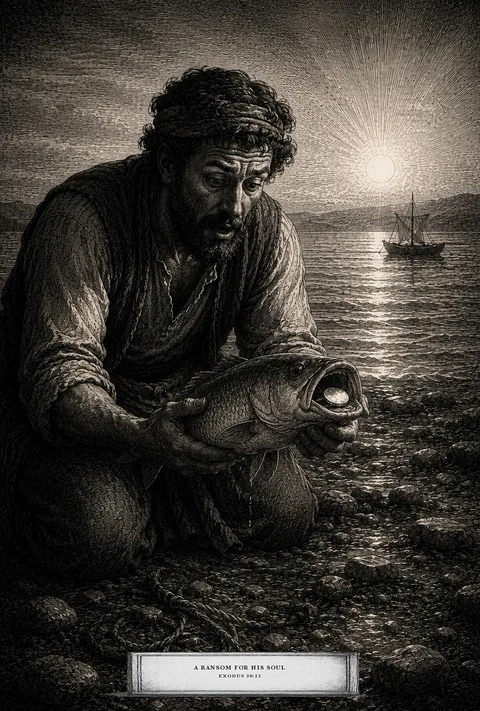
And when they were come to Capernaum, they that received the half-shekel came to Peter, and said, Doth not your teacher pay the half-shekel? He saith, Yea. And when he came into the house, Jesus spake first to him, saying, What thinkest thou, Simon? the kings of the earth, from whom do they receive toll or tribute? from their sons, or from strangers? And when he said, From strangers, Jesus said unto him, Therefore the sons are free. But, lest we cause them to stumble, go thou to the sea, and cast a hook, and take up the fish that first cometh up; and when thou hast opened his mouth, thou shalt find a shekel: that take, and give unto them for me and thee.
ASV
The fish is the one symbol even the world still reads: people put fish on their cars as a sign of their faith — the fish is a believer. Read the rest of the scene the same way: Peter, the fisher of men (Matthew 4:19), goes to the sea — the peoples and nations — and the first fish that comes up out of it carries silver in its mouth. The Son owes no ransom in His Father’s house — “then are the sons free” — yet He pays, and the payment is a parable in miniature. Why a fish, why first, and why the mouth? The answers are all in the law the coin was minted under — for the half-shekel the collectors asked for is not a market price; it is a statute.
The Census and Its Ransom
The law prices persons in silver — not as a figure of speech, but as statute: a man vowed to God is redeemed “by thy estimation”, in sanctuary shekels (Leviticus 27:2-8). Whenever Israel is counted, every counted head owes a coin:
When thou takest the sum of the children of Israel after their number, then shall they give every man a ransom for his soul unto the LORD, when thou numberest them; that there be no plague among them, when thou numberest them… The rich shall not give more, and the poor shall not give less than half a shekel… to make an atonement for your souls.
15
Every clause carries doctrine. The ransom is owed at the counting — to stand in God’s census is to stand ransomed. The old spiritual asks for exactly this: “Lord, how I want to be in that number, when the saints go marching in” — that number is the census of the ransomed. The price is flat — no man’s soul outbids another’s at that window. The tribute trap opened with this very clause, spoken as flattery — “You do not regard the person of men” — and Scripture testifies it of God in the census’s own pair:
…that accepteth not the persons of princes, nor regardeth the rich more than the poor? for they all are the work of his hands.
What was offered as bait was the census price, stated back to its Author — every soul His work, every soul the same half shekel.
The money is called “a memorial” (Exodus 30:16) — the same word the law uses for the sign bound between the eyes (on the forehead) — and it is not banked but appointed “for the service of the tabernacle.” Exodus records the appointment to the shekel: “of the hundred talents of silver were cast the sockets of the sanctuary, and the sockets of the vail; … a talent for a socket” (Exodus 38:25-27) — a half-shekel a head for 603,550 counted men, melted into the foundations. God’s house stood on the ransom-money of His counted people. The house has never changed its engineering: “ye also, as lively stones, are built up a spiritual house” (1 Peter 2:5), and the stone is covenant rock — a temple of covenant-people, socketed in redemption silver.
The census began at the door in Egypt. The first ransom of the firstborn was the Passover lamb — the firstborn under the marked doors were bought with its blood — and Israel marched out “on the fifteenth day of the first month” (Numbers 33:3). On the morrow — the sixteenth, the day of firstfruits, the very day of the year the Firstborn would rise as “the firstfruits of them that slept” (1 Corinthians 15:20) — God stated His claim:
Sanctify unto me all the firstborn, whatsoever openeth the womb among the children of Israel, both of man and of beast: it is mine.
The womb the law watched opens again in Revelation, where the travailing woman “brought forth a man child… and her child was caught up unto God, and to his throne” (Revelation 12:5). The dragon stands before her to devour him as Egypt’s king stood before the firstborn — every redeemed firstborn a rehearsal of “the firstborn of every creature” (Colossians 1:15). Under the claim, every firstborn thereafter “shalt thou redeem” (Exodus 13:13), and the redemption travels under a sign with three locations:
And it shall be for a sign unto thee upon thine hand, and for a memorial between thine eyes, that the LORD’S law may be in thy mouth: for with a strong hand hath the LORD brought thee out of Egypt.
Hand, eyes, mouth. When the claimed were redeemed by silver, the count was a census of names: “Number all the firstborn… take the number of their names” (Numbers 3:40) — 22,273 of them, exact to the man where the army musters are round, and the overage above the Levites' count was ransomed at five shekels a head (Numbers 3:43-50). God counts what He redeems by name — and the price attaches to the name counted.
Now the fish gives up its riddle. The redemption sign’s third location is the mouth — “that the LORD’s law may be in thy mouth” — and the seal-texts keep the word there: “the word is very nigh unto thee, in thy mouth, and in thy heart” (Deuteronomy 30:14); “confess with thy mouth the Lord Jesus” (Romans 10:9). A man wears the seal on his forehead; a fish carries it in its mouth — on a fish they are the same place. The first man drawn up out of the sea of nations comes up with the ransom-witness in his mouth: the caught man carries his confession, and the confession is his redemption. The coin itself is exact: a stater — one full shekel, precisely two half-shekel ransoms — “for me and thee.” The Hebrew Gospel seals the grammar: the coin is given be’ad us — “on behalf of” — the very preposition of the atonement, “and Aaron shall make atonement for himself, and for his house” (Leviticus 16:6). The substitution is in the preposition: one pays, another is covered.
The Mark of the Beast
Now the piece this symbol unlocks. Revelation holds two enrollments, and nearly every reader studies the beast’s mark in isolation — never suspecting that the mark is an enrollment at all. Set the two side by side instead. In chapter seven, God counts:
And I heard the number of them which were sealed: and there were sealed 144,000 of all the tribes of the children of Israel.
This is a census, taken tribe by tribe like Sinai’s, of servants sealed in their foreheads before the four winds blow. The Hebrew of the count carries the firstborn census inside it: 144 alaphim — and the consonants of thousands are the consonants of alluphim, chiefs, firsts — and Revelation names the sealed exactly that: “the firstfruits unto God and to the Lamb” (Revelation 14:4). God’s last census, like His first, is a census of firstborn. In chapter thirteen, the beast counts:
And he causeth all, both small and great, rich and poor, free and bond, to receive a mark in their right hand, or in their foreheads: And that no man might buy or sell, save he that had the mark, or the name of the beast, or the number of his name… Let him that hath understanding count the number of the beast: for it is the number of a man…
The mark of the beast is the counterfeit of the temple census, member for member. Its name sits where the NAME goes; its number answers the number of the sealed; its enrollment is universal where God’s is “of all the tribes”; and where God’s census collects a ransom-coin for the sanctuary, the beast’s census issues its coin-mark for the market — “no man might buy or sell” without it.
Even the word is mint vocabulary: the mark is charagma — an impression struck or engraved, the die-strike — and its only other use in the New Testament is coin-and-idol language, the Godhead falsely imaged in “gold, or silver… graven by art and man’s device” (Acts 17:29). The man who takes the mark is minted: the beast’s image and inscription struck on flesh — the census coin, paid in persons.
The counterfeit even keeps the ransom’s equality clause: where the census took the same half shekel of “the rich” and “the poor” (Exodus 30:15), the mark falls on “rich and poor” — with “small and great, free and bond” stacked beside them, and the Hebrew Revelation reads “the wealthy and the poor” outright. The beast’s census, like God’s, is no respecter of persons: the counterfeit keeps even that clause. Even the registers face each other in the same chapter — the beast’s rolls against “the book of life of the Lamb” (Revelation 13:8), the register of which the psalm says, “The LORD shall count, when he writeth up the people” (Psalm 87:6).
The plague-clause inverts with the rest. The ransom was paid “that there be no plague among them, when thou numberest them” — and the tormentors of the trumpets touch “only those men which have not the seal of God in their foreheads” (Revelation 9:4), while the first vial falls “upon the men which had the mark of the beast” (Revelation 16:2). God’s counted take no plague; Babylon’s counted are the plague’s named address. Nor can Babylon’s market starve the sealed, for the other market never closed:
Ho, every one that thirsteth, come ye to the waters, and he that hath no money; come ye, buy, and eat; yea, come, buy wine and milk without money and without price.
The beast’s enrollment is older than Rome. Its founding charter was spoken on the plain of Shinar:
Go to, let us build us a city and a tower, whose top may reach unto heaven; and let us make us a name, lest we be scattered abroad upon the face of the whole earth.
Babel opened a counter-covenant: a name of man’s own minting for every man to be enrolled under. The reason the marked cannot be saved is now plain grammar: they are counted under the wrong name, and “there is none other name under heaven given among men, whereby we must be saved” (Acts 4:12). Two names, two censuses, two coinages — no man is enrolled in both.
The Number of One Man
“Let him that hath understanding count the number of the beast: for it is the number of a man” (Revelation 13:18) — and the Hebrew Revelation reads one man, adam echad. Most reach for gematria here, as though Revelation were asking for another candidate whose letters add to 666. This chapter’s claim is different: Revelation 13 is not first a gematria problem but a covenant census problem.
The words themselves vote that way. The Greek verb is psēphizō — to tally with a psēphos, the pebble used for ancient counting and voting — and its only other use in Scripture is a cost-tally: “which of you, intending to build a tower, sitteth not down first, and counteth the cost?” (Luke 14:28). John hands the overcomer the very object four chapters earlier: “I will give him a white stone, and in the stone a new name written, which no man knoweth saving he that receiveth it” (Revelation 2:17) — and his word is not lithos, a rock, but psēphos, the counting-pebble. A psēphos is a vote and an enrollment-token: Paul casts one against the saints — “I gave my voice against them” (Acts 26:10) — and Matthias is “numbered with the eleven” by one (Acts 1:26).
The Hebrew Revelation names what the white stone holds: the overcomer receives “a good testimony, and in this testimony a new name written” — God’s vote cast for a man, his sealed entry in the census of the sealed; the mark is the vote against, carried on the flesh. The Hebrew’s counting verb agrees: chashav — the ledger-reckoning of “counted it to him for righteousness” (Genesis 15:6) and of the law’s redemption-price arithmetic (Leviticus 25:50-52) — and its text finishes the instruction as a tally: “you shall find the sum.”
Scripture uses the number itself twice: once as money, once as a census — the two things the beast’s enrollment controls. The number 666 is a money figure:
Now the weight of gold that came to Solomon in one year was 666 talents of gold…
The revenue lands at the very turn where the king began multiplying gold against the law of the king (Deuteronomy 17:17). It is also a census figure, and the roll shows the format of a number-of-a-name exactly:
The children of Adonikam, 666.
It is a count filed under the name that owns it, in the register of those coming out of Babylon. A number of a name is a census entry; Revelation keeps both ledgers in that grammar — “I heard the number of them which were sealed” (Revelation 7:4) stands against the number of its name, and the victors of the sea of glass overcome “the beast… his mark, and the number of his name” (Revelation 15:2) — the enrollment itself, refused.
So the instruction “count the number” asks for arithmetic, not alphabet-magic: a census is a thing you count — the redeemed against the enrolled. The Remnant chapter runs that count down 15 converging lines of evidence, and they settle near 2 persons in 1,000 — beside 1 in 666, which is 1.5 in 1,000. The wisdom the verse calls for is the verdict the count returns: “few there be that find it” (Matthew 7:14) — how few are ransomed, and how broad the way of the enrolled. Every man ends in one census or the other: counted and ransomed, or counted and marked.
Hosea acted the ransomed side out in one verse: commanded to love an adulteress “according to the love of the LORD toward the children of Israel,” he went to market for his own wife — “So I bought her to me for fifteen pieces of silver, and for an homer of barley” (Hosea 3:2) — the Husband paying coin to redeem the wife who left him. The marriage itself — what joins it, what can break it, and how far the Husband went to keep it — is the next chapter.