…which my covenant they brake, although I was an husband unto them, saith the LORD.
— Jeremiah 31:32
Marriage and Divorce
The common reading says Jesus permits divorce for sexual immorality, taking porneia broadly as illicit sexual activity outside monogamous marriage. Other readers confine the exception to sin discovered during betrothal, like Joseph’s dilemma, or tie it to the forbidden unions of Leviticus 18.
Every camp shares the same assumption. All three read the exception as a permission about literal sex, and not one of them opens the Torah to ask what the law itself does with each case. This chapter will run that test — the law first, then the words, then the Bible’s symbolic language — and the common interpretation will not survive it.
The Collision with the Law
Here is the problem the common view never faces. Under the law, adultery is not a divorce ground; it is a capital crime:
And the man that committeth adultery with another man’s wife, even he that committeth adultery with his neighbour’s wife, the adulterer and the adulteress shall surely be put to death.
Deuteronomy repeats it for the married and the betrothed alike — “they shall both of them die… so shalt thou put away evil from Israel” (Deuteronomy 22:22-24) — and the scribes could still quote it to Jesus’ face: “Moses in the law commanded us, that such should be stoned: but what sayest thou?” (John 8:5). A dead spouse needs no bill of divorcement.
If the exception clause means “divorce is permitted for adultery,” then Jesus quietly commuted a death penalty — amended the law — a dozen verses after declaring that “one jot or one tittle shall in no wise pass from the law” (Matthew 5:18), in the same sermon. The reading that everyone holds makes Jesus break the rule He had just laid down. Either He contradicted Himself in a single chapter, or the exception is not about adultery at all.
Two Words in One Sentence
The Greek settles which, because Jesus used two different words — in the same breath:
But I say unto you, That whosoever shall put away his wife, saving for the cause of fornication, causeth her to commit adultery: and whosoever shall marry her that is divorced committeth adultery.
The exception is porneia — fornication; the consequence is moicheia — adultery. He had the adultery-word in His mouth and did not use it for the exception; and when He lists the sins of the heart, He lists them separately: “adulteries, fornications” (Matthew 15:19) — two words, two things.
Mark and Luke record the saying with no exception at all — “Whosoever shall put away his wife, and marry another, committeth adultery” (Mark 10:11; Luke 16:18) — the absolute form.[1] Only Matthew carries the clause — and Matthew has already shown his readers the case it covers.
In his first chapter: Mary, “espoused to Joseph,” is found with child, and Joseph — called “her husband” and “a just man” in the same verse — is “minded to put her away privily” (Matthew 1:18-19). A betrothed man in Israel is a husband; ending a betrothal takes a putting-away; and the text calls Joseph just — law-keeping — in the very act of resolving suspected fornication by a quiet bill rather than a public stoning. The exception clause covers Joseph; it does not commute Leviticus.
What God Hath Joined
Before the divorce question can be answered, marriage itself must be defined — and Scripture defines it as one would expect:
And he answered and said unto them, Have ye not read, that he which made them at the beginning made them male and female, And said, For this cause shall a man leave father and mother, and shall cleave to his wife: and they twain shall be one flesh? Wherefore they are no more twain, but one flesh. What therefore God hath joined together, let not man put asunder.
He answers from the beginning, quoting Genesis 2:24. What kind of joining? The last chapter watched it enacted: the husband spreads his wing over the bride — “I spread my skirt over thee… yea, I sware unto thee, and entered into a covenant with thee… and thou becamest mine” (Ezekiel 16:8) — and she is called by his name. Malachi names the wife by the bond: “she is thy companion, and the wife of thy covenant” (Malachi 2:14). And Proverbs names the bond by its Owner — the adulterous woman is one “which forsaketh the guide of her youth, and forgetteth the covenant of her God” (Proverbs 2:17).
Marriage is the covenant in miniature: a one-flesh union that God Himself joins, sworn, witnessed, and worn like a name. The joining is real whichever way it runs — “he which is joined to an harlot is one body… but he that is joined unto the Lord is one spirit” (1 Corinthians 6:16-17) — which is why the question of who joined this union will turn out to be the whole divorce question.
The Nakedness of a Thing
Now open the statute the Pharisees waved at Jesus:
When a man hath taken a wife, and married her, and it come to pass that she find no favour in his eyes, because he hath found some uncleanness in her: then let him write her a bill of divorcement, and give it in her hand, and send her out of his house.
“Some uncleanness” is, in the Hebrew, the nakedness of a thing — and “nakedness” here is the exact word of the forbidden-union chapter: “None of you shall approach to any that is near of kin to him, to uncover their nakedness” (Leviticus 18:6), the catalog of unions that were never lawful to make. The statute’s own vocabulary points away from adultery — which Deuteronomy has already sentenced to death two chapters earlier — and toward the union with something unlawful at its root: the nakedness uncovered, the covenant covering absent.
Read the rest of the statute’s shape. Divorce is regulated, never celebrated: the bill in her hand protects the woman (a hard-hearted man could otherwise simply cast her out and leave her bound); she is free to remarry (Deuteronomy 24:2); and one door is bolted — her first husband “may not take her again… after that she is defiled: for that is abomination” (Deuteronomy 24:4). The no-return rule matters because the whole gospel will hang on it before this chapter ends. The law also forbids divorce outright in two cases (Deuteronomy 22:19, 29), and guards the wife’s provision — “her food, her raiment, and her duty of marriage, shall he not diminish” (Exodus 21:10), the very rights the seven women of the last chapter offered to waive.
When the Pharisees asked Jesus, “Is it lawful for a man to put away his wife for every cause?”[2] — He answered past the whole debate: Moses “suffered” divorce “because of the hardness of your hearts” — but “from the beginning it was not so” (Matthew 19:8). The statute manages the wreckage of hard hearts; it does not bless it. “The LORD… hateth putting away” (Malachi 2:16) — when what is put away is “the wife of thy covenant.”
The Commanded Divorce
There is a union the law refuses to bless — and there, Scripture does not permit divorce; it commands it. Watch how the law describes marrying outside the covenant:
Lest thou make a covenant with the inhabitants of the land, and they go a whoring after their gods… And thou take of their daughters unto thy sons, and their daughters go a whoring after their gods, and make thy sons go a whoring after their gods.
The out-of-covenant marriage is not at risk of leading to fornication; the law calls the union itself a going-a-whoring — fornication in the Bible’s symbolic language is covenant-unfaithfulness, and Israel commits it “with stones and with stocks” (Jeremiah 3:9), with high places (2 Chronicles 21:11), with kingdoms (Revelation 17:2), and with the daughters of strange gods (Deuteronomy 7:3-4). Now read Ezra with that definition in hand. The returned exiles had “taken of their daughters… so that the holy seed have mingled themselves with the people of those lands” (Ezra 9:2), and the remedy was a covenant:
Now therefore let us make a covenant with our God to put away all the wives, and such as are born of them… of those that tremble at the commandment of our God; and let it be done according to the law.
“Put away… according to the law” — divorce, not as concession but as obedience, demanded by the men who trembled at the commandment; and Nehemiah enforces the same, holding up Solomon as the proof of where the strange wives lead: “even him did outlandish women cause to sin” (Nehemiah 13:26).
Here Malachi’s oracle shows its two edges, for the same prophet who thundered “the LORD… hateth putting away” thunders first against the marriage Ezra dissolved: “Judah… hath married the daughter of a strange god. The LORD will cut off the man that doeth this” (Malachi 2:11-12). Putting away the wife of the covenant is treachery; keeping the daughter of the strange god is treachery. Divorce in Scripture is evil or obedience depending entirely on which union it severs — because “what God hath joined together” is a covenant clause, and the union God never joined is the one He commands undone.
Paul keeps both edges for the assemblies — and marks whose voice is whose. To the married he gives the absolute rule and names its source: “I command, yet not I, but the Lord, Let not the wife depart from her husband” (1 Corinthians 7:10). Then, turning to the man called while already married to an unbeliever, he changes the attribution: “But to the rest speak I, not the Lord” (1 Corinthians 7:12) — the absolute belongs to the Lord; the mixed-marriage counsel is the apostle’s own judgment, for a case Ezra’s courts never faced: a man converted mid-marriage, his household half in and half out.
Paul’s judgment runs the opposite direction from Ezra’s: “if she be pleased to dwell with him, let him not put her away… and the unbelieving wife is sanctified by the husband” (1 Corinthians 7:12, 14). Paul writes the rule in both directions — the believing wife likewise does not leave her unbelieving husband, who is sanctified by her (1 Corinthians 7:13-14) — for a reason Ezra’s generation did not have. The covenant door now stands open to every nation, and the out-of-covenant spouse is no longer a pull toward strange gods but a soul within reach of the salvation the gospel now publishes to all peoples: “For what knowest thou, O wife, whether thou shalt save thy husband?” (1 Corinthians 7:16). In Ezra’s day the strange wives drew the holy seed out; in Paul’s day the believing spouse may draw the stranger in. New marriages are still made “only in the Lord” (1 Corinthians 7:39), and if the unbeliever departs, the believer “is not under bondage” (1 Corinthians 7:15).
The Deposed Queen
Scripture also stages a divorce where no sexual sin appears at all — and the grounds are the symbol laid bare. Queen Vashti is summoned by the king, “but the queen Vashti refused to come at the king’s commandment” (Esther 1:12). The case is heard “according to law” (Esther 1:15), and the concern of the court is not jealousy but obedience across the whole realm: “this deed of the queen shall come abroad unto all women, so that they shall despise their husbands” (Esther 1:17). The verdict:
…That Vashti come no more before king Ahasuerus; and let the king give her royal estate unto another that is better than she.
That sentence is the Bible’s standing formula for a deposed covenant partner. Samuel to Saul: “The LORD hath rent the kingdom of Israel from thee this day, and hath given it to a neighbour of thine, that is better than thou” (1 Samuel 15:28). Jesus to the husbandmen of the vineyard: “The kingdom of God shall be taken from you, and given to a nation bringing forth the fruits thereof” (Matthew 21:43). And Solomon — the very case Nehemiah cited — hears it over his strange wives: “I will surely rend the kingdom from thee, and will give it to thy servant” (1 Kings 11:11). One formula, one lesson: the King’s wife must obey, or the estate passes — not because the King is petty, but because the whole land learns from the queen; the covenant marriage is public, and its breach teaches rebellion to every house in the empire.
Next comes the replacement, and she is the deposed queen’s exact inversion. Esther — a bride taken from the scattered exiles — is “made queen instead of Vashti” (Esther 2:17); and where Vashti refused to come when summoned, Esther goes in unsummoned, at the peril of her life, to intercede for her people: “I will go in unto the king, which is not according to the law: and if I perish, I perish” (Esther 4:16). The queen who would not come, and the bride who comes at the cost of her life: the two wives of the whole symbolic story, side by side in one Persian court.
God’s Own Case File
Now open the greatest divorce case in Scripture — God’s own — and watch Him keep His own law at every step. His wife committed adultery, endlessly, “with stones and with stocks.” The law says death; He is the Judge; and He does not stone her:
And I saw, when for all the causes whereby backsliding Israel committed adultery I had put her away, and given her a bill of divorce; yet her treacherous sister Judah feared not, but went and played the harlot also.
The bill of divorce is the exile — the wife sent “out of his house,” scattered among the nations — and God holds the paperwork up to her children (Isaiah 50:1). But now the Husband has a legal problem, and He states it Himself, citing His own statute:
They say, If a man put away his wife, and she go from him, and become another man’s, shall he return unto her again? shall not that land be greatly polluted? but thou hast played the harlot with many lovers; yet return again to me, saith the LORD.
Deuteronomy 24:4 bars the road home: the first husband may not take her again. God announces His intention to do the one thing His own law forbids — and He does not waive the law to do it; the whole testimony of this book is that He never does. Listen to Paul find the door:
For the woman which hath an husband is bound by the law to her husband so long as he liveth; but if the husband be dead, she is loosed from the law of her husband… Wherefore, my brethren, ye also are become dead to the law by the body of Christ; that ye should be married to another, even to him that is raised from the dead…
Death dissolves the bond — and the death that dissolves this one is the Husband’s. The wife earned the stoning; the Husband takes the stroke; and rising, He is free to wed her again in a renewed marriage bond. The covenant is no contract renegotiated among peers: its Head establishes the law and terms, which remain; what changes is who stands within the covenant, and whether its law is broken outside the heart or kept from within it.
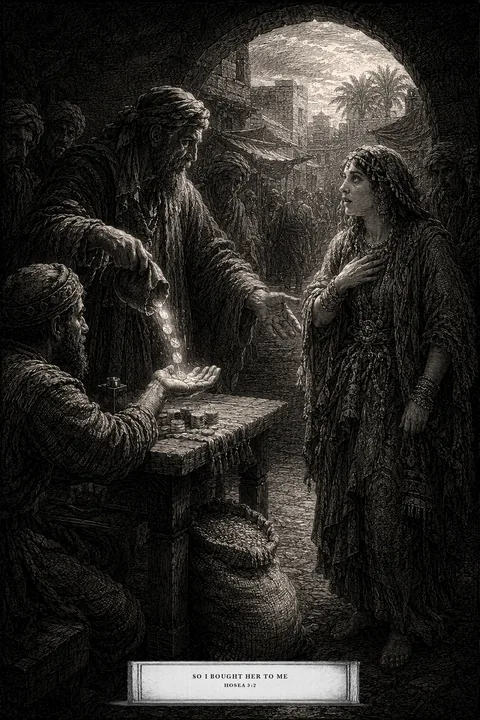
The Husband’s death is why the renewed covenant is announced in remarriage language: “I will make a new covenant… not according to the covenant… which my covenant they brake, although I was an husband unto them” (Jeremiah 31:31-32). That is why Hosea, God’s sign-and-similitude marriage, must not only endure his wife’s adultery but buy her back — “So I bought her to me for fifteen pieces of silver” (Hosea 3:2). The reunion is a fresh betrothal in the vocabulary this book keeps finding at the center: “I will betroth thee unto me for ever; yea, I will betroth thee unto me in righteousness, and in judgment… and thou shalt know the LORD” (Hosea 2:19-20).
It is why the forsaken wife is told her shame is over:
Fear not; for thou shalt not be ashamed: neither be thou confounded; for thou shalt not be put to shame: for thou shalt forget the shame of thy youth, and shalt not remember the reproach of thy widowhood any more. For thy Maker is thine husband; the LORD of hosts is his name; and thy Redeemer the Holy One of Israel; The God of the whole earth shall he be called. For the LORD hath called thee as a woman forsaken and grieved in spirit, and a wife of youth, when thou wast refused, saith thy God. For a small moment have I forsaken thee; but with great mercies will I gather thee.
Her reproach is named widowhood: the bond was dissolved the one way the law allows — by the Husband’s death — and the Maker who bore that death is the Husband who gathers her back.
It is why, when they dragged a woman taken “in the very act” of adultery before Jesus and quoted the death penalty at Him (John 8:4-5), the only Man present with the right to cast the first stone stooped, wrote in the dust, and let her accusers file out — “Neither do I condemn thee: go, and sin no more” (John 8:11). The trap was also lawless on its face: the statute they quoted requires both — “they shall both of them die, both the man that lay with the woman, and the woman” (Deuteronomy 22:22; Leviticus 20:10) — and a woman taken in the very act was taken with a man they knew and did not bring. To stone her alone would have broken the very law they invoked; He could not lawfully condemn her on their case.
He was not waiving the penalty. He was on His way to pay it.
The Burning and the Wedding
The Bible closes its marriage file the way the law requires — with an execution and a wedding, in that order. The false wife, “the great whore” who corrupted the earth with her fornication, is judged at last: “true and righteous are his judgments: for he hath judged the great whore” (Revelation 19:2), and she is “utterly burned with fire” (Revelation 18:8) — the law’s own sentence for the priest’s daughter who plays the whore (Leviticus 21:9). And in the very next breath:
Let us rejoice and be exceeding glad, and let us give the glory unto him: for the marriage of the Lamb is come, and his wife hath made herself ready. And it was given unto her that she should array herself in fine linen, bright and pure: for the fine linen is the righteous acts of the saints.
ASV
The counterfeit wife burned; the true bride wed, dressed in _righteous acts_[3] — the commandments kept, worn: the garment whose full reading has its own chapter ahead.
Paul had named the mystery long before:
For this cause shall a man leave his father and mother, and shall be joined unto his wife, and they two shall be one flesh. This is a great mystery: but I speak concerning Christ and the church.
Every marriage since Eden has been a similitude of this one — which is why the law guards marriage so fiercely, and why the prophets grieve its breaking in the language of heaven’s own wounds. “For I am jealous over you with godly jealousy: for I have espoused you to one husband, that I may present you as a chaste virgin to Christ” (2 Corinthians 11:2).
The symbols return their verdict on the common reading. Divorce for adultery is not the law’s remedy and was never Jesus’ concession — adultery’s wage is death, and the Husband paid it. The putting-away Scripture allows is the one it commands: the union that is itself fornication, the marriage to the daughter of a strange god, the covenant God never joined. And the marriage Scripture will not let go of is the covenant one — defended in the law, mourned by the prophets, kept by God Himself through His wife’s adultery, His own bill of divorce, His death, and the wedding feast He has already announced.
The gospel, read through this symbol, is a Husband who would not quit: “Turn, O backsliding children, saith the LORD; for I am married unto you” (Jeremiah 3:14). The marriage is the covenant between one God and one people — and the wing the bride came under, the covenant’s own hem, is the next symbol.