Except the LORD of hosts had left unto us a very small remnant, we should have been as Sodom, and we should have been like unto Gomorrah.
— Isaiah 1:9
The Remnant
Ask almost anyone whether they expect to be saved, and they answer yes — quietly assuming they stand with the majority, on the safe side of whatever line God draws. Someone once put the question to Jesus outright:
Lord, are there few that be saved? And he said unto them, Strive to enter in at the strait gate: for many, I say unto you, will seek to enter in, and shall not be able.
He answered a question about quantity with a command about effort, and the direction is unmistakable: few enter, while many seek and fail. The rest of Scripture repeats that direction through counts, harvests, metals, animals, and lived similitudes. These witnesses do not share a denominator and must not be averaged into a universal percentage. Their consistency is qualitative but forceful: the remnant is very small beside the whole.
The Plain Witnesses
Solomon records the rarity he found “counting one by one”:
Which yet my soul seeketh, but I find not: one man among a thousand have I found…
Jeremiah places the same smallness inside the promise of return:
Turn, O backsliding children, saith the LORD; for I am married unto you: and I will take you one of a city, and two of a family, and I will bring you to Zion.
Elijah thought he alone remained, and God answered with a count:
Yet I have left me seven thousand in Israel, all the knees which have not bowed unto Baal, and every mouth which hath not kissed him.
Scripture does not supply a reliable population denominator for turning those seven thousand into a percentage, and Paul does not ask us to. He carries forward the conclusion: “Even so then at this present time also there is a remnant according to the election of grace” (Romans 11:5), while elsewhere setting the sand-of-the-sea multitude against the remnant that shall be saved (Romans 9:27).
Zechariah’s surviving third likewise belongs first to its own judgment scene; it is then brought through fire and refined (Zechariah 13:8-9). It shows preservation through judgment, not a final worldwide percentage.
Gleanings, Gold, and Lone Survivors
Isaiah makes the remnant visible as what remains after harvest:
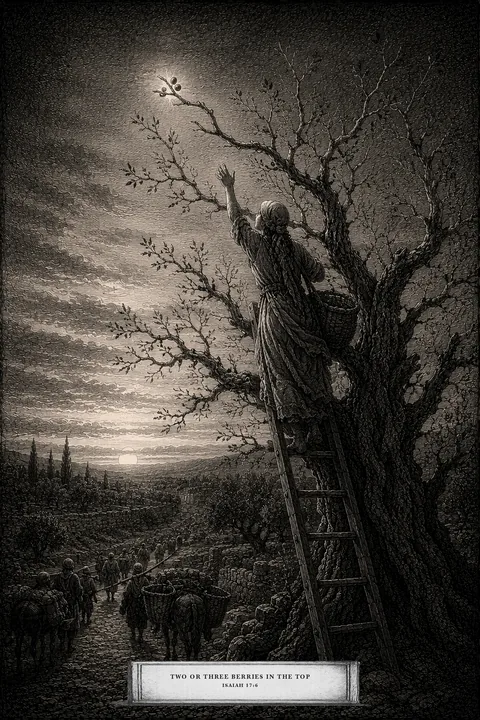
…as when the harvestman gathereth the standing grain… Yet gleanings shall be left therein, as the shaking of an olive tree, two or three berries in the top of the uppermost bough, four or five in the outmost branches of a fruitful tree…
ASV
The point does not depend upon estimating how many olives grew on an ancient tree. The harvest is gathered; only the hard-to-reach gleanings remain. The law reserves the edge of the field for the poor, stranger, fatherless, and widow (Leviticus 19:9-10; Deuteronomy 24:19-22), and Jesus says “the field is the world” (Matthew 13:38).
Isaiah reaches for rarity again: “I will make a man more precious than fine gold; even a man than the golden wedge of Ophir” (Isaiah 13:12), while Ezekiel calls the surrounding mass dross in the furnace (Ezekiel 22:18). Micah sets the remnant “in the midst of many people” as dew and as a lion among beasts and flocks (Micah 5:7-8): scattered and outnumbered, yet bearing life and rule. Moses says it without a figure: “ye were the fewest of all people” (Deuteronomy 7:7).
Job’s four disasters each leave a messenger saying, “I only am escaped alone to tell thee” (Job 1:15-19). Micaiah stands against four hundred court prophets (1 Kings 22:6-8), and Elijah stands alone before Baal’s prophets (1 Kings 18:22). None of these scenes is a census of the saved; all train the reader to recognize the same pattern — a faithful or escaped few amid the many.
An ancient witness outside the canon says it plainly: “The most High hath made this world for many, but the world to come for few,” then pictures a wave beside a drop and a grape kept from the cluster (2 Esdras 8:1; 9:15-16, 21-22). It is called only as corroboration, never as the ground of doctrine.
What the Witnesses Establish
The passages agree on direction, not on a calculable rate. They concern different populations, moments, and figures; combining them into a fraction of one percent gives the appearance of precision Scripture has not supplied. What Scripture does supply is consistent and sufficient: a strait gate with few finders, a little flock, a very small remnant, gleanings after harvest, rare gold amid dross, and lone witnesses amid crowds.
The distinction Scripture draws is not between perfect keepers and imperfect ones, for no one keeps the commands perfectly — it is between those who acknowledge the commands and stumble keeping them, and those who deny the commands exist at all. The one confesses and is cleansed (1 John 1:9); the other cannot confess what he does not call sin (1 John 1:8).
Ruth, the Remnant Enacted
Before these figures, Scripture gave the remnant a face. Ruth arrives in Bethlehem carrying every name of the gleaning household at once: poor — “I went out full, and the LORD hath brought me home again empty” (Ruth 1:21); a stranger — “seeing I am a stranger” (Ruth 2:10); a widow, her husband dead (Ruth 1:5); fatherless in every practical sense, having “left thy father and thy mother, and the land of thy nativity” (Ruth 2:11).
Where does she glean? In the field of Boaz — the goel, the kinsman-redeemer, who will restore her inheritance, marry her, and raise up seed. The gleaner finds the Redeemer in the field; she goes from gleaning the edge to standing in the line of the Messiah (Matthew 1:5).
The gleaning law does not only tell us that few remain after the harvest. Ruth shows who they are.
What "Remnant" Actually Means
English readers hear “remnant” and think leftovers — the scraps, the unwanted tail of the bolt. The Hebrew says the opposite, four times over, in the four words our Bibles render “remnant” — and each one is worth the dig.
She’erith, the most common, grows from a root meaning to swell — and its sibling noun from the same letters is she’er: flesh, living flesh, and by extension one’s blood kin. The remnant is not the dry residue; it is the living flesh of the covenant family — what is still warm when everything else has been cut away.
Yether comes from a root meaning to jut over, to exceed, to excel; its feminine form means wealth, and Jethro — “his excellence” — carries the same name. The remnant is not what nobody wanted; it is the exceeding portion, the overflow — and there is Jesus’ word again: your righteousness must “exceed” that of the scribes and Pharisees (Matthew 5:20). The remnant is the exceeding part. The word’s second sense — a small rope hanging free — is a lifeline dangling from something greater; the treasure’s cord in the dirt.
Sarid — “survivor” — grows from a root meaning to puncture, to slip out through the pierced point; its brother-words are the carpenter’s scribing-awl and stitching pierced with a needle. The remnant-survivor is, in the Hebrew’s own picture, the one who passes through the puncture — through the impossibly small opening. Now hear the Lord again: “It is easier for a camel to go through the eye of a needle, than for a rich man to enter into the kingdom” (Matthew 19:24) — and remember what the rich are in this book’s vocabulary: the proud, the unbowed. The needle’s eye was hiding in the remnant’s own name all along; the unbowed cannot pass the puncture, and the poor — the bowed — slip through.
Peletah is the escaped portion, the delivered — the same family as the word Job’s messengers gasp: nimlateti, “I only am escaped.” Living flesh, exceeding excellence, the one who slips through the needle’s point, the delivered portion: four words, one portrait — and not one of them means leftovers.
A Remnant by Design, Not by Failure
None of this is God falling short of a larger plan; the remnant was the plan, announced before the choosing as the fewest of all people (Deuteronomy 7:7). Noah’s household was eight, out of a world (1 Peter 3:20). Gideon’s army was cut from thirty-two thousand to three hundred before the LORD would use it — “lest Israel vaunt themselves against me, saying, Mine own hand hath saved me” (Judges 7:2). The strait gate with its few finders (Matthew 7:14) is not a tragedy God is powerless to widen; it is “your Father’s good pleasure to give you the kingdom” (Luke 12:32) — a little flock, handed a kingdom, on purpose.
The Only Safe Response
Now return to the question Jesus was asked, and weigh His answer with these witnesses in view. “Are there few that be saved?” — and He does not say do not worry about it. He says “strive” (Luke 13:24), and the Greek is agōnizomai — to agonize, to contend as an athlete contends in the arena — because “many will seek to enter in, and shall not be able”: even seeking is not enough.
Scripture marks the strivers plainly, and every mark is a symbol this book has already opened: they keep the commandments (Revelation 14:12); they overcome — every promise of the seven letters is “to him that overcometh”; they are not deceived; they will die before they bow to the beast (Revelation 20:4). The smallness is not revealed to produce despair; it is revealed to produce urgency — for if the gate is as narrow as every witness testifies, the deadliest thing in the world is the comfortable assumption that you are already through it.
“Except the LORD of hosts had left unto us a very small remnant, we should have been as Sodom” (Isaiah 1:9): the smallness was never God’s defeat. The gold was always going to be rare. It was never going to be lost.