I call heaven and earth to record this day against you, that I have set before you life and death, blessing and cursing: therefore choose life.
— Deuteronomy 30:19
Heaven and Hell
Ask the modern reader where the Bible’s story ends, and the answer comes back as a direction: the saved go up to heaven, and the lost go down to hell, and both go forever. Neither direction survives the text. The prayer the Lord Himself taught runs the traffic the other way:
Thy kingdom come. Thy will be done in earth, as it is in heaven.
Heaven is not asked to receive us; earth is asked to become like heaven. This chapter gathers the words — heaven, and the three different words our Bibles print as “hell” — and lets Scripture define each one.
Two Jurisdictions
Scripture draws the map in one verse:
The heaven, even the heavens, are the LORD’s: but the earth hath he given to the children of men.
Heaven is where God’s rule runs uncontested; the earth is the delegated realm, given to men — which is why His will must be prayed done here, and simply is done there. Isaiah states the same structure as government: “The heaven is my throne, and the earth is my footstool” (Isaiah 66:1) — throne and footstool are not scenery but offices, the seat of rule and the territory under it. And the Hebrew word itself keeps both registers at once: shamayim is always dual or plural, never singular — the visible sky overhead and the seat of authority above, two layers of one word. When fire falls “from the LORD out of heaven” on Sodom (Genesis 19:24), it comes through the sky and from the throne in the same motion.
This is the heaven the fourth day furnished: the sun, moon, and stars were set in it to govern (Genesis 1:16-18) — the offices the Sun, Moon & Stars chapter will seat in Part Four.
The direction of movement between the two domains is the Bible’s quiet grammar. God’s motion is downward: rain from heaven’s treasure (Deuteronomy 28:12), fire on Sodom, the LORD descending on Sinai (Exodus 34:5), the Spirit descending as a dove, the Son — “he that came down from heaven” (John 3:13) — and at the end, the city itself. Man’s upward reach is almost always the counterfeit: Babel builds “a tower, whose top may reach unto heaven” (Genesis 11:4), and Lucifer’s five-fold boast begins “I will ascend into heaven” (Isaiah 14:13) — the self-made climb into the jurisdiction that was never given. Scripture leaves no third account: “no man hath ascended up to heaven, but he that came down from heaven” (John 3:13); and Peter, preaching the resurrection with David’s tomb in sight, says it of the sweet psalmist himself — “For David is not ascended into the heavens” (Acts 2:34). The one legitimate ascent belongs to the One who descended first, and to those He takes up.
The Hope Comes Down
Where, then, are the dead — Abraham, David, the faithful of every age? Scripture’s answer is consistent and calm: they sleep. “Many of them that sleep in the dust of the earth shall awake” (Daniel 12:2); Job asks to be hidden in the grave “until thy wrath be past… thou shalt call, and I will answer thee” (Job 14:13, 15); David “fell on sleep, and was laid unto his fathers” (Acts 13:36). The dead are not watching from above; they are waiting below: “the dead in Christ shall rise” (1 Thessalonians 4:16). The hope Scripture holds out was never a disembodied escape upward; it is resurrection — bodies raised as His was raised, on this side of the sky.
The destination comes to meet them:
And I John saw the holy city, new Jerusalem, coming down from God out of heaven, prepared as a bride adorned for her husband. And I heard a great voice out of heaven saying, Behold, the tabernacle of God is with men, and he will dwell with them…
The city descends, and the tabernacle — heaven’s authority touching earth at one curtained point in the wilderness — becomes the whole order: God dwelling with men, on a renewed earth, under renewed heavens. And “new” is the word this book has met before: the Hebrew of Isaiah 65:17 is chadash, the root of renew, repair, rebuild — the word of the renewed covenant (Jeremiah 31:31) — and the Greek is kainos, new in freshness, not new in existence.
The heavens are not discarded; they are purged and restored — shaken until “those things which cannot be shaken” remain (Hebrews 12:27), the contested powers swept out of the heavenly places (Ephesians 6:12; Revelation 12:9), and the whole three-story world simplified: “a new heaven, and a new earth… and there was no more sea” (Revelation 21:1) — no more restless mass of nations at all. This is why “the meek shall inherit the earth” (Matthew 5:5) is a promise and not a consolation prize: the earth, measured and allotted, is where the kingdom lands — the very ground the Remnant chapter measured. Heaven was never the finish line; it is the government that finally arrives.
Three Words Under One English Word
Open a concordance under “hell” and the single English word splits into three that Scripture never confuses.
The first is sheol — and the King James itself testifies that something is buried here, because it renders the one Hebrew word “grave” 31 times and “hell” 31 times — one word, split down the middle.
Sheol is not where the wicked go; it is where everyone goes. Jacob expects it: “I will go down into the grave unto my son mourning” (Genesis 37:35). Job prays for it: “O that thou wouldest hide me in the grave” (Job 14:13). David’s psalm sends the Messiah Himself through it: “thou wilt not leave my soul in hell; neither wilt thou suffer thine Holy One to see corruption” (Psalm 16:10) — the verse Peter preached at Pentecost as the resurrection (Acts 2:27-31). If the patriarch, the blameless man, and the Holy One all enter sheol, sheol is not the place of the damned. It is the grave, the demanding place, for the word grows from sha’al, to ask, to demand: “Hell and destruction are never full” (Proverbs 27:20); sheol “hath enlarged herself, and opened her mouth without measure” (Isaiah 5:14).
Scripture personifies it as a power — a mouth that swallows, “gates” (Isaiah 38:10; Matthew 16:18), “bars” (Job 17:16), cords (Psalm 18:5) — mortality’s claim on all flesh, holding what death delivers.
What is it like inside? Not fire, and not screaming — silence:
For the living know that they shall die: but the dead know not any thing, neither have they any more a reward; for the memory of them is forgotten.
“In death there is no remembrance of thee: in the grave who shall give thee thanks?” (Psalm 6:5); “the dead praise not the LORD, neither any that go down into silence” (Psalm 115:17); “his breath goeth forth… in that very day his thoughts perish” (Psalm 146:4). The dead of sheol think nothing, feel nothing, praise nothing. That is why Scripture’s own word for their state is sleep — and why sheol is temporary: “The LORD killeth, and maketh alive: he bringeth down to the grave, and bringeth up” (1 Samuel 2:6); “O grave, I will be thy destruction” (Hosea 13:14); and in the end, “death and hell delivered up the dead which were in them” (Revelation 20:13). The grave gives back everything it demanded, and the risen Lord already holds its keys (Revelation 1:18).
The second word is Gehinnom — in Greek dress, Gehenna — the Valley of Hinnom outside Jerusalem where apostate Israel burned its children to Molech, and which the prophets made a name for judgment. When Jesus warns of “hell fire,” this is His word — and He keeps it strictly apart from hades: the gates of hades shall not prevail (Matthew 16:18), but it is in Gehenna that God is “able to destroy both soul and body” (Matthew 10:28). One is the grave that holds the dead; the other is the judgment that ends the wicked.
The third is the fire itself — and here the popular picture fails most completely, because the fire is not a place at all.
The Fire Is God
For the LORD thy God is a consuming fire, even a jealous God.
The verse does not say God uses fire; it says God is fire — and the New Testament repeats it without softening: “for our God is a consuming fire” (Hebrews 12:29). The unquenchable fire cannot be quenched for the same reason God cannot be extinguished. There is no chamber constructed for the wicked in some corner of creation; there is the unshielded presence of the Holy One, and the question Scripture presses is not where you are sent but what you are wearing when you meet Him. Moses is told the rule at the cleft of the rock: “thou canst not see my face: for there shall no man see me, and live” (Exodus 33:20). Even His own land is warned: “a fire is kindled in mine anger, and shall burn unto the lowest hell [Hebrew: Sheol]” (Deuteronomy 32:22, KJV) — the fire reaches into the grave itself; there is no God-free zone, for “if I make my bed in sheol, behold, thou art there” (Psalm 139:8).
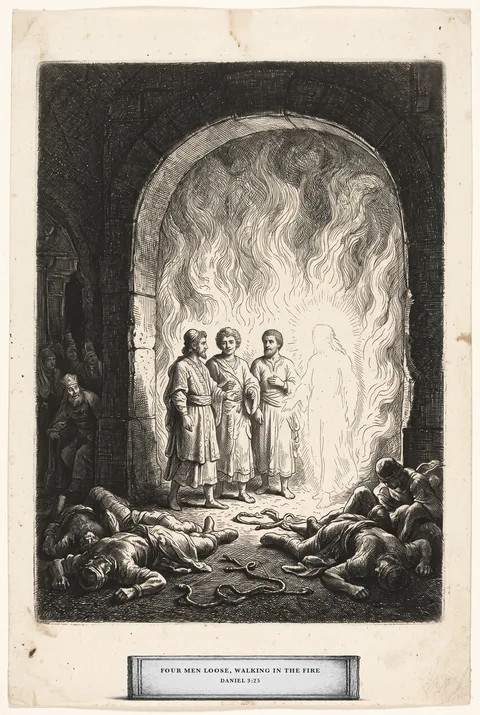
The same fire produces three different outcomes. The bush “burned with fire, and the bush was not consumed” (Exodus 3:2) — sustained, because God willed to dwell in it. The furnace of Babylon, heated seven times, killed the soldiers at its mouth — the uncovered — burned the ropes off the three inside, and left the three themselves without the smell of smoke, “and the form of the fourth is like the Son of God” (Daniel 3:22-27) — the covered walked free, and only their bonds were consumed. And the refiner: “he shall sit as a refiner and purifier of silver” (Malachi 3:3) — the dross goes, the silver stays, in one and the same crucible; the very fire the Remnant chapter watched carry the third part through (Zechariah 13:9). Same fire, every time; the difference was never the fire — it is the covering.
This is why Scripture never once describes salvation as escape from the fire, but as passage through it. “He himself shall be saved; yet so as by fire” (1 Corinthians 3:15). “We went through fire and through water: but thou broughtest us out into a wealthy place” (Psalm 66:12). Joshua the high priest stands accused, and the LORD calls him “a brand plucked out of the fire” (Zechariah 3:2) — charred, alive, and about to be given clean garments. The pattern is set at the gate of Eden: God set the cherubim and the flaming sword “to keep the way of the tree of life” (Genesis 3:24) — and the Hebrew is shamar, to guard and preserve, the word of watchmen and keepers, not the word for shutting. The way to the tree of life was never bricked up. It was kept — behind fire — and the road home runs through the flame, for the covered.
What the Law Says Punishment Is
If the fire is God, what does God’s own law say His punishments are like? Every principle the law lays down points one direction. Punishment is proportional: “eye for eye, tooth for tooth” (Exodus 21:24) — the penalty is measured by the offense. Punishment is capped, and the cap comes with God’s own reason: “Forty stripes he may give him, and not exceed: lest… thy brother should seem vile unto thee” (Deuteronomy 25:3) — excess punishment degrades the punished in the eyes of all, and God forbids it. Punishment ends at death: the law’s severest sentence is stoning, and the sentence is finished when the man is dead — the gravest sins are punished by being “cut off from among his people” (a cutting, not a keeping). And release is built into the calendar itself: the jubilee the Liberty chapter proclaimed frees every debtor and bond-servant on a set day — nothing in the system is endless.
Now comes the silence that should end the argument. Deuteronomy 28 is God’s own catalogue of covenant curses — fifty-four verses of escalating horror: blight, boils, madness, siege, famine driving parents to unspeakable things, exile, slavery. And in all fifty-four verses of the worst that God Himself threatens, endless torment after death is never mentioned. Either the Lawgiver forgot the most terrible penalty in His own covenant document — or it is not in His system at all. The law’s whole grammar of punishment is proportional, bounded, and terminal; a torment without proportion, bound, or end contradicts every clause of it, and would do precisely what Deuteronomy 25:3 forbids: make the Judge Himself seem vile.
The Soul Can Die
The doctrine of endless torment survives on a single hidden premise: that the soul cannot die — that God must keep the wicked in existence because souls are indestructible. Scripture denies the premise in plain words. Adam did not receive a soul; “man became a living soul” (Genesis 2:7) — the soul is what happened when breath met dust, and what began can end. “The soul that sinneth, it shall die” (Ezekiel 18:4). “Fear him which is able to destroy both soul and body in Gehenna” (Matthew 10:28). And Paul closes the question twice over: God “only hath immortality” (1 Timothy 6:16) — if every soul were immortal, He would not be alone in it — and the righteous are those who “seek for glory and honour and immortality” (Romans 2:7). No one seeks what he already owns. Immortality is the gift on the far side of the fire, not the factory setting of every man.
The Second Death
Revelation’s final scene therefore reads exactly as the law and the prophets prepared it to read:
And the sea gave up the dead which were in it; and death and hell delivered up the dead which were in them: and they were judged every man according to their works. And death and hell were cast into the lake of fire. This is the second death.
The grave surrenders its dead; then the grave itself — with death, its rider (Revelation 6:8) — goes into the fire and is destroyed. The text supplies its own label for the fate of the lost, and the label is not “the second torment.” It is “the second death” — and the Hebrew Revelation of the Cochin manuscripts sharpens the word: in three of its four occurrences the phrase is acher maveth, another death, a death of a different kind — the word used for taking “another” wife (Exodus 21:10) and for Caleb’s “another spirit” (Numbers 14:24).
The Aramaic Targums had already coined the same phrase for the same verses of the prophets — Jeremiah’s Babylon sleeps “a perpetual sleep, and not wake” (Jeremiah 51:39), and the Targum glosses it: the second death — the death from which there is no waking. Permanent, final, past atonement; not endless dying, but a death that holds. “And they shall be as though they had not been” (Obadiah 16). Un-created — returned to the nothing they were called out of — while “God shall wipe away all tears… and there shall be no more death, neither sorrow, nor crying” (Revelation 21:4), because the whole apparatus of death and judgment has itself been burned.
The hard verses fall into place around this, once the words are weighed. “Everlasting punishment” (Matthew 25:46) is kolasis — from a root meaning to prune, the gardener’s word, and Jesus drew its picture Himself: the fruitless branch “is cast forth… and burned” (John 15:6) — cut off and consumed, not kept alive in the coals. “Everlasting” (aiōnios) marks the permanence of the result, exactly as “eternal redemption” (Hebrews 9:12) is a redeeming that happened once and holds forever, and as Sodom, set forth as an example of “eternal fire” (Jude 7), is not burning this afternoon.
The undying worm and unquenched fire of Isaiah 66:24 work on “the carcases of the men that have transgressed” — corpses, viewed by the living, being consumed; the dead in that verse are looked at, not listening. Smoke that “ascendeth up for ever” is Scripture’s picture of a finished burning — Babylon’s smoke rises while Babylon lies destroyed (Revelation 19:3; Isaiah 34:10) — for the smoke is the receipt of the fire, not its continuation: “as smoke is driven away… so let the wicked perish” (Psalm 68:2).
The rich man and Lazarus (Luke 16) is the fourth parable in a chain, told with familiar images from its day. Its spoken point is not to describe the afterlife but to declare the sufficiency of the Scriptures: “They have Moses and the prophets; let them hear them… If they hear not Moses and the prophets, neither will they be persuaded, though one rose from the dead” (Luke 16:29, 31). A parable’s imagery cannot overrule the plain testimony of the very Moses and prophets it commands us to hear — the dead know not anything, and David is not ascended.
Moses or Plato
If endless torment is not in the law, not in the prophets, and not in Revelation’s own label, where did the doctrine come from? It has an author, and a paper trail. Plato taught, four centuries before the cross, exactly the two planks Scripture denies: that the soul is indestructible by nature, and that the incurably wicked are punished forever in Tartarus. Greek philosophy flooded Judea after Alexander; Philo of Alexandria wove Plato into Moses; and the church fathers trained in that stream — Tertullian first, Augustine most powerfully, both steeped in the philosophers — read “death” and “destruction” as conscious torment, because they had already accepted the premise that a soul cannot die. Dante painted the result, and the painting hangs in the imagination of the church to this day.
Strip the Greek premise out — let the soul be what Scripture says it is, mortal, destructible, seeking immortality as a gift — and the whole edifice comes down in one motion, leaving what the text always said: “the wages of sin is death; but the gift of God is eternal life” (Romans 6:23). Life or death — existence or its end. The choice Moses set before Israel with heaven and earth as his witnesses is the choice of the whole book — “I have set before you life and death… therefore choose life” (Deuteronomy 30:19).
One question remains: if the covered pass through the fire and the uncovered are consumed, what is the covering, and how does a man come under it? Scripture has a word for shelter in the presence of the Almighty, and it is the next chapter.