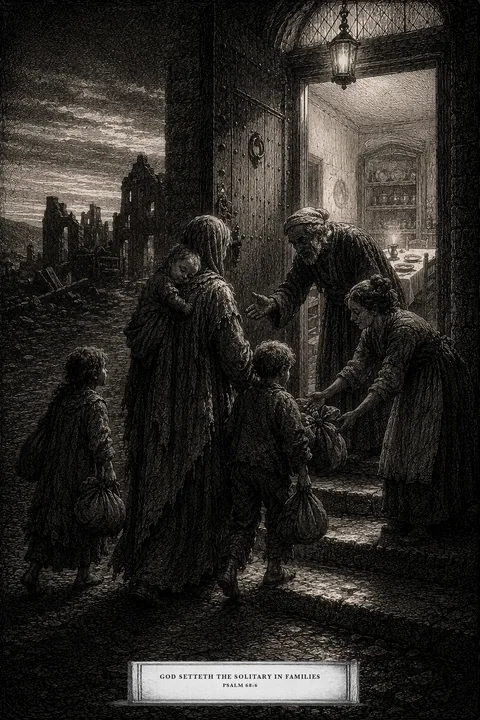
We are orphans and fatherless, our mothers are as widows.
— Lamentations 5:3
Orphans, Widows, and the Fatherless
Few commands are easier to applaud than the care of widows and orphans. “Pure religion and undefiled,” says James, is “to visit the fatherless and widows in their affliction” (James 1:27); even the godless agree, funding the work through the state. It is a good thing, and we are commanded to it. But it is so plainly good that we read past it — and we read past it assuming one thing: that we stand among the givers, never the widow, never the orphan. The symbolic language overturns the assumption.
We Are the Widow
A widow is a woman whose husband is dead or has put her away; the fatherless are children left without their father. Now hear how God speaks of His own people when they break covenant. He hands them a bill of divorce:
…Where is the bill of your mother’s divorcement, whom I have put away?… for your iniquities have ye sold yourselves…
The city, cut off from her Husband, sits alone: “how is she become as a widow!” (Lamentations 1:1). Her children take up the cry: “We are orphans and fatherless, our mothers are as widows” (Lamentations 5:3). Here the symbol turns. The widow and the fatherless are not only the poor down the street; they are the covenant people themselves, severed from the God who was their Husband and their Father. We are the widow; we are the orphans.
In the Bible’s symbolic language this confession has an exact opposite, and she is a queen. “I sit a queen, and am no widow, and shall see no sorrow” (Revelation 18:7) — the boast in her heart, quoted word for word from Isaiah’s oracle against the daughter of Babylon (Isaiah 47:1):
Therefore hear now this, thou that art given to pleasures, that dwellest carelessly, that sayest in thine heart, I am, and none else beside me; I shall not sit as a widow, neither shall I know the loss of children: But these two things shall come to thee in a moment in one day, the loss of children, and widowhood…
She assumes herself married to the King — Vashti’s posture, the deposed queen of the marriage chapter — and the sentence answers the boast in kind, repeated in Revelation: “therefore shall her plagues come in one day, death, and mourning, and famine” (Revelation 18:8) — the moment itself has a study of its own in Part Five.
Two women, one word: the covenant people who confess their widowhood are the ones the Redeemer remarries — and the queen who denies hers is made a widow in a moment. The whole difference is the confession.
Thy Maker Is Thine Husband
Which is why God’s fierce defense of the widow and the fatherless is no generic charity — it is a Husband and a Father moving toward His own:
For thy Maker is thine husband; the LORD of hosts is his name; and thy Redeemer the Holy One of Israel…
He “doth execute the judgment of the fatherless and widow, and loveth the stranger, in giving him food and raiment” (Deuteronomy 10:18). And the corner of the field left unreaped from the last chapter was reserved for exactly these: “for the stranger, for the fatherless, and for the widow” (Deuteronomy 24:19). The widowed remnant gleans the edge, as Ruth did, and is brought home by the Redeemer.
The Stranger
The third name in that gleaning law is a defined symbol, and Scripture fixes its meaning by setting it against its exact opposite:
Now therefore ye are no more strangers and foreigners, but fellowcitizens with the saints, and of the household of God.
The opposite of a stranger is a fellowcitizen; so a stranger is a non-citizen — one who belongs to another commonwealth than the one he stands in. And Paul names the commonwealth in the verse just before: the Gentiles had been “aliens from the commonwealth of Israel, and strangers from the covenants of promise, having no hope, and without God” (Ephesians 2:12). The covenant is the commonwealth, and to be a stranger is to hold no citizenship in it.
The key turns both ways. Outside the covenant, a man is a stranger to God’s commonwealth — and the law leaves the field’s corner to draw him in. The gleaning stranger is the ger, the sojourner who has left his own people to dwell among God’s; Israel had been one in Egypt — “ye were strangers in the land of Egypt” (Leviticus 19:34) — so they must love him, and bring him toward citizenship: let him keep the Passover, and “he shall be as one that is born in the land” (Exodus 12:48). This is the whole of Ruth, a Moabite stranger who gleans the corner and is grafted into the line of the Redeemer, until the far-off are “no more strangers… but fellowcitizens.”
Once a man is made a citizen of God’s commonwealth, the symbol inverts: he becomes a stranger to the world. The patriarchs “confessed that they were strangers and pilgrims on the earth,” and Hebrews gives the reason — “they seek a country… an heavenly” (Hebrews 11:13-16); “our conversation” — the word is citizenship — “is in heaven” (Philippians 3:20); even in the land God says, “ye are strangers and sojourners with me” (Leviticus 25:23). The stranger to the world keeps the one law that is now his: “I am a stranger in the earth: hide not thy commandments from me” (Psalm 119:19). The covenant that ends a man’s estrangement from God begins his estrangement from the world.
The Poor and the Rich
There is a fourth name at that unreaped corner. The gleaning law itself sets it beside the stranger — “thou shalt leave them for the poor and stranger” (Leviticus 19:10) — and Zechariah gathers the whole defended household in one breath:
And oppress not the widow, nor the fatherless, the stranger, nor the poor; and let none of you imagine evil against his brother in your heart.
Widow, fatherless, stranger, poor: one company, gleaning one corner. The final member of the defended household seems at first to differ from the rest — the first three names are losses of kin and country, the fourth sounds like money. Yet Scripture unfolds the poor by the same pattern: we read the word as the man with less money than we have, count ourselves among the givers — and then open the promises and find the poor holding all of them:
Blessed be ye poor: for yours is the kingdom of God.
Why should the poor inherit a kingdom? They should not, and they do not — because the wallet was never the measure. The Hebrew words rendered “poor” in these promises form a close family whose members are also rendered “meek” and “humble” — Strong’s calls its two chief members “practically the same” — and the family grows from a root that means bowed down. The poor of the promises are the bowed.
Watch the two renderings trade places across the same texts. The psalm says “the meek shall inherit the earth” (Psalm 37:11), and Jesus repeats it word for word: “Blessed are the meek: for they shall inherit the earth” (Matthew 5:5). Isaiah says the Anointed comes “to preach good tidings unto the meek” (Isaiah 61:1) — and when Jesus stands up in Nazareth and reads that very verse, it comes out “to preach the gospel to the poor” (Luke 4:18): the same people under either rendering. Matthew’s beatitude names the state outright: “Blessed are the poor in spirit: for theirs is the kingdom of heaven” (Matthew 5:3) — bowed before God, nothing in the hand held up to Him.
Hear God say whom He means:
…but to this man will I look, even to him that is poor and of a contrite spirit, and trembleth at my word.
The poor man God looks to is defined by his posture toward the word, not his balance. He is the remnant: “I will also leave in the midst of thee an afflicted and poor people, and they shall trust in the name of the LORD” (Zephaniah 3:12). Hannah sang his future — “He raiseth up the poor out of the dust… to make them inherit the throne of glory” (1 Samuel 2:8) — and James states it flat: “Hath not God chosen the poor of this world rich in faith, and heirs of the kingdom?” (James 2:5). When John the Baptist sent from prison to ask whether Jesus was the One, the closing credential of the answer was this: “the poor have the gospel preached to them” (Matthew 11:5).
Now the other column. If the poor are the bowed, the rich of the symbol are the unbowed — the self-sufficient who have need of nothing. Solomon wrote the proverb: “There is that maketh himself rich, yet hath nothing: there is that maketh himself poor, yet hath great riches” (Proverbs 13:7) — and two churches in Revelation act out its two halves. To suffering Smyrna: “I know thy… poverty, (but thou art rich)” (Revelation 2:9). To comfortable Laodicea:
Because thou sayest, I am rich, and increased with goods, and have need of nothing; and knowest not that thou art wretched, and miserable, and poor, and blind, and naked…
The counsel that follows prices heaven’s currency: “buy of me gold tried in the fire, that thou mayest be rich; and white raiment, that thou mayest be clothed” (Revelation 3:18) — faith tried in the fire, and the garment of righteousness.
Jesus names the true wealth in a phrase — the fool who filled his barns was “not rich toward God” (Luke 12:21) — and pronounces the woe: “woe unto you that are rich! for ye have received your consolation” (Luke 6:24). And the exchange at the center of the gospel is stated in exactly these terms: “though he was rich, yet for your sakes he became poor, that ye through his poverty might be rich” (2 Corinthians 8:9).
Here a long-standing paradox dissolves. If the poor of the promises are the bowed, then the rich of the woes are the proud — the unbowed — and the hardest saying about them was never about a balance sheet: “How hardly shall they that have riches enter into the kingdom of God!” (Mark 10:23). The disciples were astonished, and Jesus answered again with the symbol opened: “Children, how hard is it for them that trust in riches to enter into the kingdom of God!” (Mark 10:24) — the trust, not the treasure.
Read the camel and the needle as a statement about money, and Scripture contradicts itself on its face: Abraham was “very rich in cattle, in silver, and in gold” (Genesis 13:2), Job’s latter end was blessed with double, Joseph administered an empire’s wealth and David a kingdom’s — and all of them heirs. Read it as the symbol reads — the unbowed cannot pass the low door — and the paradox was never there: “with men this is impossible; but with God all things are possible” (Matthew 19:26), and what God does with the proud is bow them.
As always, the symbol does not dissolve the literal command; it deepens it. “The poor shall never cease out of the land: therefore I command thee… thou shalt open thine hand wide unto thy brother, to thy poor” (Deuteronomy 15:11). The corner stays unreaped and the hand stays open — but the giver now knows what he is handling, and where he himself stands. Before God, every man is the beggar lifted from the dunghill (Psalm 113:7); the only question is whether he knows it, as Smyrna did, or says “I have need of nothing.”
Food and Raiment
He gives the widow food and raiment (Deuteronomy 10:18) — and by now neither word is bare. Scripture makes bread the word of God — “man doth not live by bread only, but by every word that proceedeth out of the mouth of the LORD” (Deuteronomy 8:3) — and the garment, as the marriage chapter showed, is the righteous deeds of the saints — deeds He ordains and grants her to do (Ephesians 2:10; Revelation 19:8). So to feed and clothe His widowed people is to give them the word, and the works the word produces. The worst famine is not of bread:
…I will send a famine in the land, not a famine of bread… but of hearing the words of the LORD.
This is why the charge to the shepherd is “Feed my sheep” (John 21:17); why the faithful servant is the one who gives the household “meat in due season” (Matthew 24:45); why the commission is to teach the nations “to observe all things whatsoever I have commanded” (Matthew 28:20). To feed is to teach the commandments; to clothe is to grant the righteous deeds the word teaches.
The covenant itself is taken the same way — by eating His flesh and drinking His blood: “the bread that I will give is my flesh” (John 6:51), and his words are spirit and life (John 6:63). His body is the bread, the word to be eaten and kept; His blood is what washes the garment clean. The crowd could not bear it — the scene this book opened with — and many walked no more with him (John 6:66), because they took the symbol for the flesh.[1]
The command to care for the widow and the fatherless therefore reaches all the way down. They are God’s own people, cut off and gleaning at the edge; to feed them is to bring them the word, to clothe them is to robe them in righteousness, and to gather them is the work of the Husband who will not leave them widowed. The next time Scripture says feed the hungry, hear what is handed across: the bread of His word, to a people hungrier than they know.