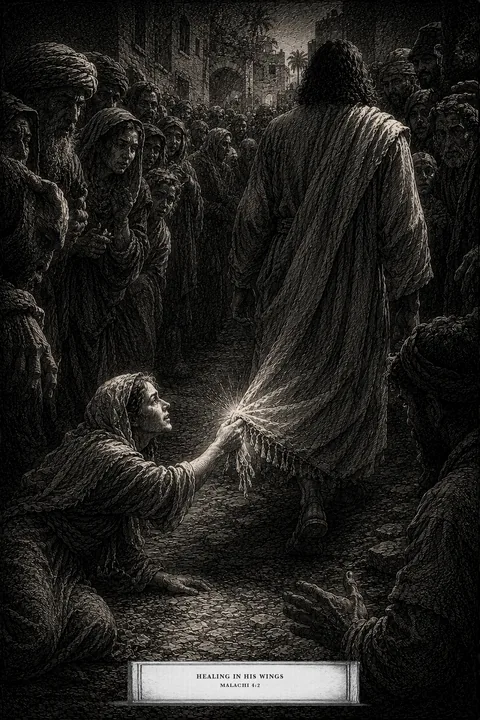
Unto you that fear my name shall the Sun of righteousness arise with healing in his wings.
— Malachi 4:2
Wings
A woman who had bled for twelve years pressed through a crowd to touch the edge of Jesus’ robe, and “immediately her flow of blood stopped” (Luke 8:44, NKJV). The Gospels are precise about what she touched — not the cloak, but its “border” (Luke 8:44), its “hem” (Matthew 9:20). She was reaching for a particular part of the garment, and to see why, you must follow one Hebrew word that English has scattered into more than a dozen.
The word is kanaph, and the scatter is worth counting. It falls one hundred and eight times in the Hebrew Scriptures, and the King James renders it wing, skirt, border, corner, quarter, end, uttermost part — once even “overspreading” (Daniel 9:27). It is the eagle’s wing on which God “bare you… unto myself” (Exodus 19:4), the skirt Boaz spread over Ruth, the border of a garment, the four corners of the earth. One word: the outermost edge of a thing, where it meets the world.
Because the English keeps changing, the reader who works only in English can miss the thread. Learn this word, and you gain a signal: wherever a verse says skirt, border, corner, or the ends of the earth, lift the English and look underneath. If kanaph is there, the commandments may be near — for reasons the next section makes plain.
The Fringe on the Wing
God commanded something bound to that edge:
…bid them that they make them fringes in the borders of their garments… that ye may look upon it, and remember all the commandments of the LORD, and do them; and that ye seek not after your own heart and your own eyes…
Those fringes — the tzitzit — hang at the kanaph: the reminder of the law is tied to every corner of the covenant garment. Their purpose is stated flatly — to remember the commandments and do them, and not to follow “your own eyes” (there is the man who is right in his own eyes — we will meet him properly in the Fool and the Wise chapter ahead).
Notice how well the command itself hides in English: here the kanaph is “borders,” and when the command is repeated — “thou shalt make thee fringes upon the four quarters of thy vesture” (Deuteronomy 22:12) — it is “quarters.” Neither verse says wing; so the English reader never connects the commandment-fringe to the wings of refuge in the Psalms, though they are one word and one thing. That is the signal to carry through Scripture: the kanaph is where the reminder of the commandments is bound — the fringe is a memory-device, not the law itself — so the kanaph in a verse is a flag that the verse may be speaking of remembering — or forgetting — the commands.
Be precise about what “remember” asks, for in Scripture remembering is not recalling; it is doing. The Torah defines forgetting as disobedience outright — “Beware that thou forget not the LORD thy God, in not keeping his commandments” (Deuteronomy 8:11): to forget is to not keep — and the psalm gives the other side in a single phrase: “those that remember his commandments to do them” (Psalm 103:18). Even God’s remembering moves His hand: “God remembered Noah… and God made a wind to pass over the earth” (Genesis 8:1); “God heard their groaning, and God remembered his covenant” (Exodus 2:24) — and the Exodus follows. So the fringe on the wing is not an aid to reflection; it is a trigger for obedience — “not a forgetful hearer, but a doer of the work” (James 1:25).
Strip the vowel points, and the word gives up one more secret. The points — and Strong’s numbering after them — split the consonants into two entries: a noun for the wing, and a verb that acts only once in all of Scripture. Unpointed they are one word, and the lone verse where it moves as a verb shows what a kanaph does:
To be kanaph-ed is to be tucked into the corner — and what Israel had tucked away there was its teachers of the law. Read it beside the fringe-command and the two verses answer each other: the tzitzit were tied at the corner “that ye may look upon it, and remember,” and restoration is promised in the same grammar — eyes that “see thy teachers” again, and ears that hear “this is the way.” The corner is where the teaching waits: hidden in judgment, seen in mercy — which is exactly where God tied it.
The counterfeit obliges by aiming at exactly this spot: the Pharisees “make broad their phylacteries, and enlarge the borders of their garments” (Matthew 23:5) — bigger fringes, “to be seen of men,” and the weightier matters of the law undone. A tassel grown large to advertise an obedience that is not there.
Healing in His Wings
Now the woman’s reach makes sense. She did not grab at random cloth; she took hold of the tzitzit — the corner where the law hangs. The word the Gospels use for what she touched, the “hem” or “border” of His garment, is kraspedon — the very word the Greek Old Testament uses for the tzitzit of Numbers 15. She laid hold of His fringes, and the prophet had foretold exactly where healing would be:
But unto you that fear my name shall the Sun of righteousness arise with healing in his wings…
Healing in his wings — in the kanaph, the corner where the tzitzit hang. The healing is not loose in the air; it is at the fringe, where the commandments are. She reached for the law made flesh and laid hold of its corner — “If I may but touch his garment, I shall be whole” (Matthew 9:21) — and she was; and she was not alone: “as many as touched were made perfectly whole” (Matthew 14:36).
The Covenant Under the Wings
If the wing carries the tassels that remind the wearer of the commandments, the sanctuary should show that reminder — and it does, in furniture. When Solomon brought the ark home, Scripture places it with this phrase:
And the priests brought in the ark of the covenant of the LORD unto his place, into the oracle of the house, to the most holy place, even under the wings of the cherubims.
The covenant dwells under the wings — Scripture’s own words. And the pattern was set at Sinai: the cherubim stretch their wings “covering the mercy seat” (Exodus 25:20), the testimony — the tablets of the law — goes inside the ark beneath (Exodus 25:21), and God tells Moses where He will speak from:
And there I will meet with thee, and I will commune with thee from above the mercy seat, from between the two cherubims which are upon the ark of the testimony, of all things which I will give thee in commandment unto the children of Israel.
The commanding voice speaks from between the wings, above the law: the whole architecture of the most holy place is Numbers 15 built in gold — commandments kept under the kanaph.
Even the burning ones wear the covering: the seraphim, six-winged, use four of their wings not to fly but to cover themselves before the fire (Isaiah 6:2). And the psalm that promises refuge names what the covering is made of: “under his wings shalt thou trust: his truth shall be thy shield and buckler” (Psalm 91:4) — and the truth, this book has shown, is the law. To hide “under the shadow of thy wings” (Psalm 17:8) is not to hide from the law; it is to hide inside it.
This is why the eagle’s wings of the Exodus land where they land:
Ye have seen what I did unto the Egyptians, and how I bare you on eagles’ wings, and brought you unto myself. Now therefore, if ye will obey my voice indeed, and keep my covenant, then ye shall be a peculiar treasure unto me above all people…
The wings carry Israel to Sinai, to the commandments — “so the LORD alone did lead him” (Deuteronomy 32:12). At the end of the story the flight is replayed: the woman is given “two wings of a great eagle, that she might fly into the wilderness” (Revelation 12:14) — the Exodus again, wings again, out of the serpent’s reach and into the place where God keeps His own.
Spread Your Wing Over Me
The edge that carries the law is the edge that makes covenant. To spread your kanaph over someone is to take them into covenant — we saw it last chapter, where the whole wedding was built on it: God “spread [his] skirt” over Israel and “entered into a covenant” (Ezekiel 16:8). Ruth asks it of Boaz in the same word:
…spread therefore thy skirt over thine handmaid; for thou art a near kinsman.
To dwell under the wing, then, is to dwell under the covenant — and to uncover the wrong one is to violate it: the law forbids a man his father’s wife with the words “nor discover his father’s skirt” (Deuteronomy 22:30), the kanaph as the covenant boundary itself, in the very chapter that commands the fringes.
Here is the grief of it: again and again He longed to gather His people under His wing, as a mother bird her young, and again and again they would not. Jesus laments it over Jerusalem in that very image:
O Jerusalem, Jerusalem, thou that killest the prophets, and stonest them which are sent unto thee, how often would I have gathered thy children together, even as a hen gathereth her chickens under her wings, and ye would not!
That lament closes the same chapter that opened with the enlarged fringes of the Pharisees (Matthew 23:5) — Matthew 23 begins with the kanaph counterfeited and ends with the kanaph refused. The wing offered is the covenant offered; to refuse it is rebellion, and it leaves the house bare — “Behold, your house is left unto you desolate” (Matthew 23:38).
Refuge does not disappear when God’s wing is refused; it is replaced. Assyria comes on wings of its own — “the stretching out of his wings shall fill the breadth of thy land, O Immanuel” (Isaiah 8:8) — and Ezekiel’s empires are “great eagles with great wings” carrying off the top of the cedar (Ezekiel 17:3, 7). Everyone ends up under some wing; the question is whose.
The Torn Skirt
Because the kanaph carries covenant, what happens to the skirt happens to the kingdom — and Scripture stages it twice in one book. When Samuel turned to leave, Saul “laid hold upon the skirt of his mantle, and it rent” — and Samuel reads the torn kanaph on the spot:
And Samuel said unto him, The LORD hath rent the kingdom of Israel from thee this day, and hath given it to a neighbour of thine, that is better than thou.
The torn skirt is the torn kingdom — the deposed-covenant verdict of the marriage chapter, enacted in cloth.
David, hiding in the cave, “cut off the skirt of Saul’s robe privily. And it came to pass afterward, that David’s heart smote him, because he had cut off Saul’s skirt” (1 Samuel 24:4-5). His men saw a missed kill; David felt what he had actually done — put a knife into the covenant edge of the LORD’s anointed. Yet the same cut skirt becomes his evidence: “see the skirt of thy robe in my hand: for in that I cut off the skirt… and killed thee not… I have not sinned against thee” (1 Samuel 24:11) — the kanaph held up in court, the covenant kept where it could have been cut.
For the skirt is where a people’s covenant record is kept. “In thy skirts is found the blood of the souls of the poor innocents” (Jeremiah 2:34); “her filthiness is in her skirts; she remembereth not her last end” (Lamentations 1:9) — what is carried in the kanaph is what the covenant sees. Haggai’s priests rule that holiness does not rub off through the skirt, but uncleanness does (Haggai 2:12-13) — the fringe transmits no merit; it testifies. And when almost everything is judged, the kanaph is where the remnant rides out the fire: “Thou shalt also take thereof a few in number, and bind them in thy skirts” (Ezekiel 5:3).
The Corners of the Earth
Scale the garment up, as this book keeps doing, and the earth itself wears one — with corners. The dispersed of Israel wait at them: God will “gather together the dispersed of Judah from the four corners of the earth” (Isaiah 11:12) — the four kanaph. Songs rise “from the uttermost part of the earth” (Isaiah 24:16) — the kanaph again. Judgment arrives at them: “An end, the end is come upon the four corners of the land” (Ezekiel 7:2). And in Job, God handles the whole earth exactly like the garment it is:
That it might take hold of the ends of the earth, that the wicked might be shaken out of it?
The dawn grips the earth by its kanaph and shakes the wicked out of it, as a man shakes out a garment. The world has edges the way the covenant garment has edges — and the scattered people of God are kept at them, like the few hairs bound in the prophet’s skirt, until the gathering.
The Corner of the Field
The same shape appears at the edge of a field — though the word now changes, for a field’s corner is pe’ah, not kanaph. That is the symbol working as it always does: by structure, not by spelling. The reserved edge may be a wing, a border, or a corner; what repeats is the shape — the boundary kept back, not reaped for oneself. And that edge God reserved:
The forgotten sheaf and the field’s corner are not the owner’s; they belong “for the stranger, for the fatherless, and for the widow” (Deuteronomy 24:19). A field is people — humanity is sown and reaped like grain — and the corner is only a thin border of the whole. Yet that thin edge is enough to live on: it is where Ruth gleaned (Ruth 2:3), and where she was redeemed. The remnant is fed at the edge.
The wing gathers this book to a single edge, and hands the reader a working tool. The law is sewn into the kanaph, and there is healing in it; the ark of the covenant sits beneath it; the covenant is made by spreading it and is read in what it carries; the kingdom tears when it tears; the dispersed wait at the earth’s four corners, and the poor glean at the field’s. From here on, when your English Bible says skirt, border, corner, quarter, or the ends of the earth, check the word underneath: if the wing is there, the commandments are near — remembered, refused, or waiting to be done. And the stranger, the fatherless, the widow who glean the corner are the next symbols to define — and after them, the remnant they add up to.