Come from the four winds, O breath, and breathe upon these slain, that they may live.
— Ezekiel 37:9
The Four Winds
Prophecy is written in wind: in Hebrew, wind, breath, and spirit are one word — ruach. Here we take up that symbol and fix what the four winds are; the Sea study in Part Six will meet these same winds stirring the nations.
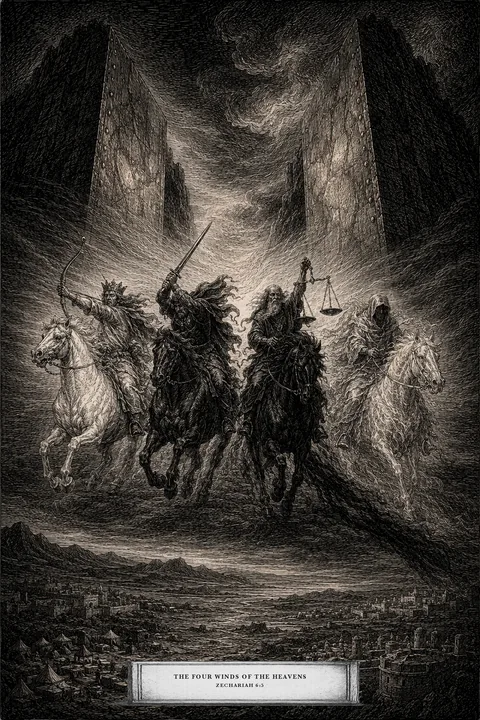
The plainest text is Zechariah’s. He sees four chariots drawn by colored horses come out from between two mountains of brass, and asks what they are. The angel answers directly:
…These are the four spirits of the heavens, which go forth from standing before the Lord of all the earth.
The word for “spirits” is ruach — the same word rendered “wind” and “breath” everywhere else in the Old Testament. So the four winds are four spirits, and they hold an office: they “go forth from standing before the Lord.” They are dispatched from the throne.
Not Directions, Not Weather
The dictionary flattens “the four winds” two ways: into the four points of the compass — north, south, east, west, a figure for “everywhere” — or into wind itself, the weather. Scripture allows neither. The angel did not call them four directions; he called them four spirits. The number four gives them their reach — they cover the four quarters of the whole earth — but the winds are the agents sent across those quarters, not the quarters themselves.
Nor are they weather. The same word names what stands in the divine council:
Who maketh his angels spirits; his ministers a flaming fire.
Angels are spirits; spirits are winds — one word in Hebrew. The four winds are commissioned beings: they stand before the Lord and go forth on assignment (Zechariah 6:5), then return to report (Zechariah 1:11). And all wind answers to its Maker — He rebukes even a literal storm, “Peace, be still,” and it obeys (Mark 4:39); the more so these spirit-winds He sends and recalls. When Scripture speaks of the four winds, it speaks of God’s executing power under His direct authority.
The Four Horsemen
The New Testament shows these same four spirits under another image. In Zechariah, they are chariots and horses; in Revelation, they are the four horsemen, commissioned one by one as the Lamb opens the seals. The colors mark their assignments: the white horse goes out conquering with a bow — a case study of its own in Part Six; the red takes “peace from the earth” with “a great sword” (Revelation 6:4); the black carries scales for famine; and the fourth is Death, who carries what all four deal:
Those four are the judgments Ezekiel had already named:
…my four sore judgments… the sword, and the famine, and the noisome beast, and the pestilence…
They are the covenant curses of Leviticus and Deuteronomy, executed by the four spirits. Jesus lists the same set — “wars… famines, and pestilences” (Matthew 24:6-7) — and calls them “the beginning of sorrows.” One sequence, recorded three times: Ezekiel’s judgments, Zechariah’s spirits, John’s horsemen.
Scatter and Gather
The four winds are not assigned to judgment only. The same spirits carry opposite errands, according to what the throne sends. They scatter a people in judgment:
…upon Elam will I bring the four winds… and will scatter them toward all those winds…
They gather a people in restoration:
…he shall send his angels… and they shall gather together his elect from the four winds, from one end of heaven to the other.
They stir the sea so that the beast-kingdoms rise from it — “the four winds of the heaven strove upon the great sea. And four great beasts came up” (Daniel 7:2-3 — a scene the Sea study in Part Six takes up in full). They carry breath to the dead — “Come from the four winds, O breath… that they may live” (Ezekiel 37:9). Scatter and gather, stir and raise: the wind’s direction is set by its Sender, not by itself.
The gathering has an address: the elect are collected “from the four winds, from one end of heaven to the other” — from the four corners of the earth where the dispersed wait (Isaiah 11:12), corners that the Wings chapter searched; the winds sweep the quarters, and the quarters give up their gleanings.
The judgment-wind even has a compass habit. It was “a strong east wind” that split the sea all night (Exodus 14:21); an east wind carried in the locusts (Exodus 10:13); a “vehement east wind” broke Jonah (Jonah 4:8); and Hosea names whose wind it is: “an east wind shall come, the wind of the LORD… and his spring shall become dry” (Hosea 13:15).
When the promised Spirit came, it came in this symbol’s own dress:
And suddenly there came a sound from heaven as of a rushing mighty wind, and it filled all the house where they were sitting.
Ezekiel’s breath arrived on the appointed day. Jesus had already tied the knot for Nicodemus: “The wind bloweth where it listeth… so is every one that is born of the Spirit” (John 3:8) — one word for wind and Spirit, in Hebrew and in Greek alike. Even the wind wears the covenant edge: God “did fly upon the wings of the wind” (Psalm 18:10) — kanphei-ruach, the hem-word on the wind itself — and the creation psalm sets chariot, wings, and ministers side by side: “who maketh the clouds his chariot: who walketh upon the wings of the wind: who maketh his angels spirits” (Psalm 104:3-4). A wind can carry a people in that hem; the first deliverance said so — “I bare you on eagles' wings, and brought you unto myself” (Exodus 19:4).
The four-going-out from the presence is older than the chariots. The Spirit moved on the face of the waters at creation (Genesis 1:2), and the water tells the wind’s story: “a river went out of Eden to water the garden; and from thence it was parted, and became into four heads” (Genesis 2:10) — one source at the presence, parted four ways to reach the whole earth, as the four spirits go forth from standing before the Lord. Wind above, water below — two carriers of one ruach, sent out fourfold at the beginning and gathering home from the same four corners at the end. The ones waiting at the corners complete the pattern: on the garment, the corner is where the law hangs its reminder — “that ye may look upon it, and remember all the commandments of the LORD” (Numbers 15:39) — and at the earth’s four wings wait “the remnant… which keep the commandments of God” (Revelation 12:17). The winds gather from the hem those who kept the hem.
Held Until the Sealing
One more fact completes the picture: the four winds can be held. Before they are loosed, John sees them restrained:
The winds are kept back until God’s servants are marked. This occurs after the sixth seal is opened (Revelation 6:12) — the riders commissioned at the first four seals are still reined in at the four corners when the sixth is broken. The seals commission; they do not release. Not a wind blows until the last servant is sealed.
The four winds, then, are God’s executing spirits — four because they cover the whole earth, the four quarters of heaven. They are dispatched from the throne and recalled to it; they stir the nations, raise and topple empires, scatter and gather peoples, deal death and breathe life, and are held or loosed at a word. They are not blind forces of nature, and not powers in revolt. They are the ministers of the One who “maketh his angels spirits,” and they do only what He sends them to do.