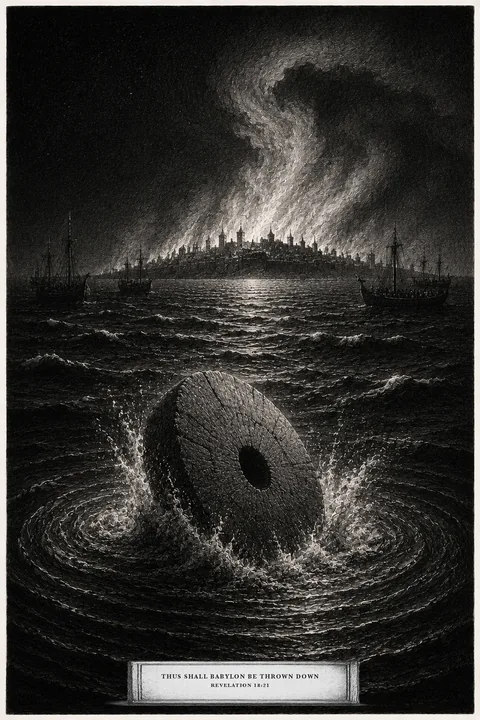
Thus shall Babylon sink, and shall not rise from the evil that I will bring upon her.
— Jeremiah 51:64
The Fall of Babylon
When the victors over the beast stand on the sea of glass at the end of the story, listen to what they sing:
Why the song of Moses — the song Israel sang on the far shore of the Red Sea (Exodus 15:1)? Because the deliverance they have just come through is the same deliverance. The Exodus is not only history; it is the similitude of the Fall of Babylon — scene for scene, as Jonah was scene for scene the Passion. Lay the two side by side.
The Plagues Replayed
The first plague turned the waters of Egypt to blood; the vials turn the sea and rivers to blood, and this time the interpretation is spoken aloud (Revelation 16:6).[1] The waters are “peoples, and multitudes, and nations” (Revelation 17:15) — the equation the sign-of-Jonah chapter first put to work — so waters turned to blood are death upon the peoples, their own shed blood given back to them; the Sea study in Part Six works the full equation.
The hands that wield the plagues are the same office. Look at the commission of the two witnesses:
These have power to shut heaven, that it rain not in the days of their prophecy: and have power over waters to turn them to blood, and to smite the earth with all plagues, as often as they will.
These are Moses and Aaron’s credentials, reissued at the end of the age. Pharaoh had his court magicians; Babylon has her sorceries (Revelation 18:23). The contest is the same contest, at full scale.
The Rod, the Serpent, and the Rod Again
The contest opened, both times, with one enacted sign — a similitude acted out before a word was argued. “What is that in thine hand? And he said, A rod. And he said, Cast it on the ground. And he cast it on the ground, and it became a serpent” (Exodus 4:2-3). The rod is no neutral stick: the Hebrew matteh means staff and tribe in one word — when the princes bring twelve rods, they are the twelve tribes by the language itself (Numbers 17:2) — and Aaron’s rod is the rod “for the house of Levi” (Numbers 17:8): the priesthood in his hand. Cast to the earth, the priesthood-rod turns serpent — and before Pharaoh the word sharpens: there it becomes a tannin, a dragon, the devouring kingdom — and “Aaron’s rod swallowed up their rods” (Exodus 7:12). The priesthood, gone serpentine, does not merely join the dragons of the nations; it swallows them and rides what remains. John saw where that ends:
And upon her forehead was a name written, MYSTERY, BABYLON THE GREAT, THE MOTHER OF HARLOTS… The seven heads are seven mountains, on which the woman sitteth… And the woman which thou sawest is that great city, which reigneth over the kings of the earth.
Only a covenant partner can wear the harlot’s title. A harlot is not an outsider; she is a wife gone traitor — harlotry is covenant defected, and only a covenant people can commit it: “How is the faithful city become an harlot!” (Isaiah 1:21). And this great city is identified by its crime scene: “the great city, which spiritually is called Sodom and Egypt, where also our Lord was crucified” (Revelation 11:8) — Jerusalem. The woman riding the beast is the covenant order gone serpent — Aaron’s rod cast down, astride the seven heads it swallowed — the mother whose daughter-harlots learned the trade in her house. The name on her forehead is not her own. Babylon the Great names the beast she rides, and she wears it where the seal goes: the saints carry the Father’s name in their foreheads (Revelation 14:1); Babylon’s own carry “the mark of his name” (Revelation 14:11). The wife who left her Husband’s name is branded with her owner’s — the beast’s mark in the seal’s place.
Jeremiah’s oracle fixes the last Babylon at the end in more than one sense. “Your mother shall be sore confounded… behold, the hindermost of the nations shall be a wilderness” (Jeremiah 50:12). The Hebrew acharith is the last or end — what comes after. In the immediate judgment, the “glory of kingdoms” is brought last in rank (Isaiah 13:19). In the prophetic succession, Nebuchadnezzar’s Babylon stood at the head of gold — “thou art this head of gold” — while Babylon the Great appears at the latter end, when the stone strikes the image’s feet (Daniel 2:34-35, 38, 44-45). Babylon frames man’s image: the original kingdom at its head, the final Babylon at its feet.
The word also carries a direction. Scripture’s compass faces east — qedem is at once “east” and “front” — so west lies behind. The related after/back/end word-family names the western sea the “hinder sea” (Deuteronomy 11:24; Zechariah 14:8). Jeremiah need not be made to choose among the layers: Babylon is brought last in rank, appears last in the imperial succession, and sits hindermost — westernmost — among the nations. The last Babylon sits at the far west of the nations: a bloc of seven mountains that even counts itself as seven, ridden by the city that killed the prophets, its base of power the westernmost nation of them all.
The similitude has a third act, and it was in Moses' hand from the beginning. “Put forth thine hand, and take it by the tail. And he put forth his hand, and caught it, and it became a rod in his hand” (Exodus 4:4). Every word is loaded. The tail is decoded in-text by Isaiah: “the prophet that teacheth lies, he is the tail” (Isaiah 9:15) — the serpent is seized at its lying-prophet end. And watch the dragon wield that member:
And his tail drew the third part of the stars of heaven, and did cast them to the earth.
The stars are the saints, and Daniel shows the same fall with the trampling included: the horn “cast down some of the host and of the stars to the ground, and stamped upon them” (Daniel 8:10). The dragon fells a third of heaven’s host not with claws but with its tail — by the prophet that teaches lies — for “the leaders of this people cause them to err; and they that are led of them are destroyed” (Isaiah 9:16). The trumpet armies carry the same reversal — “their power is in their mouth, and in their tails: for their tails were like unto serpents, and had heads” (Revelation 9:19) — tails grown heads, which is the covenant curse in one clause: “he shall be the head, and thou shalt be the tail” (Deuteronomy 28:44), the inversion of the blessing that made obedient Israel “the head, and not the tail” (Deuteronomy 28:13). So the command to seize the serpent by the tail is the countermove itself: take the liar’s instrument in hand, and it is mastered. The Hebrew for “caught” is chazaq — the very verb of the whole contest, for “I will harden [chazaq] Pharaoh’s heart” (Exodus 4:21): the hand that chazaq-grips the serpent turns it back into the staff of God; the heart that chazaq-hardens itself belongs to the serpent. One verb, two grips. Revelation keeps the scene for the end: “he laid hold on the dragon, that old serpent… and bound him” (Revelation 20:2).
The rod that comes back is not bare wood. Set overnight before the testimony, “the rod of Aaron for the house of Levi was budded, and brought forth buds, and bloomed blossoms, and yielded almonds” (Numbers 17:8) — the dead stick alive, the priesthood proven by resurrection. The almond is the shaqed, the watcher-tree, first to wake — “I see a rod of an almond tree… for I will watch over my word to perform it” (Jeremiah 1:11-12) — and the lampstand of the sanctuary is carved as this very tree, its bowls “made like unto almonds” (Exodus 25:33): the watcher-tree bears the lamp, and the lamp, Scripture says, is the commandment (Proverbs 6:23).
An almond is a fruit that is itself a seed — and “the seed is the word of God” (Luke 8:11). Root to crown the watcher-tree carries nothing but the word: its blossom the priesthood’s proof, its fruit the seed-word, its carved form the commandment’s lampstand. Rod, serpent, rod again — and then blossom: the priesthood cast down and gone dragon is seized at the liar’s tail, restored to the Owner’s palm, and buds with the resurrection sign. The similitude that opened the first exodus is the arc of the last one.
Let My People Go — Come Out of Her
The demand carried to Pharaoh — “let my people go, that they may serve me” (Exodus 8:1) — returns as the last call of the book:
And I heard another voice from heaven, saying, Come out of her, my people, that ye be not partakers of her sins, and that ye receive not of her plagues.
Jeremiah had already given Babylon the same summons:
My people, go ye out of the midst of her, and deliver ye every man his soul from the fierce anger of the LORD.
One voice, three ages: out of Egypt, out of Babylon, out of Babylon the great. The people of God end every act of the story by walking out of a doomed house — and the plagues fall on those who stay.
The Spoiler from the North
The destruction enters from a specific quarter. “For, lo, I will raise and cause to come up against Babylon an assembly of great nations from the north country” (Jeremiah 50:9); “a people shall come from the north, and a great nation” (Jeremiah 50:41); “the spoilers shall come unto her from the north” (Jeremiah 51:48). The word itself tells you why the destroyer owns that door. “North” — tsaphon — is the hidden quarter, the lurker’s quarter: the dark one, the direction the ambush comes from.[2]
The north behaves this way throughout the prophets: “out of the north an evil shall break forth” (Jeremiah 1:14) — and when the evil comes, it comes like a predator from cover, “the lion is come up from his thicket, and the destroyer of the Gentiles is on his way” (Jeremiah 4:7); the spoiler, the robber-word, falls suddenly on the unwatchful (Jeremiah 6:22-26). Robbers work from the dark — “in the dark they dig through houses… they know not the light” (Job 24:16) — and the north is the sky’s own dark, the one quarter the sun never crosses.
The word carries both of its appearances in this book at once: the north country is the hidden quarter where Babylon’s spoilers gather, and the sides of the north — the uttermost recesses of that dark — are the address the enemy chose for his own seat (Lucifer’s Declared Plan). The lurker who worked from the hidden dark is repaid out of it: the spoiler comes upon Babylon from the door she cannot watch.
The Stone That Sinks
Now the ending both stories share. When the pursuer followed Israel into the sea, the song names his end twice: “they sank into the bottom as a stone” (Exodus 15:5); “they sank as lead in the mighty waters” (Exodus 15:10) — “their persecutors thou threwest into the deeps, as a stone into the mighty waters” (Nehemiah 9:11). Jeremiah turned that ending into a commanded sign: the scroll of Babylon’s judgment bound to a stone and thrown into the Euphrates —
…thou shalt bind a stone to it, and cast it into the midst of Euphrates: And thou shalt say, Thus shall Babylon sink, and shall not rise from the evil that I will bring upon her…
Revelation performs the sign at scale:
And a mighty angel took up a stone like a great millstone, and cast it into the sea, saying, Thus with violence shall that great city Babylon be thrown down, and shall be found no more at all.
This is a phrase-symbol in its own right — cast into the sea, a ruling power sunk into the sea of peoples, never to surface; the Sea study in Part Six gathers its every use. The mountain that destroyed all the earth is rolled down and burned (Jeremiah 51:25); the millstone goes under; the music stops (Revelation 18:22).
Jesus put this very sign into His disciples' mouths, twice. “Whosoever shall say unto this mountain, Be thou removed, and be thou cast into the sea; and shall not doubt in his heart… he shall have whatsoever he saith” (Mark 11:23) — and a parallel saying runs on the other kingdom-figure: “ye might say unto this sycamine tree, Be thou plucked up by the root, and be thou planted in the sea” (Luke 17:6). A mountain is a kingdom and, at this scale, a tree is a nation; what faith commands into the sea is not landscaping — it is Babylon’s sentence, spoken by the household of faith.
And Revelation shows the mechanism in order: the incense goes up “with the prayers of all saints” (Revelation 8:3-4), the censer is cast to the earth, and at the second trumpet “as it were a great mountain burning with fire was cast into the sea” (Revelation 8:8) — Jeremiah’s burnt mountain, over the cliff at last. The prayers ascend; the mountain falls. Faith that moves mountains was never about landscaping either — it is the saints praying down the destroying mountain, and being heard.
The Verdict Is the Not-Rising
The sentence keeps the going-down separate from the verdict. Everyone in these stories goes into the waters. Babylon sinks “and shall not rise.”
Jonah went into the same sea and rose; the Messiah went into the heart of the earth and could not be held by it (Acts 2:24); and every convert enacts the split in baptism, going under into death and coming up in newness of life (Romans 6:4), his sins staying down like Babylon (Micah 7:19).[3] The waters take everyone; the covenant decides who comes up.
The coming up is the difference between the lawless kingdom and the righteous man in the same flood — and it is why the millstone is also a personal warning: better one “hanged about his neck, and that he were drowned in the depth of the sea” (Matthew 18:6) than to make the little ones stumble. A man can be Babylon in miniature.
That Great City
Who is she? Revelation defines both coordinates in one chapter: the waters where the whore sitteth are the waters already identified — peoples, multitudes, and nations (Revelation 17:15) — and “the woman which thou sawest is that great city, which reigneth over the kings of the earth” (Revelation 17:18). The title has a history — Nineveh wore it three times (Jonah 1:2; 3:2; 4:11), and the sign-of-Jonah chapter traced where it points. Babylon swallowed God’s people “like a dragon” (Jeremiah 51:34) — and the dragon, we saw with Jonah, is made to give back what it swallowed.
Revelation does more than describe the great city; it gives her street address, and gives it in the book’s own symbolic grammar:
And their dead bodies shall lie in the street of the great city, which spiritually is called Sodom and Egypt, where also our Lord was crucified.
One city, three names. Where was the Lord crucified? — there is one answer, and every reader knows it. And the verse says the other two names are what that city is called spiritually — the very kind of writing the woman carries on her forehead: “MYSTERY, BABYLON THE GREAT, THE MOTHER OF HARLOTS” (Revelation 17:5) — a mystery-inscription; and in the seal’s own grammar, the name on a forehead names the one she belongs to.
Nor did Revelation invent the method. Isaiah stood in Jerusalem and addressed her rulers to their faces:
Hear the word of the LORD, ye rulers of Sodom; give ear unto the law of our God, ye people of Gomorrah.
Ezekiel makes the kinship formal: “thine elder sister is Samaria… and thy younger sister… is Sodom” (Ezekiel 16:46). The prophets already called Jerusalem Sodom when she lived like Sodom.
Egypt is the same grammar. Egypt is “the house of bondage” (Exodus 20:2) — and Paul writes of “Jerusalem which now is,” that she “is in bondage with her children” (Galatians 4:25): the covenant city living as the slave-house is called by the slave-house’s name. Ezekiel had already watched her earn it: Jerusalem the harlot “multiplied her whoredoms” in remembering “the days of her youth, wherein she had played the harlot in the land of Egypt” (Ezekiel 23:19).
The last identifying mark is blood. In the great city “was found the blood of prophets, and of saints” (Revelation 18:24) — and Jesus fixed that address forever: “upon you may come all the righteous blood shed upon the earth” (Matthew 23:35); “it cannot be that a prophet perish out of Jerusalem” (Luke 13:33); “O Jerusalem, Jerusalem, thou that killest the prophets” (Matthew 23:37). Sodom for her sin, Egypt for her bondage — and on her brow her owner’s name, Babylon, the beast’s mark — and the street where the witnesses lie dead runs through the city that crucified her King. The unfaithful wife of the marriage chapter and the boasting queen of the widows’ chapter are the same woman, and her own name is not a foreign capital’s.
The Song on the Far Shore
The sea of glass scene now reads whole. The victors stand where Israel stood — on the far side of the waters that drowned their pursuer — and they sing the same song, doubled: “the song of Moses… and the song of the Lamb.” The first Exodus gave the pattern; the last performs it on every nation at once: plagues on the oppressor, a people called out, the pursuer sunk like a stone, and a shore with singing on it. “Thus shall Babylon sink, and shall not rise.” The gospel the book has been reading all along ends exactly where it began at the Red Sea: the kingdom that would not let go, gone under the waters — and the people of God standing on glass, dry-shod, learning the old song by heart.