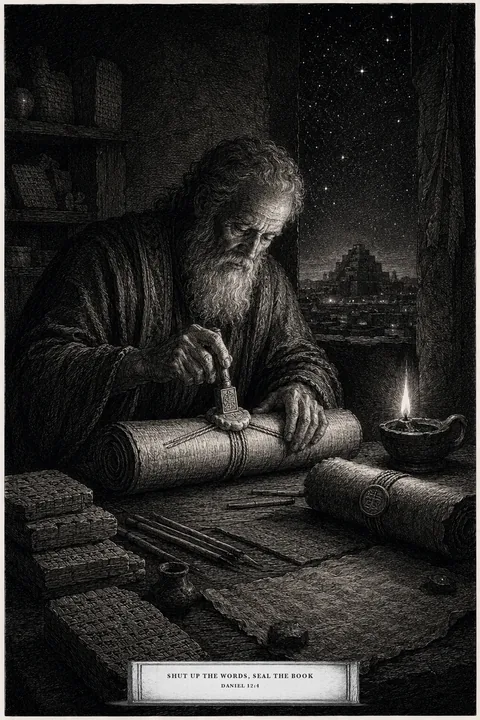
But thou, O Daniel, shut up the words, and seal the book, even to the time of the end: many shall run to and fro, and knowledge shall be increased.
— Daniel 12:4
Daniel Unsealed
Daniel is the one prophet ordered to lock his own book. “Shut up the words, and seal the book, even to the time of the end” — and when he asks what his own visions mean, he is refused:
…Go thy way, Daniel: for the words are closed up and sealed till the time of the end… none of the wicked shall understand; but the wise shall understand.
A sealed book expects an unsealing.
A book sealed in Hebrew was never going to be unsealed by a translation of a translation: the vowel points are themselves the first translation, and our English Bibles translate the pointing, not the bare letters — so part of the seal sits in readings that first translation chose away. This chapter takes the covering off with tools already forged — the chapter What Is the Point? made the case for revisiting these books with fresh eyes, the vowel points set aside — and unseals the way a seal demands: by translating again, this time from the letters themselves.
Seventy of What?
Start where Daniel himself started: with a promise of Jeremiah’s that did not add up.
And this whole land shall be a desolation, and an astonishment; and these nations shall serve the king of Babylon seventy years. And it shall come to pass, when seventy years are accomplished, that I will punish the king of Babylon, and that nation, saith the LORD, for their iniquity, and the land of the Chaldeans, and will make it perpetual desolations.
Many people, Daniel among them at first, understood this as Israel serving Babylon for seventy literal years. But read carefully what the seventy must contain: all of Jeremiah’s words brought upon that land — “even all that is written in this book” (Jeremiah 25:13) — and Babylon made a desolation forever.
History did something else. Babylon fell to Cyrus in 539 BC without a fight, during the Feast of Tabernacles, and was not made a perpetual desolation; the captives went home in 538 BC — some sixty years after Daniel was carried off, not seventy. Either Jeremiah is a false prophet, or “seventy years” counts seventy of some larger unit — for the word translated “year” is a flexible measure of time, the way “day” is. Daniel had the same question:
In the first year of his reign I Daniel understood by books the number of the years, whereof the word of the LORD came to Jeremiah the prophet, that he would accomplish seventy years in the desolations of Jerusalem.
He prays, and the angel Gabriel brings the answer:
Weeks seventy are cut — divided, covenanted — upon thy people and upon thy holy city, to shut up the transgression, and to make an end of sins, and to atone for lawlessness, and to bring in everlasting righteousness, and to seal — complete — the vision and prophet, and to anoint the most Holy.
Now set the verse side by side, word by word — the received points beside this book’s, and beside every claimed sense its proof: the verse where the King James prints the same sense, or the repointed word itself.
| Log | Masorete | MEAT | Prophecy |
|---|---|---|---|
weeks |
שָׁבֻעִים |
Deut 16:9 · H7620 |
Sevens — the jubilee count |
Seventy |
שִׁבְעִים |
seventy |
|
are determined |
נֶחְתַּךְ |
“to cut off” — H2852 |
is cut — divided, covenanted |
upon thy people |
עַל־עַמְּךָ |
upon thy people |
|
and upon… city |
וְעַל־עִיר |
and upon the city of |
|
thy holy |
קָדְשֶׁךָ |
thy holiness |
|
to finish |
לְכַלֵּא |
“refrained” — Ps 40:9 · H3607 |
to shut up |
the transgression |
הַפֶּשַׁע |
the transgression |
|
and to make an end of |
וּלְהָתֵם |
and to end |
|
sins |
חַטָּאת |
sins |
|
and to make reconciliation |
וּלְכַפֵּר |
“pitch” — Gen 6:14 · H3722 |
and to atone |
for iniquity |
עָוֹן |
for lawlessness |
|
and to bring in |
וּלְהָבִיא |
and to bring in |
|
righteousness |
צֶדֶק |
righteousness |
|
everlasting |
עֹלָמִים |
of the ages |
|
and to seal up |
וְלַחְתֹּם |
“seal the book” — Dan 12:4 · H2856 |
and to seal — complete |
the vision |
חָזוֹן |
the vision |
|
and prophecy |
וְנָבִיא |
“prophet” — H5030 |
and prophet |
and to anoint |
וְלִמְשֹׁחַ |
H4886 |
and to anoint |
the most Holy |
קֹדֶשׁ קָדָשִׁים |
the doubling again — Isa 26:3 |
the holy of holies |
The goals themselves are jubilee-work. The transgression is shut up while the jubilee opens the prison — “the opening of the prison to them that are bound” (Isaiah 61:1); sins end as a slave’s service ends — “whosoever committeth sin is the servant of sin” (John 8:34), and at the jubilee the servant “shall return unto his own family” (Leviticus 25:41). The atonement is the jubilee’s own gate — the trumpet of the fiftieth year sounds “in the day of atonement” (Leviticus 25:9) — and its economics, the kinsman buying back what was sold. Righteousness of the ages is every man restored “unto the possession of his fathers” (Leviticus 25:41), and the count closes on an anointing, because proclaiming the Jubilee is the Anointed One’s own commission: “the LORD hath anointed me… to proclaim liberty to the captives” (Isaiah 61:1). A count measured in jubilees, given to do jubilee-work.
Sins have not been ended, and the vision of Jeremiah has not been completed — so seventy “weeks,” four hundred ninety years, cannot be the whole of it. Look at the letters. The Hebrew under “weeks” is the seven-word in a plural form — and with the points removed, the verse opens with the same word written twice:
שבעים שבעים — seventy seventy
The plural ending makes the seven at least double — and a complete cycle of sevens, seven sevens, is the jubilee. Jeremiah’s unit was already compared to a year, and a year is itself a complete cycle of time; so the letters give us seventy sevens-of-sevens: seventy jubilees — seventy times 49 years — 3,430 in all.[1] The jubilee clock started at the Jordan crossing in 1406 BC, and the seventieth jubilee year closed in the spring of 2026.
That places 2026-2027 in the third year of Hezekiah’s sign — two fallow years, “and in the third year sow ye, and reap” (Isaiah 37:30) — and the third is the year of going up: “on the third day thou shalt go up unto the house of the LORD” (2 Kings 20:5). The letters also permit a second reading, and both can stand: seventy seventy as seventy times seventy — 4,900 years “determined upon thy people,” the seed of Abraham. That count runs from the covenant itself, sealed in 1876 BC, 430 years to the selfsame day before the Exodus (Exodus 12:40-41) — and if the reign of a thousand years is its final millennium, the reign opens 3,900 years in: the very year the seventieth jubilee closed. The count’s own first verb names its starting line: nechtak — cut, divided — the word of the covenant of the pieces, “divided… in the midst” as the lamp “passed between those pieces” (Genesis 15:10, 17). Two counts, two starting lines four centuries apart — and they close on the same year.
The Count at Two Scales
The Torah has already run this very count at two scales. The word under Daniel’s “weeks” is the name of a feast — Shavuot, the Feast of Weeks, the Feast of Sevens — and that feast is counted exactly the way the jubilee is counted: “seven sabbaths shall be complete: even unto the morrow after the seventh sabbath shall ye number fifty days” (Leviticus 23:15-16), as the jubilee numbers “seven sabbaths of years” and hallows “the fiftieth year” (Leviticus 25:8, 10). Seven sevens of days to a fiftieth day; seven sevens of years to a fiftieth year.
The Feast of Weeks is the jubilee run in days — the Torah’s own day-for-a-year model, rehearsed every spring on the way to Pentecost. So when Gabriel answers a question about years in sevens, the scale is already licensed: the count that walks in days walks in years.
Daniel marks his own scales. One chapter later, mourning three ordinary weeks, he writes “three sevens of days” (Daniel 10:2-3) — the King James prints “three full weeks” — the numeral leading and the scale named, exactly as the feast counts: “seven weeks shalt thou number” (Deuteronomy 16:9). This prophecy inverts that order — Sevens seven… Sevens sixty-and-two — the noun leading its own count, and no scale named anywhere: the bare Sevens are not day-weeks and not year-weeks; they are the feast’s unit, the jubilee’s shape. The hint survives the pointing itself: the Masoretes kept the Sevens first even as they pointed “weeks” — the received text preserves, on its own grammar, the mark that these are no calendar weeks, which means its keepers knew something was here; only the King James’s “Seventy weeks,” smoothing the order for English, hid the signal.
The letters go one step further. Written without points, the plural here is letter for letter the number seventy — the spelling Scripture uses some ninety times — and the pointing that reads “weeks” appears only in this prophecy; the vowels decide, and context chooses the vowels. Scripture’s own idiom crowns the choice: a doubled word is the thing perfected — shalom shalom the King James prints “perfect peace” (Isaiah 26:3); tzedek tzedek, “altogether just” (Deuteronomy 16:20) — and this verse is framed in doublings: the Sevens perfected at its head, and “the most Holy” — the holy of holies — perfected at its close. The doubling also multiplies: when Jesus set the measure of forgiveness He reached for this figure — “until seventy times seven” (Matthew 18:22) — the Greek hearing the pair multiplied, 490, the count of the very prophecy given to make an end of sins; the Hebrew Matthew hears “seventy and seven,” Lamech’s vengeance-count (Genesis 4:24) answered in forgiveness. One skeleton, every arithmetic the letters allow — and the fiftieth that crowns each seven-of-sevens carries the same cargo at every scale: “proclaim liberty throughout all the land” (Leviticus 25:10) in the fiftieth year; the Spirit poured out on the fiftieth day, and “where the Spirit of the Lord is, there is liberty” (2 Corinthians 3:17).
The Two Decrees
Gabriel then divides the count from a landmark anyone can check:
Know therefore and understand, that from the going forth of the commandment to restore and to build Jerusalem unto the Messiah the Prince shall be seven weeks, and threescore and two weeks: the street shall be built again, and the wall, even in troublous times.
The “weeks” here carry the same plural form as verse 24 — and the word the King James renders “two” is also the Hebrew for second, another; the word for “seventy” can stand for the jubilee-cycle it completes. Read the letters again:
Know therefore and understand, that from the going forth of the word to restore and build Jerusalem until Messiah the Prince shall be seventy seven [490 years] — then Jubilee sixty, and another [490]: they will come back and build again, with the plaza and the moat — and in distress [shall be] the times.
| Log | Masorete | MEAT | Prophecy |
|---|---|---|---|
Know |
וְתֵדַע |
and know |
|
therefore and understand |
וְתַשְׂכֵּל |
and be wise: |
|
from the going forth |
מִן־מֹצָא |
from the going forth |
|
of the commandment |
דָבָר |
“word” — Dan 9:2 |
of the word |
to restore |
לְהָשִׁיב |
to restore |
|
and to build |
וְלִבְנוֹת |
and to build |
|
Jerusalem |
יְרוּשָׁלִַם |
Jerusalem |
|
unto Messiah |
עַד־מָשִׁיחַ |
until Messiah |
|
the Prince |
נָגִיד |
a ruler |
|
weeks |
שָׁבֻעִים |
שִׁבְעִים |
seventy |
seven |
שִׁבְעָה |
seven |
|
and… weeks |
וְשָׁבֻעִים |
Deut 16:9 · H7620 |
and Sevens — jubilees |
threescore |
שִׁשִּׁים |
sixty |
|
and two |
וּשְׁנַיִם |
“year two” — Dan 2:1 |
and a second [word and seventy Sevens — 490] |
again |
תָּשׁוּב |
“return” — Jer 29:10 |
they shall return |
shall be built |
וְנִבְנְתָה |
and it is built |
|
the street |
רְחוֹב |
the plaza |
|
and the wall |
וְחָרוּץ |
“trench, moat” — BDB · H2742 |
and the moat |
even in troublous |
וּבְצוֹק |
and in distress [shall be] |
|
times |
הָעִתִּים |
the times |
History proves the reading out, twice over. The first decree went forth in 458 BC; count the 490, and the last of them runs from spring 32 to spring 33 — the year of the cross, where Messiah cut the covenant and rose.[2]
In 1535 — on the sixtieth jubilee — Sultan Suleiman gave the second decree to rebuild Jerusalem, and that decree names the plaza and the moat; the words were carved in stone at the moat and on the Temple Mount, where they stand today. The two rebuildings could not be confused with each other. In the first, the Jews refused foreign hands and built with a weapon in one hand; in the second, a foreign empire raised the walls — exactly as written: “the sons of strangers shall build up thy walls” (Isaiah 60:10) — a verse that sits, for whoever is counting, at chapter sixty, verse ten. Four hundred ninety years — 490 — from that second decree is where the reading says the times end, “in tribulation.”
The Cutting and the Vanishing
The verse between the decrees carries a second story.
And after threescore and two weeks shall Messiah be cut off, but not for himself: and the people of the prince that shall come shall destroy the city and the sanctuary; and the end thereof shall be with a flood, and unto the end of the war desolations are determined.
Now read the whole verse the second time through:
And after the Sevens — sixty, and a second [word, and seventy Sevens more] — Messiah shall cut a covenant, and he vanishes — and to him the watchful — and he sanctifies: and he shall destroy the people of a ruler who is coming. And his end is in the flood, and until the end of war it is decreed: desolations.
| Log | Masorete | MEAT | Prophecy |
|---|---|---|---|
and after |
וְאַחֲרֵי |
and after |
|
weeks |
הַשָּׁבֻעִים |
Deut 16:9 · H7620 |
the Sevens — the jubilee count |
threescore |
שִׁשִּׁים |
sixty |
|
and two |
וּשְׁנַיִם |
“year two” — Dan 2:1 |
and a second [word and seventy Sevens — 490] |
shall be cut off |
יִכָּרֵת |
יִכְרֹת |
he shall cut — a covenant |
Messiah |
מָשִׁיחַ |
Messiah |
|
but not |
וְאֵין |
Gen 5:24 |
and he vanishes |
for himself |
לוֹ |
“unto him” — Gen 49:10 |
— to him: |
and the city |
וְהָעִיר |
“a watcher” — Dan 4:13 |
and the watchful |
and the sanctuary |
וְהַקֹּדֶשׁ |
וְהַקְדֵּשׁ |
and he sanctifies |
shall destroy |
יַשְׁחִית |
the verb is singular |
and he shall destroy |
the people |
עַם |
the people |
|
of the prince |
נָגִיד |
of a ruler |
|
that shall come |
הַבָּא |
who is coming |
|
and the end thereof |
וְקִצּוֹ |
and his end |
|
with a flood |
בַשֶּׁטֶף |
Dan 11:22 · Isa 8:7 |
in the flood |
and unto the end |
וְעַד קֵץ |
and until the end |
|
of the war |
מִלְחָמָה |
of war |
|
are determined |
נֶחֱרֶצֶת |
it is decreed: |
|
desolations |
שֹׁמֵמוֹת |
desolations |
First, the opening: verse 25 wrote its sevens twice with no article, but verse 26 writes the sevens — and a definite article points at a system already named: the jubilee count of verse 24, the sixtieth, and the second decree. The consonants under “cut off” are karath — the standard covenant verb of the whole Old Testament: covenants are not signed in Hebrew; they are cut. Messiah does not merely suffer the verb; He performs it: Messiah shall cut a covenant.
The phrase “but not for himself” — v’ain lo — reads “and he vanishes”: the same idiom as Enoch, “he was not; for God took him” (Genesis 5:24) — and when the Greek translators met Enoch’s ain, they rendered it “was not found,” the very phrase the New Testament writes at the empty tomb: “and found not the body of the Lord Jesus” (Luke 24:3). To vanish is to be missing from the place one is expected: fifty men sought the taken Elijah three days “but found him not” (2 Kings 2:17), as Enoch was sought and the tomb was searched. The little to him that follows is the gathering-word of the oldest Messiah-prophecy — “unto him shall the gathering of the people be” (Genesis 49:10, v’lo) — and the apostles name the day by it: “the coming of our Lord Jesus Christ, and our gathering together unto him” (2 Thessalonians 2:1). Gone is he — and to him the watchful, “caught up together… to meet the Lord” (1 Thessalonians 4:17), received “unto myself” (John 14:3); then he sanctifies what he has gathered (Judges 17:3; Ephesians 5:26). The pair that follows is Daniel’s own: “behold, a watcher and an holy one came down from heaven” (Daniel 4:13) — the watchful and the holy, three times in his book — and the same letters carry the waking as a verb, he’ir, “the LORD stirred up the spirit of Cyrus” (Ezra 1:1), and the holy as its act, haqdesh, “I had wholly dedicated” (Judges 17:3). The destroying verb stays singular — he shall destroy, not they — and the received reading must front its objects to say otherwise, reading the city and the sanctuary backward across the verb; this reading walks the verse in its own order.
In plain terms: read as sixty-two Sevens, the count from the first decree reaches the last supper — the engagement, where Messiah cut the covenant and then vanished, to himself. Read as sixty jubilees and a second word, it reaches through the second decree of 1535 and its 490 years to the gathering: to him the watchful — to the city, Zion, where he sanctifies them, “mount Sion… the city of the living God… the general assembly and church of the firstborn” (Hebrews 12:22-23). Then he destroys the people of the coming ruler, whose end comes in the flood of armies, and until the war’s end the desolations stand decreed. The engagement was cut at the supper; the marriage is the strengthening — one covenant, completed (verse 27).
Under the traditional reading, the “he” of these verses has divided Christendom for centuries: is it Messiah, or antichrist? Read from the letters, the ambiguity dissolves: Messiah is the subject throughout — He cuts, He vanishes, He sanctifies, He destroys — and the antichrist appears only as the coming ruler, whose people He will destroy.
The Marriage Covenant
The covenant He cut has a second act.
And he shall confirm the covenant with many for one week: and in the midst of the week he shall cause the sacrifice and the oblation to cease.
Verse 26 cut the covenant — karath; verse 27 does not cut a new one — it strengthens the one already cut: gabar, to make strong. Two verbs, one covenant, two stages — and the two stages are the Hebrew marriage, exactly as the Marriage and Divorce chapter walked them.
The groom offers the cup, and the covenant is cut: “This cup is the new testament in my blood” (Luke 22:20). He abstains until the wedding: “I will not drink of the fruit of the vine, until the kingdom of God shall come” (Luke 22:18). He departs to prepare the bridal chamber, and vanishes: “I go to prepare a place for you… I will come again, and receive you unto myself” (John 14:2-3) — and His “receive” is the very Greek word of “one shall be taken, and the other left” (Matthew 24:40). The cutting is the cross; the vanishing is the ascension; the strengthening is the return — the covenant confirmed with many at the marriage supper.
The Abomination’s Desolation
Daniel’s twelfth chapter seals the timeline — and the King James points the tenses forward while the letters point back:
And from the time that the daily sacrifice shall be taken away, and the abomination that maketh desolate set up, there shall be 1,290 days. Blessed is he that waiteth, and cometh to the 1,335 days.
Read the letters again:
From the time that the daily was taken away, going toward the setting up of the abomination that becomes desolate, 1,290 days. Blessed is he that waiteth, and cometh to the 1,335 days.
| Log | Masorete | MEAT | Prophecy |
|---|---|---|---|
And from the time |
וּמֵעֵת |
and from the time |
|
shall be taken away |
הוּסַר |
the form is past — H5493 |
it was taken away |
the daily sacrifice |
הַתָּמִיד |
the daily |
|
and… set up |
וְלָתֵת |
and toward the setting of |
|
the abomination |
שִׁקּוּץ |
an abomination |
|
that maketh desolate |
שֹׁמֵם |
Dan 11:31 writes the active form |
that becomes desolate |
there shall be… days |
יָמִים |
days: |
|
a thousand two hundred |
אֶלֶף מָאתַיִם |
1,200 |
|
and ninety |
וְתִשְׁעִים |
and 90 |
The verb under “shall be taken away” is a completed past — was taken away — and the setting up is a direction of travel, not a date behind us; the “abomination that maketh desolate” can as readily be read the other way around: the abomination that becomes desolate — the thing destined for destruction.
Now count, a day for a year. The daily was taken away on March 16 — 2 Adar of the biblical year that began in the spring of 598 BC — the day Daniel’s city fell to Nebuchadnezzar and the temple service failed. Add 1,290 years: AD 692 — and inside the Dome of the Rock, on the Temple Mount, a dedicatory inscription dates the building to the Islamic year 72, which runs from July 691 to July 692. And the Lord had made that very sight the signal to flee:
When ye therefore shall see the abomination of desolation, spoken of by Daniel the prophet, stand in the holy place, (whoso readeth, let him understand:) then let them which be in Judaea flee into the mountains.
The abomination was set up on schedule, in the holy place, where He said to watch for it.
The blessing has a second number: add 1,335, and its 1,335th year opens in the spring of 2027 — which might mean the abomination will be made desolate around that time. Set that end against the seventy jubilees and the second decree’s four hundred ninety: the three counts, as currently understood, converge on the same window in time — and suggest the tribulation of the times’ end that the ninth chapter named may arrive within it.
“Whoso readeth, let him understand.” The understanding was never withheld from the wise; it was sealed — and the seal was never wax. It is the reading tradition laid over the letters, and it comes off with the tools you now hold.