Test all things; hold fast what is good.
— 1 Thessalonians 5:21, NKJV
Time Tested Tradition
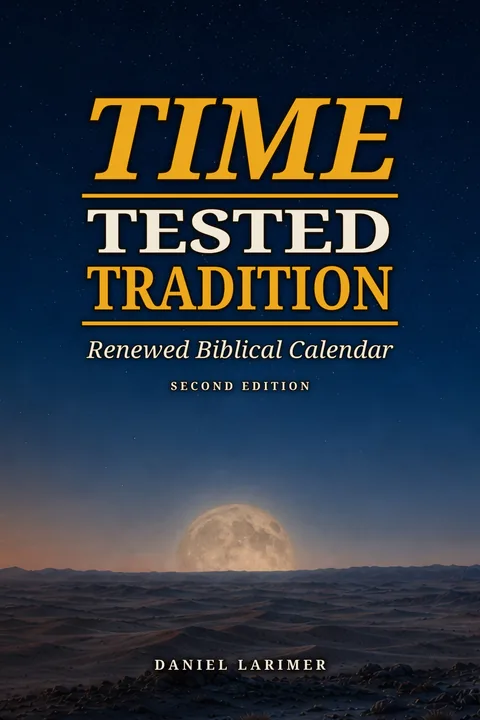
The chapters of this part rest on a dated and tested calendar, and the testing fills a companion volume — offered here as further reading. Time Tested Tradition: The Renewed Biblical Calendar (July 2026) takes Scripture and the historical record together and tests the calendars we have inherited from our fathers.
The premise is simple: almost everyone assumes that the calendar and oral history of the modern Jews reflect the calendar actually in use at the temple in Jesus’ day and throughout the Old Testament. But if we can definitively identify the years, the months, and the days of the week on which certain events occurred, then we can see what calendar — if any — matches the historical testimony. The evidence is overwhelming, and it is damning to the assumed traditions.
Time Tested Tradition shows, on the most direct reading of nearly all of the primary sources — from Josephus to Philo to Scripture itself, anchored by solar and lunar eclipses documented in stone — that the cross had to be AD 32. On the known dates, none of the known weekly sabbaths align with Saturday; the year of the cross puts the crucifixion on a Monday — an impossibility for rising on the third day after three days and three nights.
This creates a dilemma: either accept errors in Scripture, or stretch the other historical evidence beyond what a disinterested student of history would accept. The political, social, and career consequences of questioning the inherited Jewish calendar outweigh every other consideration — and so the question goes unasked.
Whose Testimony?
Before weighing the evidence, weigh the witnesses, for Scripture itself commands it. The inherited calendar rests, in the end, on testimony transmitted through a religious succession that rejects Messiah. That is a spiritual and doctrinal lineage, not a genetic one; Jesus rendered His verdict on leaders who rejected Him and taught others to do the same:
Ye are of your father the devil, and the lusts of your father ye will do… When he speaketh a lie, he speaketh of his own: for he is a liar, and the father of it.
The relevant succession is continued rejection of Messiah and the preservation of doctrine that displaces the written word, not ancestry. Jesus warned His disciples to “beware of the leaven of the Pharisees” — which, Matthew explains, “is their doctrine” (Matthew 16:6, 12); Mark records the charge that reaches our question exactly — “making the word of God of none effect through your tradition” (Mark 7:13); Paul instructs Titus to give no heed “to Jewish fables, and commandments of men, that turn from the truth” (Titus 1:14), and warns the Colossians against being taken captive “after the tradition of men… and not after Christ” (Colossians 2:8). The Revelation names the same counterfeit claim to covenant standing in this book’s symbols: the synagogue of Satan, “which say they are Jews, and are not” (Revelation 2:9). Most Christians miss the force of these verses because they imagine the Pharisees’ fault was keeping the law too strictly; Scripture’s charge is the opposite — that their oral tradition nullified the written commands they claimed to guard.
Where teachers reject Messiah and preserve a tradition that nullifies God’s word, institutional succession cannot make their testimony the final court of appeal. What may be received, and by what rule? Scripture gives the rule in this chapter’s epigraph: “Test all things; hold fast what is good” — test the testimony, but do not receive it untested because it is old, or loud, or theirs.
When that testimony is put on the stand, weigh what it actually brings. Its witnesses are dated, nearly to a man, after the fall of the temple: the Mishnah was compiled around AD 200, the Talmuds centuries later still, and the fixed, calculated calendar in use today is attributed to Hillel II in the fourth century — three hundred years after the altar went cold. From the years when the temple stood, the defenders of the inherited calendar bring almost nothing; and the evidence that does survive from those years — the eclipse-dated king-lists, Josephus, Philo, the Scriptures themselves — reads against them. So the argument runs backwards.
Where the record is silent, silence is pressed into service as proof: no one recorded a change, therefore nothing changed — as though a hostile majority ever preserves the records of the minority it silenced; the writings of the losing side are not archived by the winners; they are neglected and destroyed. Vowel points are changed, and symbols reinterpreted, to hide the Messiah and their blatant rebellion. That same argument from silence once dismissed the house of David as legend — until the Tel Dan stone surfaced in 1993 with “House of David” cut into it; and Pontius Pilate — until his stone came out of the ground at Caesarea in 1961. Where the record speaks, it is dismissed for contradicting the conclusion. And when the accounting is finally demanded — a date, a source, a stone — the answer given is “tradition,” said twice, and louder the second time.
Tradition is a map, and the map is not the terrain. Maps drift with every generation of copyists who inherit them; the terrain does not move. And God did not appoint the map — He appointed the terrain: “let them be for signs, and for seasons” — for moedim, the appointed times — “and for days, and years” (Genesis 1:14), spoken of the lights in the firmament, which have kept perfect time through every century in which the maps were redrawn. Time Tested Tradition is a resurvey of the terrain: every claim dated, every source cited, every date checked against a sky that cannot be edited.
In Time Tested Tradition, effectively every piece of primary evidence is laid on the table, dated and cited, with enough detail that you can judge for yourself who is reading the facts objectively and who is bending their interpretation to protect the dark-or-sliver-moon calendar and the Saturday sabbath. The book then makes the case for the sabbaths — as a sign and a moed — to be governed by the moon, and in particular by the full moon. MEAT The Bible’s Symbolic Language documents extensive new evidence that only further confirms the conclusions of Time Tested Tradition.
The book is free to download, or can be purchased in paperback, at TimeTested.Bible — for everyone who hungers and thirsts for righteousness, and who is committed to proving all things and holding fast that which is good.