The thing that hath been, it is that which shall be; and that which is done is that which shall be done: and there is no new thing under the sun.
— Ecclesiastes 1:9
Signs and Similitudes
How did Paul read the Old Testament? Not by a revelation the rest of us lack — he tells us his method outright, in the middle of a passage about Israel’s wilderness history:
Now all these things happened unto them for ensamples: and they are written for our admonition, upon whom the ends of the world are come.
The King James’ “ensamples” is the Greek typos — types, patterns struck in advance — and its two verbs reveal the order: the things “happened” as types before they were “written” as types (so too 1 Corinthians 10:6). Paul is not decorating history with lessons; he is telling us what the history is: composed. And watch him work the method on text after text: the rock that followed Israel — “that Rock was Christ” (1 Corinthians 10:4); Adam — “the figure of him that was to come” (Romans 5:14); Abraham’s two households — “which things are an allegory: for these are the two covenants” (Galatians 4:22-24), real women, real sons, and at the same time a composed likeness. Paul is the proof that this is a method of reading and not a private gift: he points at scrolls everyone owned and demonstrates what was always in them.
So far this book has let Scripture define its symbols one word at a time — in the sower the seed is the word, and the ground is the heart — but Paul read whole lives that way, because God writes with more than words: with wonders, with scenes, and with the lives of real men. Scripture claims nothing less for the whole canvas.
All creation testifies: “The heavens declare the glory of God… There is no speech nor language, where their voice is not heard” (Psalm 19:1-3; so Romans 1:20). And all history testifies: the psalm that recounts Israel’s whole story opens, “I will open my mouth in a parable: I will utter dark sayings of old” (Psalm 78:2) — the very line Matthew lays over the parables of Jesus (Matthew 13:35), the psalm the last chapter took its exam under. A history that can be called a parable is a history that was composed.
Scripture has two words of its own for that larger writing — sign and similitude — and this chapter defines them the same way the last chapter derived the seed and the ground: by letting Scripture use them in front of us.
What Scripture Calls a Sign
Men who demand signs mean one thing by the word; the prophets mean another. The demand is for a wonder performed on the spot. But watch what Scripture calls a sign, and notice that there is no wonder in it anywhere.
When Samuel anointed Saul, he sent him home with signs: two men would meet him by Rachel’s tomb and tell him the lost donkeys were found; three men would meet him at the plain of Tabor carrying three kids, three loaves, and a bottle of wine, and would hand him two loaves; then a company of prophets would come down from the high place (1 Samuel 10:2-6). Travelers on a road, a greeting, bread changing hands — scenes told in advance, down to the count of the loaves.
And it was so, that when he had turned his back to go from Samuel, God gave him another heart: and all those signs came to pass that day.
Nothing was conjured; everything foretold simply happened. A sign is a word given ahead of events, and its proof is that it comes true. And a sign can be more than a spoken word — it can be a prophet:
Thus Ezekiel is unto you a sign: according to all that he hath done shall ye do: and when this cometh, ye shall know that I am the Lord GOD.
Not Ezekiel’s sermon — Ezekiel, the man; his acted story; “all that he hath done.” Isaiah and his message-named children were “for signs and for wonders in Israel” (Isaiah 8:18), and Isaiah himself walked out one prophecy barefoot for three years “for a sign” (Isaiah 20:3).
The pattern holds into the gospels: the shepherds are given “a sign” that is simply a scene to find — “Ye shall find the babe wrapped in swaddling clothes, lying in a manger” (Luke 2:12) — and Simeon calls the child himself “a sign which shall be spoken against” (Luke 2:34). It holds to the last book of the Bible, whose visions are titled signs: “a great sign appeared in heaven” as the woman travailed (Revelation 12:1, NKJV), and the dragon waiting for her appears as another sign (Revelation 12:3).
Gather these uses and the first sense writes itself: a sign is a message given ahead of time — an oracle, a scene, or a prophet’s own lived story — so that its fulfillment testifies. A wonder on demand is what men ask for; a sign is what God gives.
Now test the definition on the most famous sign in the Bible:
Is this sign not a miracle? Its fulfillment is. But what happened on the day the sign was given? Nothing. No wonder was performed in Ahaz’s court; the word itself was the sign, and it stood as the sign for seven centuries before its fulfillment arrived to testify. The miracle belongs to the fulfillment; the sign is the message that ran ahead of it.
There is a second sense of sign, and it does not point forward at all: it points back to an established covenant and keeps that word visibly before the people. The bow in the cloud is “the token of the covenant” (Genesis 9:12-13 — a chapter of its own ahead); circumcision is “the sign… a seal of the righteousness of the faith” (Genesis 17:11; Romans 4:11); the Passover blood on the houses was “a token” (Exodus 12:13); the word of God itself is bound “for a sign upon thine hand” (Deuteronomy 6:8); and the sabbath is “a sign between me and you throughout your generations… that ye may know that I am the LORD that doth sanctify you… a sign… for ever” (Exodus 31:13, 17; Ezekiel 20:12). A sign, then, bears witness in one of two directions: prophetic evidence points forward and is proved by fulfillment; a covenant reminder points back and remains as the visible token of an established word.
The Two Tests of a Prophetic Sign
For the first sense — a sign given in advance — Moses gives two tests. The first is fulfillment: “if the thing follow not, nor come to pass, that is the thing which the LORD hath not spoken” (Deuteronomy 18:21-22) — a sign that fails is no sign, and the prophet who gave it spoke presumptuously. But fulfillment alone is not enough, and the second test overrides the first: if a prophet gives a sign “and the sign or the wonder come to pass,” yet he teaches you to go after other gods, you shall not hearken — “for the LORD your God proveth you, to know whether ye love the LORD your God” (Deuteronomy 13:1-3). To go after other gods is no separate offense standing beside lawbreaking; it is the first commandment broken — the head of the law — and Deuteronomy draws that conclusion itself in the next verse: “keep his commandments, and obey his voice” (Deut 13:4). A valid prophetic sign must both come true and come from one who does not teach against the law. A fulfilled sign never licenses lawbreaking; God Himself may send one as the proving.
A Likeness Made of Lives
The second word comes from God’s own mouth:
I have also spoken by the prophets, and I have multiplied visions, and used similitudes, by the ministry of the prophets.
A similitude is a likeness — but not a likeness drawn in words, like a parable. God says He used similitudes by the ministry of the prophets: He composed likenesses out of lives. The prophet who wrote that line was himself the proof — his whole life a sign.
Hosea’s book opens with the command:
The interpretation is handed down in the same breath as the command. His children were message-named like Isaiah’s: Lo-ruhamah, Not-pitied; Lo-ammi, Not-my-people (Hosea 1:6, 9). And when the wife was lost to her adulteries, the command came again: “Go yet, love a woman beloved of her friend, yet an adulteress, according to the love of the LORD toward the children of Israel” (Hosea 3:1) — and the prophet bought his own bride back for fifteen pieces of silver (Hosea 3:2). A marriage, a betrayal, a redemption — lived out over years, so that Israel could watch the love of the LORD walk through town. This is the writing Paul learned to read — the typos that “happened unto them” — and it runs beyond lives into the covenant’s own patterns: the law is “a shadow of good things to come” (Hebrews 10:1), the tabernacle built “according to the pattern” of heavenly things (Hebrews 8:5).
Jesus reads history the same way, time after time: “as the days of Noe were, so shall also the coming of the Son of man be” (Matthew 24:37); “as it was in the days of Lot… even thus shall it be in the day when the Son of man is revealed” (Luke 17:28, 30); “as Moses lifted up the serpent in the wilderness, even so must the Son of man be lifted up” (John 3:14). He does not treat the histories as illustrations that happen to fit. He treats them as prophecies that must be fulfilled.
The New Testament ratifies the method instance after instance, in so many words. The manna was a similitude of “the true bread from heaven” (John 6:32) — and the feeding of the five thousand that opens that discourse is itself a lived sign: John calls it one (the “miracle” of John 6:14 is the Greek sēmeion), the sign the last chapter read in full — the Law carried by witnesses, feeding the famished — and the Sea & Waters chapter ahead will deepen the fish’s half of its key.
The temple was a similitude of “the temple of his body” (John 2:19-21); the Passover lamb, of “Christ our passover… sacrificed for us” (1 Corinthians 5:7) — John even cites the lamb-rule “a bone of him shall not be broken” (John 19:36; Exodus 12:46) as fulfilled prophecy. A past man prophesied a future man: “this is Elias, which was for to come” (Matthew 11:14). And Peter calls baptism the “like figure” of the flood (1 Peter 3:21) — his Greek word is antitypon: type and antitype are Scripture’s own vocabulary, not a scholar’s invention.
How far may this be carried? But the risen Lord’s own claim outruns any cautious answer:
And beginning at Moses and all the prophets, he expounded unto them in all the scriptures the things concerning himself.
He said as much elsewhere: “Moses… wrote of me” (John 5:46). Not a proof-text here and there: all the Scriptures.
God Requireth That Which Is Past
How can real history be prophecy? Solomon gives the warrant, and it is the epigraph over this chapter: “The thing that hath been, it is that which shall be… and there is no new thing under the sun” (Ecclesiastes 1:9).
Read flat, it sounds like world-weariness. But the sun is a symbol with a chapter of its own ahead — “the LORD God is a sun” (Psalm 84:11) — and under that Sun, the saying turns from a sigh into a signature: under the Father’s hand there is no new thing, because history is composed, and the Composer repeats His themes on purpose. Solomon says it again with the veil pulled back:
That which hath been is now; and that which is to be hath already been; and God requireth that which is past.
God requires the past — summons it back, calls for the pattern again. What has been done will be done again, because the same Author is writing. That is why a life can be a prophecy: the first telling is the similitude, and God will require it.
The Method Proved on Moriah
God says to Abraham:
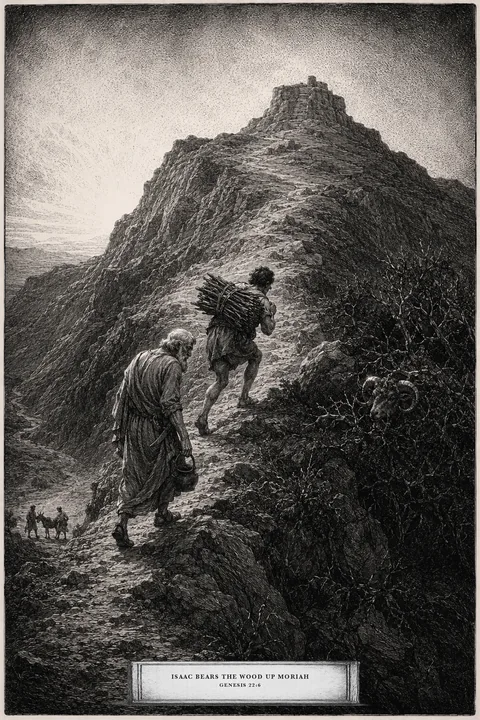
Take now thy son, thine only son Isaac, whom thou lovest, and get thee into the land of Moriah; and offer him there for a burnt offering upon one of the mountains which I will tell thee of.
Three facts emerge from that one verse. It is the first time the word love appears in all Scripture — and the Bible’s first love is a father’s love for the son he must offer. The son is “thine only son” — the very phrase Hebrews keeps: Abraham “offered up his only begotten son” (Hebrews 11:17). And the place is chosen by God: the land of Moriah — the mountain where the temple would stand, “the house of the LORD at Jerusalem in mount Moriah” (2 Chronicles 3:1).
Now the scenes run. “On the third day” Abraham lifts up his eyes and sees the place (Genesis 22:4). The wood of the offering is laid on the son, and the son carries it up the hill (Genesis 22:6) — as another Son, on that same ridge, “bearing his cross went forth” (John 19:17). The son asks where the offering is, and the father answers with the gospel a full two millennia early: “My son, God will provide himself a lamb” (Genesis 22:8) — the sentence John the Baptist completes: “Behold the Lamb of God” (John 1:29). The substitute dies with his head caught in thorns — “a ram caught in a thicket by his horns” (Genesis 22:13). And Abraham names the place with a promise in the future tense: “In the mount of the LORD it shall be seen” (Genesis 22:14).
Hebrews then hands down the verdict on what kind of event this was:
Accounting that God was able to raise him up, even from the dead; from whence also he received him in a figure.
“In a figure” — the Greek is en parabolē: in a parable. Scripture itself declares the event a lived parable of death and resurrection — a father receiving his only son back from the dead — staged on the very mountain where it would be fulfilled, two thousand years in advance. That is a similitude: not a story about the truth, but the truth rehearsed.
Or take Joseph, and count the frames as they go by. Betrayed by his brothers; stripped of his garment; sold for pieces of silver; condemned between two prisoners, of whom one was lifted up to the king’s presence and the other hanged (Genesis 40:13, 19-22 — as two would hang beside another condemned man, Luke 23:39-43); raised out of the pit to the throne; made the savior of the nations with bread; unrecognized by his own brothers. And then the line Stephen preached to the Sanhedrin: “at the second time Joseph was made known to his brethren” (Acts 7:13). At the second coming, his brothers knew him. Stephen told that story to the very council that had condemned his Lord, and they heard what he was saying — it is the sermon that got him killed.
Or take Rahab, whose story the generation after the apostles still read this way. A woman in a city devoted to destruction asks the spies for a sign — “give me a true token” (Joshua 2:12) — and the token is “this line of scarlet thread in the window” (Joshua 2:18). When the city fell, every soul in the scarlet-marked house lived (Joshua 6:25): the Passover, kept this time by a gentile household — the marked house spared in the judged city. She did not merely survive; she entered the line of the Messiah (Matthew 1:5).
Clement of Rome, writing while men who knew the apostles still lived, says the spies gave her “a sign… a scarlet thread, thereby showing beforehand that through the blood of the Lord there shall be redemption unto all them that believe,” and draws the conclusion for us: “not only faith, but prophecy, is found in the woman” (1 Clement 12). Her life was a prophecy — the verdict is Clement’s, not mine.
Now widen the lens all the way, because the master similitude is Israel herself. Hosea wrote of the nation’s past: “When Israel was a child, then I loved him, and called my son out of Egypt” (Hosea 11:1) — and Matthew quotes that line as prophecy, “fulfilled” when the child Jesus comes up out of Egypt (Matthew 2:15). A sentence about the nation’s history is cited as the Son’s future: the history itself was the similitude.
The Son thus relives the nation’s story, and where Israel fell, He stands: through the water — as all Israel was “baptized… in the cloud and in the sea” (1 Corinthians 10:2, a crossing that the Sea & Waters chapter will read) — then forty days fasting in the wilderness answering Israel’s forty years (Matthew 4:2), turning the tempter away each time with words drawn from the very chapters Moses wrote about those years (Deuteronomy 8:3; 6:16; 6:13). All of Israel’s history is written this way: lived first, fulfilled after.
Treat the histories as composed. When Scripture tells a life in unusual detail — a fare paid, a garment stripped, a third day, a thicket of thorns — the details are not color; they are lines of a similitude, and God requireth that which is past: what has been done will be done again. Jesus, asked to prove who He was, reached for one prophet’s whole life and called it the sign. The next chapter reads it scene by scene.