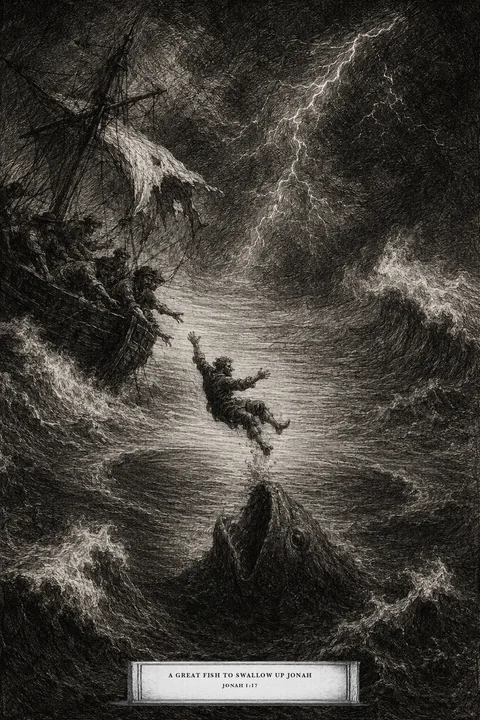
Now the LORD had prepared a great fish to swallow up Jonah. And Jonah was in the belly of the fish three days and three nights.
— Jonah 1:17
The Sign of Jonah
When the scribes and Pharisees demanded a sign, Jesus refused them every sign but one.
…An evil and adulterous generation seeketh after a sign; and there shall no sign be given to it, but the sign of the prophet Jonas: For as Jonas was three days and three nights in the whale’s belly; so shall the Son of man be three days and three nights in the heart of the earth.
It is a strange thing to hand a skeptic: a short book about a runaway prophet. The common readings tend to rank this way:
| Rank | Common interpretation |
|---|---|
1 |
Only the time-comparison — three days in the fish, three in the tomb |
2 |
A call to repent, as Nineveh repented |
3 |
A rebuke of sign-seeking, nothing more |
4 |
Partial typology — a few parallels, such as the belly as the grave or a ransom in the storm |
5 |
A scene-by-scene prophecy — from the betrayal, to the Passion, to the turn to the nations |
The common reading takes one clause — the three days — and stops, while other readings emphasize Nineveh’s repentance, the rebuke of sign-seeking, or a few isolated parallels. But listen to how Luke reports the same saying:
Jonah himself was the sign — the man and his whole story, not one verse of his book. The last chapter showed what that means: a sign is a message given ahead of time — an oracle like Isaiah’s virgin, a lived story like Ezekiel’s — whose fulfillment testifies. So the sign of the prophet Jonah is the oracle that is Jonah: a similitude already written, already lived, handed to that generation to watch come true.
The habit this chapter teaches, stated generally, is this: when Scripture is quoted, consider the broader context around the quotation. Here the context is a whole book — Jonah is short — and Jesus cited far more than a verse of it: He cited the entire sign, duration and all.
Jonah is exactly the kind of composed history the last chapter proved from Isaac and Joseph, and Jesus set His own seal on this one. So let us read the whole scroll, with the symbols we now hold.
Begin with his name, because Hebrew names are small sentences. Yonah is the word for dove — the bird Noah sent out over the floodwaters (Genesis 8:8), the shape the Spirit took over the water at Jesus’ baptism (Matthew 3:16) — and he is ben Amittai, son of my truth. A dove, son of truth, sent out over the sea of the nations: the name alone announces that this book is doing more than reporting weather at sea.
Now the two phrases that anchor the sign — “the heart of the earth,” and, in Jonah’s own prayer, “the heart of the seas.” The first is usually ranked this way:
| Rank | Common interpretation |
|---|---|
1 |
The grave — a synonym for the tomb |
2 |
Hades, the realm of the dead |
3 |
A mere idiom for burial, with no place in view |
4 |
Jerusalem — the navel of the land |
The tomb is the reflex — yet no Scripture calls a grave the heart of the earth, and that surface reading is what created the counting problem in the first place. But Scripture itself locates the heart of the earth. God says of one city:
This is Jerusalem: I have set it in the midst of the nations and countries that are round about her.
Ezekiel sees the regathered people “that dwell in the midst of the land [the navel of the land]” (Ezekiel 38:12, KJV).[1] And the world Jesus spoke into knew the name: Philo of Alexandria calls Jerusalem the “heart of the whole earth”; the Sibylline Oracles, “the navel and heart of the earth”; later Greek copies of Ezekiel even change “navel” to “heart” where Jerusalem is in view. Those witnesses help — but they only confirm what the symbols prove from within, as the mirrored phrase is about to show.
Read that way, “the Son of man… three days and three nights in the heart of the earth” is, first of all, three days and three nights in Jerusalem — taken into the city under arrest, and out of it again on the third day.
Jonah names his own destination with the mirrored phrase:
For You cast me into the deep, into the heart of the seas, and the floods surrounded me; all Your billows and Your waves passed over me.
NKJV
The Hebrew phrase is bilvav yammim — in the heart of the seas — and the NKJV keeps it visible. And with that phrase the proof closes inside Scripture itself. The sea is a defined symbol — “the waters… are peoples, and multitudes, and nations” (Revelation 17:15; the full case study waits in Part Six) — so the heart of the seas is, by Scripture’s own dictionary, the heart of the nations: Jonah is sent down into the very midst of the peoples. Mirror the phrases and the sign reads itself: the heart of the earth — the land — is the land’s center, the city God set “in the midst of the nations” (Ezekiel 5:5). No witness outside the Bible is needed; the symbol carries the proof, and Philo and the Oracles merely nod along.
There is the sign in two phrases. Jonah goes down into the heart of the seas — the nations, with their floods (armies) and waves (turbulent peoples) compassing him about; the Son of Man goes down into the heart of the earth — Jerusalem, with Rome’s armies and the turbulent peoples compassing Him about. Two centers, one sign.
The sign begins before the storm, with a command and a flight. The word of the LORD comes to Jonah: “Arise, go to Nineveh” (Jonah 1:2); Jonah rises, but to “flee… from the presence of the LORD” (Jonah 1:3). The Passion opens with the same departure in Judas. After Jesus tells him, “That thou doest, do quickly,” Judas “went immediately out: and it was night” (John 13:27, 30). Jonah pays a fare to flee; Judas is paid to betray. Both departures carry the story down into its first night.
Jonah’s flight takes him down to Joppa and onto a ship bound for Tarshish (Jonah 1:3) — and the ship too is a defined symbol: a kingdom, city, or state riding upon the sea of peoples, rulers for pilots and inhabitants for crew. The Ship, ch. 39 proves it from Ezekiel’s oracle against Tyre and from the ancient world’s own speech: the fleeing prophet has stepped aboard a nation.
Now the storm, with the sea and the ship defined. The LORD hurls a great wind onto the sea, and the ship is “like to be broken” (Jonah 1:4). This is not weather wandering across Jonah’s route. The lot reveals that the storm has come for one man (Jonah 1:7), and Jonah himself confesses, “I know that for my sake this great tempest is upon you” (Jonah 1:12). The appointed storm threatens the ship and everyone inside it until the man it seeks is given up.
While it gathers, the prophet is asleep in the sides of the ship (Jonah 1:5). The shipmaster wakes him: “What meanest thou, O sleeper? arise, call upon thy God… that we perish not” (Jonah 1:6). If that scene feels familiar, it should: a prophet asleep in a laboring ship, woken with “carest thou not that we perish?” (Mark 4:38). Jesus played Jonah’s scene on Galilee and rewrote the ending — He rose and stilled the sea with a word, the signature of His identity, as the Sea & Waters chapter ahead will show from the psalms. The scene plays a second time on the first night of the Passion, with the roles reversed: in Gethsemane it is the disciples who cannot keep watch — “What, could ye not watch with me one hour?” (Matt 26:40) — and the One awake in the storm rises to meet it alone: “Rise, let us be going: behold, he is at hand that doth betray me” (Matt 26:46).
The interrogation comes next, and it reads like a transcript from the Passion. The lot has singled out the prisoner (Jonah 1:7), and his judges put him to the question: “What is thine occupation? and whence comest thou? what is thy country? and of what people art thou?” (Jonah 1:8) — the questions the priests and the governor would press: “Art thou the King of the Jews?” (John 18:33); “Whence art thou?” (John 19:9).
Jonah confesses his identity plainly: “I am an Hebrew; and I fear the LORD, the God of heaven, which hath made the sea and the dry land” (Jonah 1:9) — and at the confession his judges grow frightened: “Then were the men exceedingly afraid” (Jonah 1:10), as Pilate, hearing whose Son his prisoner claimed to be, “was the more afraid” (John 19:8). They ask the question every judge of an innocent man dreads: “What shall we do unto thee?” (Jonah 1:11) — Pilate’s very question: “What shall I do then with Jesus which is called Christ?” (Matthew 27:22). They try to escape the sentence: “the men rowed hard to bring it to the land; but they could not” (Jonah 1:13), as Pilate “sought to release him” and could not prevail (John 19:12). And they wash their hands of him — the sailors in words, “lay not upon us innocent blood” (Jonah 1:14); the governor in water, “I am innocent of the blood of this just person” (Matthew 27:24). Scene for scene, question for question, fear for fear — seven centuries apart.
On Passover night He fulfilled the casting too — not as the stiller of the storm but as the man given to it:
One man, knowing the storm is for his sake, given to the raging sea — and the ship is spared. The verbs hold a double truth: Jonah offers himself — “cast me forth” — yet it is other hands that take him up and cast him; exactly as the Messiah is “delivered… by wicked hands” (Acts 2:23) and yet insists, “No man taketh it from me, but I lay it down of myself” (John 10:18). The rulers of Jerusalem describe the same danger: if Jesus is left alone, “the Romans shall come and take away both our place and nation” (John 11:48). The ship is not a loose metaphor: Ezekiel addresses Tyre as a city, then builds her as a vessel whose inhabitants are mariners, wise men pilots, armies defenders, and commerce cargo before the wind breaks “thee in the midst of the seas” (Ezekiel 27:2-32). The ship of the nation will be lost. The high priest therefore states Jonah’s bargain from the deck, prophesying more than he knew — “it is expedient for us, that one man should die for the people, and that the whole nation perish not” (John 11:50). One man is thrown to the storm so the ship may live.
The first worship comes from the gentile crew. The heathen sailors, who had each cried to his own god (Jonah 1:5), watch the sea cease and “feared the LORD exceedingly, and offered a sacrifice unto the LORD, and made vows” (Jonah 1:16). At the cross the scene replays almost to the syllable: the heathen soldiers, watching Him die, “feared greatly, saying, Truly this was the Son of God” (Matthew 27:54). In both stories the first gentile worshippers are the crew that carried out the execution. The smaller details are keeping pace too — the fare paid, the wreath of reeds, the lots against the garments — but hold them for the table at the end; the story is still going down.
The narrative now names the power behind the waters: the great fish. It can look like a new danger arriving after the storm, but the symbols do not divide so neatly. The same God who hurled the wind had appointed the fish; the storm and the swallowing answer to one purpose. The sea is the mass of peoples, its waves are those peoples stirred into motion, and the great fish is the ruler moving through that sea and ruling over it. The storm is not independent of the fish. It is the fish’s dominion in tumult — the ruler acting through the peoples and powers under his head.
First, what the great fish is not. The King James says “whale,” but that is an interpreter’s guess: Jonah’s Hebrew says dag gadol, a great fish, and Matthew’s Greek says kētos, a sea-monster. The Hebrew Matthew, for its part, keeps Jonah’s own word — ha-dagah, the fish, in the very feminine form Jonah 2:1 uses; the witness refuses the monster and quotes the prophet. Notice also who sends it: “the LORD had prepared a great fish” (Jonah 1:17) — vayman, appointed. The monster was on assignment before Jonah reached its mouth.
The symbols keep their scale: one doubting man is “like a wave of the sea” (James 1:6), and the sea is the mass of them — a scaling the Sea & Waters chapter will establish in full. A fish is a man in that sea of nations; a great fish is a great man in it — a ruler or king. The ruler can stand for the kingdom, administration, and armies acting through him, as a nation can be named by its capital or its present ruler. Daniel makes the head-body grammar explicit: the four beasts are first “four kings” and then the fourth beast is “the fourth kingdom” (Daniel 7:17, 23). The ruler is named for the body without becoming the body. Scripture uses exactly this picture for devouring rulers:
Nebuchadrezzar the king of Babylon hath devoured me… he hath swallowed me up like a dragon, he hath filled his belly with my delicates, he hath cast me out.
Devoured, swallowed into the belly, cast out again — that is Jonah’s itinerary, spoken personally of Nebuchadnezzar and corporately of Babylon acting through him. Pharaoh likewise is “the great dragon” (Ezekiel 29:3), “a whale in the seas” (Ezekiel 32:2): one ruler named for the Egypt he heads. The great fish is a devouring ruler: he swallows through the body he heads, holds in his belly, and is made to give back.
Which great ruler governed the storm that swallowed the Messiah? The rulers feared Rome before they seized Jesus: “the Romans shall come and take away both our place and nation” (John 11:48). That fear raised the storm and supplied its proposed remedy — surrender one man so the nation would not perish. At the sentence Jerusalem finally named the ruler whose power had surrounded the whole proceeding: “We have no king but Caesar” (John 19:15). The very next verse has Pilate deliver Jesus to be crucified. Caesar is the personal head; Rome is the power acting through his name. He does not enter the sign at the sentence; there he is revealed.
Which covenant city delivered Him to that ruler? Scripture names her outright:
…the great city, which spiritually is called Sodom and Egypt, where also our Lord was crucified.
Jerusalem. Spiritually Egypt — and Egypt is the dragon. She is the city “that killest the prophets” (Matthew 23:37).
Yet she did not act alone; she rode the beast. Rome is the iron of Nebuchadnezzar’s image — Daniel named the second and third kingdoms outright, Medo-Persia and Greece (Daniel 8:20-21), and the iron fourth that “breaketh in pieces” all before it (Daniel 2:40) is the empire that held the world when He came — the current face of the one world-empire. Scripture frames the whole appointed storm: “both Herod, and Pontius Pilate, with the Gentiles, and the people of Israel, were gathered together” to do what God’s hand and counsel “determined before to be done” (Acts 4:27-28). The rulers are its head, the Gentiles and Israel its troubled waters, and all move together against the one man for whose sake the storm has risen. (Who the harlot is, the Fall of Babylon chapter proves; the beast she rides is a study of its own; here it is enough to see the ruler and kingdom that swallowed Him.)
The place of that swallowing is the heart of the earth. Its three-day count begins when the appointed powers seize Jesus outside the gates on the night of the betrayal and take Him into Jerusalem’s custody. The interrogation, the failed attempt to release Him, the cry for His death, and the casting to the crowd are not events before the Great Fish; they are the storm within its dominion. There they held Him three days and three nights, put Him to death, and were forced to give Him back. Listen to Jonah inside:
…out of the belly of hell [Hebrew: Sheol] cried I, and thou heardest my voice.
I went down to the bottoms of the mountains; the earth with her bars was about me for ever: yet hast thou brought up my life from corruption, O LORD my God.
Jonah’s prayer is as revealing for what it omits as for what it says. He is not a corpse; he is alive in the belly and praying (Jonah 2:1) — as good as dead, shut behind the earth’s bars, brought down to the bottoms of the mountains — and a mountain, one verse settles, is a kingdom: “the seven heads are seven mountains… and there are seven kings” (Revelation 17:9-10; the full case study waits in Part Six). Jonah lies beneath the very foundations of the kingdoms. And he is “brought up… from corruption” — the precise word Peter presses at Pentecost: “thou wilt not… suffer thine Holy One to see corruption” (Psalm 16:10; Acts 2:27).
Two details of the prayer reward the dig. The “weeds… wrapped about my head” (Jonah 2:5) are suph — the reed of yam suph, the sea our Bibles call the Red Sea: the death-waters Israel walked through alive with the Passover blood still wet on the doorposts. The same consonants also spell the end — a wordplay the Sea & Waters chapter will weigh; on his way down to death the prophet wears the red crossing’s own wreath bound about his head.
The prayer’s last words — the words that trigger his release — are these: “Salvation is of the LORD” (Jonah 2:9). In Hebrew, yeshuatah laYHWH: the salvation is yeshuah. Out of the belly of Sheol, the prophet’s final word is the name: “thou shalt call his name JESUS (Yeshua): for he shall save his people from their sins” (Matthew 1:21). The very next verse: “And the LORD spake unto the fish, and it vomited out Jonah upon the dry land” (Jonah 2:10). Salvation named; the monster overruled. (The name has a chapter of its own ahead.)
For a dragon does not keep what it devours. God says it of Babylon in so many words: “I will bring forth out of his mouth that which he hath swallowed up” (Jeremiah 51:44). The kingdom that swallowed the Holy One was forced to give Him back. The sign is a resurrection.
Now set the two castings side by side, because the contrast is the verdict. Babylon is cast into the sea and “shall not rise” (Jeremiah 51:64); Jonah is cast into the same sea — and rises. The sea swallows the righteous and the lawless alike; the difference between them is the coming up. The lawless kingdom sinks like a stone and stays down; the righteous man goes down, and “it was not possible that he should be holden of it” (Acts 2:24).
Baptism enacts exactly this: the convert goes under the water like Jonah, “buried with him by baptism into death,” and comes up to “walk in newness of life” (Romans 6:4) — while his sins go down like Babylon, “cast… into the depths of the sea” (Micah 7:19), never to rise. One sea, two outcomes: the righteous rise; the lawless never do.
Now comes the part no skeptic would script. Delivered up out of death, the prophet goes to the great gentile city — and the city turns to God:
Nineveh is a city of the sea — a great mass of peoples — and at the preaching of a man brought back from the dead, the sea turns. The similitude is why she turned: Luke says Jonah himself “was a sign unto the Ninevites” — the preacher was the message, a man given to the deep and given back — and the great city bowed to it, as the nations would bow to the preaching of the risen Lord. The order is fixed and cannot be reversed: the prophet must first be swallowed and vomited out, dead and raised, and only then do the nations repent. So the sign of Jonah is not only the Passion; it is the gospel going out to the nations after the resurrection.
Listen to the city’s title. Three times the book calls her “that great city” (Jonah 1:2; 3:2; 4:11) — and “that great city” is Revelation’s title for the harlot (Revelation 17:18; 18:21; 11:8). The world-city of the nations wears one title across the whole of Scripture, and Jonah is sent into it — and at the preaching of the risen prophet, the great city repents in sackcloth instead of falling.
The book even gives the great city a measure: “an exceeding great city of three days’ journey” (Jonah 3:3), and Jonah went in “a day’s journey” before he cried (Jonah 3:4). Scripture supplies the scale for such days: “one day is with the Lord as a thousand years” (2 Peter 3:8; so too Psalm 90:4) — three days’ journey, three thousand years; the cry sounding a thousand years in. (The reckoning of those days is the work of Time Tested Tradition; the point here is only that the sign carries its durations — three days in the fish, three days’ journey in the city, forty days of warning — and that none of them are idle.)
See what Jesus says these gentiles will then do: “The men of Nineveh shall rise in judgment with this generation, and shall condemn it.” “Shall rise” is no figure of speech — the Greek is anastēsontai, the resurrection word, the very form Paul uses when “the dead in Christ shall rise” (1 Thessalonians 4:16). The Ninevites are themselves raised, and in rising they condemn “this generation” — the generation that demanded a sign and refused the One who gave it.
The reversal could not be sharper: pagan Nineveh repented at a reluctant prophet who carried no resurrection; this generation had the risen Messiah in person, and would not. So the saved out of the nations rise to judge the very people who handed Him to the dragon — for “the saints shall judge the world” (1 Corinthians 6:2). “A greater than Jonas is here.”
The book does not end at Nineveh’s repentance — it ends with the prophet angry about it, and even the anger is part of the sign. “It displeased Jonah exceedingly, and he was very angry” (Jonah 4:1) — and he tells God why he had fled in the first place: “I knew that thou art a gracious God, and merciful… and repentest thee of the evil” (Jonah 4:2). He did not run because he feared the mission would fail; he ran because he knew it would succeed — he could not bear the mercy of God falling on the great gentile city.
The fulfillment follows the same pattern. When the gentiles flocked to hear the word, “the Jews… were filled with envy” (Acts 13:45), and the apostles answered, “lo, we turn to the Gentiles” (Acts 13:46). Paul says the jealousy itself was in the script — Moses sang it: “I will provoke you to jealousy by them that are no people” (Romans 10:19; Deuteronomy 32:21) — and that God is working through it still: salvation is come unto the Gentiles “for to provoke them to jealousy” (Romans 11:11). The prophet sulking outside the spared city is Israel standing outside while the nations go in — the elder brother who “was angry, and would not go in” (Luke 15:28), while the father comes out to entreat him. Even Jonah’s anger was prophecy.
Laid side by side, scene for scene, the two stories form the pattern shown in the table that closes this chapter.
| Jonah | Jesus |
|---|---|
The word comes: “Arise, go to Nineveh” |
Jesus tells Judas, “That thou doest, do quickly” |
Jonah rises to flee from the LORD |
Judas leaves Jesus, “and it was night” |
Jonah pays the fare |
Judas is paid thirty pieces of silver |
Jonah goes “down” to Joppa and into the ship |
Jesus goes out across the Kidron to Gethsemane, beneath the Mount of Olives |
God sends a storm for Jonah; the ship is about to break |
The rulers fear that because of Jesus Rome will take their place and nation |
Jonah sleeps in the ship while the storm gathers |
On the first night, the disciples sleep three times while the Passion gathers |
Captain wakes Jonah: “What meanest thou, sleeper? Arise!” |
Jesus wakes the disciples: “Rise, let us be going” |
A lot singles out the man for whose sake the storm has come |
Judas’s sign singles out Jesus, and the officers seize Him outside the gates |
Sailors question Jonah about his identity and the cause of the storm |
High priest and Pilate question Jesus about his identity and the cause of the trouble |
Jonah’s confession makes the sailors exceedingly afraid |
Jesus' claim makes Pilate “the more afraid” |
Sailors ask, “What shall we do unto thee?” |
Pilate asks, “What shall I do then with Jesus?” |
Sailors row hard to release Jonah but cannot |
Pilate seeks to release Jesus but cannot prevail |
Sailors cry, “lay not upon us innocent blood” |
Pilate washes his hands: “I am innocent of the blood of this just person” |
The appointed storm moves the sea against the ship |
Herod, Pilate, the Gentiles, and Israel gather by God’s determined counsel |
Jonah says, “Take me up, and cast me forth” |
Jesus voluntarily lays down his life |
Jonah is cast to the sea so the ship will not perish |
One man is given to the crowd so the nation will not perish |
The Great Fish is the appointed ruler over the sea that has raged |
Caesar is the head; Rome acts through the rulers, soldiers, and turbulent peoples |
The fish receives the man surrendered by the ship |
Pilate delivers Jesus after Jerusalem declares, “We have no king but Caesar” |
The sailors fear the LORD exceedingly and sacrifice |
The centurion fears greatly: “Truly this was the Son of God” |
In his prayer Jonah recalls the red reeds wrapped about his head |
On His descent to death Jesus wears the bloody crown of thorns |
Jonah’s lot marks the man surrendered to the sea |
Soldiers cast lots for Jesus’ garments |
Three days and three nights in the fish |
Three days and three nights in the heart of the earth |
Jonah’s prayer ends, “Salvation (yeshuah) is of the LORD” |
His name is JESUS (Yeshua): “for he shall save his people” |
Jonah cast up alive onto dry land |
Jesus rises alive from the tomb |
The command comes again: “Arise, go to Nineveh”; Jonah obeys |
The risen Jesus sends the gospel to the nations |
Jonah angry that the great city is spared |
Israel “filled with envy” as the gentiles receive mercy |
If this reading feels new, it is newer than it should be. Augustine saw the shape of it sixteen centuries ago: “As Jonah passed from the ship to the belly of the whale, so Christ passed from the cross to the sepulchre” — and he saw the turn to the nations too: the preaching “did not actually come to the Gentiles until after the resurrection of Christ from the grave” (Letter 102). But he compressed the whole descent into two frames, and so set one of them wrong: the ship is not the cross. You have just watched the ship carry the night of the betrayal — the sleeper wakened, the questioning, the innocent blood, and the surrender of one man so the ship might live. Nor does the Great Fish wait offstage until after the storm. The ruler governs the sea that rages, and the sentence finally names the power that has driven the entire proceeding. The cross stands further down, where the reeds are bound about the prophet’s head and the man surrendered to the sea is put to death.
In surveying the published teaching of every major tradition, I could not find one source that assembles the whole pattern; walking through it here, you now hold more of the sign than sixteen centuries of commentary carried. It is not a novelty; it is a recovery.
Now notice what the symbols have quietly done to the old argument. Because “the heart of the earth” is Jerusalem — not the tomb — the “three days and three nights” measure the Son of Man under the city’s power: seized outside its gates on the night of His betrayal, taken into its custody, and out again on the third day, when two disciples walk “that same day” to Emmaus saying, “to day is the third day since these things were done” (Luke 24:13, 21). The sign measures His time in the heart of the earth, and the count comes out exactly — without the calendar gymnastics the surface reading forces.
Why This Matters
This is not an argument over one difficult phrase. Entire theologies and calendar reconstructions depend upon reading “three days and three nights” as time in the grave. Every Wednesday- or Thursday-crucifixion proposal must first make Matthew 12:40 say that Christ remained buried for 3 complete days; without that equation, the calendar loses its controlling premise.
Scripture fixes His death to Passover on the 14th and First Fruits to the 16th. The 3 days of the sign are therefore the 14th, 15th, and 16th. Burial falls within that span, but it does not define the span: the sign begins with His seizure into the city’s power and ends when that power is forced to give Him back.
The independence of the 2 arguments matters. The reading of the sign was built from Scripture’s own cross-texts — Ezekiel’s navel of the land, Jonah’s heart of the seas, the sea already defined as the peoples — with no calendar premise anywhere in the chain; the calendar arrives afterward and finds the count already made. The symbol and the calendar stand as separate witnesses, and they converge.
The full case for First Fruits on the 16th, and for the calendar on which those 3 days fall, is made in Time Tested Tradition: The Renewed Biblical Calendar, available at TimeTested.Bible.
Step back and take in what this chapter has demonstrated. A reluctant prophet’s biography — his flight, his fare, his sleep, the lots, the storm, the sea, the fish, the three days, the city that repents — turns out to be a frame-by-frame prophecy of the Messiah’s betrayal, arrest, interrogation, death, resurrection, and mission to the nations, written some seven centuries in advance. This is the signature of a composed history — a story that is literally true and symbolically true at the same time, in more simultaneous details than any human author could contrive — and the Sea & Waters study in Part Six will meet it again at the Red Sea.
The scale of the symbols matters. In this chapter the mountain and the sea carried the language at the macro level — kingdoms and nations in a single word. Jonah is the same language at the micro level: a fare, a nap, a lot, a wreath of reeds — single lines of one man’s story, each carrying its frame of the Passion. The symbols run all the way down. This is Isaiah’s own description of how the word is written: “precept upon precept, precept upon precept; line upon line, line upon line; here a little, and there a little” (Isaiah 28:10). It is truly line upon line.
Jesus called it “the sign of the prophet Jonah” and offered no other, because this one already held the whole gospel — at least as that word is commonly understood. You only had to know how to read it. Along the way we have gathered more symbols for the chapters ahead: the great fish that is a devouring ruler named for the kingdom he heads, Nineveh the city of the sea, the swallowing power made to give back what it took, and the name that is itself salvation.
The sign proves a specific claim. Christ died for our sins, was buried, and rose again the third day — according to the Scriptures — and you have just read the Scriptures it happened according to. The similitude of Jonah carries the whole of what most call the gospel. Yet gospel is itself one more symbol: when Jesus preached “the gospel,” what did He mean by the word? That question opens the next part of this book.