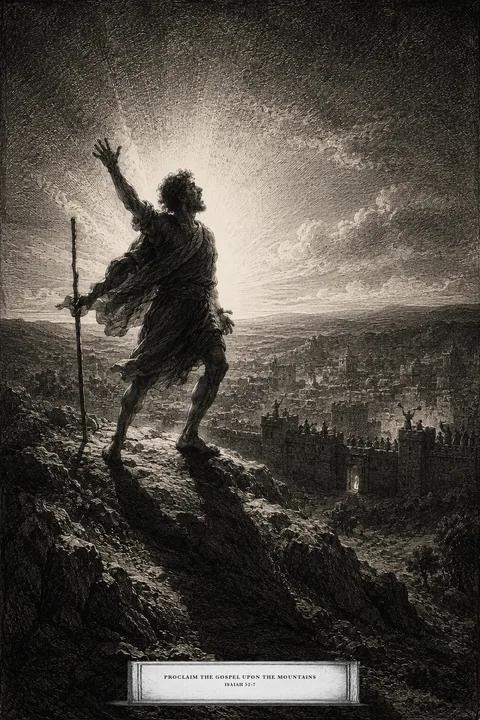
How beautiful upon the mountains are the feet of him that bringeth good tidings… that saith unto Zion, Thy God reigneth!
— Isaiah 52:7
Gospel
A familiar summary defines the gospel as the good news that Jesus died for our sins, was buried, and rose on the third day so that those who repent and believe may be forgiven and receive eternal life. Every part is true, and readers commonly find the summary in Paul’s opening words to Corinth:
Moreover, brethren, I declare to you the gospel which I preached to you… by which also you are saved, if you hold fast that word which I preached to you — unless you believed in vain. For I delivered to you first of all that which I also received: that Christ died for our sins according to the Scriptures, and that He was buried, and that He rose again the third day according to the Scriptures.
NKJV
Stop here, and you might think the gospel is the death and resurrection themselves; but Paul anchors it twice in the Scriptures — and his Scriptures were the Old Testament.
The word “gospel” falls in ninety-eight verses of the King James, and its verb — “preach the gospel,” “bring good tidings” — in dozens more; behind them stand one Greek word-family (euangelion, the good news; euangelizō, to announce it) and one Hebrew family (basar, to bear tidings; besorah, the tidings themselves).
Here are the titles the gospel wears, counted across the King James:
| Title | Uses |
|---|---|
the gospel of Christ |
11 |
the gospel of God |
7 |
the gospel of the kingdom |
4 |
the gospel of peace |
2 |
the gospel of the grace of God |
1 |
the gospel of your salvation |
1 |
the everlasting gospel |
1 |
The Hebrew Revelation gives that last title a body: where the Greek reads “everlasting gospel,” the Hebrew text hands the messenger a certain stone tablet (gilyon) “to make known to those dwelling upon the earth” (Revelation 14:6) — the good news, written in stone.
Of these, John the Baptist, Jesus, and His disciples preached the gospel of the kingdom — and preached it before the cross.
And Jesus went about all Galilee, teaching in their synagogues, and preaching the gospel of the kingdom, and healing all manner of sickness and all manner of disease among the people.
Mark records the herald-cry in full:
Hear what the gospel asks for. Not “accept this fact,” but “repent ye, and believe” — turn, trust, and obey; for to believe, as the Love, Knowing, Faith, and Belief chapter will prove, is to obey.
The word for preaching it is the herald’s word — kēryssō, what a royal crier does: he announces the decree of the one who sent him, and the fitting response is allegiance.
Isaiah gives the publication its single sentence:
How beautiful upon the mountains are the feet of him that bringeth good tidings, that publisheth peace; that bringeth good tidings of good, that publisheth salvation; that saith unto Zion, Thy God reigneth!
There is the whole of it compressed to three words: “Thy God reigneth.” The Hebrew verb here is basar; the Greek Old Testament renders it with euangelizō, the origin of the English evangelize; and Paul quotes this very verse as gospel-preaching: “How beautiful are the feet of them that preach the gospel of peace” (Romans 10:15).
Look once more at the herald’s third clause: “that publisheth salvation” — the Hebrew is yeshuah: the Old Testament’s gospel-verse publishes Jesus by name.
Nahum carries Isaiah’s verse almost word for word — and adds the hearer’s marching orders:
Behold upon the mountains the feet of him that bringeth good tidings, that publisheth peace! O Judah, keep thy solemn feasts, perform thy vows: for the wicked shall no more pass through thee; he is utterly cut off.
If we are to hearken to the herald’s cry, the stakes of understanding the symbolic language of the Sun, Moon, and Stars run much higher.
When Jesus stood up in His hometown synagogue to announce His own commission, listen to which Scripture He chose:
The passage is Isaiah 61:1-2, and its closing proclamation — “the acceptable year of the LORD” — is the year of release, the seventh year of Deuteronomy 15, when debts are cancelled and captives go free.[1] The gospel, in Jesus’ own chosen words, is a royal proclamation of release — and He sat down and told them, “This day is this scripture fulfilled in your ears” (Luke 4:21). (That year of release is dated to the Day of Atonement, AD 29, in Time Tested Tradition; what matters here is which text Jesus reached for when He defined His gospel.)
Now the test that the common definition cannot survive. Jesus preached this gospel — the whole of it — before He died:
From that time Jesus began to preach, and to say, Repent: for the kingdom of heaven is at hand.
From the opening of His ministry, years before the cross, He was already preaching the gospel of the kingdom (Matthew 4:23), and commanding hearers to “believe the gospel” (Mark 1:15). If the gospel were the message about His death and resurrection, He could not have preached it for three years while both were still ahead of Him — nor commanded men to believe it before it existed. Even when He told the twelve plainly what was ahead, “they understood none of these things” (Luke 18:34).
What He preached was the arrival of God’s reign and the way of life under it: the kingdom and its terms. The gospel is the message Jesus taught, not merely the message about Jesus.
Nor was it new even to Him. The book of Hebrews drops a line most readers pass over: the gospel was preached long before, to the generation in the wilderness —
“Unto them” is Israel at Sinai. The same gospel-word describes what was proclaimed there — and what was proclaimed there was a kingdom:
And ye shall be unto me a kingdom of priests, and an holy nation.
God, having broken the siege of Egypt and set the captives at liberty, declares His reign over them and calls them to enter it as His kingdom. That is the gospel of the kingdom — preached at Sinai. Earlier still, to Abraham:
“Preached before the gospel” is a single Greek word, proeuangelizomai — pre-gospeled. Abraham received the gospel, and its reach — all nations — is the same reach it has from first to last. One gospel runs the length of Scripture: Abraham, Sinai, Jesus, the apostles. Revelation even gives it its proper adjective, and states its content one final time:
And I saw another angel fly in the midst of heaven, having the everlasting gospel to preach unto them that dwell on the earth, and to every nation, and kindred, and tongue, and people, Saying with a loud voice, Fear God, and give glory to him; for the hour of his judgment is come: and worship him that made heaven, and earth, and the sea, and the fountains of waters.
Everlasting — a thing cannot be everlasting and also have begun at the cross. And read what the everlasting gospel says when it opens its mouth: fear God, give Him glory, worship the Maker, the judgment is come. The last gospel-preaching in the Bible is the herald’s cry of the reigning Creator — the same three words Isaiah gave it.
If the gospel announces a King’s reign, it necessarily carries terms, for a king reigns by covenant. Here the threads draw together: the gospel of the kingdom is the covenant of the kingdom. This is not a contract negotiated among peers. A covenant is established by its head: the King gives the law, promises, and judgments by which the relationship is governed, and those who enter come under His word. And the covenant, Scripture is careful to say, was never scrapped and replaced — it was renewed. The promise everyone calls the “new covenant” rests on a Hebrew word, chadash, whose root means renew, repair, rebuild:
Create in me a clean heart, O God; and renew a right spirit within me.
And it came to pass after this, that Joash was minded to repair the house of the LORD.
David does not ask for a spirit he never had; Joash does not build a different temple. Chadash restores what already stands. So the “new” covenant is the same covenant, renewed — and Jeremiah, who gave the promise, says precisely what changes and what does not:
Behold, the days come, saith the LORD, that I will make a new covenant with the house of Israel… Not according to the covenant that I made with their fathers… which my covenant they brake… I will put my law in their inward parts, and write it in their hearts; and will be their God, and they shall be my people.
The fault lay not with the covenant but with the people — “my covenant they brake.” The law is the same law; the terms are the same terms. What changes is who stands within it and where its law is written: unfaithful branches are broken off, faithful branches are grafted in, and the law passes from tablets of stone to the inward parts (Romans 11:17-23). Same covenant Head, same word and terms, renewed in a people who receive that word upon the heart. This is why Jesus could insist, in the very sermon where He pressed the law to its depths:
Think not that I am come to destroy the law, or the prophets: I am not come to destroy, but to fulfil.
Not destroy — fulfil. And “fulfil” is the Greek plēroō: to fill full, to fill to the brim — the exact opposite of “destroy” (kataluō, to tear down). Jesus did not come to abolish the law, nor to complete it and retire it, but to fill it full — to preach it in its fullness, packing back the weight the surface reading had drained away.
Filling full is precisely what He does next: “Ye have heard that it was said… but I say unto you,” pressing past the act to the heart behind it (Matthew 5:21-22) — filling each commandment full, writing it where Jeremiah said it would be written. The Sermon on the Mount is the renewed covenant in motion: the same Torah, filled full and taught from the inside. This is the message Jesus taught — not a new religion about Himself, but the ancient covenant of the kingdom, renewed and written on the heart.
The gospel, then, is no abolition of the law of Moses but its establishment — “we establish the law,” as Paul says (Romans 3:31). The gospel of the kingdom is the law of that kingdom: the Torah preached in the wilderness, the constitution of God’s reign, the very law the prophets foresaw going forth from Zion when the King at last reigns from His mountain:
One law, from first to last: preached in the wilderness, written now upon the heart, and one day issuing from Zion over all the earth (Micah 4:2 says the same).
This is why Scripture speaks of the gospel in a way that makes no sense for a mere announcement of facts: it speaks of obeying it. “They have not all obeyed the gospel” (Romans 10:16); the Lord returns “in flaming fire taking vengeance on them… that obey not the gospel of our Lord Jesus Christ” (2 Thessalonians 1:8); and Peter asks, “what shall the end be of them that obey not the gospel of God?” (1 Peter 4:17). Information is believed or doubted; nobody obeys a news bulletin. But a king’s proclamation with terms is obeyed or defied — and Scripture says the gospel is the kind of thing men will be judged for not obeying.
Paul glosses his own words inside that first verse:
Obeyed in one sentence, believed in the next — one act under two names. That is what believe means in Scripture’s mouth: not thinking a thing true, but trusting enough to obey. The equation runs both directions — the Greek under “believeth not” in John 3:36 locks it from the other side.[2] To believe the gospel is to obey the King.
Where, then, is the cross in all this? Exactly where Scripture sets it — as the act that secures the kingdom, not as the whole content of the announcement:
When Jesus therefore had received the vinegar, he said, It is finished: and he bowed his head, and gave up the ghost.
“It is finished” completes the work that ratifies the covenant in blood. The cross is indispensable — it is how the kingdom is purchased and the renewed covenant sealed. But the purchase is not the proclamation. The proof stands where we left it: Jesus preached the whole gospel of the kingdom for years before Calvary.
Here the fair objection rises: does not Paul himself define the gospel as the death and resurrection? He does say it plainly:
For I delivered unto you first of all that which I also received, how that Christ died for our sins according to the scriptures; And that he was buried, and that he rose again the third day according to the scriptures.
Read closely, this confirms rather than overturns what we have seen. Twice Paul anchors it “according to the scriptures” — the death and resurrection fulfill what the prophets had already announced; they are how the long-promised kingdom is secured, not a new message that cancels it. And he is expressly defending the resurrection here — the burden of the whole of 1 Corinthians 15 — summarizing the gospel, not redrawing its borders. Where Paul opens a letter by stating his gospel at length, the kingdom is unmistakable:
Paul… separated unto the gospel of God, (Which he had promised afore by his prophets in the holy scriptures,) Concerning his Son Jesus Christ our Lord, which was made of the seed of David according to the flesh; And declared to be the Son of God with power… by the resurrection from the dead.
Every clause is kingdom language. The gospel was “promised afore by his prophets” — the same ancient announcement, not a novelty. Its subject is the “seed of David” — the rightful heir to the throne. And the resurrection “declared” Him “the Son of God with power” — the enthronement of the King.
Paul’s gospel is that the Son of David has been raised and installed as Lord; the cross and the empty tomb are how He took the throne. That is the gospel of the kingdom, told from the side of the King’s accession.
It is why Paul can stake everything on there being only one gospel — “though we, or an angel from heaven, preach any other gospel unto you… let him be accursed” (Galatians 1:8) — the very gospel, he reminds the same readers, that was “preached before… unto Abraham” (Galatians 3:8). And it is why, at the end of the age, the message has not changed:
And this gospel of the kingdom shall be preached in all the world for a witness unto all nations; and then shall the end come.
The last gospel preached before the end still wears the only content-title it has ever worn.
The familiar summary is true in every clause — the death for sins, the burial, the third day, the call to repentance and faith. But as a definition of gospel it does not carry the full witness of Scripture.
The word we thought we owned opens up like all the rest. The mountain is the kingdom; the gospel is the herald’s cry that the kingdom has come — “Thy God reigneth” — published upon the mountains and carried to every nation: the siege broken, the captives freed, the covenant renewed onto hearts, the King enthroned. Read it as a private transaction and it shrinks to a fraction of itself. Read it as Scripture defines it, and the turning of the nations that closed the last chapter stands revealed for what it is: not the spread of information about a man, but the kingdom of God going forth to fill the earth.
The Commission Seals It
After the resurrection the risen King sent His heralds to the nations, and the commission names the gospel’s content one last time: “teaching them to observe all things whatsoever I have commanded you” (Matt 28:19-20). The commission’s verb is matheteusate — disciple the nations — and Isaiah had already defined the word: “bind up the testimony, seal the law among my disciples” (Isa 8:16); to disciple the nations is to seal the law among them. What had He commanded them? Where our Bibles read “all therefore whatsoever they bid you observe, that observe and do” — a sentence at war with the chapter of woes that follows it — the Hebrew Matthew reads:
On the seat of Moses sit the Pharisees and the sages. Now, all that he says to you, keep and do; but according to their ordinances and their deeds, do not do — for they say, and do not.
All that he says — Moses: the seat carries the authority of the one it belongs to, not of the men who sit in it. Their “ordinances” are taqqanot — the technical term for rabbinic enactments, the man-made rules of the oral torah, the very “tradition of the elders” (Matt 15:2) that “made the commandment of God of none effect” (Matt 15:6): keep Moses; drop the enactments. And the Hebrew commission closes on a word the Greek lost — have them keep “all the words which I have commanded you — forever”: the King enthroned, sending heralds to every nation with the law of the kingdom, taught, kept, forever.