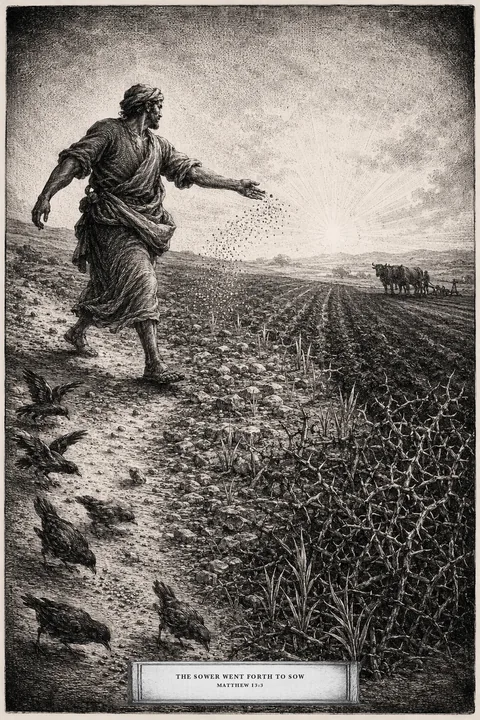
Jesus saith unto them, Have ye understood all these things? They say unto him, Yea, Lord.
— Matthew 13:51
The Parables of the Kingdom
At the end of the seven parables of the kingdom, Jesus gave His hearers an exam of one question, and they passed it: “Yea, Lord.” It had not started that way. At the first parable — the key to all of them — His own disciples stumbled, and He rebuked them: “Know ye not this parable? and how then will ye know all parables?” (Mark 4:13).
Stop and weigh that rebuke. A teacher may not be astonished that students fail an exam on material they were never given; His astonishment is only just if the answers were already on the table. They were, and He said where.
The psalm He fulfills by teaching in parables locates the material in the past, not the future: “I will open my mouth in a parable: I will utter dark sayings of old: which we have heard and known, and our fathers have told us” (Psalm 78:2-3; Matthew 13:35). And the Scriptures the disciples grew up on do not merely contain parables — they decode them in front of the reader and expect him to grade himself.
Nathan told David a story about a ewe lamb; David judged its villain to death without seeing his own face — “the man that hath done this thing shall surely die” (2 Samuel 12:5) — and Nathan handed him the key in four words: “Thou art the man” (2 Samuel 12:7). Isaiah sang a parable of a vineyard, then handed over the key: “the vineyard of the LORD of hosts is the house of Israel” (Isaiah 5:7). Ezekiel told a riddle of two eagles and a vine, and God’s next word is the very question Jesus would ask on the boat: “Know ye not what these things mean?” — followed by the answer, “the king of Babylon is come to Jerusalem” (Ezekiel 17:2, 12).
The exam is closed-book in one direction only: everything needed sits in the Law, the Prophets, and the Psalms. Take each parable, then, the way a disciple on the shore had to take it — derive the meaning from the Scriptures he already had, write it down, and only then let the Teacher grade the work. That is how this chapter will read them, and it will keep score. More broadly, it will establish the principle of how to decode all Scripture using the full body of the word.
How the Exam Is Taken
Before the first parable, fix the procedure, because it is this book’s whole method in miniature. Take the parable’s own words — sower, seed, ground, thorns, fowls — and search the Scriptures for the same words and phrases, everywhere they fall. Where Scripture has already defined a term out loud — Isaiah’s own key, above: the vineyard is the house of Israel — that definition is not local color for one passage; it holds, and it holds uniformly, or parables could not be decoded at all.
Next, weigh what you gathered before you lean on it. One verse makes a candidate, not a key: a symbol is established when the pattern spans Moses and the prophets and the psalms — independent witnesses carrying the same figure, with no counter-text standing against them. That standard is what makes the rebuke in the boat just, and it measures its weight: Jesus did not upbraid the twelve for missing an obscurity; seed and ground and thorns and fowls were established patterns, laid down across the whole of the Scriptures read to them every sabbath since childhood. The better attested the pattern, the more accountable the hearer.
The difference between their seat and yours matters. The disciple on the shore had his memory and the weekly reading; you have the whole text searchable in moments — a concordance, a search bar, and tools that can gather every use of a word while you frame your next question. Recall was never the point of the exam, and now it is not even the obstacle: the test is not whether you remember the matches, but whether you go look for them.
The Sower, Derived and Graded
“Behold, a sower went forth to sow” (Matthew 13:3). Close the Gospels; what could a hearer of Moses and the prophets make of that? Start with the seed, which Isaiah had defined in one breath with the rain:
The word is the seed to the sower and the bread to the eater — one verse, both figures. And Moses had sung the same rain long before: “My doctrine shall drop as the rain, my speech shall distil as the dew” (Deuteronomy 32:2) — what falls from heaven to make the ground bear is teaching.
Next the ground. Jeremiah had already preached this parable as a command: “Break up your fallow ground, and sow not among thorns” — and his very next sentence names the soil: “take away the foreskins of your heart” (Jeremiah 4:3-4) — plowing and circumcising, one operation in two figures: remove the blocking flesh so the seed can enter. Hosea gives the same order in the same words: “break up your fallow ground: for it is time to seek the LORD” (Hosea 10:12). The ground is the heart, and the thorns were choking Judah’s heart seven centuries before the sermon by the sea — and the thorns have a pedigree older still, for they are the curse-ground’s own crop: “thorns also and thistles shall it (the ground) bring forth to thee” (Genesis 3:18), what the cursed earth grows where food should stand.
Now derive what the thorns mean, for the Old Testament assigns that too. Read the sentence they grow in: the same curse that gives the ground its thorns sentences the man to anxious toil for his bread — “in sorrow shalt thou eat of it… in the sweat of thy face shalt thou eat bread” (Genesis 3:17, 19) — the thorns spring up in the field of the struggle for a living. And that pair of weeds — thorn and thistle together — returns exactly once more in the Hebrew Scriptures, and Hosea builds the whole indictment around it:
Increase, a divided heart, and the curse-ground’s own crop sprouting on the altars: riches choking the heart is Hosea’s picture before it is the parable’s.
Isaiah’s vineyard tells the same story, and he graded it himself. The vineyard planted with the choicest vine gave wild grapes instead, and the sentence fell:
And I will lay it waste: it shall not be pruned, nor digged; but there shall come up briers and thorns: I will also command the clouds that they rain no rain upon it.
Isaiah then hands over the key:
For the vineyard of the LORD of hosts is the house of Israel, and the men of Judah his pleasant plant: and he looked for judgment, but behold oppression; for righteousness, but behold a cry.
The vineyard is Israel, and its briers and thorns are men — the woes that follow name them, person by person:
Woe unto them that join house to house, that lay field to field, till there be no place, that they may be placed alone in the midst of the earth!
Here is the monopoly-builder — buying house after house and field after field until no one else has a place, alone in the middle of everything he has swallowed.
Woe unto them that rise up early in the morning, that they may follow strong drink; that continue until night, till wine inflame them! And the harp, and the viol, the tabret, and pipe, and wine, are in their feasts: but they regard not the work of the LORD, neither consider the operation of his hands.
Here is the pleasure-lover — feasting from morning drink to evening music, past all notice of God. Riches and pleasures came up where fruit should have stood: Isaiah graded the thorns seven centuries before the sermon by the sea.
Even the stony ground was on record, for the heart God promises to replace is “the stony heart” (Ezekiel 36:26). And why is the exchange a heart of flesh for a heart of stone? Because flesh is ground: adam was formed “of the dust of the ground,” adamah (Genesis 2:7) — the man is named for the soil he is — and he was sent forth “to till the ground from whence he was taken” (Genesis 3:23), so the Sower’s field was staked out in Eden. No one plows rock — “will one plow there with oxen?” (Amos 6:12) — and the very oracle that promises the heart of flesh promises its plowing: “I am for you… and ye shall be tilled and sown” (Ezekiel 36:9). The seed that found “no deepness of earth” on stone takes root in flesh: the law once carved on “tables of stone” written now “in fleshy tables of the heart” (2 Corinthians 3:3) — “ye are God’s husbandry” (1 Corinthians 3:9).
What does ground bring forth when the seed takes? Grass — “all flesh is grass” (Isaiah 40:6) — a symbol with a chapter of its own.
What of the fowls that devour the wayside seed? The first time birds descend on a covenant in Scripture, they come as devourers: “when the fowls came down upon the carcases, Abram drove them away” (Genesis 15:11) — uninvited, snatching at the covenant sacrifice, driven off by the covenant man. In Egypt, Joseph heard a dream of birds eating baked bread out of a basket and graded it without hesitation as a sentence of death (Genesis 40:17-19). Birds that snatch what was given out of its place are the enemy’s agents; a boy raised on Genesis could have written that down.
| Element | Derived from the Law and the Prophets | The Teacher’s key |
|---|---|---|
Seed |
The word — rain-borne seed, rain-borne doctrine (Isa 55:10-11; Deut 32:2) |
“The seed is the word of God” (Luke 8:11) |
Ground |
The heart — plowed, circumcised, tilled and sown (Jer 4:3-4; Hos 10:12; Ezek 36:9, 26; Gen 2:7) |
The word “sown in his heart” (Matt 13:19) |
Fowls |
The devourers on the covenant and on the bread (Gen 15:11; 40:17-19) |
“Then cometh the wicked one, and catcheth away that which was sown” (Matt 13:19) |
Thorns |
The curse-crop; riches dividing the heart (Gen 3:17-19; Hos 10:1-8; Isa 5:6-12) |
“The care of this world, and the deceitfulness of riches, choke the word” (Matt 13:22) |
Four for four — Isaiah’s answer, Jeremiah’s, Abram’s, Hosea’s — and not one of the four needed a word Jesus had not yet spoken. His astonishment in Mark 4:13 was just.
Yet let me be fair, for I would have fared no better. Handed the parable with no Bible in reach, I would have failed it as completely as any man on the shore. With a Bible and a printed concordance — and the assurance that the answer was in there somewhere — the derivation above might have cost me days, or months. It is only with modern tools that I can derive the interpretation independently at all, without leaning on any man’s commentary.
Daniel was told to seal the words “even to the time of the end,” when “many shall run to and fro, and knowledge shall be increased” (Daniel 12:4). The running to and fro is through the Scriptures themselves — and the knowledge increased is this.
The Wheat and the Tares
An enemy sows counterfeit grain among the good seed by night. Where does the Old Testament teach two seeds in one field? In its third chapter, in the sentence passed on the serpent:
And I will put enmity between thee and the woman, and between thy seed and her seed; it shall bruise thy head, and thou shalt bruise his heel.
Two seeds, two families, growing in the same world since Eden. Job knew the picture of weeds where grain was sown — “Let thistles grow instead of wheat, and cockle instead of barley” (Job 31:40) — and Isaiah’s vineyard, planted entirely with “the choicest vine,” nonetheless “brought forth wild grapes” (Isaiah 5:2).
The harvest the disciples’ Scriptures already knew as the day of reckoning: “Put ye in the sickle, for the harvest is ripe” (Joel 3:13); “O Judah, he hath set an harvest for thee” (Hosea 6:11); Babylon herself is a threshingfloor whose “time of her harvest shall come” (Jeremiah 51:33). And the fire at the end was Malachi’s closing word:
For, behold, the day cometh, that shall burn as an oven; and all the proud, yea, and all that do wickedly, shall be stubble: and the day that cometh shall burn them up, saith the LORD of hosts, that it shall leave them neither root nor branch.
On that day one shall again “discern between the righteous and the wicked” (Malachi 3:18), the ungodly driven “like the chaff” (Psalm 1:4). Write the derivation out: an enemy’s seed grows beside God’s seed in one field, indistinguishable until fruit, and a harvest-day of burning sorts them.
The Teacher’s key: the field is the world; the good seed, the children of the kingdom; the tares, “the children of the wicked one”; the enemy, the devil — the serpent whose seed Genesis 3:15 named; the harvest, “the end of the world” — the age; the tares bound in bundles “to burn them” (Matthew 13:30, 38-40). Item for item, the derivation stands. Two parables, two perfect scores — for a reader who had done the assigned reading.
The Mustard Seed
The kingdom enters the world as the least of seeds:
Derive it. The seed-to-tree movement begins with one life and ends with a people. Isaiah says it plainly of Abraham: “I called him alone, and blessed him, and increased him” (Isaiah 51:2). The disciple’s Scriptures also define the least as the chosen beginning: “The LORD did not set his love upon you, nor choose you, because ye were more in number than any people; for ye were the fewest of all people” (Deuteronomy 7:7) — a verse the remnant chapter will weigh again. One man became Israel; the least planting became a nation. And the disciples had already watched God plant one tender life and grow it into the shelter of the world, in a parable He decoded Himself:
God spoke that as a riddle to be decoded (Ezekiel 17:2, 12) and closed it with the rule the mustard seed obeys: “I the LORD have brought down the high tree, have exalted the low tree” (Ezekiel 17:24). Daniel grades the same picture for a king: the great tree in whose boughs “the fowls of the heaven dwelt” is a kingdom in its head — “It is thou, O king” (Daniel 4:12, 22). So a tree grows from one planted person into a house, people, or nation; the smallest planting becomes the greatest shelter, and the birds of every wing are the peoples nesting in its reach — the stone that became “a great mountain, and filled the whole earth” (Daniel 2:35), told in a gardener’s vocabulary; the mountain has a case study of its own in Part Six.
Even the strange word “lodge” was derivable. Ezekiel’s “dwell” is shakan, the tabernacle word, and Matthew’s Greek keeps it — kataskēnoō, to pitch one’s tent — and the prophets had promised the nations exactly that tent-rest in a Person: “a Branch shall grow out of his roots… and in that day there shall be a root of Jesse… to it shall the Gentiles seek: and his rest shall be glorious” (Isaiah 11:1, 10); “Behold the man whose name is The BRANCH” (Zechariah 6:12). The birds lodge in the branches because the nations find rest in the Branch.
This parable Jesus left unkeyed — He supplied no decoding, and He did not need to, for God had already published His own in Ezekiel. But carry the first parable’s edge with you: fowls also devour seed, and Assyria’s sheltering cedar housed “all great nations” on its way to the axe (Ezekiel 31:6) — the branches that shelter the nations shelter what the nations bring.
The Leaven
Next comes the strangest of the seven, if the symbols mean what Scripture made them mean:
The kingdom of heaven is like unto leaven, which a woman took, and hid in three measures of meal, till the whole was leavened.
Derive it from Torah, where every hearer of Moses began. Leaven is purged from every house before the feast (Exodus 12:15); it is banned from the altar absolutely — “ye shall burn no leaven… in any offering of the LORD made by fire” (Leviticus 2:11); Amos names a leavened offering in sarcasm to a rebellious people — “offer a sacrifice of thanksgiving with leaven… for this liketh you” (Amos 4:5); and Hosea watches adulterous Ephraim rise like dough, the baker idle “until it be leavened” (Hosea 7:4). Not once in Moses or the prophets is leaven a figure of anything good: it is corruption working hidden through the whole lump.
Tradition reads this parable as the gospel quietly permeating the world — but the derived vocabulary refuses, and the Teacher’s own usage grades the tradition down: leaven is “the doctrine of the Pharisees” (Matthew 16:12), and Paul cries “purge out the old leaven” (1 Corinthians 5:7). If the symbol holds, the parable is a warning laid alongside the tares: as the enemy sows counterfeit wheat in the field, so corrupt teaching, hidden in the meal by stealth, works “till the whole was leavened.”
The parable flags two words this book has not yet mapped: the woman who hides it, and the three measures of meal — the very quantity Sarah kneaded for the LORD at Mamre (Genesis 18:6). These candidates receive the same test as every other: gather the uses, and let Scripture define them.
The Treasure
Again, the kingdom of heaven is like unto treasure hid in a field; the which when a man hath found, he hideth, and for joy thereof goeth and selleth all that he hath, and buyeth that field.
The field we may carry forward from the tares — the exam allows a student to reuse a graded answer: the field is the world. And the treasure has a definition older than the parable, spoken at Sinai to the whole nation:
…if ye will obey my voice indeed, and keep my covenant, then ye shall be a peculiar treasure unto me above all people…
“The LORD hath chosen Jacob unto himself, and Israel for his peculiar treasure” (Psalm 135:4). And this treasure is hidden — Asaph says so of the saints themselves: the enemy takes “crafty counsel against thy people,” consulting “against thy hidden ones” (Psalm 83:3). The treasure hid in the field is the covenant people hidden in the world, the remnant scattered and unseen — and the man who sells all he has to buy the whole field for the treasure’s sake is the Redeemer.
Grade the common teaching against that, for this parable is almost always preached inverted: God — or salvation — is the treasure, and we are the fortunate finder who gladly gives up everything. Test it: the buyer “selleth all that he hath” — and in this same gospel, the one man told to do exactly that “went away sorrowful” (Matthew 19:21-22). Disciples do forsake all — Peter says so five verses later and is not corrected (Matthew 19:27), and “whosoever he be of you that forsaketh not all that he hath, he cannot be my disciple” (Luke 14:33) — but no disciple ever did one thing: buy the field. The field is the world by the Teacher’s own key, and the buyer purchases all of it to possess the treasure — a price One alone paid: “though he was rich… he became poor” (2 Corinthians 8:9), “the propitiation… for the sins of the whole world” (1 John 2:2) — and the treasure was defined at Sinai before the parable ever borrowed it: the people are the treasure, and the seeker is God.
The Hebrew Matthew tradition sharpens the picture, reading gold hidden in the field — and no man buys a field for gold coins; coins you pocket and walk away. Gold in a field is ore: scattered through the ground, dug, crushed, and refined — exactly what the prophets say the Owner does with His treasure: “I will refine them as silver is refined, and will try them as gold is tried” (Zechariah 13:9); “when he hath tried me, I shall come forth as gold” (Job 23:10). He buys the whole field, mines His people out of it, and refines what He mines.
The Pearl
Again, the kingdom of heaven is like unto a merchant man, seeking goodly pearls: who, when he had found one pearl of great price, went and sold all that he had, and bought it.
This one the Teacher left unkeyed, and this book will give it a chapter of its own; here, set down the floor the disciples’ own Scriptures supply. The derivation stands on the Old Testament the disciples held. The Hebrew peninim is by Strong’s own definition “probably a pearl (as round)”.[1] Wisdom is “more precious than pearls” (Proverbs 3:15), her price “above pearls” (Job 28:18), and the virtuous woman — the bride of a later chapter — is “far above pearls” (Proverbs 31:10). The seeker who “searchest for her as for hid treasures” (Proverbs 2:4) is the merchant himself, one figure in Solomon’s book.
A pearl is drawn up out of the sea — the nations, as the net will show in a moment — formed slowly, in secret, around a wound; and the merchant seeking many goodly pearls finds one of great price and sells everything, for the kingdom is not a collection; it is one bride, bought whole. And the Pearl chapter will carry the derivation a ring deeper, for the parable holds more than a jewel: the gates of the city John saw are waiting inside it, and Scripture keeps its one pearl of great price where no tradition has thought to look for it.
The Teacher gave no key here; He speaks to hearers expected to understand “a proverb, and the interpretation” (Proverbs 1:5-6) from the Scriptures they already hold. Test all things against that word, and “hold fast what is good” (1 Thessalonians 5:21, NKJV).
The Net
Again, the kingdom of heaven is like unto a net, that was cast into the sea, and gathered of every kind: which, when it was full, they drew to shore, and sat down, and gathered the good into vessels, but cast the bad away.
Derive it — the fishermen in the boat needed no help at all. The sea is the peoples, and Habakkuk had already put men in it:
The fishers are sent by God Himself: “Behold, I will send for many fishers, saith the LORD, and they shall fish them” (Jeremiah 16:16). The catch “of every kind” is Ezekiel’s river-vision, where the healed waters swarm and “the fishers shall stand… their fish shall be according to their kinds, as the fish of the great sea, exceeding many” (Ezekiel 47:10). And the sorting on the shore was Torah before it was parable — fins and scales, clean from unclean (Leviticus 11:9-10): these men were fishermen of Israel; they had sorted every catch of their lives by Leviticus.
The Teacher’s key: “So shall it be at the end of the world: the angels shall come forth, and sever the wicked from among the just” (Matthew 13:49) — the same verdict the harvest told in field-language: wheat to the barn and tares to the fire, good fish to vessels and bad away. Two landscapes, one message — the sown field and the peopled sea — because the kingdom is drawing from both.
Notice where He sits as He says it. Matthew staged the discourse before writing a word of it: Jesus “went into a ship, and sat; and the whole multitude stood on the shore” (Matthew 13:2) — the Teacher seated in a vessel upon the sea He has just decoded, casting the word like the net into the peoples at its edge. The sermon acts out its own vocabulary while it is spoken — the prophets' habit the Signs and Similitudes chapter takes up next — and what the vessel He sits in means, The Ship, ch. 41 proves in full.
A Similitude Lived Out Loud
Jesus then did what He had been saying. With the symbols in hand, the feeding of the multitude reads as the lived parable it is — John even calls it a sign (John 6:14). A boy has “five barley loaves, and two small fishes” (John 6:9); from them a multitude is fed, and “they took up of the fragments that remained twelve baskets full” (Matthew 14:20).
Five loaves: the five books of the Law, the bread of the word — and barley, the humble firstfruits grain Scripture itself pins to Israel: when the barley loaf tumbled into Midian’s camp, the watchman decoded it inside the dream — “this is nothing else save the sword of Gideon… a man of Israel” (Judges 7:13-14). Two fishes: witnesses — for the Law itself fixed the number, “at the mouth of two witnesses… shall the matter be established” (Deuteronomy 19:15), and the Lord sent His fishers of men out “by two and two” (Mark 6:7). The bread is blessed, broken, and handed to the disciples, and the disciples to the people — and as the word is shared it multiplies, until the hungry are filled and twelve baskets remain, one for each tribe. The Law, carried by witnesses, feeds the famished, and there is more left at the end than was held at the start.
The crowd that watched it graded the sign correctly: “This is of a truth that prophet that should come into the world” (John 6:14) — they read a similitude and recognized the Prophet like unto Moses, who had also fed a multitude on bread from heaven.
The scene has a second act, and it grades the hearers. The next day the same crowd hunts Him down, and He tells them what they missed: “Ye seek me, not because ye saw the signs, but because ye did eat of the loaves, and were filled” (John 6:26) — they had eaten the sign without reading it. So He states the similitude at full strength — my flesh is meat indeed — and the room divides: many go back at the hard saying, milk-hearers meeting strong meat (John 6:55, 60, 66). Peter passes, holding the key Jesus handed out before they went: the flesh profits nothing, the words are spirit and life (John 6:63, 68).[2] The saying sorted the hearers, exactly as Isaiah said the concealed word would; they left because they did not know His symbolic language.
Have Ye Understood?
Tally the exam. Where the Teacher supplied an answer key — the sower, the tares, the net — every key matched what the Law, the Prophets, and the Psalms had already put in the disciples’ hands: Isaiah’s seed, Jeremiah’s fallow heart, Abram’s fowls, Hosea’s thorn-grown altars, the two seeds of Eden, Joel’s sickle, Malachi’s stubble, Leviticus’ sorted catch. That is why the score was owed: not one answer hung on a single verse. Seed, ground, fowls, thorns — each stands on a pattern laid across Moses and the prophets, witness upon witness; the accountability was proportioned to how established the pattern was.
Where He supplied none — the mustard tree, the leaven, the treasure, the pearl — the same Scriptures carry the reader most of the way, and mark plainly where the derivation ends and the testing begins. That is why His rebuke was fair, and why His question was not rhetorical. The disciples answered it — “Yea, Lord” (Matthew 13:51) — and He immediately described what such a reader becomes:
Therefore every scribe which is instructed unto the kingdom of heaven is like unto a man that is an householder, which bringeth forth out of his treasure things new and old.
Things new and old — the old is the derivation, and the new is its fulfillment; the dark sayings “of old… which our fathers have told us,” and the kingdom now speaking them fluently. That is the reader this book aims to form: not a keeper of its conclusions but a scribe instructed — one who can take a text he has never been taught, derive it from what Scripture itself defined, mark honestly what remains under test, and go gather the uses.
Before leaving the exam, count what it cost. The seven parables, with the householder’s saying that seals them, run twenty-six verses — some five hundred and eighty-five words — and carry more than fifty decodable terms, one symbolic use every five words, defined by more than eighty passages from twenty-three books of the Law, the Prophets, and the Psalms. A few minutes in a boat, and the sermon is three times larger than itself — nearly every phrase leaning on text written centuries before.
Books were costly then; copying was slow; memory was the library; a text composed under that economy wastes nothing. So stands the question the rest of this book will test: what if all Scripture is this dense?
Everything that follows in this book stands or falls with the method you have just watched graded; once the method holds, the conclusions are arithmetic. The language does not stop, and neither does the exam. “Who hath ears to hear, let him hear.”