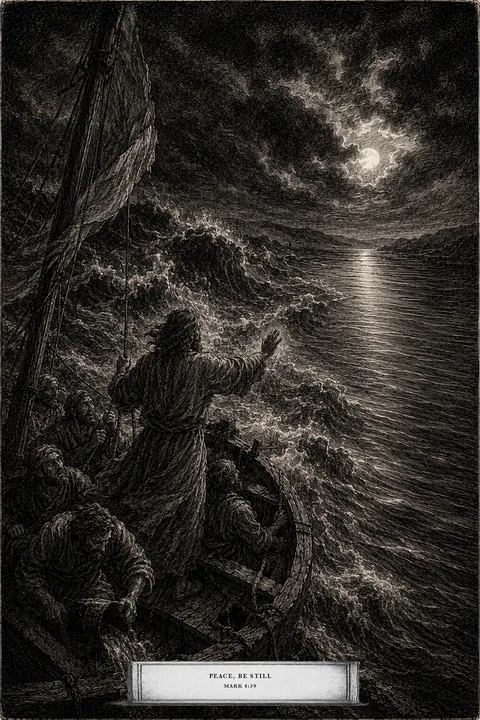
The LORD on high is mightier than the noise of many waters, yea, than the mighty waves of the sea.
— Psalm 93:4
Sea & Waters
The next symbol we will investigate is the sea. The sea is a symbol that comes up over and over again in Scripture. The symbol appears in the beasts coming out of the sea, mountains and trees being thrown into it, Jonah, Jesus walking on it, and disciples fishing in it. Understanding how its symbolic meaning is consistent across so many different situations is critical for understanding the prophecies, miracles, and less notable references to the sea.
The sea is sometimes called waters or waves and is related to floods. This chapter gathers those uses and shows how they clarify verses often read as mere poetic ornament.
Like the mountain symbol, Scripture directly tells us the meaning of “waters” and “sea” in several different verses across the Old and New Testaments. Let’s start with Revelation.
…the judgment of the great whore that sitteth upon many waters:
Here we do not have to guess: the messenger is interpreting the vision for John, just as he interpreted the seven mountains a few verses earlier. The waters are peoples, multitudes, nations, and tongues — humanity in the mass, described four ways so that nothing slips between the words.
Notice that this is the very same chapter that defined the mountain (Revelation 17:9-10). One chapter of Revelation hands us both halves of the map: the woman sits on seven mountains — kingdoms — and upon many waters — the peoples those kingdoms rise from and rule over. In the mountain chapter I deferred the evidence that the sea means the masses of people; this chapter is that evidence.
The picture is natural enough that English keeps it to this day: we still speak of a sea of faces, a wave of immigration, a flood of refugees. But as we learned with the mountain, an apt analogy is not the basis for defining a symbol — and neither is a familiar idiom. The question is whether Scripture itself uses the sea this way consistently, or whether Revelation 17 is a one-off.
In answering it I can show you one of the most useful tools for discovering symbols on your own: Hebrew poetry rhymes ideas instead of sounds. A verse says a thing once, then says it again in other words — so the second line is an inspired gloss on the first, Scripture defining its own terms in parallel columns. Watch Isaiah do it:
Woe to the multitude of many people, which make a noise like the noise of the seas; and to the rushing of nations, that make a rushing like the rushing of mighty waters! The nations shall rush like the rushing of many waters…
People are set against seas; nations against waters. The Psalms do the same:
Seas, waves, and the tumult of the people — three phrases, one meaning. Once you know to look for these parallel columns, definitions turn up in verses you have sung right past. Here is one sitting in plain sight in a praise psalm:
Let the sea roar, and the fulness thereof; the world, and they that dwell therein.
The sea is matched to the world, and the fulness of the sea to them that dwell in the world. What fills the sea is people.
The witnesses are not a handful of hand-picked verses. The word “sea” appears in 376 verses of Scripture, and “waters” and “floods” in hundreds more. Gather the sea verses and sort them, and the shape of the whole is striking: roughly three of every four either connect the sea to people outright, put the symbol to work — kingdoms rising out of it, armies as floods, men as fish, multitudes as sand — or take on a second depth once the symbol is known. Only about eighty are plain geography: borders, coastlines, harbors, and shipping. No figure of speech stays that consistent by accident — dozens of authors, some fifteen centuries apart, all speaking one vocabulary.
Jesus uses the symbol exactly the same way, and even supplies the gloss in the same sentence:
The common readings rank this way:
| Rank | Common interpretation |
|---|---|
1 |
Literal ocean upheaval — tsunamis, rising seas, disasters |
2 |
General end-times chaos and dread |
3 |
Stock apocalyptic imagery with no specific meaning |
4 |
The nations in turmoil |
The meaning is not hidden: “distress of nations, with perplexity” and “the sea and the waves roaring” are the same parallel columns Isaiah used — the symbol and its meaning side by side in a single sentence. Haggai does the same thing across two verses:
…I will shake the heavens, and the earth, and the sea, and the dry land; And I will shake all nations…
Shaking the sea is shaking the nations.
What kind of thing, then, is this sea? Isaiah tells us its nature:
The wicked are the sea: restless, churning, casting up their own filth. Jude says the ungodly are “raging waves of the sea, foaming out their own shame” (Jude 13). And the symbol scales all the way down to a single person:
But let him ask in faith, nothing wavering. For he that wavereth is like a wave of the sea driven with the wind and tossed.
One doubting man is one wave — part of the mass, driven by whatever wind blows across it. That wind returns later in the chapter.
The next texts show where kingdoms come from.
…the four winds of the heaven strove upon the great sea. And four great beasts came up from the sea, diverse one from another.
Daniel is given the interpretation directly: the beasts are kings (Daniel 7:17) — kingdoms — and they come up out of the sea.[1] Empires do not fall from the sky; they take shape out of the churning mass of peoples.
What churns the mass? The four winds of heaven — the “four spirits of the heavens, which go forth from standing before the Lord of all the earth” (Zechariah 6:5) — for throughout Scripture wind is spirit. Unseen powers sent from God’s throne agitate the nations, and out of the agitation kingdoms rise. The winds had their chapter at the head of Part Five; here it is enough to see the pattern working. Revelation reuses the image exactly:
Even the Psalms know this sea is full of beasts:
So is this great and wide sea, wherein are things creeping innumerable, both small and great beasts. There go the ships: there is that leviathan, whom thou hast made to play therein.
Small beasts and great — petty powers and empires — swarming in the sea of peoples, with the dragon himself at play among them.
Now the verse from the mountain chapter pays out in full. A burning mountain is “cast into the sea,” and “the third part of the sea became blood; And the third part of the creatures which were in the sea, and had life, died” (Revelation 8:8-9). A kingdom is thrown down into the mass of peoples, and a third of the people die — which is exactly how the judgment reads when a vial is poured on the sea:
Souls live in this sea. No literal ocean has souls in it; the sea of peoples has nothing else.
There is a particular motion of this sea to watch for. When the waters rise, overflow, and sweep across the land, the symbol is a nation on the move — an invading army. Isaiah names the flood outright:
…the Lord bringeth up upon them the waters of the river, strong and many, even the king of Assyria, and all his glory…
The flood is the king of Assyria — the verse says so in the same breath — and the next verse follows the water up to Judah’s neck: “he shall overflow and go over, he shall reach even to the neck” (Isaiah 8:8). Egypt gets the same picture, and this time the flood speaks:
A flood that talks, boasts, and plans a campaign is not weather. Jeremiah asks the riddle — who is this flood? — and answers it in the next line: Egypt. So too “waters rise up out of the north, and shall be an overflowing flood, and shall overflow the land” (Jeremiah 47:2) — the army out of Babylon. The armies even sound like what they are: “their voice roareth like the sea” (Jeremiah 6:23); and when Babylon’s own turn comes, the identical sentence is turned back on her, word for word — “their voice shall roar like the sea… against thee, O daughter of Babylon” (Jeremiah 50:42). And in Revelation the dragon attacks the woman with this very weapon:
And the serpent cast out of his mouth water as a flood after the woman… And the earth helped the woman, and the earth opened her mouth, and swallowed up the flood…
A flood sent after the woman is a hostile people set in motion to sweep her away, and the earth swallowing it is her deliverance. Once you see that a flood is a nation in motion, dozens of “overflowing” and “drowning” passages become legible.
The flood is not only the enemy’s weapon; it is also how the enemy ends. Daniel seals his prophecy of the seventy sevens with this symbol. The destroying verb of the verse is singular, and its subject is the Messiah: he will destroy the people of the coming ruler, “and the end thereof shall be with a flood” (Daniel 9:26).[2]
The corrected reading does not bend the symbol; it completes it. A flood is a people in motion — and the Messiah has a people of his own: “the Lord cometh with ten thousands of his saints” (Jude 14), and “the armies which were in heaven followed him” (Revelation 19:14). The city is not destroyed by the coming ruler’s people; his people are destroyed — swept away by the Lord’s own host, the flood turned around. And that is exactly what happened to the first army that pursued God’s people into the sea.
We can now return to that most famous sea event and read it with new eyes. Habakkuk read it this way long before us, and he asks the question for us:
Was God’s wrath really against water? Of course not.
Notice who rides against it: the LORD upon “thine horses and thy chariots of salvation” — heaven’s own cavalry on the move. Then look at the last word of the verse in Hebrew: “salvation” is yeshuah — the very name the angel would give the Son (Matthew 1:21), and Jonah’s last word out of the belly of Sheol (Jonah 2:9). The LORD rides against the sea on the chariots of Yeshua — His army rides in His salvation — and when the armies of heaven follow Him “upon white horses” (Revelation 19:14), they ride those same chariots.
At the Red Sea, the flood that had been drowning Israel’s sons — Egypt, the nation that “riseth up like a flood” — was itself drowned in the sea:
Pharaoh’s chariots and his host hath he cast into the sea: his chosen captains also are drowned in the Red sea. The depths have covered them: they sank into the bottom as a stone.
The phrase joins two actions: cast into the sea, sank as a stone. Not every symbol is a single word; some are whole phrases, and this is one of Scripture’s most loaded. The sinking stone is the fall of Babylon — a ruling power sunk into the sea of peoples, never to rise (Jeremiah 51:63-64; Revelation 18:21) — and the Song of the Sea sang it first, centuries before either prophet wrote.
Now run Egypt’s plagues from first to last, because Revelation does. The judgment opened with water turned to blood: Pharaoh had commanded, “Every son that is born ye shall cast into the river” (Exodus 1:22), and the first plague turned that very river to blood, and “the fish that was in the river died” (Exodus 7:21) — the waters that had swallowed the sons were made to show what they held. And it closed with the drowners drowned: an army dead in the sea.
Revelation replays the sequence on the whole world: the burning mountain turns a third of the sea to blood (Revelation 8:8), the vials finish it — “every living soul died in the sea” (Revelation 16:3), and the rivers become blood — and this time the interpretation is spoken aloud:
For they have shed the blood of saints and prophets, and thou hast given them blood to drink; for they are worthy.
Waters turned to blood are the bloodshed of the peoples given back to them to drink.
The last battle ends the way Egypt’s story ended: “blood came out of the winepress, even unto the horse bridles” (Revelation 14:20) — a river of blood where an army stood — exactly what Ezekiel promised Pharaoh, the dragon of the sea: “I will water with thy blood the land… and the rivers shall be full of thee” (Ezekiel 32:6). Egypt was the rehearsal; Revelation is the performance.
Revelation even names the cast: the victors over the beast stand on the sea of glass singing the song of Moses and the Lamb — the Red Sea anthem, struck up at Babylon’s fall (Revelation 15:2-3) — and the call to come out of Babylon is the Exodus call, plagues and all (Revelation 18:4; Jeremiah 51:45). The Exodus is the typology of the fall of Babylon: the plagues, the call to come out, the sinking of the pursuer, the song.[3]
Even the sea’s name carries the freight: our Bibles call it the Red Sea, after the Greek (Acts 7:36), but the Hebrew is yam suph — and the consonants of suph, reeds, are the very consonants of soph, the end. The Sea of Reeds is, on its letters, the Sea of the End — and there the oppressor’s army met it.
The plague did not retire with Moses; Revelation hands the same power to the two witnesses:
And if any man will hurt them, fire proceedeth out of their mouth, and devoureth their enemies… These have power to shut heaven, that it rain not in the days of their prophecy: and have power over waters to turn them to blood, and to smite the earth with all plagues, as often as they will.
The common readings rank this way:
| Rank | Common interpretation |
|---|---|
1 |
Literal plague-power — water to blood, as Moses did |
2 |
A cue that the witnesses are Moses and Elijah figures |
3 |
A general emblem of divine judgment |
4 |
Authority to bring death upon the peoples, with waters as peoples |
The allusion to Moses invites a literal plague reading, but run the symbols: the waters are the peoples, and to turn the waters to blood is to bring death upon the peoples — the witnesses carry the power to kill, and they carry it in their testimony.
Scripture has already defined the fire of their mouth the same way:
…I will make my words in thy mouth fire, and this people wood, and it shall devour them.
Look how much that one sentence defines: the fire is His words, and “this people” is the wood — for wood is the stuff of a tree, and at this collective scale a tree is a nation, as its own chapter will show. Word-fire devours people-wood; word-plague turns people-waters to blood. The fire is the word; the plague is the word; the first plague of Moses, wielded “as often as they will,” by speaking.
Moses himself was told his wonders would speak — “they will believe the voice of the latter sign” (Exodus 4:8): signs have voices. And hear the voice of his first sign.
The staff cast to the ground became a serpent (Exodus 4:3) — and the Hebrew for staff, matteh, is a branch-word, the same word by which Israel’s tribes are named: a branch of the family tree. The tribe, cast down, becomes a serpent; taken up by the hand, it is a staff again (Exodus 4:4). Israel corrupted; Israel restored — a prophecy spoken in a wonder, and read aloud at its ripening: “O generation of vipers” (Matthew 3:7; 12:34).
When the sign was replayed in Pharaoh’s court, it spoke at the scale of empires. The magicians cast down their staffs — the nations in the service of the whore, ruled, ridden, and consumed by her — and “they became serpents: but Aaron’s rod swallowed up their rods” (Exodus 7:12). One tribe swallows the corrupted nations whole — the very promise Daniel heard of the kingdom of God, that it shall “consume all these kingdoms, and it shall stand for ever” (Daniel 2:44, from the mountain chapter). First to last, the signs of Egypt are sayings: the tribe turned serpent, the nations swallowed, the waters turned to blood.
This verse shows how the letter and the symbol can stand together. Moses’ plague was literal — real blood in a real river, real fish dead on the water — and it was at the same time the symbol enacted: the river that had swallowed the sons shown for what it held. The witnesses may yet turn literal water to literal blood; nothing in the symbol forbids it. The symbolic reading does not cancel the literal one — the two are often true together, and the symbol is the deeper reason that particular literal event was chosen.
Writing on two levels at once is also the signature of the Author. To write one verse that is true on both levels is craft; to sustain it across dozens of interlocking symbols — sea, flood, fish, mountain, wind — each keeping its meaning in every other verse where it appears, through sixty-six books and some fifteen centuries of writers, is an equation with more simultaneous variables than any human author could hold. The consistency is not a reader’s trick; it is the fingerprint of a single mind above the text.
Paul then reads the crossing itself as a symbol:
…all our fathers were under the cloud, and all passed through the sea; And were all baptized unto Moses in the cloud and in the sea;
The people pass through the sea and come out God’s own; their old master goes under it. That is what baptism pictures, and Micah completes the thought — what God did to Pharaoh’s host He will do to our sins:
Micah has just invoked the Exodus — “according to the days of thy coming out of the land of Egypt” (Micah 7:15) — so the picture is exact: our sins go down like Pharaoh’s army, cast into the sea, never to rise.[4]
Notice the flag that marks these verses as symbolic — the same flag that stopped me at the fleeing island in the mountain chapter: personification.
When Scripture has the sea seeing, fleeing, speaking, or travailing, it is telling you the sea is not water.
Return now to Babylon. She is a destroying mountain (Jeremiah 51:25), and she is enthroned on the sea:
O thou that dwellest upon many waters, abundant in treasures, thine end is come…
Yet the throne becomes the grave:
The verse glosses itself — covered with the multitude. The peoples she sat on rise and swallow her; and in the same oracle God promises, “I will dry up her sea, and make her springs dry” (Jeremiah 51:36) — her supporting mass of peoples drained away — which is why Isaiah’s burden against Babylon is addressed to “the desert of the sea” (Isaiah 21:1): a sea already sentenced to become desert.
Tyre is drawn with the same pen. God brings “many nations” against her “as the sea causeth his waves to come up” (Ezekiel 26:3) — the nations are the waves; her rulers are “the princes of the sea” (Ezekiel 26:16); she is “a merchant of the people for many isles” (Ezekiel 27:3) — her cargo is people; and her prince boasts, “I sit in the seat of God, in the midst of the seas” (Ezekiel 28:2) — a throne amid the peoples, claiming God’s chair. Isaiah even lets Tyre’s sea speak as a barren mother: “I travail not, nor bring forth children, neither do I nourish up young men, nor bring up virgins” (Isaiah 23:4) — for when this sea does bear, it bears people.
Her sentence reads:
He stretched out his hand over the sea, he shook the kingdoms: the LORD hath given a commandment against the merchant city, to destroy the strong holds thereof.
Hand over the sea; kingdoms shaken. By now that equation should feel familiar.
If the sea is the peoples, then the people in it are fish — and Scripture says exactly that: God makes men as the fishes of the sea, creatures with no ruler over them (Habakkuk 1:14) — the scattered, ungoverned mass, exposed to every net dragged through the waters.[5] Now listen to Jesus recruit His disciples, and watch the interpretation arrive in the very next verse:
And Jesus, walking by the sea of Galilee, saw two brethren… casting a net into the sea: for they were fishers. And he saith unto them, Follow me, and I will make you fishers of men.
Reading the next verse is another habit worth forming: when a symbol appears, Scripture often sets the interpretation right beside it. The kingdom itself is then described as a net cast into the sea and gathering of every kind (Matthew 13:47-48) — swept through the sea of humanity, sorted on the shore.
Recall from the mountain chapter that Jeremiah’s fishers and hunters work “from every mountain, and from every hill” (Jeremiah 16:16); the fishers also work the sea, because the catch lives in both — people among the kingdoms, people among the nations. In the end the sea even yields up its wealth to Zion: “the abundance of the sea shall be converted unto thee, the forces of the Gentiles shall come unto thee” (Isaiah 60:5) — the verse glossing itself once more, the abundance of the sea being the Gentiles — and Moses had promised exactly that, when the tribes would “call the people unto the mountain” and “suck of the abundance of the seas” (Deuteronomy 33:19).
Through all of this, one figure stands over the sea and is not moved by it.
The next-verse rule again: ruling the raging sea is glossed as breaking Rahab and scattering enemies — and Rahab is Scripture’s name for Egypt (Psalm 87:4), the dragon cut in pieces when the sea was dried before the ransomed (Isaiah 51:9-10). Job adds that God alone “treadeth upon the waves of the sea” (Job 9:8). Those two facts set the terms for the boat scene:
The common readings rank this way:
| Rank | Common interpretation |
|---|---|
1 |
Jesus calms the storms of your life |
2 |
A display of deity — power over nature |
3 |
A historical miracle, nothing more |
4 |
A sign of authority over the raging nations |
Comfort in personal storms and the display of power over nature are not false readings, but they stop short. The disciples’ question is the point of the account: what manner of man is this? The Scriptures they knew had already answered it — the One who stills the noise of the seas and the tumult of the people (Psalm 65:7), the One who rules the raging of the sea and breaks Rahab (Psalm 89:9-10).
When Jesus rebukes the sea, He is signing His name. The miracle on the water is a claim of dominion over the nations, and the claim is repeated when He comes to them “walking on the sea” (Matthew 14:26), doing what Job said God alone does. Asaph had already seen Him there:
A way in the sea, footsteps unknown — and the next line: thou leddest thy people. He walks the sea, and the people are led through it.
Mark adds a detail no one would think to invent: walking on the sea, he “would have passed by them” (Mark 6:48) — and the same chapter of Job joins those two acts:
Which alone spreadeth out the heavens, and treadeth upon the waves of the sea… Lo, he goeth by me, and I see him not: he passeth on also, but I perceive him not.
11
Treading the waves, passing by, unperceived — the disciples were watching Job 9 climb into their boat.
Isaiah supplies the reason His path runs where ours cannot: “as the heavens are higher than the earth, so are my ways higher than your ways” (Isaiah 55:9). Our way lies through the sea, at its mercy; His way is upon it — the LORD “which maketh a way in the sea, and a path in the mighty waters” (Isaiah 43:16). And the way is itself a symbol — the walk, a man’s covenant conduct — with a chapter of its own back in Part Two; here His walk runs over the very waters ours drowns in.
Even the staging of Jesus’ ministry acts the symbol out.
The scene is precise: he sat in the sea, and the multitude stood on the land. The teacher of the nations takes his seat upon the sea, and the multitude — drawn out of it to hear him — stands on solid ground. The arrangement is a parable before he speaks a word.
In the country of the Gadarenes the symbol turns violent: the demons answer, “My name is Legion: for we are many” (Mark 5:9) — Legion, a Roman army word; many, a multitude word — and the many rush down “a steep place into the sea” and are “choked in the sea” (Mark 5:13), drowned like Pharaoh’s host. There is one more sea story of this kind — a prophet thrown into the raging sea so that it ceased, and swallowed by what waited beneath — but it carries a whole sign with it, and Part One read it scene by scene as the sign of Jonah; recall it here with the sea’s meaning in hand.
There is one more turn to the symbol, and it goes back to the first page of the Bible.
Notice what a sea is by definition: a gathering of waters. And notice what God does with it: he separates dry land out of it. From the first page the pattern is set — the undifferentiated mass gathered on one hand, and what God draws up out of the mass on the other.
Genesis also divides the waters vertically: waters under the firmament, and waters above it (Genesis 1:6-7). Water drawn up from the sea below into the heavens above joins the two. Jeremiah tells us — twice, word for word (Jeremiah 10:13; 51:16) — how the drawing up works:
…there is a multitude of waters in the heavens, and he causeth the vapours to ascend from the ends of the earth…
A multitude of waters above, filled by vapours drawn up from below — the pattern Elijah’s servant watched as the little cloud arose out of the sea like a man’s hand (1 Kings 18:44).
Now run the symbol through it. The waters below are the peoples; the vapour God draws up out of the sea is people drawn up out of the mass; and the multitude gathered in the heavens is exactly what John sees before the throne — “a sea of glass like unto crystal” (Revelation 4:6), with “them that had gotten the victory over the beast” standing on it, “having the harps of God” (Revelation 15:2). Two seas of people: below, the restless nations, roaring; above, the gathered assembly, still as glass. And when that upper assembly speaks, listen to what its voice sounds like:
And I heard as it were the voice of a great multitude, and as the voice of many waters… saying, Alleluia: for the Lord God omnipotent reigneth.
The voice of a great multitude is the voice of many waters — the definition of Revelation 17:15 running in reverse. Solomon knew about the two seas. He built one — a “molten sea” (1 Kings 7:23), holding two thousand baths (1 Kings 7:26), lifted up on “twelve oxen” facing the four quarters of the earth (1 Kings 7:25) — twelve, the number of the tribes — and it stood in the court of God’s house “for the priests to wash in” (2 Chronicles 4:6). A sea stilled, bounded, raised on twelve, set in the sanctuary for cleansing: the sea of glass rendered in brass.
Moses' court held the casting before him: the laver, made “of the lookingglasses of the women assembling at the door of the tabernacle” (Exodus 38:8) — the basin the priests washed in was not merely bright; it was cast from mirrors. And one word welds the copies to the original: the temple’s sea is “a molten sea” (1 Kings 7:23), and Job asks of the sky itself — the shachaq where the faithful witness stands (Psalm 89:37) — “Hast thou with him spread out the sky… as a molten looking glass?” (Job 37:18): one casting verb, yatsaq, pours them both. John’s “before the throne” is enōpion — in the face of (Revelation 4:6) — and a mirror returns only what it faces: the sea of glass is the mirror-sea, the stilled waters giving back the light of the One enthroned above them, as the mirror-made basin stood facing the door of His house. And when the kingdom fell, the Chaldeans broke the sea in pieces and “carried the brass of them to Babylon” (2 Kings 25:13) — even the emblem of the gathered people went into captivity with them.
Thus, the symbol runs to its end. In the mountain chapter, Daniel’s stone became a mountain that “filled the whole earth” (Daniel 2:35). Here is the same consummation seen from the sea’s side:
And I saw a new heaven and a new earth… and there was no more sea.
The common readings rank this way:
| Rank | Common interpretation |
|---|---|
1 |
Literal — the new earth has no oceans |
2 |
The sea as chaos or evil, now abolished |
3 |
No more separation — John exiled on Patmos, cut off by sea |
4 |
The end of restless, rebellious humanity — the nations |
Will the new creation really lack oceans, or is this the end of the restless mass of ungoverned humanity? The chapter itself has already told us who the sea is. When the mountain has filled the whole earth, there is no sea left for it to rise over: no restless mass outside the kingdom, no waters for a beast to climb out of, no flood to send after the woman. Habakkuk paints the same end as a flood of another kind:
The last flood to sweep the earth is the knowledge of the glory of the LORD — and the sea it covers is us.
Sand
The sand is where the sea meets the land — grains beyond all counting, heaped at the boundary. That is why “the sand of the sea” is Scripture’s byword for a multitude past numbering: Abraham’s seed “as the sand which is upon the sea shore” (Genesis 22:17); Israel “as the sand of the sea, which cannot be measured nor numbered” (Hosea 1:10); and the last enemy horde, Gog and Magog, “the number of whom is as the sand of the sea” (Revelation 20:8). It is also why John watches the beast rise while standing “upon the sand of the sea” (Revelation 13:1) — on the shore of multitudes, at the edge of the mass the beast climbs out of. And God uses the sand to preach to His people:
Fear ye not me? saith the LORD… which have placed the sand for the bound of the sea by a perpetual decree, that it cannot pass it: and though the waves thereof toss themselves, yet can they not prevail; though they roar, yet can they not pass over it? But this people hath a revolting and a rebellious heart; they are revolted and gone.
The next-verse rule once more: the raging sea that cannot cross its bound is set against “this people,” who will not stay within theirs. Take the comfort in it: the waves may toss and roar, but the raging of the nations has a decreed limit it cannot pass. But sand is loose and forever shifting, and that makes it the one ground a man must never build on:
…a foolish man, which built his house upon the sand: And the rain descended, and the floods came, and the winds blew, and beat upon that house; and it fell: and great was the fall of it.
The rock is the covenant; the sand is the multitude. To build on sand is to found your house on the many — the crowd, the consensus, whatever most people think — and when the flood comes (a nation in motion) and the winds blow (the spirits sent forth), the house built on the crowd goes down with the crowd. The house on the covenant-rock “fell not” (Matthew 7:25).
Isaiah shows what the sand was meant to be: “O that thou hadst hearkened to my commandments!… thy seed also had been as the sand” (Isaiah 48:18-19) — the innumerable multitude God desired, bound to His commandments instead of lying loose on the shore. (The two builders are weighed in the Fool & Wise chapter.)
Islands
If the sea is the nations, ask what an island must be — the question I promised to answer back in the mountain chapter, when it struck me as odd that an island could flee. An island is land standing up out of the sea: the head of a mountain, a rock breaking the surface. Both of those we have already fixed: the mountain is a kingdom, and the rock is the covenant. So the island is covenant ground standing out of the sea of peoples — a people set apart, which is what holy means: separated.
The Hebrew word is iy, and Scripture’s usage never bends. The first “isles” are the nations distinguished “every one after his tongue” (Genesis 10:5) — peoples marked off from one another, not a swarm.
God summons them as those who answer to Him: “Keep silence before me, O islands… let us come near together to judgment” (Isaiah 41:1); “Listen, O isles, unto me” (Isaiah 49:1). They wait for His law — “the isles shall wait for his law” (Isaiah 42:4; so too 51:5; 60:9) — for it is by the truth, the law, that men are sanctified (“thy word is truth,” John 17:17). They glorify Him — “glorify ye the LORD… in the isles of the sea” (Isaiah 24:15); “let the multitude of isles be glad” (Psalm 97:1). And they are gathered home — the remnant recovered “from the islands of the sea” (Isaiah 11:11), His glory sent “unto the isles afar off” (Isaiah 66:19). Summoned, waiting, glorifying, gathered: across the prophets the isles are one thing — the set-apart peoples, turned toward the God who set them apart.
When the last judgment shakes the world, watch the islands and the mountains part ways:
The kingdoms are “not found” — thrown down, dissolved into the sea. The islands “fled away” — removed, carried out of harm, delivered before the sea is judged (so also “every mountain and island were moved out of their places,” Revelation 6:14). Job names them in a phrase that the vowel points later buried: “the island of the innocent,” delivered “by the pureness of thine hands” (Job 22:30 — the unpointed consonants, iy, are the very letters that name the isles).
In the new creation there is no more sea — and so no more islands: not because the set-apart vanish, but because nothing remains to be set apart from.
One caution before we close. The same word “water” carries a second, opposite symbol, and the difference is the source. The gathered, salt, restless waters are the peoples; but “living water” — water that springs and flows from God (“the fountain of living waters,” Jeremiah 2:13; “rivers of living water,” John 7:38) — is the Spirit and word of God going out to give life. The two meet in Ezekiel’s vision, and the living water wins:
The river from the temple flows into the sea, the sea is healed, and the healed sea teems with a very great multitude of fish — the nations made alive, and full of people to be gathered. The living water is a symbol in its own right, and the glossary carries it; for now, simply note that a sea of salt and a river of life are not the same symbol, and the context tells you which is which.
Set this chapter beside the mountain and the structure of power comes into view. The sea is the peoples; the winds stir it; the beasts — kingdoms — rise out of it; the mountains are those kingdoms enthroned; Babylon sits on the sea and is at last covered by it; and God stills the sea, walks on it, draws His people up out of it, and finally makes an end of it. Mountain and sea are not two unrelated pictures but two halves of one map: the governing and the governed, the rule and the ruled.
By now you should also have three habits that will let you make these discoveries yourself: read the parallel columns, read the next verse, and treat personification as a flag that a symbol is in play.
Along the way we have again gathered symbols, and each now has its home. The flood that is an army in motion, the fish, the sand and the island, the dragon at play in the deep, and the living water that heals the sea were defined in these pages, and the glossary carries each of them. The four winds of Daniel 7 had their chapter at the head of Part Five; the way He makes in the sea had its own back in Part Two. And the beasts that rose out of this sea are next, taken up with the trees and defined the same way we have defined the mountain and the sea: by letting Scripture interpret Scripture.