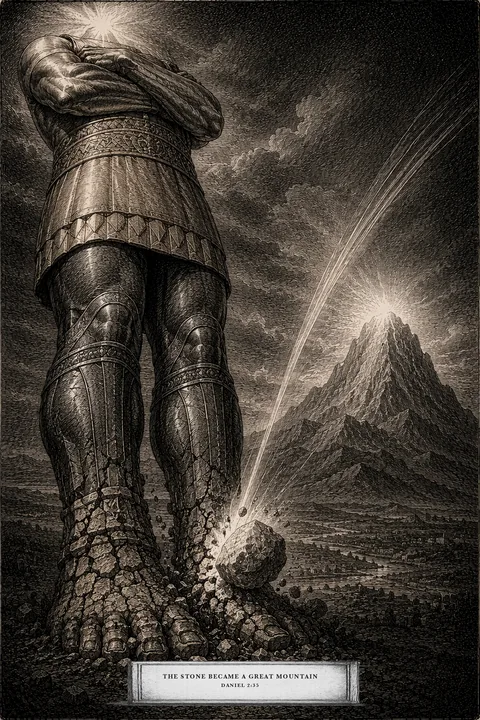
…the stone that smote the image became a great mountain, and filled the whole earth.
— Daniel 2:35
Mountain
The first case study is “mountain,” which represents kingdoms or power structures. The pyramid-like structure of a mountain mirrors the power structure of delegated authority and is an apt analogy — but subjective aptness is not a basis for defining a symbol. Thankfully, in this case Scripture comes right out and defines it:
This calls for a mind with wisdom. The seven heads are seven mountains on which the woman sits. They are also seven kings (kingdoms).
Revelation tells us that mountains mean kingdoms, and by analogy hills are cities. The question is whether Scripture consistently uses mountain with the same symbolic meaning, or whether this is a one-off. Other times in Scripture we are given a vision and an interpretation, which establishes the definition by analogy:
And in the days of these kings the God of heaven will set up a kingdom which shall never be destroyed; and the kingdom shall not be left to other people; it shall break in pieces and consume all these kingdoms, and it shall stand forever. Inasmuch as you saw that the stone was cut out of the mountain without hands, and that it broke in pieces the iron, the bronze, the clay, the silver, and the gold — the great God has made known to the king what will come to pass after this. The dream is certain, and its interpretation is sure.
In this case Daniel explains a vision of a statue with layers of gold, silver, bronze, and feet of clay and iron, and explains that this statue represents successive kingdoms. When God’s kingdom comes as a stone, it destroys the statue and consumes all the kingdoms the statue represents. The stone then grows into a mountain that fills the entire earth, and God’s kingdom rules forever and ever.
You are this head of gold. After you shall arise another kingdom inferior to yours; then another, a third kingdom of bronze, which shall rule over all the earth.
Daniel’s own explanation lets a ruler stand for the kingdom he heads: “You are this head of gold,” followed immediately by “another kingdom.” The Stone follows the same scale. It enters the vision as one appointed Head and becomes the Mountain as a people and kingdom gather under Him.
Rock and Stone are related, but they do not hold the same office. The Rock is the bedrock beneath the house and kingdom — its covenant Head, source, and foundation: “that Rock was Christ” (1 Corinthians 10:4). Isaiah gives the relationship at the human scale:
Look unto the rock whence ye are hewn… Look unto Abraham your father, and unto Sarah that bare you…
The rock is the father and source; the stones hewn from it are his people. Peter carries the same order into the house of Christ: Jesus is the “living stone” rejected by men, and those who come to Him “also, as lively stones, are built up a spiritual house” (1 Peter 2:4-5). Jesus is the Rock beneath the house and the chief Stone within it; His people are the other living stones built under His authority.
The chief corner stone is the Head in authority while remaining at the foundation in position. Isaiah lays the tried corner stone “for a foundation” (Isaiah 28:16), and Paul says the house is “built upon the foundation of the apostles and prophets, Jesus Christ himself being the chief corner stone” (Ephesians 2:20). Placed at the foundation corner, the Head Stone establishes the line to which every other stone must be fitted. Zechariah’s physically upper stone uses a different expression: Psalm 118:22 calls Christ rosh pinnah, “the head of the corner,” while Zechariah 4:7 calls the completing top stone ha-even ha-roshah, “the headstone.” The cornerstone governs the building from beneath; the capstone crowns it from above.
Daniel’s Stone cut without hands is therefore Christ as the Head appointed by God, not a kingdom assembled by men. As the living stones are built under Him, the single Stone becomes the great Mountain — the kingdom that fills the earth.
The fact that the mountain is described as growing and covering the entire earth is another clue that this isn’t a physical mountain. The analogy from Daniel is carried on in Isaiah.
It shall come to pass in the latter days that the mountain of the house of the Lord shall be established as the highest of the mountains, and shall be lifted up above the hills; and all the nations shall flow to it, and many peoples shall come.
See the same symbolic meaning applied in Jeremiah, describing Babylon the Great, which rules over the whole earth and destroys nation after nation. Here Jeremiah tells us this destroying mountain will become a burnt mountain.
Behold, I am against you, O destroying mountain, Who destroys all the earth,” says the Lord. “And I will stretch out My hand against you, Roll you down from the rocks, And make you a burnt mountain.
Now we have Daniel, Revelation, Isaiah, and Jeremiah all agreeing on the meaning of this symbol of a Mountain as a Kingdom. With this knowledge we can now gain greater insight into many other Scriptures. Consider the account in Revelation of a flaming mountain thrown into the sea:
Then the second angel sounded his trumpet, and something like a huge mountain, all ablaze, was thrown into the sea. A third of the sea turned into blood, a third of the living creatures in the sea died….
The common readings rank this way:
| Rank | Common interpretation |
|---|---|
1 |
Literal asteroid or meteor impact |
2 |
Literal volcano hurled into the sea |
3 |
Nuclear blast or modern warfare |
4 |
A nation or world empire |
How do we know that this isn’t a literal mountain in this context? The answer is in the phrase “thrown into the sea,” the “sea turning into blood,” and the “creatures in the sea,” all in the same sentence. In a later chapter I will show the evidence that sea is a symbol that means the masses of people, the population of the earth, and that living creatures, beast, and animals represent gentile nations.
Symbolically, Revelation 8:8-9 is saying that when a “huge mountain” — a world empire — is thrown down, a third of the people will die and a third of the nations will be destroyed.
One final supporting piece of evidence is that a “stone, rock, mountain, etc.” being “thrown into the sea” to “never rise again” is the prophetic symbol tied to the fall of Babylon the Great. And thus symbols can be composed of both words and catchphrases.
For assuredly, I say to you, whoever says to this mountain, ‘Be removed and be cast into the sea,’ and does not doubt in his heart, but believes that those things he says will be done, he will have whatever he says.
The common readings rank this way:
| Rank | Common interpretation |
|---|---|
1 |
A personal obstacle or problem |
2 |
A literal mountain, used as hyperbole |
3 |
The Mount of Olives or Temple Mount |
4 |
A spiritual stronghold or doubt |
5 |
The corrupt temple or religious system |
6 |
A national power or kingdom |
How do we know that this mountain is not a literal mountain, or merely an impossible obstacle, in this context? Because the context is a fig tree and a mustard tree — and trees are rooted covenant lives that can stand for peoples or nations — and of course “thrown into the sea” is a symbol clearly referring to Babylon the Great, as the Fall of Babylon chapter demonstrated — and as the next chapter will trace from the Song of the Sea onward.
What we learn from this is that the symbolic language of the Bible is interconnected: symbols are defined in terms of symbols and phrases, as well as the verbs, adjectives, and other personifications used with the symbol. For this reason, we often see the same set of symbols connected over and over.
Though the mountains be carried into the midst of the sea; though the waters thereof roar and be troubled, though the mountains shake with the swelling thereof.
The common readings rank this way:
| Rank | Common interpretation |
|---|---|
1 |
Literal earthquakes or natural disaster |
2 |
Life’s troubles and instability |
3 |
Cosmic or end-times upheaval |
4 |
Nations or kingdoms shaken |
Now consider this poetic picture from Joel:
A day of darkness and gloom, A day of clouds and of thick [dark] mist, Like the dawn spread over the mountains;
The picture is of “dawn,” “mist,” or “fog” spread over the “mountains,” which is quite common in early morning and aligns with the visual of a “day of clouds and thick dark mist.” The Hebrew word for “dawn,” shachar, names the dark before sunrise.[1] It names the first light while the sky is still quite dark, before the sun burns away the fog. Now, with the greater context, we have dark clouds of smoke spread over the nations. This is just one of dozens of verses that gain new meaning when you apply the symbolic meaning of mountain.
So when you see the abomination of desolation spoken of by the prophet Daniel, standing in the holy place (let the reader understand), then let those who are in Judea flee to the mountains.
Here is a verse that contains instructions for the future, and to understand the instructions it is helpful to know that “mountains” means nations. In other words: get out of Judea. In AD 70, those who survived the fall of Jerusalem were scattered to the nations, so this prophecy has been fulfilled in this sense already.
When you see Jerusalem being surrounded by armies, you will know that its desolation is near. Then let those who are in Judea flee to the mountains, let those in the city get out, and let those in the country not enter the city.
Another verse sounds poetic on the surface, but carries a far more practical message when read by Scripture’s own symbols:
My people have been lost sheep; their shepherds have led them astray, in the mountains they have turned them away. From mountain to hill they have gone; they have forgotten their resting place.
Here His people are the sheep; the shepherds are the pastors and teachers who led people astray among the nations they were scattered to. His people have gone from nation to city and have forgotten their home.
Every valley shall be exalted, and every mountain and hill shall be made low.
This verse from Isaiah now has far deeper meaning: the nations and cities will be humbled (brought low). And those who are humble, obedient even to death, will be exalted and lifted up. The mountains are high places, proud places, and they contrast with their opposite, the valleys — those enslaved by the mountains.
Behold, I will send for many fishers, said the LORD, and they shall fish them; and after will I send for many hunters, and they shall hunt them from every mountain, and from every hill, and out of the holes of the rocks.
Here is another case where mountains (nations) are used with other symbols: fishermen and hunters. Here Jeremiah is prophesying about Jesus calling people to be fishers of men. Then, those who are not caught as fish will be hunted down from among the nations, in every city, and out of every bunker. The holes of the rocks are then referenced in Revelation:
And the heaven departed as a scroll when it is rolled together; and every mountain and island were moved out of their places. And the kings of the earth, and the great men, and the rich men, and the chief captains, and the mighty men, and every slave, and every free man, hid themselves in the dens and in the rocks of the mountains; and said to the mountains and rocks, Fall on us, and hide us.
Now that you know that mountain means a kingdom, we should ask ourselves: what does an island represent?
And great Babylon came in remembrance before God, to give to her the cup of the wine of the fierceness of his wrath. And every island fled away, and the mountains were not found.
Are literal mountains going to disappear, or is this clearly talking about the third of the nations thrown into the sea, never to rise again? When I read this, it struck me as odd that an island could flee, or escape. It is the personification of the island that led me to research the island symbol, which we will cover in a future chapter.
I will close this chapter on mountains with one final notable use, when Jesus was tested in the desert:
Again, the devil takes him up into an exceeding high mountain, and shows him all the kingdoms of the world, and the glory of them;
Here we see an exceedingly high mountain from which all the other kingdoms of the earth can be seen. In other words, he is taken to a kingdom ruling over all the other kings of the earth — likely Babylon the Great.
By now you should see the pattern: Scripture reliably and consistently uses the word mountain as a way to say “nation” or “kingdom” in many different contexts across the whole of Scripture. I have only addressed a few of the notable uses, but once you internalize this symbol you will find it used in countless other places in profound ways.
In the process of exploring the mountain symbol, we came across many other symbols: the sea (the masses of mankind), the hills (cities), the tree and the fig tree (kingdoms and Israel), the stones (people built into a house), the Rock (Christ, the foundation beneath it), the beasts and living creatures (the gentile nations), the island, the fishers and the hunters, the valley, and Babylon the Great. The sea, the trees and their beasts, and the island are taken up in the chapters just ahead, each defined the same way we defined the mountain — by letting Scripture interpret Scripture. Babylon the Great we have already traced through Part Five, and the glossary carries the rest.
The meaning is already there, recoverable by following the repeated relationships rather than leaning on inherited opinion. What forces the answer is not the cleverness of the reader but the discipline of the process.