Are All Children Saved?
Every parent wants to know their children are safe. And virtually every major Christian teacher in the last 150 years has said the same thing: yes, all children who die go to heaven. It's one of the most comforting teachings in modern Christianity. It feels compassionate. It feels righteous. It feels like what a loving God would do.
That's what makes it dangerous.
The most destructive doctrine isn't the one that sounds evil — it's the one that sounds kind. The serpent's pitch was never "do something obviously wicked." It was: this looks good, it feels wise, it's desirable (Gen 3:6). And the sin underneath that pitch — making yourself the judge of good and evil, overruling God's declared word with your own moral sense — is exactly the sin at work when a teacher says "God wouldn't let innocent children be lost."
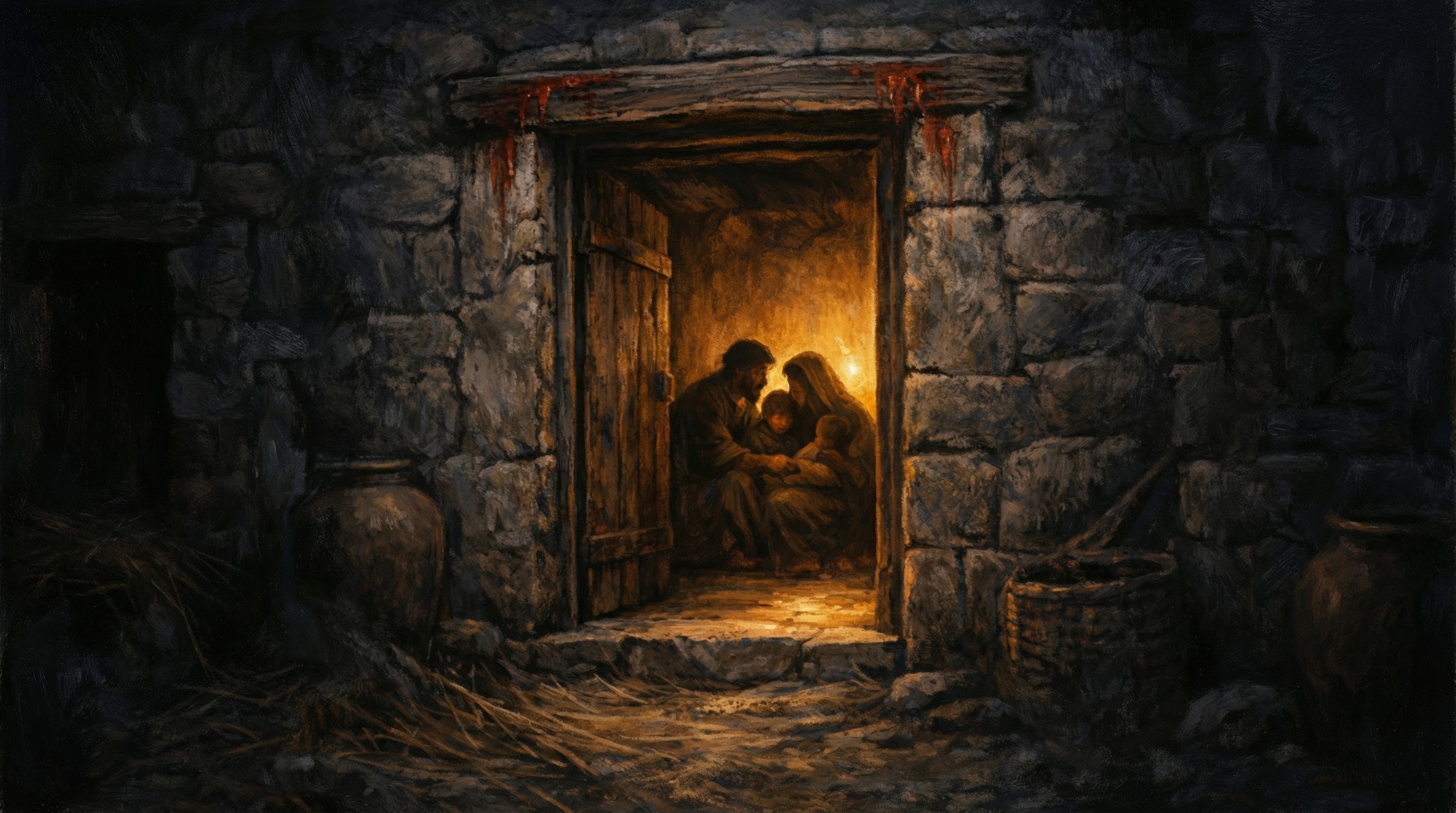
This article is not about curiosity. It's about your household. In Exodus 12, the only thing that kept the firstborn alive was the blood of the lamb on the doorpost — and everyone inside that house was covered. Scripture teaches that children are covered by their parents' covenant standing in the same way (1 Cor 7:14). Your faithfulness to God's word — especially the parts that feel hard — is the blood on the door that protects your house. And the moment you start overruling God's judgments with your own compassion, the doorpost starts to crack.
I didn't want to write this. People judge the messenger as cruel for even questioning whether uncovered children are saved. But that fear — the fear of man, the fear of being called heartless for testing a comforting idea against Scripture — is exactly what keeps this doctrine unexamined. The watchman who sees the sword and stays silent because he fears the crowd is not compassionate. He is negligent (Ezek 33:6). And the fear of man bringeth a snare (Prov 29:25).
I. What the Modern Teachers Say
The popular consensus is overwhelming. Nearly every major evangelical voice of the last 150 years has taught the same thing:
Charles Spurgeon (sermon "Infant Salvation," Metropolitan Tabernacle, Sept 29, 1861): "I know of no exception, but we all hope and believe that all persons dying in infancy are elect." He also argued that the vast population of heaven requires infant souls as "the great majority."
John MacArthur (Safe in the Arms of God, 2003): All infants who die go to heaven. He uses a "condition of accountability" — those who "have not reached sufficient, mature understanding to comprehend convincingly the issues of sin and salvation."
Billy Graham: Children who die go to heaven. He cites David's confidence about his dead child: "I shall go to him, but he shall not return to me" (2 Sam 12:23).
John Piper (Desiring God, "What Happens to Infants Who Die?"): All infants who die are saved/elect.
B.B. Warfield: All who die in infancy are "unconditionally predestinated to salvation."
Charles Hodge: All who die in infancy are saved.
This is the view virtually every modern Christian has heard. It's preached at funerals. It's the assumed answer.
But it's not the only view — and it's not the oldest. But first, we need to address the assumption underneath it all.
II. Why Children Die
Modern teachers declare children "innocent." But if children are innocent, why do they die?
Death is a wage — payment for something earned. You cannot receive a wage you did not earn. If an infant dies, the infant received the wage. And the wage is for sin.
"All" is all. Death passed upon ALL men because ALL have sinned. Paul does not carve out an exception for age. Neither does the text.
The Condition Is Present from Conception
This is not something that develops later. David traces it to the earliest possible moment:
Shapen in iniquity. Conceived in sin. Estranged from the womb. The condition is present before the child takes a first breath — let alone makes a first choice.
Two Kinds of Sin, One Mistake
Modern teachers confuse two distinct things:
- Personal sin — willful transgression, choosing evil. Children haven't done this.
- The sin condition — the Adamic corruption present from conception (Ps 51:5). Children HAVE this.
"No personal sin" does not mean "no sin." It means a child has not yet added personal guilt on top of the inherited condition. But the condition is there — and death proves it. If condemnation required willful personal sin, no infant should ever die. Their death is itself the proof that the condition — not just personal deeds — carries consequences.
God states this principle explicitly, in the Ten Commandments:
Children bear the consequences of their fathers' iniquity. Not because they personally sinned — but because they belong to a household that hates God. And the contrast in v.6 is telling: the Hebrew word translated "thousands" is H505 eleph — but H504, the same word, means family, clan. "Showing mercy unto the families of them that love me" makes the household principle explicit: iniquity visits the children of those who hate God; mercy covers the families of those who love Him. The same pattern Paul states in 1 Cor 7:14 — holy or unclean, depending on the household — is written into the Ten Commandments.
(Ezekiel 18:20 — "the son shall not bear the iniquity of the father" — addresses the other phase: once a child can choose, personal accountability overrides household standing. A righteous son of a wicked father lives; a wicked son of a righteous father dies. These aren't contradictory — they're two stages of the same model. Before choice: household determines standing. After choice: personal faithfulness does.)
When a teacher says "children are innocent," he is looking at personal sin and ignoring the Adamic condition. He ascribes innocence to those whose own mortality testifies against them.
The comfort people want to hear is: "Your child was innocent." The comfort Scripture provides is: "Your child was covered." One denies the problem. The other provides the solution.
What About Jesus?
If all flesh descended from Adam is sinful from conception, how was Jesus sinless? Because Jesus did not descend from Adam through natural generation.
Jesus had a different Father. Scripture says "the LORD your God is a consuming fire" (Deut 4:24; Heb 12:29). God IS fire. And in Hebrew, H2233 zera (seed) is always the male contribution — every genealogy traces seed through the father. Women do not have zera. So when Genesis 3:15 says "the seed of the woman," the phrase is a biological impossibility. It is the only verse in all of Scripture that traces seed through the woman rather than the father. Something unprecedented is being signaled.
The Hebrew deepens the signal. The word for "woman" (H802 ishah) is spelled אִשָּׁה. But H801 — the same spelling, same vowel points, same pronunciation — means "fire-offering, sacrifice made by fire," derived from H784 esh (fire). Strong's had to assign separate numbers to distinguish them. So "seed of the אִשָּׁה" carries a double layer embedded in the letters themselves: seed of the woman and seed of the fire. The biological impossibility — seed without a human father — is resolved by the homograph: the seed comes from fire. From God.
He is the "last Adam" (1 Cor 15:45) — a new origin, not a continuation of the corrupted line. Romans 8:3 says God sent His Son "in the likeness of sinful flesh" — his flesh looked like ours, but it was not generated through the Adamic seed. The word "likeness" does that work.
But Does This Mean Babies Go to Hell?
No. And this may be the most important paragraph in this article.
The picture in your head right now — infants screaming in flames for eternity — comes from Dante's Inferno and Greek mythology, not from Scripture. The Bible never describes eternal conscious torment for ordinary humans. What it describes is death:
- "The wages of sin is death" (Rom 6:23) — not "the wages of sin is eternal torment"
- "The soul that sins, it shall die" (Ezek 18:4)
- "They shall be as though they had not been" (Obad 1:16)
- "No man shall see me, and live" (Ex 33:20) — God's unshielded presence consumes what has no covering
- The "second death" (Rev 20:14) — the Hebrew word is acher maveth, "another kind of death," not "another kind of torment"
The fate of the uncovered is not eternal torture. It is permanent cessation — not participating in the resurrection, not existing in the renewed earth. Still sobering. Still worth guarding the doorpost over. But it is not the horror movie that drives the "all children must be saved" doctrine. That horror comes from a pagan concept of "hell" that Scripture does not teach. (Full study: The Nature of Hell →)
The Right Question
The question was never: "Are innocent children saved?" Children are not innocent. Their death proves it. The question is: Who covers guilty children who cannot yet cover themselves?
That is what the rest of this article answers.
III. The Harmless Sin
The teacher who declares all children "innocent" thinks it costs nothing. It feels compassionate. It sounds righteous. But look at what he's actually doing: God says children are shapen in iniquity (Ps 51:5), estranged from the womb (Ps 58:3), and the teacher says "no, they're innocent." He has just overruled God's verdict with his own.
The Potter's Answer
The objection comes immediately: "But a loving God wouldn't let children be lost."
God anticipated this. And His answer is not an apology.
"Woe" is not a polite disagreement. It is a curse. And the specific example God gives — questioning what a parent has brought forth — is the very question people ask about children.
"Would you condemn me that you may be justified?" That's what happens when a teacher says "a loving God wouldn't do that." He condemns God's justice so that he can feel righteous. He becomes the compassionate one. God becomes the one who needs correcting.
This is what Paul means when he classifies children of unbelievers as "unclean" (1 Cor 7:14). It is what God means when He makes vessels of dishonour from the same lump as vessels of honour (Rom 9:21). These children are not a tragic oversight. They are the potter's design. And the one who says "a loving God wouldn't make vessels for dishonour" is the clay telling the potter what to do.
Reaching for the Tree
And here is the deepest cut. The sin underneath "all children are innocent" is not a new sin. It is the original sin.
The serpent's promise was that man could be his own judge of good and evil — his own moral authority, independent of God. The tree of knowledge was not about information. It was about authority — who gets to decide what is good and what is evil. God said: "I decide." The serpent said: "you decide."
Every teacher who overrules God's plain text with "but a loving God wouldn't..." is reaching for that same tree. He places his moral sense above God's declared word. He decides for himself what is good — and calls God's judgment evil. That is precisely the sin of Eden.
And the most dangerous form of this is the phrase: "My God would never..." The moment you say it, you have denied Him. The God of Scripture did. He drowned the world. He burned Sodom. He killed the firstborn of Egypt — infants included. He swallowed Korah's little children into the earth. If your god would "never" do what Scripture says God did, then your god is not the God of Scripture. He is an idol — a god you fashioned in your own image, shaped by your own preferences, as surely as the golden calf was shaped by Aaron's hands.
Calling the guilty "innocent" is calling evil good. And the serpent's pitch was never "do something obviously wicked." It was: this looks good, it feels wise, it's desirable (Gen 3:6). The most dangerous sins are the ones that feel righteous.
And the irony cuts both ways: the parent's covenant standing is what covers the child (1 Cor 7:14). The covering depends on the parent being in faithful covenant with God — accepting His word over your own judgment, not reaching for the tree. So the parent who normalizes overruling Scripture with "a loving God wouldn't..." is training himself in the very act that weakens the doorpost. Not just on this doctrine. On everything. Divorce. Sexual ethics. Sabbath. Torah. Once "a loving God wouldn't require THAT..." becomes your operating principle, the blood on the door begins to thin.
The Blood Must Be Applied
But notice what this means: the blood of Christ IS sufficient. It CAN cover children. The question is not whether the blood works — it is how it gets applied.
The Passover lamb could have covered every house in Egypt. The lamb was slain. The blood existed. It was sufficient for every door. But if the father didn't put it on the doorpost, the firstborn died (Ex 12:13). The blood's existence doesn't equal its application.
Nobody argues that Jesus' blood automatically saves all adults. "Whosoever believeth" (John 3:16). The mechanism is faith that produces obedience — the father in Egypt didn't just believe the lamb's blood worked, he had to put it on the door. Faith without works is dead (Jas 2:26). Children can't believe or obey. So how is the blood applied to them? Through the household — the believing parent's obedient faith is the hand that puts the blood on the doorpost. Paul states the mechanism directly:
If at least one parent is a believer, the children are "holy." If neither parent is a believer, the children are "unclean." If the blood automatically covered all children regardless of household, this verse collapses. Why would Paul need to say children of believers are holy if ALL children everywhere are holy by default? The word "else" has no force if no child is ever unclean.
Some argue that "holy" and "unclean" here mean only social legitimacy or ritual status — not salvific standing. But consider: Paul's words are G40 hagios (set apart for God) and G169 akathartos (impure, defiled). These are covenant words — the same vocabulary Scripture uses for Israel's separation from the nations, for the holy things of the temple, for the distinction between what God accepts and what He rejects. And Paul applies the same word — sanctified — to the unbelieving spouse. If this is merely social legitimacy, the whole passage is trivial. Paul wouldn't need to make the argument at all — interfaith marriages were already legally valid. The weight he places on it, and the binary he draws (holy or unclean, no middle ground), only makes sense if covenant standing is at stake.
IV. What the Older Confessions Actually Say
The original Reformed confessions were far more cautious. Look at what they actually wrote:
Westminster Confession of Faith (1646), Chapter 10, Section 3: "Elect infants, dying in infancy, are regenerated, and saved by Christ, through the Spirit." The word "elect" was deliberate. They did not write "all."
Canons of Dort (1619), Article 17: Specifically addresses "children of believers." The Synod fathers made no statement that ALL infants are saved. Many delegates privately held that some infants are reprobate.
R.C. Sproul (PCA): Children of BELIEVERS go to heaven. Children of unbelievers? "Left to the realm of mystery."
Loraine Boettner (Reformed Doctrine of Predestination): "The Scriptures seem to teach plainly enough that the children of believers are saved; but they are silent or practically so in regard to those of the heathens."
Francis Turretin (1623–1687): Covenant children possess "seminal faith" and are saved. Distinguished from non-covenant children.
Herman Hoeksema / Protestant Reformed Churches: Explicitly teach that NOT all children of believers are necessarily saved. "God chose Isaac; He rejected Ishmael. God chose Jacob; He rejected Esau." Election cuts through families.
Do you see the pattern? The older the source, the more careful the language. "Elect infants" — not "all infants." "Children of believers" — not "children of everyone."
V. The 1,500-Year Consensus
For the first 1,500 years of Christianity — Catholic, Orthodox, and early Protestant combined — the dominant teaching was that children's salvation was NOT automatic.
Augustine (354–430): The most influential Church Father taught that unbaptized infants face "the mildest condemnation of all." Not saved. Not in heaven. This dominated Western theology for over a thousand years.
Thomas Aquinas (1225–1274): Infants in limbo don't suffer but are NOT in heaven.
Council of Florence (1431): "All who die in original sin descend to hell" — includes unbaptized infants, though with lighter punishment.
Council of Trent (1545): "No other means of salvation for infants besides baptism."
Eastern Orthodox — Synod of Jerusalem (1672): Unbaptized infants "subject to eternal punishment." Constantinople (1815): excluded from the Kingdom.
Martin Luther: Maintained baptism is necessary for infant salvation.
John Calvin: ELECT infants are saved — but not all infants are elect. Infants bear original sin and are "damnable."
Ulrich Zwingli (1520s): The FIRST to teach universal infant salvation — ALL infants who die are saved, even pagan children. This was the new and minority position.
Read that again. The "all children saved" view was essentially invented by Zwingli in the 1520s. It remained a minority position for roughly 300 years. It only became the popular evangelical consensus in the mid-1800s through Spurgeon and Hodge.
This consensus was not perfectly unanimous. Gregory of Nazianzus (4th century) held that unbaptized infants were neither punished nor glorified — a softer position than Augustine's. Some read Irenaeus as implying infant salvation through Christ's sanctification of every stage of life. And in 2007, the Catholic Church's International Theological Commission published The Hope of Salvation for Infants Who Die Without Being Baptized — expressing "hope" but explicitly declining to teach certainty. These voices exist. But they were minority positions within their own eras — the dominant weight of 1,500 years of Christian teaching held that children's salvation was not automatic.
The Catholic and Orthodox position — tied to baptism rather than covenant — represents the vast majority of Christian opinion for most of history. But here's the connection: Catholic baptism functions as the covenant entry rite, just as circumcision did in the Old Testament. The principle is the same as 1 Corinthians 7:14: the child's status depends on being brought into the covenant community, not on universal innocence.
Yet Scripture shows zero examples of infant baptism. Every baptism in Acts involves people who hear, believe, repent, or speak in tongues. The mechanism isn't ritual — it's covenant standing.
VI. The Household Model
The consistent biblical pattern is not "universal age of accountability" but household covering — children share the covenant status of the house they belong to. Let's walk through it.
The Passover (Exodus 12)
The lamb covers the HOUSE. Everyone inside — infants included — lives. Everyone outside — infants included — is exposed. No age exemption. The only exemption was the blood on the doorpost.
Every firstborn — from Pharaoh's heir to the prisoner's child. No age exemption. The only protection was the blood on the doorpost.
Noah's Ark (Genesis 7)
Noah is declared righteous. His family enters on his standing. Every other household on earth — including their infants — perished. Eight souls total (1 Pet 3:20). The world was full of families with babies and small children. The ark carried eight people.
Rahab (Joshua 2 and 6)
Her faith covers her whole household. Meanwhile:
Young and old. No age exemption. The only exemption was Rahab's household.
Korah's Rebellion (Numbers 16)
Little children explicitly present. Swallowed with the household. The text goes out of its way to mention the children standing there. They go down with the house.
Lot and Sodom (Genesis 19)
Lot's household was extracted. The children of Sodom were not. Abraham's principle (Gen 18:32) operates at the city level — not "spare the children individually," but "if 10 righteous are found, I will not destroy the city." The judgment falls on the whole city. The extraction is by household.
Five examples. Five times the same pattern. The protective unit is the household, not the individual child's age. The covering belongs to whoever is inside the house with the blood on the door.
VII. The Verse That Changes Everything
One verse in the New Testament makes this explicit. And it's a verse most people skip over:
Look at Paul's logic. If at least one parent is a believer, the children are "holy" (G40 hagios — set apart, consecrated). The word "else" (G1893 epei — "since otherwise") means: if NEITHER parent were a believer, the children would be "unclean" (G169 akathartos — impure, ceremonially unclean).
If all children were universally safe regardless of parentage, Paul's argument collapses. There would be no "else" to worry about. Why would Paul need to reassure these believers that their children are holy if all children everywhere are holy by default? The "else" only makes sense if the alternative — children being unclean — is a real possibility for children outside a covenant household.
VIII. Who the Household Model Actually Applies To
The household model does NOT restrict who can be saved. "Whosoever believeth" (John 3:16). The door is open to anyone who chooses — spouse, stranger, child of pagans. The household model answers only one question: what is the status of those who die before they can choose?
Sanctification vs. Salvation
Paul draws a careful distinction in 1 Corinthians 7:
- The unbelieving spouse IS sanctified (v.14) — stated as fact
- The children ARE holy (v.14) — stated as fact
- But saving the spouse is only a possibility: "What knowest thou, O wife, WHETHER thou shalt save thy husband?" (v.16) — uncertainty, not promise
Peter says the unbelieving spouse "may be won" (1 Pet 3:1) — possibility, not certainty. The sanctification is functional (makes the children clean), not salvific (doesn't save the spouse). The spouse still needs to believe personally — same as anyone.
The Covenant-Keeper, Not the "Head"
The covering flows from whoever carries the covenant — husband OR wife. First Corinthians 7:14 works both directions: the believing wife sanctifies the husband, and the believing husband sanctifies the wife.
Rahab wasn't the head of her father's household, but HER faith covered her father, mother, and brothers (Josh 6:23–25). A believing wife submits to her husband's authority (1 Pet 3:1) while carrying the spiritual covering. Authority structure and covenant standing are two different things.
The Door You Must Stay Inside
The blood covers those who stay inside. Leave the house, and the covering breaks.
Young children can't leave — they're covered by default (Deut 1:39, "no knowledge between good and evil"). Grown children can — Esau sold his birthright, Absalom rebelled, the prodigal left the father's house. Once they can choose, Ezekiel 18 applies:
Because the son is now personally accountable. This explains why not all children of believers end up saved (Hoeksema's point): not because the covering fails, but because grown children can walk out from under it.
The Bottom Line
The only people whose eternal status depends on the household model are those who die before they can choose — infants, young children, the unborn. For everyone else, the same door is open regardless of parentage. "Whosoever believeth."
IX. What About the Proof Texts?
Every time universal infant salvation is taught, the same verses come up. Let's look at each one carefully.
David's Child (2 Samuel 12:23)
David's confidence. But David was a covenant man — the anointed king of Israel. His child was under household covering. This verse tells you about the status of a covenant child. It says nothing about children of non-covenant households.
Deuteronomy 1:39
These are children of ISRAEL — covenant people. "Your" children. Meanwhile, the children of the Canaanites received no such promise:
Same chapter, same context. Covenant children go in. Non-covenant children are destroyed. Both statements sit in the same book.
Matthew 18:14, 19:14
This is MacArthur's strongest verse. But who are "these little ones"? Read the chapter from the beginning. In v.3-4, Jesus says whoever humbles himself like a child is greatest in the kingdom — "like a child" is a quality, not an age bracket. In v.6, He identifies the group explicitly: "these little ones which believe in me." By v.14, "these little ones" has already been defined: believers who have childlike faith. Jesus is not making a categorical promise about all infants everywhere. He is describing His Father's care for humble believers — using the child as the illustration, not the subject.
"Of such" describes the QUALITY of childlike faith — humility, dependence, trust — not a categorical promise that all children everywhere are saved. Yeshua is speaking to the families of Israel — covenant households.
Isaiah 7:15–16
This acknowledges a pre-accountability stage — a time before children can choose. But it doesn't say whose children benefit from it. It describes a developmental fact, not a universal salvation promise. The household model tells you who benefits during that stage: children inside a covenant house.
Every proof text, when read in context, turns out to describe covenant children — not all children universally.
X. Malachi's Warning
If children's status depends on the covenant household, then breaking the household has consequences. And that's exactly what Malachi says:
God made the marriage "one" FOR THE PURPOSE of seeking a "godly seed" (H430 elohim + H2233 zera — literally "a seed of God"). Break the union, and you threaten the godly seed.
The garment/covering language connects directly to the nakedness/covenant framework. In Ezekiel 16:8, covering nakedness = entering covenant:
If the believing spouse departs or the household breaks (1 Cor 7:15), the children's status follows whichever parent they're with. The covering follows the covenant-keeper, not the household structure.
XI. The Hardest Question
This is the section most people won't want to read. But the text says what it says.
The Molech prohibition sits inside the Leviticus 18 "uncover nakedness" chapter (Lev 18:21) — categorized as a covenant boundary violation.
Child sacrifice is called "whoredom" — harlotry, covenant-breaking. The judgment falls on the family.
And God claims the children:
The children were covenant children — "borne unto me," "MY children." The parents' act of sacrifice breaks the covering.
The children's blood is "innocent." But the parents "went a whoring." Innocence and covering are separate things. The children are innocent in the sense that they didn't choose evil. But the parents, by their act, removed the covering from the house.
The act of abortion is itself covenant-breaking. You cannot simultaneously break covenant and provide covenant covering. The parent who aborts has, by that act, walked away from the doorpost.
XII. The "Heaven" Problem
Before we look at the numbers, we need to address the assumption hiding behind every modern teacher's answer. When they say "all children who die go to heaven," what exactly is "heaven"? And does Scripture ever promise anyone will go there?
The Phrase That Doesn't Exist
Search the entire Bible. The phrase "go to heaven" does not appear — not once, in any form. No one "goes to heaven," "went to heaven," or is told they will "go to heaven." The phrase that defines the hope of modern Christianity is absent from its own text.
What does appear is the opposite direction:
David — the very man whose confidence about his dead child (2 Sam 12:23) is used as the proof text for children going to heaven — has not himself gone to heaven. Peter says so explicitly, after the resurrection, speaking under the power of the Holy Spirit at Pentecost.
What "Heaven" Actually Means
The Hebrew word is שָׁמַיִם (H8064 shamayim) — from a root meaning "to be lofty." It means the sky: the visible arch where clouds move and the higher expanse where celestial bodies revolve. It appears 395 times in the Old Testament — overwhelmingly referring to the physical sky, the cosmic heavens, or as a metonym for God's domain.
The Greek word is οὐρανός (G3772 ouranos). Its derivation is revealing: Strong's notes it is "perhaps from the same as G3735 (oros) through the idea of elevation." And G3735 means mountain — "a mountain, as lifting itself above the plain." The word for "heaven" may come from the word for mountain.
This is not incidental. In Scripture, mountain = kingdom — an established ruling authority. "The seven heads ARE seven mountains" (Rev 17:9). "The mountain of the LORD's house shall be established in the top of the mountains" (Isa 2:2) — His kingdom above all kingdoms. The word for "heaven" may derive from the word for "mountain" — and both point to the same concept: an elevated seat of authority. Hebrews calls it "mount Sion, the city of the living God, the heavenly Jerusalem" (Heb 12:22). The "heavenly" city is a kingdom-city — and it comes down.
The Direction Is Wrong
Modern theology says: people go up to heaven. Scripture says:
The inheritance is not in heaven. It is from heaven:
"Reign in heaven" — zero occurrences. "Reign on the earth" — Revelation 5:10.
What About "Treasure in Heaven"?
The strongest counter-texts are "treasure in heaven" (Matt 6:20), "reward in heaven" (Matt 5:12), and the inheritance "reserved in heaven for you" (1 Pet 1:4). But notice the preposition: the treasure is in heaven — stored there, held there, safe there. Not: "you will go to heaven to collect it." A bank in London can hold your inheritance; that doesn't mean you live in the vault. The inheritance is reserved in heaven — and then the city that holds it comes down (Rev 21:2).
"Our conversation [citizenship] is in heaven" (Phil 3:20) — but the very next phrase says "from whence also we look for the Saviour." He is coming FROM there TO us. Citizenship is registered in the capital; you don't have to live in the capital to be a citizen.
The Kingdom OF Heaven
"Kingdom of heaven" appears 32 times — all in Matthew. Mark and Luke, describing the same events, write "kingdom of God." The phrases are interchangeable. "Kingdom of heaven" does not mean "a kingdom located in heaven" any more than "kingdom of England" means "a kingdom inside England." It is the kingdom that originates from heaven — and it comes to earth: "Thy kingdom come, thy will be done, on earth as it is in heaven" (Matt 6:10).
Why This Matters for Children
When a modern teacher says "all children who die go to heaven," the entire statement rests on a destination Scripture never describes. The Bible doesn't say the saved "go to heaven." It says the dead await resurrection (1 Thess 4:16), the meek inherit the earth (Matt 5:5), the saints reign on the earth (Rev 5:10), and the city of God comes down to a renewed earth (Rev 21:2). The destination is physical. The inheritance is land. And that makes the population question inescapable.
Full Word Study: Heaven (H8064 / G3772) →
XIII. The Resurrection Math
Here's where it gets testable. If the household model is right, the numbers should work. If universal infant salvation is right, the numbers should work too.
About 117 billion people have ever been born (Population Reference Bureau). Pre-industrial child mortality was devastating — roughly 40–50% of all births died before age 5. That's about 50–55 billion children who died across human history.
If ALL children are automatically saved: ~55 billion children + ~124 million saved adults (0.2% per Jer 3:14) ≈ 55 billion total. That's 47% of all humans ever born.
47% is not "few." Spurgeon's argument actually backfires: he said heaven must include infants to explain the "vast" population. But "vast" and "few" cannot both be true.
The inheritance was never "heaven." It was always physical land (Gen 15:18). Physical bodies on physical land create a hard density constraint:
| Scenario | Total Saved | Promised Land (~300K sq mi) | Greater Israel (~900K sq mi) |
|---|---|---|---|
| All children saved | ~55 billion | ~183,000/sq mi (2× Manhattan) | ~61,000/sq mi (denser than Manhattan) |
| Household model | ~200–500 million | ~667–1,667/sq mi (like England) | ~222–556/sq mi (like rural France) |
Under the household model: comfortable, livable — people building houses and planting vineyards (Isa 65:21). Under the all-children model: denser than Manhattan even with the most generous land reading. Farms become physically impossible.
The Hebrew text of Revelation adds precision. Where the Greek measures the New Jerusalem in "stadia," the Hebrew uses קִבְרוֹת הַשָּׂדֶה — "grave-plots of the field" — echoing Abraham's first land purchase (Gen 23:9). The city is measured in burial-and-resurrection vocabulary. And the number per side — 12 אֶלֶף — yields 12,000 × 12,000 = 144 million plots. Divide by ~117 billion ever born: ~0.12%. Divide by ~61 billion since the cross: ~0.24%. The Jeremiah 3:14 ratio ("one from a city, two from a family") = ~0.2%. The numbers converge independently.
(Some argue Rev 21:1's "no more sea" means the renewed earth has no oceans — tripling the available land. But Scripture itself defines the sea as peoples and nations (Rev 17:15), and a literal no-ocean planet would be an uninhabitable wasteland of temperature extremes — not the fruitful inheritance where people build houses and plant vineyards. See the Rev 21:1 verse study.)
"Few" has to mean few for the physical promises to be physically meaningful. The full analysis — land density at three scales, the Hebrew measurement unit, the 144 clan-structure, and the directionality argument — is developed in detail:
- The Population of the Renewed Earth — the complete density math, New Jerusalem Hebrew analysis, and four converging biblical questions
- Land of the Free, Home from the Grave — what the narrowness of the gate means for you
XIV. What This Means
The protective unit in Scripture is the HOUSEHOLD, not the individual child's age. Children of covenant households are covered (1 Cor 7:14). Children of non-covenant households are not automatically covered. And the population math confirms it: "few" means few, and a physical inheritance requires physical numbers.
This is a hard teaching. But it's what the text says. And it's what Christianity taught for 1,500 years before the modern softening.
Here is what it means for you: your covenant standing matters more than you thought. Not just for you — for your children. Your faithfulness is the doorpost with blood on it. Your children are inside the house. If you walk away from the covenant, you take the blood off the door.
The door to salvation is open to anyone. But for those who can't yet walk through it themselves — the infants, the unborn, the little ones — everything depends on whose house they're in.
Guard the door.