The Remnant Equation
What to Expect and How to Prepare for the Age to Come
Where do you go when you die? The modern church has an answer: heaven. An infinite, cloudy, spiritual realm where everyone who said the right prayer gets a mansion. It is comforting. It is familiar. And if the Bible is taken at face value, it is wrong — in ways that change everything about how you prepare for what is coming.
The Uncomfortable Math
God promised Abraham a specific piece of real estate — from the river of Egypt to the Euphrates (Gen 15:18). Roughly 300,000 to 900,000 square miles of physical land with physical borders. Jesus promised physical resurrection bodies — flesh and bones, capable of eating, touchable, recognizable (Lk 24:39–43). Not clouds. Not ghosts. Bodies that occupy space.
Physical bodies on physical land create a hard mathematical limit. How many people fit?
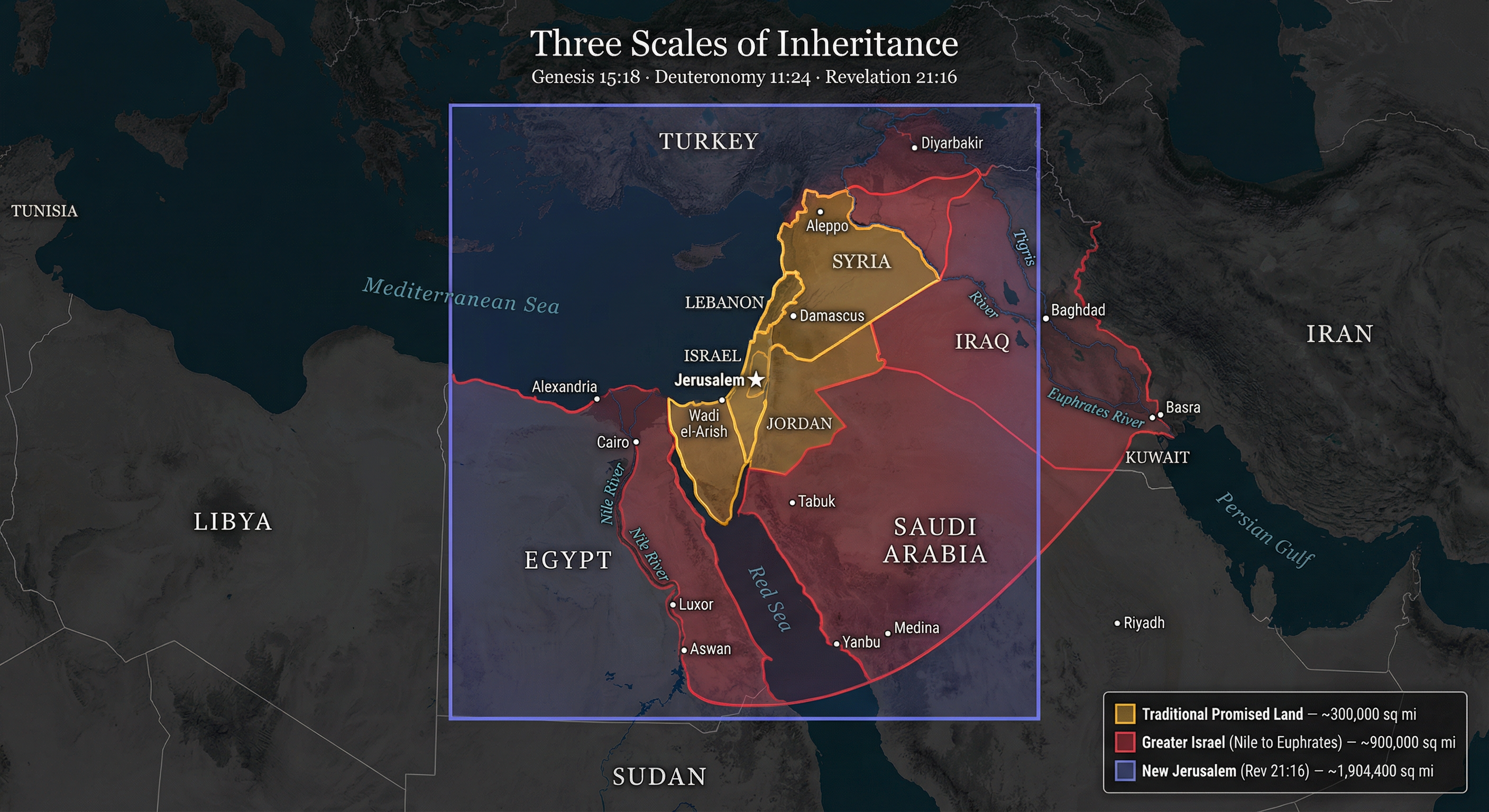
Three scales of the inheritance compared. Physical land with physical borders — not an infinite ethereal realm.
God Himself said the Promised Land has a designed capacity. When Israel entered Canaan, He told them: "I will not drive them out from before thee in one year; lest the land become desolate… By little and little I will drive them out, until thou be increased, and inherit the land" (Exod 23:29–30). Too few people and the land goes wild. The right number and it flourishes. The territory was sized for a population that would grow into it.
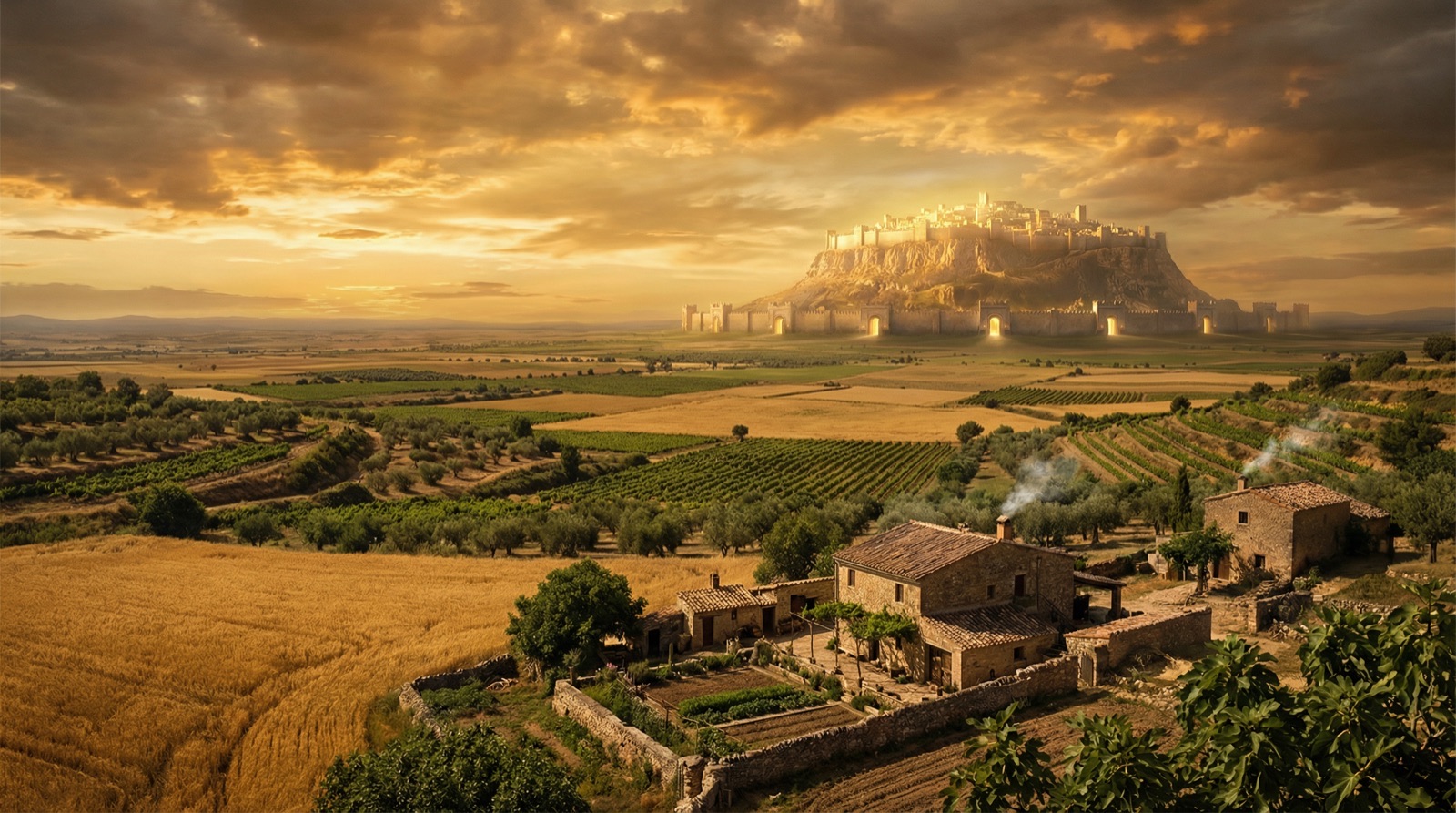
By Solomon's golden age (~970 BC), the population had grown to ~5–6 million, and the density in the settled territory was roughly 1.7 acres per person. That era produced the first occurrence of the phrase "every man under his vine and under his fig tree" (1 Ki 4:25) — the picture of prosperous, spacious, agricultural life. Apply Solomon's density to the FULL Promised Land, and it holds 110–330 million people — the mature combined population of immortal firstfruits and mortal growth.
How many firstfruits? The ratio of Jeremiah 3:14 is 0.2% — "one from a city, two from a family." Of the 8 billion alive today, that is just 16 million — comparable to the population of a single metro area. Even counting all births since Christ (~43 billion), it is ~86 million. The firstfruits start well below the land's capacity, with the mortal population growing into the space over the millennium until the "vine and fig tree" density is reached. Micah 4:4 promises this identical picture for the age to come.
Now see what that number looks like next to the alternative:
| Model | Total People | Space per Person (Promised Land) |
|---|---|---|
| If all children who ever died are saved | ~55 billion | ~150 sq ft — a small bedroom |
| If the remnant is ~0.2% (Jer 3:14) | ~16-86 million | ~2-12 acres — a homestead with a vineyard |
A bedroom — or a homestead. The prophets describe vineyards, fig trees, feasts, and agricultural life. Only one of these numbers produces that picture.
"Few there be that find it" (Mat 7:14) is not a vague spiritual sentiment. It is a spatial constraint. The gate is narrow because the real estate is finite.
The objection writes itself: "God wants to save everyone — He can make more space." But God gave the dimensions in advance. The New Jerusalem has 12 gates, 144 clan-territories, and measured walls. The Promised Land has defined borders — the river of Egypt to the Euphrates. Ezekiel 48 divides it into specific tribal allotments. God did not describe a territory and then discover it was too small. He knew exactly how many would inherit it, and He sized the inheritance accordingly. The measurements are not placeholders. They are the architecture of a kingdom designed for a specific number.
For the full exegetical evidence behind every claim in this post, see the companion study: The Population of the Renewed Earth.
The Four Questions That Set the Boundary
The population number depends on four questions. The answers are not what most churches teach.
1. The dead are not in heaven — they sleep.
"No man hath ascended up to heaven" (Jn 3:13). "David is NOT ascended into the heavens" (Acts 2:34) — Peter says this 1,000 years after David died. The man after God's own heart is not in heaven. He is sleeping in the dust, waiting for the resurrection trumpet.
Nine Old Testament passages describe death as total unconsciousness. Eight people are raised from the dead in Scripture — none report a heavenly experience. Lazarus was dead four days and says nothing. Because there is nothing to report. Death is dreamless sleep. Your next conscious moment after death IS the resurrection.
This removes the safety net. There is no intermediate heaven where you coast. You sleep — and the next thing you hear is the trumpet. Are you ready for it?
2. Heaven comes down — you don't go up.
"The tabernacle of God is with men, and he will dwell with them" (Rev 21:3). The New Jerusalem descends from heaven to earth (Rev 21:2). The goal of Scripture is not for people to escape earth. It is for God's governance to arrive ON earth. "The meek shall inherit the land" (Mat 5:5, Ps 37:11).
The destination is not an ethereal realm with infinite capacity. It is a physical territory with measured borders. That is why population density matters.
3. Resurrection bodies are physical — and extraordinary.
Post-resurrection Jesus had flesh and bones (Lk 24:39), ate fish (Lk 24:42–43), cooked breakfast (Jn 21:12–13), was touched by Thomas (Jn 20:27) — but could also pass through locked doors (Jn 20:19), vanish (Lk 24:31), and ascend (Acts 1:9). Physical when present, but not imprisoned in three-dimensional space. Spirit-animated, not blood-sustained. Incorruptible, immortal, glorious.
"We shall be like him" (1 Jn 3:2). These bodies occupy space. They eat food. They live on land. They are not clouds.
4. Marriage is fulfilled — reproduction stops.
"In the resurrection they neither marry, nor are given in marriage" (Mat 22:30). Not because marriage was bad — but because its task is done. "Be fruitful and fill the earth" (Gen 1:28) is a mandate with a completion point. Once the earth is filled with the redeemed, the scaffolding comes down. The one marriage that endures is the marriage of the Lamb and His bride (Rev 19:7).
No reproduction means the resurrected population is FIXED. It does not grow. The number of the firstfruits is the number — forever.
The First Fruits and the Final Harvest
This is the key that most eschatology misses. You are not competing for a seat in an infinite heaven. You are fighting to be part of a numbered inheritance on a measured piece of land.
The agricultural feast cycle (Lev 23) maps directly onto the resurrection timeline:
- Firstfruits — Christ's resurrection. The first sheaf dedicated to God. One man.
- The Harvest — the first resurrection (Rev 20:4–6). The bride. The priests. The few. They inherit the Promised Land.
- The Ingathering (Feast of Tabernacles) — the second resurrection at the end of the 1,000 years. The massive final harvest. They inherit the whole renewed earth.
The proportions are striking. The firstfruits are 0.2% of the covenant-accessible population — as few as 16 million of the 8 billion alive today. To put that in perspective: 16 million is roughly the population of the greater Los Angeles area. Out of the entire world, one metro area's worth of people. The Promised Land is approximately 0.5% of the earth's total land — and in the renewed earth, the deserts bloom (Isa 35:1), so the entire globe becomes habitable. A tiny percentage of humanity inherits a proportional slice of the earth as their priestly heartland. The rest of the redeemed — the final harvest — fill the globe.
Revelation 20:9 uses G3925 parembole — the exact Septuagint word for the Israelite wilderness camp — to describe "the camp of the saints" surrounding the city. The final arrangement IS the wilderness tabernacle made permanent: city = Holy of Holies (center), saints = priestly camp (inner ring), nations = tribal territories (surrounding), and the broader earth beyond. Numbers 2 becomes Revelation 21.
Left Behind — But Not Damned
If you miss the firstfruits gathering, are you lost? No. But the path is harder.
Revelation 12:17 shows the dragon, unable to reach the hidden bride, turning to make war on "the remnant of her seed, which keep the commandments of God, and have the testimony of Jesus Christ." These are genuine believers — covenant-faithful saints — who are on earth during the tribulation. The beast makes war on them and overcomes them (Dan 7:21, Rev 13:7). Many are martyred.
But here is the comfort within the framework of unconscious sleep: if the beast kills you, you do not go to a conscious holding cell of torment. You sleep. And your next conscious moment — with zero subjective time passing — is the resurrection trumpet. The enemy can hit the pause button on your consciousness. He cannot hold you. Death is an interruption, not a prison.
The tribulation martyrs — those who kept the commandments and the testimony even unto death — are raised in the first resurrection and join the completed bride (Rev 20:4). Their pause is short: perhaps 3.5 years at most. They wake, reign with Christ for the full thousand years, and the second death has no power over them.
But do not mistake this for a universal safety net. The short pause belongs to those who die IN COVENANT — keeping the commandments and holding the testimony of Yeshua (Rev 12:17). Those who die OUTSIDE the covenant — caught in the sudden destruction, not watching, not keeping Torah, not walking the narrow way — face a very different timeline. They do not wake at the first resurrection. They sleep through the entire thousand-year reign, missing all of it. "The rest of the dead lived not again until the thousand years were finished" (Rev 20:5). When they finally wake, it is not to a kingdom prepared for them. It is to judgment: "they that have done evil, unto the resurrection of damnation" (Jn 5:29). "Some to shame and everlasting contempt" (Dan 12:2).
The contrast is stark. Die in covenant during the tribulation: short sleep, wake to reign for a thousand years as the bride. Die outside the covenant: sleep through the entire millennium, wake to stand before the judgment throne. The firstfruits are the bride, the priests, the rulers — and that calling is worth everything. The alternative is not a slightly less prestigious inheritance. It is a thousand years of unconscious sleep followed by the books being opened.
The Prophetic Moment
Seven independent prophetic timelines converge on the biblical year 2025–2026. The almond tree is blooming. The fig tree is putting forth leaves. The convergence has been laid out in detail in Summer Is Near.
If the gathering is near, the time to prepare is not next year. It is now. Understanding the architecture of the age to come is not academic. It is the difference between aiming at a myth and fighting to enter a reality.
The Narrow Gate
The gate is narrow because the inheritance is physical and the number is finite. The Promised Land has borders. The firstfruits have a fixed count. The priestly calling has requirements. The math does not bend.
Wishing to go to heaven when you die is aiming at a destination that does not exist — at least not in the form you imagine. The real destination is a renewed earth, a physical city, a priestly camp, and a Bridegroom who follows His own Torah. Getting there requires more than a prayer. It requires covenant faithfulness — walking the narrow way that leads to life.
The full evidence — the Hebrew word studies, the resurrection catalogue, the extra-dimensional body framework, the Ezekiel Temple mechanics, the Hebrew Revelation measurements — is laid out in the companion study: The Population of the Renewed Earth.
The question before you is not whether you believe in the afterlife. The question is whether you are doing what it takes to be part of the firstfruits.